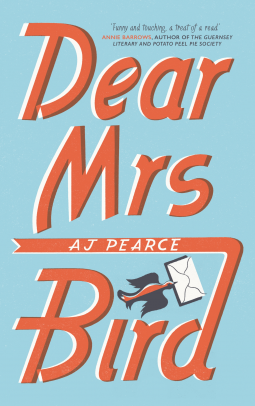
Dear Mrs Bird by AJ Pearce

It’s 1941 and Britain is at war. Emmeline Lake has always wanted to be a journalist and is thrilled when she sees an advertisement in the newspaper for a job at the London Evening Chronicle. This could be her opportunity to become a Lady War Correspondent. How exciting!

To her delight, Emmy is offered the job and arrives at the Chronicle offices ready to ‘sniff out Political Intrigue, launch Difficult Questions at Governmental Representatives, or best of all, leap onto the last plane to a far-off country in order to send back Vital Reports of resistance and war’. Unfortunately, it soon becomes clear that there has been a misunderstanding. Emmy isn’t going to be a War Correspondent – she won’t even be working for the newspaper at all. Her new job actually involves typing up letters for Mrs Henrietta Bird’s problem page in the weekly women’s magazine Woman’s Friend, which happens to be based in the same building as the Chronicle. Emmy does her best to pretend that Everything Is Absolutely Tip Top (as you can see, she likes to think in capital letters), but really she is devastated. This is not what she had expected at all!

Trying to make the best of things, Emmy begins sorting through the letters, picking out some for Mrs Bird to reply to. She quickly discovers, though, that Mrs Bird has a whole list of words and topics which she considers unsuitable for publication in the magazine. Any letters which mention love, marriages, pregnancies, affairs or romantic relationships of any kind – almost all of them, in other words – must be rejected and thrown away immediately. Emmy can’t bear to see so many readers’ problems being ignored; if only there was something she could do to help…

Dear Mrs Bird was an absolute joy to read from start to finish! I loved Emmy from the beginning and her friendly, enthusiastic narrative voice pulled me straight into her world. She’s such a kind-hearted, well-meaning person, yet she doesn’t always say or do the right thing, which makes her feel very human. The language is perfect for the time period too and I could easily have believed that I was reading a much older book – and as I usually complain about language feeling too ‘modern’, that’s high praise from me!

At first, much as I was enjoying following Emmy’s adventures at Woman’s Friend and meeting the other characters in the story – who include her best friend Bunty, her fellow typist Kathleen, and the formidable Mrs Bird herself – I thought this was going to be a very light-hearted, cheerful novel despite the wartime setting. However, in the second half of the book there’s a noticeable change in the tone, as the bombing raids on London become more frequent and more ferocious. There’s drama, there’s tension and there’s heartbreak…but there’s never too much of any of these things and the book never loses its charm and its warmth.

Dear Mrs Bird is a lovely book and I was pleased to discover that there is already the possibility of a television adaptation. It will be perfect for a Sunday evening, I think. Meanwhile, I highly recommend finding yourself a copy of this book and getting to know Emmy and her friends.

Thanks to Pan Macmillan for providing a review copy via NetGalley.

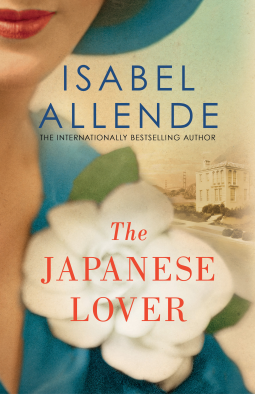
The Japanese Lover by Isabel Allende

The Chilean author Isabel Allende is probably best known for her first novel The House of the Spirits, but since its publication in 1982 she has written over twenty other books, most recently last year’s In the Midst of Winter. The Japanese Lover (2015) is the first one I’ve read; I was drawn to it by its wartime setting and by the fact that, unlike some of her other books, it didn’t seem to include any magical realism, of which I’m not really a fan.

The novel opens in the present day with Irina Bazili, a young woman from Moldova, starting a new job at Lark House, a home for the elderly in San Francisco. Irina soon settles in, getting to know the old people in the home and forming a special bond with one of them, a woman called Alma Belasco who is able to live independently on the ground floor of the building but knows the day could soon come when she no longer can. When Irina is introduced to Seth, Alma’s grandson, the two are united in their concern for Alma and their curiosity over her occasional disappearances from Lark House. Eventually they piece together the story of Alma’s life, but this only happens gradually over the course of the entire novel.

When I first read the synopsis for this book I assumed it was a dual timeline novel with two alternating stories – Irina’s in the present day and Alma’s in the past. Well, it is, but not in the same way as dual timeline novels written by authors like Lucinda Riley, Kate Morton or Susanna Kearsley, for example. In other words, it doesn’t feel like a book with two distinct storylines, but more like a book set in the present with some chapters describing events from Alma’s past.

And Alma is a character with a very interesting past. At the beginning of the Second World War, she is sent away from her native Poland to stay with rich relatives in San Francisco and here she meets Ichimei Fukuda, the son of the family’s Japanese gardener. As time goes by, Alma and Ichimei begin to fall in love, but when war finds its way to America and the Japanese become ‘the enemy’, the Fukudas are sent to an internment camp. The two young lovers are later reunited, only to be separated again, a pattern which will repeat itself several times over the decades and their relationship will endure despite Alma’s marriage to another man. It is this relationship which Irina and Seth find so intriguing and which they hope to learn more about.

Although I struggled to believe in the love Alma and Ichimei felt for each other (I couldn’t sense much passion between them and, for me, it just wasn’t the heartbreaking romance I thought it should have been, given the setting and subject), I did find it interesting to read about the injustices suffered by the Fukuda family, their time in the internment camp, and the racial, cultural and class barriers that stood in the way of Ichimei and Alma’s happiness. However, Allende does not just focus on this storyline; she also delves into Irina’s background and those of some of the other characters, touching on a huge number of issues such as child abuse, homosexuality, pornography, drug use and abortion. All things which are relevant to modern life, but the book was not really long enough to explore them in much depth.

I found plenty of things to like about this book, but there were times when I felt that I was reading a long string of facts and information rather than an engaging story – too much ‘telling instead of showing’ – and there’s also not much dialogue, which could explain why I found it difficult to connect with Alma and Ichimei. I was slightly disappointed, but it’s possible that I just chose the wrong Isabel Allende book to begin with. I know she has a lot of fans who love her writing, so I’m hoping that if I try another of her books I’ll understand why.

This book counts towards this year’s What’s in a Name? Challenge: A title containing a nationality.

The Stolen Marriage by Diane Chamberlain

Diane Chamberlain is not an author I have ever thought about reading, but when I unexpectedly received a review copy of her new book, The Stolen Marriage, from the publisher a while ago I was intrigued. The setting and the plot both sounded appealing and I decided that it would be worth at least giving it a try to see what it was like.

Our narrator is Tess DeMello and as the novel opens in 1944 it seems that she has her future all planned out. She is engaged to the man she loves – Vincent Russo, a newly qualified doctor – and she is about to take the final exams that will enable her to become a registered nurse. Things begin to go wrong when Vincent volunteers to help with a polio epidemic in Chicago and stays away for longer than expected. Feeling lonely and neglected, Tess agrees to join her best friend Gina for a weekend trip to Washington, where one thing leads to another and she finds herself pregnant by another man.

Convinced that Vincent will want nothing more to do with her, Tess goes in search of her baby’s father, Henry Kraft, the wealthy owner of a furniture company in Hickory, North Carolina. All she wants from Henry is enough money for somewhere to live and to provide for the child when it is born, so she gets a big surprise when he asks her to marry him. Thinking about the baby’s future, Tess agrees and soon she is part of the Kraft family, living in their luxurious home in Hickory.

Life in Hickory brings new challenges for Tess, however. She quickly discovers that, although Henry is not unkind, her marriage is a loveless one. Worse, she is unable to trust her new husband. Why is he hiding money from her and where does he disappear to in the middle of the night? And worst of all, Tess finds it impossible to fit in with Henry’s family and friends. His mother and sister seem to hate her – and make no secret of their hatred – but Tess isn’t sure why. Is it just that, with her Italian background and her desire to work for a living, they don’t consider her good enough for Henry – or could there be another reason for their resentment?

It took me a few chapters to really get into The Stolen Marriage, but after that the pages flew by. I was kept in suspense wondering what Henry’s secret could possibly be and although there were plenty of clues I still didn’t guess correctly! Tess didn’t understand what was happening either and I had nothing but sympathy for her as she tried to come to terms not just with the destruction of her old life but the awareness that her new one was built around lies and deceit. However, I struggled to understand some of the choices she made and I felt that her actions (and the actions of other characters) were sometimes contrived to move the story forward rather than feeling like the natural way she would have behaved. There were a few unconvincing plot twists and developments near the end of the novel too, but although this was slightly disappointing it didn’t spoil my enjoyment of the novel too much. There were so many other things to love.

I particularly enjoyed the insights into what it may have been like to live in a small town in North Carolina in the 1940s. Having moved from an Italian neighbourhood in Baltimore, Maryland, Tess experiences a culture shock when she arrives in Hickory. Her husband’s family and friends are prejudiced, narrow-minded snobs who make Tess feel very uncomfortable, finding fault with her looks, her clothes, her opinions and her family background. Racial tensions are also high in the town and this aspect is explored through the story of a black family who work as servants in the Kraft household. Of course, there are good and bad people everywhere and in all walks of life, which Tess discovers when the polio epidemic reaches Hickory and the community must pull together to build and staff a new hospital in record time.

The building of the hospital is based on a true historical event (you can find out more by searching online for ‘the Miracle of Hickory’); I had never heard about this before, so I found that section of the novel fascinating! As the story is set in 1944, it was also interesting to read about the impact of World War II on the people of Hickory, with rationing in place and families waiting anxiously for news of sons, husbands and brothers fighting overseas. I loved the glimpse this book gave me into another time and place and although I’m not sure whether this is typical of Diane Chamberlain’s novels, I will certainly be looking for more of her books in the future.

Thanks to Macmillan for providing a copy of this novel for review.

Death in Bordeaux by Allan Massie

As some of you may know, I am currently working my way through all of the titles shortlisted for the Walter Scott Prize for Historical Fiction since the prize began in 2010. Allan Massie’s End Games in Bordeaux appeared on the 2016 list, but on discovering that it was the final book in a series of four, I was faced with a dilemma: should I just read the book that I needed to read for the prize or should I do as I usually prefer to do and start from the beginning of the series? In the end I decided to at least try the first book, Death in Bordeaux, in the hope that I would enjoy it enough to want to read the other three anyway.

The novel opens in Bordeaux in March 1940, with Superintendent Jean Lannes investigating the death of an old friend, Gaston Chambolley, whose mutilated body has been found in a street near the railway station. Gaston was homosexual and Lannes’s superiors are happy to assume that this was some sort of sex crime, but Lannes himself is sure there must be another explanation. The dead man’s sister-in-law has gone missing after becoming caught up in the political intrigue surrounding the Spanish Civil War, but as soon as Lannes suggests that her disappearance could be linked in some way with Gaston’s murder, he is ordered to drop his investigations immediately. Lannes, however, knows that he won’t be able to rest until he finds out who killed his friend and why.

In a seemingly unrelated case, he is also called in to help the elderly Comte de Grimaud identify the sender of some threatening letters he has received. As he gets to know the various members of the Comte’s dysfunctional family, Lannes begins to uncover some links with the other case he is working on – and that is all I will say about the plot, as it quickly becomes quite complex and I couldn’t go any further without spoiling the story.

All of this unfolds during the early stages of World War II – a period in which, at first, very little seems to be happening despite France having declared war on Germany. Soon, though, France becomes occupied, refugees from Paris begin to arrive in Bordeaux, and Lannes and his wife become increasingly afraid for their eldest son, Dominique, who is at the Front. While the author does provide a lot of historical detail, describing the major events and political decisions, and setting the story in its context, the focus is always on how the war is affecting the lives of our main characters: Lannes’ wife, Marguerite, writes letters to Dominique which she knows she’ll never send; their younger children, Alain and Clothilde, try to decide how they feel about the occupation of their country; and Alain’s new Jewish friend, Léon, wonders for how much longer he will be safe in France.

By the end of the novel, the war is still in progress and the personal stories of the characters mentioned above (and many others) have not been resolved. I believe that in the next book in the series, Dark Summer in Bordeaux, we rejoin some of the characters introduced in this one, so for that reason I’m glad I decided to start at the beginning. I can’t say that I loved this book – I found it slow and a bit too drawn out in places and it didn’t really work for me as a murder mystery. As a portrayal of life in Occupied France, though, it is an interesting, quietly atmospheric read. I liked it enough to want to continue with the second novel – and hopefully then the third and the fourth.

This is Book #3 for the R.I.P. XII challenge.

Red Sky at Noon by Simon Sebag Montefiore

This is the third in Simon Sebag Montefiore’s Moscow trilogy. I have read the second one, One Night in Winter, but not the first, Sashenka; the books are only loosely connected and it’s not essential to read all three in order. Montefiore is better known as a historian and writer of non-fiction, but these three books are fictional – although based on real events from Russian history.

Red Sky at Noon tells the story of Benya Golden, a Jewish writer and former teacher who, in 1940, is given the death sentence for “terrorism, conspiracy to murder Comrades Stalin, Molotov, Kaganovich and Satinov, and membership of a counter-revolutionary Trotskyite group”. At the last minute Benya is given a reprieve and instead of being executed he is exiled to the Gulag of Kolyma and sentenced to ten years’ hard labour in the gold mines. Life in the camp is harsh and miserable, so when a chance comes two years later to join a penal battalion (a shtrafbat) formed to fight the Germans, Benya is quick to volunteer. The reward will be the opportunity to win redemption by the shedding of blood – either his own or the enemy’s.

The rest of the novel follows the adventures of Benya, his beloved horse Silver Socks and the assorted group of murderers, Cossack gangsters and fellow political prisoners who fight alongside him in the Soviet cavalry. Together they undertake dangerous missions behind enemy lines, facing death, capture or betrayal – or all three – and for Benya, there is also a romance when he meets a widowed Italian nurse, Fabiana. Of course, with Russia and Italy on opposite sides of the war, it’s clear from the beginning that their love affair is unlikely to run smoothly.

With so much happening and with such an action-packed plot and interesting historical setting, this could have been a wonderful novel, filled with drama, romance and excitement. However, I think Montefiore is probably a better historian than he is a novelist; although I have no doubts that he knows his Russian history, he never quite managed to bring the characters and events in this novel to life. The dialogue didn’t feel entirely convincing and there were only a few moments in the whole book when I felt any real emotional connection to Benya or the other characters, despite the horrors of war that were being described. I remember having similar thoughts about One Night in Winter, which was a more enjoyable novel in my opinion, but another one which made little emotional impact.

I haven’t mentioned yet that there is another thread to the novel, involving Svetlana Stalina. As Stalin’s daughter, sixteen-year-old Svetlana is a lonely and isolated figure, who has experienced little in the way of love and friendship as people are afraid to get too close because of who her father is. Svetlana’s story doesn’t really have anything to do with Benya’s, but it offers insights into life in the Stalin household and does add another layer to the novel.

I’m not sure if I would want to read more of Montefiore’s fiction – although Sashenka does still sound tempting – but I’m curious to know what his non-fiction is like. Has anyone read any of it?

A French Trio: Mediterranean Summer; Eugenie; A Week in Paris

Coincidentally, three of my recent reads have been set in France, so I thought I would combine my thoughts on them into one French-themed post. It’s a good way for me to get through my review backlog too!

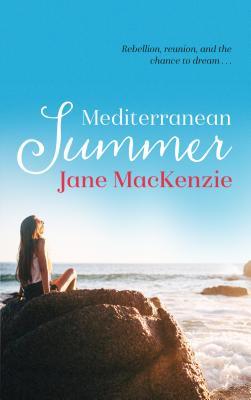
Mediterranean Summer by Jane MacKenzie was a nice surprise; a book I knew nothing about, by an author I’d never come across before, but one that I ended up really enjoying. It tells the story of Laure, a young art student who finds herself caught up in the excitement of the 1968 student demonstrations at her university in Paris. When the rebellion is over, with her future as an artist in doubt due to her involvement in the protests, Laure returns home for the summer to her parents’ house in the Mediterranean village of Vermeilla. Here, in the small Catalan community of her childhood, she is reacquainted with old friends as well as making new ones – and with the help of Robert, a lawyer, she begins to search for a way to rescue her career.

This is a lovely summer read; the descriptions of the fictional Vermeilla and the surrounding area are so beautiful I wished I could go and spend the rest of the summer there myself! There’s an interesting selection of characters to get to know too, mostly very likeable, but with one or two who could be considered villains. As for the historical background, I knew almost nothing about the Paris student protests in the 1960s, so I learned something new there, and I was also interested to read about the Nobel dynamite factory in Paulilles and the shocking lack of regard for the health and safety of the employees. I loved Mediterranean Summer and would be happy to try Jane MacKenzie’s previous novels.

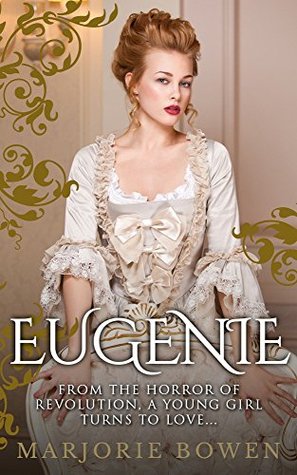
The next book I want to talk about takes us further back in time, to the French Revolution. Published in 1917 (originally titled The Third Estate), Eugenie by Marjorie Bowen introduces us to two sisters, Eugenie and Pélagie Haultpenne. Pélagie, the eldest, is heiress to a fortune and, at the beginning of the book, is engaged to a handsome young nobleman, the Marquis de Sarcey. As soon as the Marquis sees her beautiful sister Eugenie, however, Pélagie is forgotten. Can he find a way to be with Eugenie without giving up his claim to the Haultpenne fortune?

I have read a few of Marjorie Bowen’s other historical novels and have found them to vary widely in style and quality. This is not one of the better ones, but despite the off-putting cover, it’s still an entertaining read. The historical aspect of the story is interesting; it focuses less on the Revolution itself than on the factors leading to it, such as the Estates General and the role of the Comte de Mirabeau. This is a novel that you would read more for the plot than because you wanted to learn some history, though. It reminded me slightly of Louisa May Alcott’s A Long Fatal Love Chase; it’s fun, as long as you don’t mind lots of melodrama, swooning heroines and an anti-hero who is “a creature expert in every vice, used to every dishonour, useless, arrogant, a parasite on the labour of others!”

Finally, I read A Week in Paris by Rachel Hore, a dual timeline novel. One thread of the story is set in 1961 and follows music student Fay Knox who is in Paris for a week with her orchestra. Fay has grown up knowing very little about her early childhood as her mother refuses to talk about it or to tell her what happened to her father, other than that he was killed during the war. However, when memories start coming back to her, she has reason to believe that the first years of her life may have been spent in France. Over the course of her week in Paris, Fay decides to find out the truth about her past – and is shocked by what she discovers. Meanwhile, she is reacquainted with an old friend, Adam, but could he also be hiding secrets?

The other storyline is written from the perspective of Fay’s mother, Kitty, who falls in love with Gene, an American doctor, during World War II. The two end up trapped in occupied Paris – and their actions during this period will have consequences that live on into the next generation.

I found this an enjoyable novel, after a slow start, though not as good as similar books by other authors such as Lucinda Riley or Susanna Kearsley. The 1940s storyline is much more engaging than the 1960s one, not just because of the drama of the war itself, but also because the romance between Kitty and Gene is more convincing than the one between Fay and Adam (and less reliant on coincidence and chance meetings). I really cared about what happened to the wartime characters and was gripped by the details of life in a city under Nazi occupation, but I wouldn’t have minded if the framing story involving Fay had been left out altogether.

Three very different books, but I found different things to like about all of them!

Thanks to Jane MacKenzie for the copy of Mediterranean Summer; the other two were both taken from the outstanding titles on my NetGalley shelf.

The Last Son’s Secret by Rafel Nadal Farreras

This novel by Catalan author Rafel Nadal Farreras apparently enjoyed a lot of success when published in its original language in 2015 and is now available for the first time in an English translation by Mara Faye Lethem.

The story is set in the Puglia region of Italy where, in the small town of Bellorotondo, the names of twenty-one members of the Palmisano family are engraved on a memorial to the First World War. Vito Oronzo, the last Palmisano man to die in the war, leaves behind a pregnant wife, Donata. When the child – a boy whom she names Vitantonio – is born, Donata is so afraid that her son will succumb to the curse of the Palmisanos that she takes desperate measures to secure his safety.

The Last Son’s Secret follows little Vitantonio through his idyllic childhood in rural Italy, growing up alongside Giovanna Convertini, the daughter of his father’s best friend who was also killed on the same day in 1918.

They took dips in the stone laundry trough, caught crickets in the garden, ran through the fields as the farmers cleared the dead leaves from the olive trees, and they ate dinner together at the kitchen table. In the evenings everyone gathered on the threshing floor and sat in the cool air: the grown-ups sang and told stories and the children played hide-and-seek until they were so worn out they fell asleep on their aunt’s lap.

Elsewhere in Puglia, however, life is not so pleasant. A neighbour’s six-year-old son is sold into child labour, while in the nearby cave houses of Matera families live in extreme poverty. Further afield, Mussolini is rising to power and Europe is on the brink of war once more. Eventually, Vitantonio, Giovanna and their friends will be forced to take sides. Will the Palmisano curse strike again or has Donata done enough to protect her son from his father’s fate?

I enjoyed The Last Son’s Secret; despite it being set during the two world wars, it’s not as depressing as it might sound – the likeable main character and the messages of hope and optimism are enough to counteract the darker aspects of the plot. The depiction of life in Italy between the wars is beautiful and I could easily imagine I was there in Bellorotondo, harvesting olives, picking cherries and planting flowers in the garden of the Convertini palazzo. I particularly liked the descriptions of Matera, where Vitantonio hides out for a while at the beginning of the war.

The Second World War chapters are also interesting to read, and I couldn’t help thinking how rarely I have read anything that looks at the war from an Italian perspective. This is certainly the first time I have read a fictional portrayal of the chemical disaster caused by the release of mustard gas during the sinking of the American ship John Harvey in the port of Bari.

The Last Son’s Secret is a surprisingly quick read, but it did take me a few chapters to really get into the story. This is probably because it begins with a long chronicle of the deaths of the Palmisano men, which I expect was intended to be a quirky and unusual opening to the novel but didn’t quite work for me. Also, while Vitantonio’s story was moving at times, I don’t really think I would describe it as the sweeping, heartbreaking epic promised by the blurb. Maybe some of the emotion was lost in translation – although in general I did think the translation flowed well and I had no real complaints about it. If any other books by Rafel Nadal Farreras become available in English I would be happy to read them.

This is Book 3/20 for my 20 Books of Summer Challenge.

Thanks to the publisher for providing a copy for review via NetGalley.