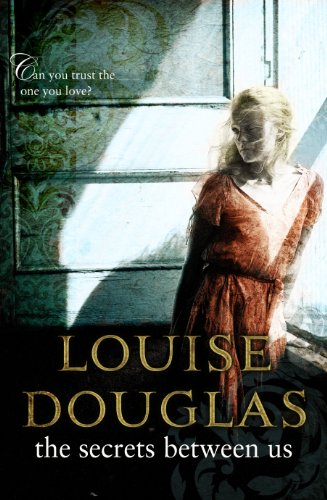
The Secrets Between Us by Louise Douglas

Suffering from the trauma of a stillborn baby and the end of her relationship with her boyfriend, Sarah agrees to accompany her sister and brother-in-law to Sicily for a holiday. Here she meets Alexander and his six-year-old son, Jamie, who are having problems of their own: Alexander’s wife, Genevieve, has left him and disappeared without trace. When Alex offers Sarah a job as housekeeper at his home in England, she agrees. Despite her family’s concerns, Sarah thinks it’s the right decision: she’s attracted to Alex, adores his little boy, and is desperate to make a fresh start and move on with her life.

But after joining Alex and Jamie at Avalon, their home in the village of Burrington Stoke in Somerset, Sarah begins to wonder exactly what happened to Genevieve. The missing woman’s family are convinced Alex knows more about the disappearance than he’s admitting to, but Sarah knows that can’t be true…or can it?

The Secrets Between Us was my final choice for the Transworld Book Group. Louise Douglas is not an author I’ve ever read before, so I didn’t know what to expect from this book, but I was immediately drawn to it when I saw that it had been compared to Rebecca by Daphne du Maurier, one of my favourite books. And there are definitely some similarities. Genevieve, like Rebecca, is described as beautiful, popular, talented and loved by everyone who knew her – and although she’s not there physically, she’s still a very strong presence and always at the heart of the story. The two books also share a gothic atmosphere and a sense of uneasiness and foreboding.

But this is also an excellent book in its own right. The author expertly keeps us guessing right to the end by adding some unexpected plot twists and ensuring that we can never be quite certain whether Alexander can be trusted or not. It’s also possible that Sarah, as the narrator, may not always be completely reliable. Some very strange and spooky things happen at Avalon and we are made to wonder whether they have supernatural causes or whether Sarah’s emotional state is making her see things that aren’t really there.

I did find it hard to believe that Sarah would agree to move in with a man she’d only met on a couple of brief occasions in Sicily, but at least this meant we were thrown into the action almost immediately, with only a short build-up. And Sarah is a narrator who is easy to like and to have sympathy for. I could really feel her fear and confusion as more and more facts about Genevieve were revealed, and her sense of growing isolation as the people of Burrington Stoke turned against her, believing that she and Alexander were trying to cover up the truth about Genevieve’s disappearance.

The Secrets Between Us is an excellent psychological thriller, with just the right amount of tension and suspense. Although Louise Douglas’ previous novels sound very different to this one, I really liked her writing and would be happy to try her other books at some point too.

I received a copy of this book from Transworld for review.

One Book, Two Book, Three Book, Four…and Five

This is the second time Simon at Stuck in a Book has hosted this meme about past, present and future reads. I didn’t take part in the previous one, although I enjoyed reading everyone else’s posts, but this time I’ve decided to join in the fun myself!

1.) The book I’m currently reading:

I’m reading two books at the moment. The first one (in honour of Halloween) is a short story collection, Gothic Tales by Elizabeth Gaskell. I’ve only read the first story in the book so far and didn’t find it particularly ‘gothic’ but I’m sure the others will be better.

I’m also reading A Red Herring Without Mustard, which is the third book in Alan Bradley’s Flavia de Luce mystery series. I loved the first two and although I’m only halfway through this one, I’m enjoying it as much as the others.

2.) The last book I finished:

This is the second Winifred Holtby book I’ve read: the first was South Riding, which I read earlier in the year and loved. The Land of Green Ginger was not as good, which was probably to be expected, as South Riding is considered to be her masterpiece, but I still enjoyed it and should be posting my thoughts on it soon.

3.) The next book I want to read:

The Ghost of Lily Painter by Caitlin Davies. This is a library book and will probably be the next book I read after I’ve finished the Alan Bradley one.

4.) The last book I bought:

I love historical fiction set during the medieval period and this trilogy about the Percy family was recommended to me. Unfortunately the books are now out of print but I managed to get a used copy of the first one, Lion of Alnwick, in good condition from Amazon. Now I’m trying to decide if I should buy the other two while I know they’re still available or if I should wait to see what I think of this one first!

5.) The last book I was given:

It’s not often that I’m given books by friends and family, but I have received a few review copies this month. This is the most recent one: The Snow Child by Eowyn Ivey. It sounds like a beautiful story and I’m looking forward to starting it soon.

If you’ve read any of these books, what did you think of them?

The Phantom of the Opera by Gaston Leroux

Gaston Leroux’s novel The Phantom of the Opera has been adapted for stage and screen so many times, many of us will be familiar with the story without ever having read the book. But whether you’ve seen any of the adaptations or not, you can expect the novel to be different in many ways and it’s an entertaining read in its own right. Although I won’t be adding it to my list of all-time favourite classics, I did enjoy it and had fun reading it.

The novel was first published in English in 1911, having previously been serialised in a French newspaper during 1909 and 1910. For those of you who don’t know the plot, the story takes place in the Paris Opera House, which is apparently haunted by a ghost. When Raoul, the Vicomte de Chagny, falls in love with Christine Daaé, a singer at the Opera House, he discovers that he has a rival for Christine’s love: the Opera Ghost himself.

In the prologue, Leroux tells us that this is a true story and that he has carried out extensive research, interviewing some of the characters and studying the archives of the National Academy of Music.

The Opera ghost really existed. He was not, as was long believed, a creature of the imagination of the artists, the superstition of the managers, or a product of the absurd and impressionable brains of the young ladies of the ballet, their mothers, the box-keepers, the cloak-room attendants or the concierge. Yes, he existed in flesh and blood, although he assumed the complete appearance of a real phantom; that is to say, of a spectral shade.

But whether or not you believe that the ghost was real, the opera house was definitely based on a real place, designed by the architect Charles Garnier in the 1860s. Almost the entire story is set inside the opera house, which becomes a whole world in itself complete with an underground lake, a maze of tunnels and even a torture chamber. It was a fascinating setting to read about and in a way, the building is the most important character in the book, providing a lot of the novel’s atmosphere and suspense.

Although the book is presented as if it was a factual account, the writing is never dry. In fact, it’s the opposite: it’s filled with passion and emotion. It’s also very melodramatic and over the top, which made it quite funny at times (though I wasn’t always sure if it was supposed to be!) but what the book lacks in quality of prose is made up for in the storytelling and exciting plot. I didn’t love The Phantom of the Opera, but it kept me entertained and I’m glad to have finally read it.

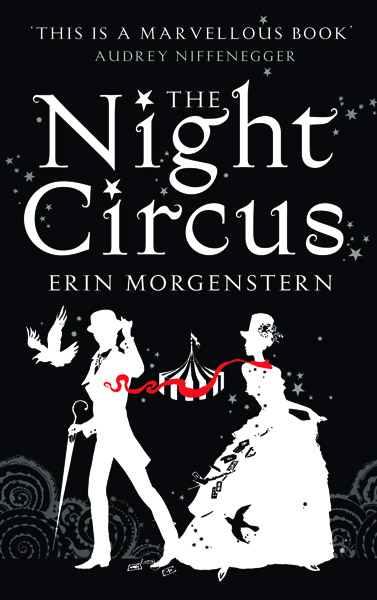
The Night Circus by Erin Morgenstern

I don’t usually pay much attention to hype, but I found I couldn’t ignore The Night Circus any longer. Judging by the number of glowing reviews this book has attracted, it has lived up to the hype for most people, but for me, although I did like it – loved it at times – I wasn’t quite as swept away by it as I had hoped to be. I’ll start by telling you what I loved about it and will then try to explain why not everything worked for me.

The Night Circus tells the story of Celia and Marco, two young magicians who have been selected by their mentors to take part in a very special contest. The rules of the competition are shrouded in mystery and even the two illusionists themselves aren’t sure what they have to do to win. And the venue for this magical battle? Le Cirque des Rêves, or the Circus of Dreams, one of the strongest, most vivid fictional worlds I’ve ever come across in a novel.

“The circus arrives without warning”, as we are told in the opening line of the novel. As it moves from town to town, it appears overnight and is “simply there, when yesterday it was not”. It really sounds amazing, more like a theme park than a traditional circus, and all the descriptions made me feel sorry that it doesn’t really exist! I know I’m not the only person who will have read this book wishing that they could visit the circus too and spend the night wandering from tent to tent, marvelling at all the spectacular attractions and performances. The setting is complemented with an authentic circus atmosphere complete with the smells of bonfire smoke and caramel, the taste of mulled cider, and a special black and white colour scheme. So much thought has gone into making the setting come to life, right down to the tiniest detail. What a great imagination Erin Morgenstern must have!

As it grows in popularity, the circus attracts a large group of followers who form a kind of fan club, calling themselves ‘rêveurs’. As we read the book we are encouraged to become rêveurs ourselves via a number of special chapters written in the second person, designed to make the reader feel they are actually there, inside the circus. I thought this aspect of the book was very effective and possibly the best use of second person narrative I’ve seen.

For me though, this book was all about the tone, the atmosphere and the descriptions of the circus, and there wasn’t much else beyond that. Outside the world of the circus there was no sense of time or place: the book is set in the late 19th and early 20th centuries, but it didn’t feel that way to me and I didn’t really notice anything to set the book in its time period. Maybe it was kept deliberately timeless – I don’t know, but I thought this was slightly disappointing as I do love a Victorian/turn of the century setting. The story develops slowly (sometimes too slowly for me), keeping the reader wondering about the true nature of the contest and what the outcome will be, but when I reached the end of the book I still wasn’t completely sure exactly what the point of the contest had been. Too many of my questions were left unanswered.

The biggest problem I had with this book, though, was the characters. When I think about my favourite books, the ones that I really loved and have kept on my shelves to read over and over again, they are the ones with strong characters, characters I can form an emotional connection with, who I can care about and understand. And that’s why, although I did like The Night Circus, I couldn’t love it. I didn’t think there was enough depth to the characters and even Celia and Marco never felt like real, fully developed people to me. Rather than being able to get inside their heads I felt I was watching them from a distance, though maybe the fact that most of the book was written in the third person present tense contributed to this. I did still enjoy this book and loved that wonderful circus setting, but if only the characters had been stronger it might have been one of my books of the year.

Classics Circuit: A Sicilian Romance by Ann Radcliffe

A Sicilian Romance is a gothic novel first published more than two hundred years ago, in 1790. Set in the late sixteenth century, it’s the story of two sisters, Julia and Emilia, the daughters of the fifth marquis of Mazzini. After the death of the girls’ mother, the marquis marries again and as his second wife prefers to spend her time in Naples, he leaves his daughters living alone in his ancient castle in Sicily with only the servants for company. When their father returns to the island and informs Julia that he has arranged a marriage for her, she rebels against his choice of husband, putting her life in danger. Meanwhile several of the castle’s inhabitants report hearing strange noises and seeing mysterious lights shining in an abandoned part of the building. Is the castle haunted?

This is not the first Ann Radcliffe novel I’ve read; I had previously enjoyed both The Mysteries of Udolpho and The Italian, so when I saw that the theme of the latest Classics Circuit tour was the early gothic novel, I decided to try another Radcliffe book. This one was shorter and less satisfying than the other two I’ve read, but in a lot of ways it was very similar. All of her books are perfect examples of gothic literature and have everything you would expect from a gothic novel: An old castle with crumbling staircases and dark, dusty chambers, locked doors, family secrets, lonely monasteries, bandits, shipwrecks, dungeons and underground tunnels, thunder and lightning, and almost anything else you can think of.

I’ve found that reading early gothic novels requires a different approach to normal. You need to be prepared for lots of melodrama and it’s necessary to completely suspend disbelief because in reality nobody would ever find themselves in the situations Radcliffe’s characters find themselves in. I hope not anyway! The characters also tend not to be as well developed as you would expect in a more modern novel and are usually portrayed as either completely good or completely evil. A Sicilian Romance features two beautiful heroines, a brave, handsome nobleman, and a wicked stepmother, among other stereotypes. The storyline is predictable and relies heavily on coincidences, last-minute escapes and other typical plot devices found in this type of book. It’s almost impossible to take these books seriously, but if you can accept them for what they are, they can be fun to read.

I should also mention that there are some beautifully written descriptions of the Sicilian scenery (although there’s not as much descriptive writing as in The Mysteries of Udolpho, which made this book easier to read and much faster-paced). I enjoyed this book but I think The Italian is still my favourite Radcliffe novel.

Visit the Classics Circuit blog to discover more early gothic literature.

Five recent reads that I couldn’t finish

How often do you start a book and find that you can’t finish it? Maybe you didn’t like the writing, maybe you couldn’t connect with the characters, or maybe it was just the wrong book at the wrong time. I hate leaving books unfinished, but sometimes it’s the right thing to do. Luckily it doesn’t happen to me very often, but there have still been quite a few books that I’ve started reading recently and for one reason or another have had to abandon. If you’ve read any of these, do you think they’re worth trying again?


A Secret Alchemy by Emma Darwin

What’s it about?
A present day historian, Una Pryor, researches the lives of Elizabeth Woodville, wife of King Edward IV, and her brother Anthony, and begins to uncover the mystery of the Princes in the Tower.
What was the problem?
With my interest in the Wars of the Roses I really wanted to like this book, but I just couldn’t. There were three different threads of the story, one narrated by Una, one by Elizabeth and one by Anthony – and they were all set in different time periods, which I found very confusing. The historical sections didn’t feel very atmospheric and the modern section seemed too disconnected. I’m sure that if I’d kept reading the three storylines would probably have been brought together eventually, but I gave up after almost 100 pages.
Would I try it again?
Probably not.

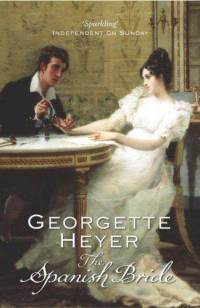
The Spanish Bride by Georgette Heyer

What’s it about?
Set during the Peninsular War, this is the story of Brigade-Major Harry Smith and his Spanish wife, Juana.
What was the problem?
This wasn’t a bad book but it wasn’t really what I’ve come to expect from Georgette Heyer. I read nearly a third of the book and it was very heavy on historical detail, particularly descriptions of army life and battles, which I wasn’t in the right mood for.
Would I try it again?
Maybe, but there are plenty of other Georgette Heyer books I’d like to read first.

Kidnapped by Robert Louis Stevenson

What’s it about?
This is a classic historical adventure novel about seventeen-year-old David Balfour, whose uncle has him kidnapped in an attempt to steal his inheritance.
What was the problem?
I wanted to read some of the children’s classics I’d missed out on when I was younger and started reading this one on my ereader. I loved the opening chapters but when I reached a long section set at sea I started to lose interest.
Would I try it again?
Probably not.

Love and Summer by William Trevor

What’s it about?
Set during one summer in the 1950s, this is a story about the small Irish town of Rathmoye and the people who live there.
What was the problem?
I think it was probably just the wrong time for me to read this book. I had recently finished reading Brooklyn by Colm Toibin and this one seemed to have a very similar feel. I wasn’t in the mood for another quiet, gentle story so I set this book aside after a few chapters.
Would I try it again?
Yes.

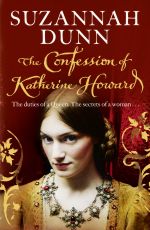
The Confession of Katherine Howard by Suzannah Dunn

What’s it about?
The story of Henry VIII’s wife, Katherine Howard, as seen through the eyes of her lady-in-waiting, Cat Tilney.
What was the problem?
I couldn’t get into this book at all and abandoned it after a couple of chapters. The dialogue was too modern and the characters didn’t feel like real people to me. Maybe if I’d kept reading I would have started to enjoy it more, but my instincts told me this wasn’t the right book for me.
Would I try it again?
No.

Have you read any of these books? Did you have better luck with them than I did?

The Queen’s Governess by Karen Harper

The Queen’s Governess is yet another historical fiction novel set during the Tudor period, but although the story is a familiar one it is told from a different perspective: that of Kat Ashley, the governess of Elizabeth I.

Born Katherine Champernowne, the daughter of a beekeeper from Devon, Kat comes to the attention of Thomas Cromwell who brings her to court to spy for him in the household of Anne Boleyn, Henry VIII’s second wife. When Anne finds herself on trial for treason, adultery and incest, Kat vows to take care of her daughter, the young Princess Elizabeth. Much more than just a governess, Kat becomes Elizabeth’s friend, advisor and mother figure. The fates of Kat and her beloved husband, John Ashley, become tied with the princess’s and they are forced to endure exile and imprisonment before Elizabeth is finally crowned.

So much has been written about the Tudor period that I’m sure it must be getting very difficult for historical fiction authors to find an original way to approach the subject. Anyone with even a vague knowledge of the Tudors will probably recognise many of the characters and events in this book. Elizabeth I, Henry VIII and all six of his wives are here, along with Thomas Cromwell, the Seymours, the Dudleys and Mary I. It’s the choice of Kat Ashley as narrator that helps to keep things new and interesting. I’m not sure if there have been any other novels about Kat, but this is certainly the first one I’ve ever been aware of and it made a refreshing change to read about a lesser-known historical figure from the period.

Telling the story from Kat’s perspective does have its disadvantages though. It seems that not much is actually known about her, and although she was obviously an important part of Elizabeth’s life she appears to have had very little direct influence on the course of history. The result of this is that for much of the book Kat is an observer, describing births, deaths, executions and other significant events of the Tudor court, rather than playing a major role in any of these historical moments.

However, I do think Karen Harper has done a good job in taking the known facts of Kat’s life and fleshing out her character, using her imagination and historical knowledge to fill in the gaps. The book includes an author’s note explaining how much is fact and how much is fiction, and it does seem that the novel has been well researched and that she has done her best to make it as accurate as possible, even down to the choice of spellings of people’s names.

While I was reading this book I kept thinking that it felt very similar to Philippa Gregory’s Tudor court novels and I’d have no hesitation in recommending The Queen’s Governess to Gregory fans, as well as to anyone interested in Tudor history in general. I’ll probably read more of Karen Harper’s work in the future.

Have you read any Tudor novels told from an unusual perspective?