The Loving Spirit by Daphne du Maurier

If you’ve been following my blog for a while you’ll know that Daphne du Maurier is one of my favourite authors, so when I saw that Simon of Savidge Reads and Polly of Novel Insights were hosting a Discovering Daphne event throughout October I knew I’d have to read at least one du Maurier book this month. There are still plenty of her books that I haven’t read yet, but I decided I wanted to go back to the start of her career and read her first novel from 1931, The Loving Spirit.

The Loving Spirit is a family saga spanning four generations of the Coombe family. It begins in 1830 with the story of Janet Coombe, a passionate young woman who is forced to abandon her dreams of going to sea when she marries and settles down to start a family with her husband, a boat builder. We then move forward through the decades, ending one hundred years later in the 1930s. Along the way we meet Janet’s son, Joseph, her grandson, Christopher, and finally her great-granddaughter, Jennifer. The book is divided into four parts, one devoted to each of the main characters, but I won’t go into any plot details here as each story has its own set of dramas and surprises which I’ll leave you to discover for yourself.

Although this is a family story and doesn’t have the gothic feel of some of du Maurier’s other books, there are hints of the supernatural in the way the stories of the four Coombes are connected, particularly Janet’s and Joseph’s. The link between the four sections of the novel is the ‘loving spirit’ of Janet Coombe which seems to be watching over each successive generation. And this is probably a good place to mention the Emily Brontë poem, Self-Interrogation, which inspired the title of this novel:

“Alas! The countless links are strong
That bind us to our clay;
The loving spirit lingers long,
And would not pass away!”

Du Maurier had a real talent for giving her novels atmosphere and a strong sense of place, and this book is no exception. The Coombe family live in Plyn, a fictional shipbuilding town on the coast of Cornwall, and you can expect some beautiful, vivid descriptions of the Cornish coastline, the sea and Plyn itself. I’m really not a fan of books about boats and sailing, but luckily the actual seafaring action and terminology is kept to a minimum here. Instead, the focus is on the passion Janet, Joseph and other members of the Coombe family feel for the sea – and the ways in which sailing and the shipping industry become an intrinsic part of their lives.

There are some interesting supporting characters too, including one of my favourites, Jennifer’s grandmother. Du Maurier’s wonderful sense of humour comes through here in some of the dialogue in which the grandmother, who is starting to lose her hearing, constantly misinterprets what Jennifer is saying. For this reason, and also because Jennifer was the character who felt the most real to me, this final section of the novel was probably my favourite.

The Loving Spirit is not one of the better du Maurier novels I’ve read, but as a debut novel published when she was only twenty-four years old I did still find it quite impressive. It’s interesting to be able to compare it with her later novels and see how her writing developed throughout her career.

Under the Greenwood Tree by Thomas Hardy

Under the Greenwood Tree, set in the small village of Mellstock in Thomas Hardy’s fictional Wessex, is both a love story and a nostalgic study into the disappearance of old traditions and a move towards a more modern way of life. The book is divided into five sections, one for each of the four seasons of the year plus a final concluding section. The story begins in the winter, when we meet a group of villagers who play stringed instruments in the church choir. There’s a new vicar in Mellstock, the Reverend Maybold, and he has plans to replace the traditional choir with a new mechanical church organ. The organ will be played by another newcomer to the village, a pretty young schoolteacher whose name is Fancy Day.

The musicians are upset when they learn that they are going to be replaced, but one of them, Dick Dewy, finds himself falling in love with Fancy Day. However, unknown to Dick he has several rivals for Fancy’s love, including a rich local farmer and even the Reverend Maybold himself. The story of Dick and Fancy’s romance is played out over the course of a year, against a backdrop of the changing seasons and the changing landscape of Mellstock.

Hardy’s novels have a reputation for being bleak and depressing, but I can promise you that this one is neither. It’s actually quite an uplifting, optimistic story with an (almost) happy ending – very different from the other three Hardy books I’ve read (Tess of the d’Urbervilles, Jude the Obscure and A Pair of Blue Eyes). It doesn’t have the depth and complexity of Tess or Jude and to be honest, I do personally prefer Hardy’s tragedies, but I enjoyed this one too and it did make a nice change from the darker books I’ve been reading recently. The strengths of Under the Greenwood Tree are its gentle humour and its portrayal of life in 19th century rural England. As usual with Hardy, his pastoral descriptions are beautifully written and I love the way he paints four different portraits of country life appropriate to each season of the year, from singing carols and making cider in the winter to gathering nuts and collecting honey from beehives in the autumn.

Where the book was less successful, in my opinion, was with the characters of Dick Dewy and Fancy Day, because they just weren’t strong enough or interesting enough for me to really care about their romance. Fancy was actually quite an advanced and ‘modern’ character for the time and place, being well-educated and independent. However, she’s depicted here as being very silly and shallow and I felt that we never got to understand her properly. Dick was easier to like but his character wasn’t given a lot of depth either. I do think Hardy captured the naiveté of their relationship perfectly, but I would have preferred to have read more about the rest of the village community, with the love story pushed further into the background. Apparently Hardy had originally wanted to call the book “The Mellstock Quire” and it did seem to me that he was maybe more comfortable with that aspect of the book.

Although I’ve only read a few of Thomas Hardy’s novels he’s quickly becoming one of my favourite Victorian authors. I hope to read all of his books eventually, but I wish I’d left Under the Greenwood Tree until later as it’s turned out to be the first one I haven’t loved. There were a lot of things I liked about it, but it didn’t have the same emotional impact on me that the others had and it’s not a book I would want to read again and again.

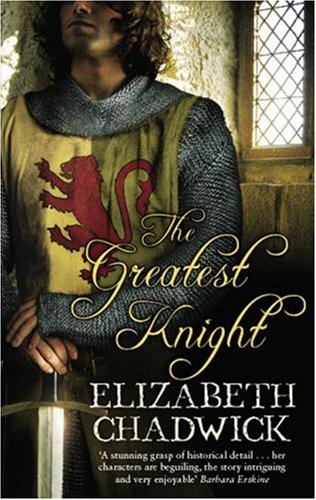
The Greatest Knight by Elizabeth Chadwick

When I read The Champion a couple of months ago and asked for recommendations of other Elizabeth Chadwick books, The Greatest Knight was mentioned, so I decided to make it the next Chadwick book I read. The Greatest Knight is historical fiction based on the life of William Marshal, one of the most important knights of the medieval period. Marshal has been largely forgotten today (I didn’t know anything about him at all before reading this book), but his story is one that deserves to be told.

William Marshal lived during the 12th and early 13th centuries and was described by the Archbishop of Canterbury, Stephen Langton, as “the greatest knight that ever lived”. Starting out as an inexperienced young knight, William comes to the attention of Eleanor of Aquitaine, and soon rises to a position of power and influence. As a friend of Eleanor’s, advisor to her husband Henry II and tutor to their son, Henry the Young King, William has an important part to play in the Plantagenet court. Keeping everybody happy in this time of shifting loyalties isn’t easy and he often finds himself in a very precarious position with some difficult decisions to make.

Elizabeth Chadwick’s version of William is a very engaging and likeable character. He’s brave, intelligent, loyal and chivalrous and despite living through dangerous and turbulent times, he manages to keep his honour and integrity intact. There were times when he seemed almost too perfect, though fortunately not quite to the extent where he became unrealistic. Assuming that the fictional Marshal is not too different to the real one, then he really did deserve the title of ‘the greatest knight’.

While The Champion took fictional characters and set them against a medieval backdrop, this book deals mainly with real historical figures and real historical events. Perhaps because of this, there’s less romance in this book and more history. William does have a mistress and then eventually a wife, but these relationships form just part of his story and many other aspects of his life and career are given equal attention. And a large amount of the book is devoted to the treachery, betrayal and political intrigues of the Plantagenets: Eleanor, her husband King Henry II, and their children – Henry, the Young King; Richard I (The Lionheart); Geoffrey and King John.

Chadwick’s note at the back of the book explains where she has tried to stick to the known facts and where she has had to use her own judgment and imagination to fill in the gaps. As always when I discuss historical fiction novels, I want to point out that I am not a serious historian and not an expert on this (or any other) period of history – therefore I can’t really comment on the historical accuracy. I read these books purely for enjoyment and in the hope of learning something new and The Greatest Knight fulfilled both of those criteria: it was very enjoyable and it was great to learn about a historical figure I previously knew nothing about and who lived through some of the most fascinating times in English history.

This book ends in the middle of Marshal’s life because, as the author explains, there was just far too much to fit into one novel, even after being selective and not attempting to cover every single event that happened to him. I’m looking forward to seeing how his story continues in the sequel, The Scarlet Lion.

The Water Room by Christopher Fowler

The Water Room is the second in a series of novels about two elderly detectives, Arthur Bryant and John May, who work for the Peculiar Crimes Unit, a branch of the London Metropolitan Police specialising in unusual cases. Bryant and May have been working together since the 1940s and have formed a strong and effective partnership, combining Bryant’s eccentricity and lateral thinking with May’s common sense and more logical approach.

When Mrs Singh is found drowned in the seemingly dry basement of her home in Balaklava Street with her mouth full of river water, her brother, who is an old friend of Arthur Bryant’s, asks the Peculiar Crimes Unit for help. But no sooner have Bryant and May begun to investigate than another bizarre incident occurs in the same street. Meanwhile, the new owner of Mrs Singh’s house is being plagued by the sound of rushing water in the basement and damp patches appearing and disappearing on the walls. What is going on?

I read the first book in this series, Full Dark House, a couple of months ago and loved it, but I thought this one was even better. This is a series that I would particularly recommend to people who love London. I’m not familiar enough with London to fully appreciate everything in these novels, but Christopher Fowler’s love and knowledge of the city is obvious on every page. Full Dark House looked at the city’s theatrical world; in this book the focus is on the underground rivers that run under the streets of London. During the course of Bryant and May’s investigations we learn lots of little facts about these lost rivers and the mythology surrounding them. The historical information is woven into the plot throughout the book and I thought the balance between education and entertainment was just right.

This is not a very fast-paced book and does require some concentration, but the story moves along steadily and has a few surprising twists. The mystery plot was quite a good one, with plenty of clues and red herrings that seemed to implicate almost everybody in the street at one point or another. But the highlight of these books for me is the partnership of Bryant and May themselves and the dialogue between them.

As well as being part of a series, The Water Room is a complete mystery novel in itself and it’s not necessary to have read Full Dark House first. However, if you’re concerned about coming across spoilers it would be a good idea to start at the beginning of the series. After enjoying the first two books so much I’m sure I’ll be reading the others and am looking forward to meeting Mr Bryant and Mr May again in Seventy-Seven Clocks.

I received a copy of this book for review from Transworld as part of the Transworld Book Group.

Uncle Silas by Sheridan Le Fanu

Until now my only previous experience of the 19th century Irish author Joseph Sheridan Le Fanu was the short story, Laura Silver Bell, which I read for Mel U’s Irish Short Story Week in March. I was keen to see what I would think of one of Le Fanu’s full-length novels and decided to read Uncle Silas for the R.I.P challenge.

Uncle Silas is an 1864 novel which seems to incorporate almost every aspect of the Victorian sensation/gothic novel you can think of: gloomy, eerie mansions, graveyards, laudanum addiction, an evil governess, locked rooms and locked cabinets, poison, family secrets. I had high hopes for the book as it sounded like exactly the type of classic I usually enjoy, and after a slow start it didn’t disappoint.

Our heroine (and the narrator of the story) is Maud Ruthyn who lives with her father at Knowl, their family estate. Maud is fascinated by a portrait of her Uncle Silas which hangs on one of the walls inside the house – she has never met her uncle before and is intrigued by hints of scandal in his past. When Mr Ruthyn decides to find a governess for his daughter, the sinister Madame de la Rougierre comes to live at Knowl and a chain of events begins which will finally bring Maud into contact with her mysterious Uncle Silas.

And that’s really all I can tell you about the plot without beginning to give too much away! I had managed to avoid reading any big spoilers so I never had any idea what was coming next, and I think that was the best way to approach this book.

It did take me a while to really get into the story. It was fun and entertaining from the beginning and I was never actually bored with it, but it seemed to take such a long time before anything really happened. It wasn’t until about one hundred and fifty pages into the book that the pace began to pick up and then I could appreciate why Le Fanu had taken his time building the suspense and slowly creating a mood of menace and foreboding. It was a very atmospheric and creepy story (particularly any scene featuring Madame de la Rougierre, who must be one of the most horrible, grotesque villains in literature), though I didn’t find it as scary as I had expected to.

Maud may not be the strongest of female characters but she felt real and believable to me. Although she could be brave when she needed to be, she was young and naïve and I felt genuinely worried for her as she found herself becoming increasingly isolated, not sure who she could and couldn’t trust. And for me, this was where the story could be described as frightening: the complete lack of control Maud had over her own destiny and the way she was forced to depend on people who may not have had her best interests at heart.

If you enjoyed The Woman in White by Wilkie Collins then I think there’s a good chance you’ll like this book too. It doesn’t have as many surprising twists and turns as The Woman in White but it is a similar type of book, though with a much darker and more gothic feel. I think it’s a shame Le Fanu isn’t as widely read as other Victorian authors, as his work is definitely worth reading. I hope you’ll decide to give this book a try if you haven’t already.

The Ghost Writer by John Harwood

Gerard Freeman has grown up in Mawson, Australia, listening to his mother’s tales of her own childhood at Staplefield, a country estate in England. However, when she finds him going through her private papers one day she is furious and from that moment she refuses to say any more about her past.

Gerard continues to investigate his mother’s background and is intrigued when he discovers some ghost stories written by his great-grandmother, Viola Hatherley. Unable to talk to his mother about his discoveries, the only person Gerard can confide in is his English penpal, Alice Jessel. It’s only as Gerard grows older and uncovers more of his family history that he begins to understand the full significance of Viola’s stories and how they relate to his own life.

The Ghost Writer was published in 2004 and seems to have been very popular at the time of its publication, yet I somehow hadn’t even heard of it until I picked it up in the library a couple of weeks ago and thought it sounded perfect for the R.I.P. challenge and for this time of year. And it was a perfect choice – I was very impressed by this book. The closest comparison I can make is to Possession by A.S. Byatt. Both books are very well written and have similar structures, with different sections written in different styles and with letters and stories woven into the plot. I did find this an easier and more entertaining read than Possession, though, and at times it also reminded me of The Forgotten Garden by Kate Morton.

Viola Hatherley’s ghost stories were my favourite parts of the novel. They were very creepy and I could really believe they’d been written during the late 19th and early 20th centuries. I loved the way the ghost stories were connected to Gerard’s own story and yet they would have been good enough to stand alone as a separate short story collection too. Often when I read a book containing stories-within-stories I find myself becoming impatient and wanting to get back to the main plot, but not this time! There were four of Viola’s stories included in the book (one, The Revenant, is much longer than the other three and almost a novella). The highlight for me was The Gift of Flight, with its descriptions of a sinister doll-like child and a mysterious fog that fills the reading room at the British Museum.

Looking through some other reviews of this book, I’ve noticed that a lot of readers felt let down by the ending. I don’t usually mind being left to make up my own mind at the end of a book, but I can definitely understand why people would be disappointed by the way this one ended. It was very ambiguous and left so much open to interpretation. Despite the ending though, there were so many other things to love about this book: the elegant writing, the intricate plot, the clever structure, the gothic atmosphere, the eerie, unsettling mood and most of all, those excellent Victorian-style ghost stories!

September Reading Summary

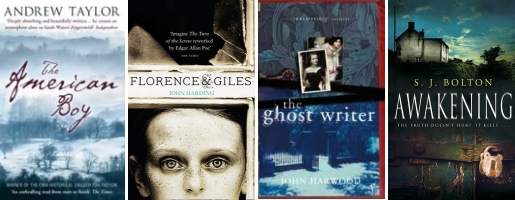
September was a good month for me – I read twelve books and enjoyed all but one of them. Choosing my favourites wasn’t easy, but I think these were the four that really stood out:

The American Boy by Andrew Taylor – 19th century setting, gothic atmosphere, mystery and adventure, even Edgar Allan Poe. This book was perfect for me!
Florence and Giles by John Harding – A great gothic story inspired by The Turn of the Screw.
Awakening by S.J. Bolton – The second book I’ve read by S.J. Bolton and I’ve loved both. I’m looking forward to reading her other two books soon.
The Ghost Writer by John Harwood – I was very impressed by this book, especially considering I had never even heard of it until I picked it up in the library. I’ll be posting my thoughts on this one soon.

Other books read in September

The Obscure Logic of the Heart by Priya Basil
Framley Parsonage by Anthony Trollope
Theodora by Stella Duffy
Devil Water by Anya Seton
The Last Dickens by Matthew Pearl
The Lady of the Rivers by Philippa Gregory
Ragnarok: the End of the Gods by A.S. Byatt (thoughts coming soon)
Uncle Silas by Joseph Sheridan Le Fanu (thoughts coming soon)

Although I limited myself to picking four favourites this month, I did enjoy all of these books with the exception of The Last Dickens, which was slightly disappointing.

Plans for October


This month Simon of Savidge Reads and Polly of Novel Insights are celebrating the work of one of my favourite authors, Daphne du Maurier, with a “Discovering Daphne” event. I managed to find a copy of The Loving Spirit at the library this morning and will hopefully be starting it this week.


I’ve also signed up for this month’s Classics Circuit tour, which has a gothic literature theme this time. I’m reading A Sicilian Romance by Ann Radcliffe for the tour and will be posting on October 25th.

What else am I reading this month? Well, I’m halfway through The Night Circus by Erin Morgenstern at the moment. I’ve been seeing this one mentioned everywhere and couldn’t resist it any longer! I also need to read my next book for the Transworld challenge, The Water Room by Christopher Fowler.

Did you have a good September? What are you reading in October?