Time for another Classics Club Spin!

The Classics Club

This is the fourth Spin hosted by the Classics Club this year. I didn’t take part in the last one but enjoyed the previous two so I’ve decided to join in again with this one.

Here are the rules:

* List any twenty books you have left to read from your Classics Club list.
* Number them from 1 to 20.
* Next Monday a number will be chosen.
* This is the book you need to read in November and December!

And here is my Spin List:

In the past I’ve tried to be creative and divide my list into categories. This time it’s less complicated; the odd numbers are books I’m looking forward to reading and the even numbers are books that I do want to read but have been putting off either because of the length or because they don’t appeal to me as much as they did when I first added them to my Classics Club list last year.

Obviously I would prefer an odd number but I’ll be happy to read whatever the Spin chooses for me!

1. The Mayor of Casterbridge by Thomas Hardy
2. Can You Forgive Her? by Anthony Trollope
3. Frenchman’s Creek by Daphne du Maurier
4. Vanity Fair by William Makepeace Thackeray
5. Family Roundabout by Richmal Crompton
6. East of Eden by John Steinbeck
7. The Sea Hawk by Rafael Sabatini
8. The Mill on the Floss by George Eliot
9. The Remains of the Day by Kazuo Ishiguro
10. A Tale of Two Cities by Charles Dickens
11. A Country Doctor’s Notebook by Mikhail Bulgakov
12. Wuthering Heights by Emily Bronte (re-read)
13. Excellent Women by Barbara Pym
14. Crime and Punishment by Fyodor Dostoevsky
15. The Vicomte de Bragelonne by Alexandre Dumas
16. The Heart of Midlothian by Sir Walter Scott
17. Idle Thoughts of an Idle Fellow by Jerome K. Jerome
18. The Charterhouse of Parma by Stendhal
19. The Heir of Redclyffe by Charlotte M. Yonge
20. The Hunchback of Notre Dame by Victor Hugo

Now I just need to wait until Monday to find out what I’ll be reading!

Have you read any of these? Which numbers should I be hoping for or dreading?
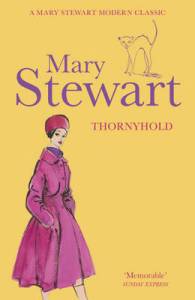
Thornyhold by Mary Stewart

Thornyhold After reading all the reviews and posts during Anbolyn’s recent Mary Stewart Reading Week, I had almost decided that the next Stewart books I read would be her Merlin series, but instead I found myself picking up this one from the library shelf.

Thornyhold starts off differently from the other Mary Stewart books I’ve read. Instead of getting straight into the action, our narrator, Geillis (Gilly) Ramsey, spends the first few chapters looking back on her childhood. As the daughter of a vicar and his cold, distant wife, bullied at school and feeling lonely and isolated, it was not a very happy childhood for Gilly and the one bright spot in her life was her relationship with her mother’s cousin, another Geillis.

Several years go by and both of Gilly’s parents die, leaving her an orphan in her early twenties. Just as she’s wondering what to do with her life, she hears that Geillis has also died, leaving her cottage in the countryside to Gilly. The name of the cottage is Thornyhold and it comes complete with an overgrown garden, a black cat called Hodge and a collection of dusty books of magic spells and herbal remedies. Could Gilly’s cousin Geillis have been a witch? With the help of William, a ten-year-old boy who shares her love of nature, Gilly begins to uncover some of the secrets of Thornyhold.

Thornyhold is one of Mary Stewart’s most recent books, published in 1988 (only Stormy Petrel and Rose Cottage came after that) and I’ve found that these final three books have a different feel from her earlier ones, being a lot gentler with less of the suspense and adventure that are usually associated with her work. In this book, although there are a few mysteries for Gilly to solve and one or two people who try to cause trouble for her (including the housekeeper Agnes Trapp, who seems desperate to get her hands on one of cousin Geillis’ herbology books), I never felt that I needed to worry about Gilly or that there was any danger of there not being a happy ending. But while I do prefer the more exciting, suspenseful books such as Nine Coaches Waiting and The Moonspinners, I enjoyed this one too, for different reasons.

This book may not have the exotic setting that many of her others have, but that doesn’t mean the descriptions aren’t still beautiful. It was a pleasure to watch Gilly exploring her new home, settling into the cottage and discovering the natural beauty of her surroundings. The story is set in the 1940s and has a lovely nostalgic feel with references to rationing and other details of post-war life. I also liked the characters, especially Gilly herself, who blossoms from a lonely child into a confident young woman with a lot to offer in terms of friendship and love (yes, there’s a love story too). Although this hasn’t become a favourite Stewart novel, it was a nice, relaxing read with a magical atmosphere and just what I was in the mood for!

After the Sunday Papers #12: Trying again

newspaper-clip-art-4 “She had read novels while other people perused the Sunday papers”
~ Mary Elizabeth Braddon, The Doctor’s Wife

***

I know I say this every time I write one of my Sunday Papers posts, but I can’t believe how long it’s been since the last one! It was always my intention to have a weekly roundup of my reading, upcoming reading events and other book-related musings, but for one reason or another I’ve never been able to get organised and post on a regular basis. As I do like to have some variety in my blogging and I feel that I’ve been posting nothing but book reviews recently, I’m going to try again and aim to post on at least one or two Sundays each month, even if I can’t manage every Sunday. Thinking about this has made me consider my whole blogging schedule (or lack of it) and I’ve been wondering whether it would be more or less stressful to have a fixed schedule where I post, for example, two reviews a week on a Tuesday and Thursday, with a post like this one on a Sunday, if I feel like it. What do you think? Do you plan ahead and post on certain days or do you prefer to be more spontaneous?

A More Diverse Universe Anyway, let’s start with an update on what I’m reading at the moment, beginning with my choice for A More Diverse Universe, which is being hosted by Aarti of Booklust from 15-17 November. Aarti has defined this on her blog as follows: “A More Diverse Universe celebrates diversity in speculative fiction by encouraging people to read books in the fantasy or science fiction genres that were written by people of color.” Who else is taking part in this? You can sign up here.

I had some trouble at first finding a book that would fit the requirements and that actually appealed to me (which I think highlights the need for an event like this, as there are so many more fantasy and science fiction books to choose from that are written by white authors), but when I saw that a few participants last year had read Salman Rushdie, I thought it would be a good opportunity to finally try one of his books. I am currently halfway through The Enchantress of Florence, which is full of magical realism, and enjoying it so far.

Speaking of fantasy, it’s not a genre I read often, but over the last few days I’ve been having fun re-reading my favourite fantasy series for the first time in more than a decade. More on that in a future post!

wilkieinwinter-1024x1024 Another event coming up in December is Wilkie in Winter hosted by The Estella Society. Wilkie Collins is one of my favourite authors and it’s been too long since I last read one of his books!

There are going to be two readalongs as part of Wilkie in Winter – The Frozen Deep and The Woman in White – though I haven’t decided yet if I want to participate in them. I’ve never read The Frozen Deep so I’m tempted to join in with that one, but I’ve already read The Woman in White a few times and while I do love it, I think I would rather re-read one of his others…possibly Armadale. I can never decide whether The Woman in White or Armadale is my favourite!

What have you been reading this week? What are your reading plans for the rest of 2013?

Sleeping Patterns by J.R. Crook

Sleeping Patterns I was lucky enough to win a copy of this book in a giveaway hosted by Charlie of The Worm Hole earlier this year. It’s probably not a book I would have chosen for myself but Charlie’s review (and others) made it sound very intriguing.

To begin with, the book is dedicated to the memory of the author, J.R. Crook, who we are told in the introduction (written by his friend, a fictional character called Annelie Strandli) is dead*. Before he died, Annelie says, he sent her fifteen envelopes each containing one piece of an untitled story and she has put them together to form a book. Annelie received these fifteen story fragments out of order and has presented them in that same order in the book so that Chapter 5 appears first, followed by Chapter 1, then 11.

Annelie herself is a main character in the story. A Finnish student living in London, the story tells of her relationship with Berry Walker, an aspiring writer. Annelie, Berry and Jamie (J.R.) Crook all live in the same student accommodation. Intrigued by the mysterious Berry, who is an insomniac, Annelie begins sneaking into his room and reading his writings, which he keeps in his desk drawer. Hoping for some insights into Berry’s character, Annelie becomes absorbed in the story he is writing – the story of Boy One, who has the habit of falling asleep at the most inappropriate times and entering the world of dreams.

There are so many clever ideas to be found in this book and it has such an unusual, innovative structure! I was impressed by its originality, though a bit disappointed that the actual plot wasn’t more compelling. Due to the fragmented nature of the story, possibly reflecting Berry’s disturbed sleeping patterns and Boy One’s dreams, I found it difficult to follow what was really happening (a story-within-a-story-within-a-story doesn’t even begin to describe it!) However, if you see the book as a sort of puzzle or jigsaw to be solved, then it definitely works in that respect.

When presented with chapters numbered incorrectly, the natural reaction is to want to read them in the correct numerical order, starting with Chapter 1. I managed to resist the temptation and just read the book straight through from cover to cover the way it was presented, but I did wonder whether the story would have made more sense if read in the right order or whether that would have just left me more confused. After spending most of the book feeling lost I was pleased to find that things did start to become clearer towards the end! At just over 100 pages, it would have been short enough to read again if I had wanted to and I’m sure a lot of things would have been clarified on a second read.

This book won the Luke Bitmead Bursary for previously unpublished authors and, having now read it, I can see why, because I can honestly say I’ve never read a book quite like Sleeping Patterns before. My personal preference is for more traditional novels – stories with a beginning, middle and end – but I’m always happy to try something a bit different. And this was certainly different!

* Don’t worry – J.R. Crook is not really dead. He even signed my copy of the book!

The Firebird by Susanna Kearsley

The Firebird Nicola Marter has a special talent, but it’s one that she doesn’t like to admit to – by touching an object she is able to see the history of the other people who have held that same object in the past. When a woman brings a wooden carving of a Russian firebird into the art gallery where Nicola works, asking for a valuation, Nicola is faced with a dilemma. The woman claims that the firebird was given to one of her ancestors by Empress Catherine of Russia and when Nicola holds the carving in her hands she knows that this is the truth, but unless she can find a way to prove it the carving is worth nothing.

Nicola decides to find out all she can about the history of the firebird but as her own psychic abilities are not strong enough, she enlists the help of an old boyfriend, Rob McMorran. Rob shares her special gift of psychometry, but while Nicola tries to keep hers a secret, Rob is happy for everyone to know about his powers. This difference in attitude is the reason they ended their relationship several years earlier, but Nicola knows that Rob is the only person who can help her now. Together they trace the path of the firebird from Slains Castle in Scotland to a convent in Belgium and finally to eighteenth century St Petersburg, and along the way they unravel the story of a young girl called Anna and learn how the Empress’s wooden firebird came to be in her possession.

This book surprised me because based solely on the synopsis, I’d expected to be learning about Russian history, but instead the focus is on Scottish history, particularly the Jacobites (the supporters of the deposed King James VII of Scotland – and II of England – and his heirs). I’ve read other historical fiction novels about the Jacobite Risings and always find it a sad subject to read about; the Jacobites were so devoted to their cause and so hopeful of success, but we know that all their efforts would only end in tragic failure. Yet somehow, in all my previous reading about the Jacobites, I had missed the fact that as well as looking to France and Spain for support, there was also a community of Jacobites working in Russia. It was interesting to read the author’s note at the end of the book and find out a bit more about the historical aspects of the story, including which of the eighteenth century characters really existed and which were fictional.

I often see Susanna Kearsley compared to Mary Stewart and in this book, the telepathic connection between Nicola and Rob reminded me of the one between Bryony and her secret lover in Stewart’s Touch Not the Cat, who could also read each other’s minds and communicate without words – though of course Nicola and Rob have the additional ability of being able to see into the past and watch the actions of people who lived many years ago. I loved following Anna’s story (especially in the earlier chapters set in Scotland and Ypres) but I also enjoyed the contemporary storyline and the interactions between Rob and Nicola. The transitions from one time period to another were smooth and natural and I thought the balance between the two felt right.

The Firebird is a sequel to Sophia’s Secret (or The Winter Sea depending on which country you’re in) and the character of Rob has also appeared in another Kearsley book, The Shadowy Horses. I haven’t read either of those two books yet, though that didn’t seem to be a problem as we are given all the background information we need early in the novel. I’m still looking forward to going back and reading them both, even if I’ve done things in the wrong order!

She reads poetry…Lyrical Ballads 1798 and 1802

Lyrical Ballads 1798 - 1802

It is an ancyent Marinere,
And he stoppeth one of three:
“By thy long grey beard and thy glittering eye
Now wherefore stoppest me?”

I’m not someone who reads a lot of poetry but that’s something I would like to change, so I was pleased to have the opportunity to try this new Oxford World’s Classics edition of Lyrical Ballads, a collaboration by William Wordsworth and Samuel Taylor Coleridge, first published in 1798. This book contains both the original 1798 version and the revised, expanded one from 1802, together with their prefaces and appendices. There’s also an extensive introduction, chronology and notes, though I didn’t personally find the notes particularly helpful – and they were sometimes a distraction when I would have preferred to just concentrate on reading the poem.

From the point of view of a casual reader of poetry I don’t think it was really necessary to have both the 1798 and 1802 versions together in one book. I would have been happy with just the second one, as it seems to include all the poems from the first edition (though in a slightly different order) as well as a large number of new poems. For students of Romantic poetry, though, it will probably be useful to be able to compare the earlier edition with the later one and see how each was originally presented (any significant changes to wording etc are mentioned in the notes).

The only poem in this collection that I was already familiar with was The Rime of the Ancient Mariner by Coleridge. It’s here in two different versions; in the 1802 one the language has been ‘modernised’, replacing some of the archaic spellings used in the original. I’ve liked this poem since the first time I read it at school and it really stands out among the other poems in the book as something special and unique. There are only a few other poems by Coleridge in Lyrical Ballads and the overwhelming majority are by Wordsworth; the most famous of Wordsworth’s is probably Lines written a few miles above Tintern Abbey. I’ve never thought Wordsworth would be a poet that I would like, but there are quite a few of his poems here that I enjoyed, including Goody Blake and Harry Gill, We Are Seven and The Thorn, all of which appear in both volumes, and in the 1802 collection I also liked his anti-hunting poem, Hart-Leap Well.

Whether or not you like William Wordsworth and Samuel Taylor Coleridge, it can’t be denied that their Lyrical Ballads was an important work with an influence on both the Romantic Movement and the development of poetry in general. While there were only a few poems in this book that I thought had any real brilliance, I did enjoy reading most of them and found them all easy enough to read even for someone like myself who isn’t really a fan of poetry. The idea behind Lyrical Ballads was to make poetry accessible to the average person by using simple language that could be understood by everyone, so in this respect I think it was a success.

As this Oxford World’s Classics edition is quite academic it would probably be a good choice for students of Romanticism but I think for the general reader like myself it might be better to look for a collection of the most popular works of Wordsworth or Coleridge.