My Commonplace Book: January 2017

Looking back at January’s reading – in words and pictures.

My Commonplace Book

commonplace book
Definition:
noun
a notebook in which quotations, poems, remarks, etc, that catch the owner’s attention are entered

Collins English Dictionary

~

cardinal-richelieu

Cardinal Richelieu

But there’s no harm in learning about history from a novelist, especially those details that historians find unworthy to relate, assuming they even know them.

The Red Sphinx by Alexandre Dumas (1865)

~

Mark had prided himself on his library. It was a mixed collection of books. Books which he had inherited both from his father and from his patron; books which he had bought because he was interested in them or, if not in them, in the authors to whom he wished to lend his patronage; books which he had ordered in beautifully bound editions, partly because they looked well on his shelves, lending a noble colour to his rooms, partly because no man of culture should ever be without them; old editions, new editions, expensive books, cheap books, a library in which everybody, whatever his taste, could be sure of finding something to suit him.

The Red House Mystery by A.A. Milne (1922)

~

Without thought, I laughed when laughter was required, or I was gentle or fiery or amiable or seductive or roguish or voluptuous or childlike, as the man wished me.  But which of these different women was truly Jane Shore?  A diamond has many facets, I told myself, and all are beautiful: I was a diamond, save that I was not hard and had no cutting-edges.

The Merry Mistress by Philip Lindsay (1952)

~

bannik

Bannik – the bathhouse spirit

“A prophecy then, sea-maiden.”

“Why do you call me that?” she whispered.

The bannik drifted up to the bench beside her. His beard was the curling steam. “Because you have your great-grandfather’s eyes. Now hear me. You will ride to where earth meets sky. You will be born three times: once of illusions, once of flesh, and once of spirit. You will pluck snowdrops at midwinter, weep for a nightingale, and die by your own choosing.”

The Bear and the Nightingale by Katherine Arden (2017)

~

One man can no more see into the mind of another than he can see inside a stone…

His Bloody Project by Graeme Macrae Burnet (2015)

~

The gardens at Wolf Hall proved a delight, a tangled land of enchantment full of overblown roses and secret paths.  Beneath the trees of the orchard I could see a harassed looking goose girl trying to round up her flock.  She was flapping as much as they.  Over in the stable yard, I could hear the chink of harness and the murmur of voices.  The air was full of scent and heat, and I wandered at will, lost in the pleasure of it.

The Phantom Tree by Nicola Cornick (2016)

~

musical-notes

“Do people see him? Does he haunt the tower?”

“Poor Goldsworthy?” Mr Ratcliffe shook his head. “Not as far as I know. No, it’s his music that people hear. Or they say they do. Fragments of melody, just a few notes.” He waved his pipe in the direction of the cathedral. “It’s as if the anthem was broken into many pieces in the fall. And all the notes it contained were thrown up into the air. They are still there. Looking for each other. Trying to come together again.”

Fireside Gothic by Andrew Taylor (2016)

~

Then, while he watched and pondered, a strange transformation took place.  The light turned to bluish over the whole mountain, with the lower slopes darkening to violet.  Something deeper than his usual aloofness rose in him – not quite excitement, still less fear, but a sharp intensity of expectation.  He said: “You’re quite right, Barnard, this affair grows more and more remarkable.”

Lost Horizon by James Hilton (1933)

~

She had scraps for a dog, milk for a cat, bread for a child, a wage for an old woman; she had a roof and a fire and a door to shut or open. She was beginning to be beloved, and she was already essential.

The Flowering Thorn by Margery Sharp (1933)

~
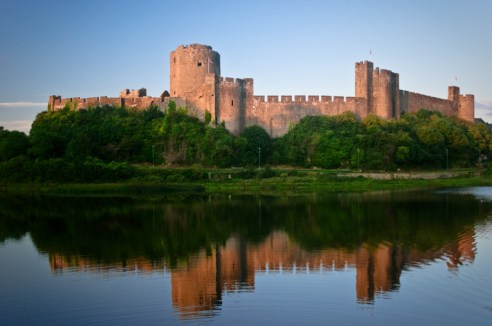
pembroke-castle

Pembroke Castle

During our journey some of the churches and abbeys we rode past had amazed me, but I had never laid eyes on anything to compare with the huge and fearsome edifice that was Pembroke Castle.

Viewed across an expanse of rippling water, it crouched like some gigantic monster on a steep rocky promontory, its mighty lime-washed towers and battlements appearing to grow out of the pale rock beneath, as if it was rooted in the earth itself.  It looked like a man-made white mountain, indestructible, impregnable.

First of the Tudors by Joanna Hickson (2016)

~

It would be reasonable to suppose that a routine time or an eventless time would seem interminable. It should be so, but it is not. It is the dull eventless times that have no duration whatever. A time splashed with interest, wounded with tragedy, crevassed with joy – that’s the time that seems long in the memory. And this is right when you think about it. Eventlessness has no posts to drape duration on. From nothing to nothing is no time at all.

East of Eden by John Steinbeck (1952)

~

Edmund coughed and filled his wife’s glass, then his own. “Aren’t you pleased, Bessie?”

“It’s not that I’m not pleased. I’m sure it’s a great compliment
to you that you should be asked to investigate such an important
case.”

“But, my love?” He pulled at his cravat.

“Well, it’s just that it’s such a very awful case. I can’t help but
think that simply by being involved with it, your name will be
tainted.”

The Unseeing by Anna Mazzola (2016)

~

Favourite books this month: The Red Sphinx, His Bloody Project, The Red House Mystery, Lost Horizon and East of Eden

January has been a great month for me where reading is concerned!  I would usually just pick out one or two books as favourites, but this month I had trouble narrowing it down to five.  I hope February will be even better.
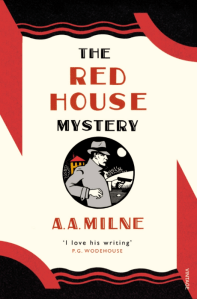
The Red House Mystery by A.A. Milne

the-red-house-mysteryI don’t think I would have ever read The Red House Mystery if it hadn’t been for seeing other bloggers reading and reviewing it. I had always thought of A.A. Milne solely as the author of the Winnie the Pooh stories and it had never occurred to me to wonder what else he had written. It turns out that The Red House Mystery, originally published in 1922, was his first and only detective novel – which is a shame, because it’s excellent.
The novel opens on a beautiful summer’s day with Mark Ablett entertaining guests from London at his home, the Red House. Earlier that morning, Mark had announced to his friends that his brother, Robert, was on his way home from Australia, having been absent for fifteen years. The guests are surprised to hear this, as Mark had never mentioned a brother before, and unfortunately – or perhaps fortunately, given the descriptions of Robert’s character – they don’t get a chance to meet him, because almost as soon as Robert arrives at the Red House he is shot dead.

Antony Gillingham, a latecomer to the party at the Red House, is one of the first on the scene, along with Mr Cayley, the Abletts’ cousin. Seeing Robert’s dead body on the office floor and no sign of Mark, who appears to have run away, it seems quite obvious what has happened…but Antony is not so sure. Joining forces with his friend and fellow house guest, Bill Beverley, he begins to search for clues in an attempt to solve the mystery.

I loved this book; being such an early example of a detective novel, it contains many of the elements of a classic ‘locked room mystery’ which would still have felt fresh and new in the 1920s: a country house, secret passages, ghostly figures, midnight adventures, red herrings etc. I also think Milne is very fair to the reader, providing enough hints for us to at least guess at the solution, while not making it too easy to work out.

Antony and Bill make a great detecting team, falling perfectly into the roles of Sherlock Holmes and Dr Watson (they even refer to themselves as Holmes and Watson several times throughout the novel). They are both very likeable characters and I would have been happy to read a whole series of Gillingham/Beverley mysteries.

Most of all, though, I loved the writing style, which is light and lively, with plenty of humour and witty dialogue. Here, for example, is a conversation between two of the Red House servants:

“I was never the one to pretend to be what I wasn’t. If I’m fifty-five, I’m fifty-five – that’s what I say.”

“Fifty-eight, isn’t it, auntie?”

“I was just giving that as an example,” said Mrs. Stevens with great dignity.

And here we learn what Antony’s father thinks of his son:

Old Gillingham returned to his paper. Antony was a younger son, and, on the whole, not so interesting to his father as the cadets of certain other families; Champion Birket’s, for instance. But, then, Champion Birket was the best Hereford bull he had ever bred.

The Red House Mystery was great fun to read.  Having enjoyed it so much, I’m disappointed that there aren’t more mysteries to read by A.A. Milne, but if you think I might like any of his other books I would love to hear your recommendations.

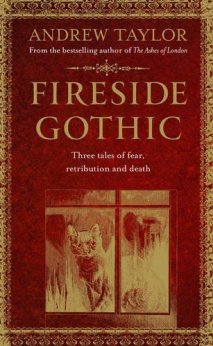
Fireside Gothic by Andrew Taylor

fireside-gothic Having read and enjoyed some of Andrew Taylor’s historical crime novels, I was immediately intrigued when I heard about Fireside Gothic, a hardback collection of three novellas which had originally been published separately in ebook form as ‘Kindle Singles’.  The stories are all quite different but, as Taylor says in his author’s note, they do share some common themes.

Broken Voices, the first of the three, has the feel of a classic Christmas ghost story. Set in an English cathedral city just before the First World War, it follows the adventures of two schoolboys whose circumstances mean they have to stay at school in the care of a retired teacher over the Christmas holidays. After listening to the teacher’s tales of mysterious happenings in the nearby cathedral, one of the boys begins to hear ghostly music and persuades his friend to sneak into the cathedral with him late one night to investigate.

Broken Voices gets the collection off to a good start.  Although I would describe it as an eerie story rather than a scary one, with its haunting atmosphere, winter setting and vivid descriptions of the deserted cathedral, this is the most obviously ‘gothic’ of the stories in the book.

The second story, The Leper House, is my favourite. Set in the modern day this time, our narrator is driving home from his sister’s funeral when his car breaks down on a lonely country road near the Suffolk coast. Setting off through the rain and wind in search of help, he manages to find shelter for the night and during his stay he has a brief but unforgettable encounter with a woman who lives in a neighbouring cottage. In the morning, he discovers that both the woman and the cottage have disappeared – and becomes obsessed with finding an explanation for his strange experience.

I can’t say too much, but the story then goes in a direction which was completely unexpected and which I loved. It raises a lot of fascinating questions and some of them are still unanswered at the end. There are some ideas here which I would have liked to have seen developed further; this story has all the ingredients of a full-length novel and I was sorry it had to come to an end so soon!

The collection finishes with The Scratch, another contemporary story. Unlike the first two, this one is narrated by a woman. Her name is Clare and she lives in the Forest of Dean with her husband, Gerald, and their pet cat. At the beginning of the story, their orphaned nephew, Jack, comes to stay with them on his return from fighting in Afghanistan. Jack’s time in the army has left him with a fear of cats, a dislike of enclosed spaces and a scratch on his arm which won’t seem to heal.

This is an interesting story, but the focus is mainly on the complicated relationships between Clare, Gerald and Jack, so the supernatural elements are much more subtle than in the other novellas. This is my least favourite of the three, although there are some clever little twists at the end which took me by surprise!

Fireside Gothic is an entertaining and unusual collection. The title and cover had led me to expect something slightly different – something spookier and, well, more gothic – but I did still enjoy these three novellas, particularly the middle one.  While it’s still winter, this would be an ideal time to get yourself a copy of this book and spend a cold, dark evening reading it by the fire.

Thanks to HarperCollins for providing a review copy of Fireside Gothic.

Margery Sharp Day: The Flowering Thorn

margery-2017My first introduction to Margery Sharp’s work came this time last year when I read The Nutmeg Tree for the Margery Sharp Day hosted by Jane at Beyond Eden Rock.  I enjoyed it and went on to read Cluny Brown a few months later.  Now Jane is hosting another celebration for Margery’s birthday (which is today – 25th January) and this seemed the perfect opportunity to read another of her books.  There were plenty to choose from – it’s much easier to find Margery Sharp books now than it was a year ago, thanks to Open Road Media reissuing them in digital form – and I settled on her 1933 novel The Flowering Thorn, one which sounded particularly appealing to me.  
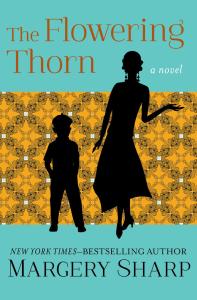
the-flowering-thornThe Flowering Thorn introduces us to Lesley Frewen, a twenty-eight-year-old socialite living in London.  Lesley’s days and nights are a whirl of bridge parties, lunch engagements, shopping trips, hair appointments and visits to matinees and art exhibitions.  Despite all of this, there’s still something missing from her life: love.  Having discovered that the one man she really wants appears to be the one man she can’t have, Lesley is still in low spirits when she joins her aunt for afternoon tea the next day.  This could explain why, when her aunt introduces her to Patrick, the orphaned child of a servant who has recently died, Lesley finds herself volunteering to adopt the boy.
Lesley has no experience of young children and can’t imagine what possessed her to make such an offer, but she knows that now the decision has been made, there’s no turning back.  Children aren’t allowed in her luxury flat, however, so the first thing to do is to look for a new home for herself and Patrick – but finding somewhere in London which is both affordable and suitable for a four-year-old boy proves to be more difficult than she’d expected.  Eventually, a solution presents itself: she and Patrick will go and live in a cottage in the Buckinghamshire countryside.  It will be cheaper, her friends will still be able to visit – and besides, it will only be for a few years, until Patrick is old enough to go away to school…

I have enjoyed all three of the Margery Sharp novels I have read so far, but I think this might be my favourite.  I wasn’t sure about the book at first; I found Lesley’s lifestyle quite tedious to read about and Lesley herself (as she was at the beginning of the book) shallow and irresponsible.  A few chapters in, though, when Lesley takes Patrick to live in the country, I immediately warmed to both the character and the novel.  It was similar to the experience I had with Julia in The Nutmeg Tree.  As the story progressed, I watched Lesley slowly adapt to life in the country and found that as she formed new friendships, rearranged her priorities and adjusted her outlook on the world, she became a much nicer person, an opinion shared by her elderly uncle when he meets her again after an absence of several years.

I was surprised by the lack of romance in the novel.  Although Lesley does have one or two love interests, things tend to be one-sided and it’s not until the very end of the book that there’s a hint of an actual romance for her.  I found this quite refreshing as it meant the focus was on other things, such as Lesley’s growth as a person and the development of her relationship with Patrick – and this was a surprise too as there’s nothing sentimental or affectionate in this relationship; Lesley doesn’t even seem to particularly like Patrick, and yet it’s obvious that she does understand and care about him in her own way.

The Flowering Thorn is a lovely story and was a good choice for this year’s Margery Sharp Day!

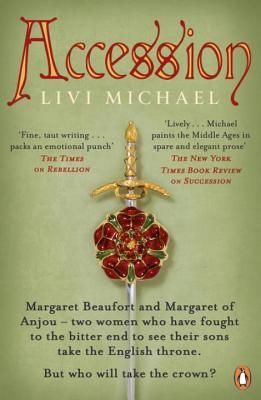
Accession by Livi Michael

accession Having followed the stories of Margaret Beaufort and Margaret of Anjou throughout the early stages of the Wars of the Roses in Livi Michael’s Succession and Rebellion, we come at last to the third book in the trilogy, Accession, which covers what is, in my opinion, the most interesting part of the period – Edward IV’s final years, the troubled reign of Richard III and Henry Tudor’s victory at the Battle of Bosworth.

The novel opens in 1471, shortly after the Battle of Tewkesbury which has secured the throne of England for the Yorkist king, Edward IV. Despite her best efforts, the Lancastrian queen, Margaret of Anjou, has had to admit failure: her armies have been defeated, her husband – the late King Henry VI – is dead, and her son, the Prince of Wales, on whom all her hopes rested, has been killed. Margaret, whose role in our story is almost over, is placed in the custody of Alice Chaucer, Duchess of Suffolk, where she will remain for the next few years.

For Margaret Beaufort, however, all is not lost. Although her son, Henry, the remaining Lancastrian heir, is still in exile in Britanny with his uncle, Jasper Tudor, Margaret is slowly preparing the ground for his return. The first stage in her plan is to marry again and the husband she has in mind – her fourth – is Thomas Stanley, a man who has become an expert at navigating through dangerous political waters and who has no qualms about changing sides between York and Lancaster whenever he believes the time is right to do so. Just the sort of man, she hopes, who has the power and the influence to help turn her dreams into reality.

I think Accession is probably my favourite of the three books in this trilogy. Although the writing feels a little bit dry on occasions – more like non-fiction than fiction – the story is still compelling, even for someone who has read about these historical figures and events many times before! As in the previous two books, Livi Michael incorporates excerpts from contemporary chronicles of the period to tell part of the story, which is a method I have found both unusual and very effective. The use of the chronicles helps to set these novels apart from others that I’ve read on the Wars of the Roses.

Another thing I appreciate about this trilogy is that Livi Michael has avoided making her characters into heroes or villains, instead giving each of them a mixture of good points and bad points – and that includes her two protagonists, neither of whom are very easy to like. Margaret Beaufort in particular is portrayed as ambitious, scheming and manipulative – but always with the best interests of her son at heart. Almost everyone in this novel appears to be out for what they can get…and yet there are little touches of humanity too: Margaret Beaufort feeling sorrow at the death of Queen Anne, for example, despite having secretly been working against Anne’s husband, Richard; or Henry Tudor recognising the sacrifices made for him over the years by his uncle Jasper.

As for Richard III, he is no more of a hero or a villain than any of the other characters in the novel. Whenever I read a book which covers Richard’s reign, I look forward to seeing how the author will choose to tackle the mystery of the Princes in the Tower, and I’m pleased to say that I was happy with the approach taken in Accession! It wasn’t quite what I’d expected, but I found it convincing and a little bit different from the theories given in other novels I’ve read.

I’ve enjoyed reading all three books in Livi Michael’s trilogy and will continue to read about this period of history as I never seem to get bored with it!

Thanks to Penguin for providing a copy of this book for review.

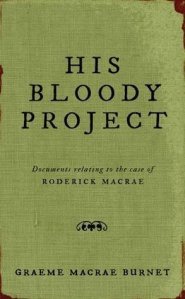
His Bloody Project by Graeme Macrae Burnet

his-bloody-project This novel by Scottish author Graeme Macrae Burnet attracted a lot of attention after being shortlisted for the Man Booker Prize last year.  Of all the books on the list, I remember thinking that this sounded like the one I would be most likely to enjoy, so I had a lovely surprise when I received a nice hardback copy from my sister for Christmas.

His Bloody Project is fiction but presented so convincingly as non-fiction that there were times when I wondered if I’d misunderstood and I was actually reading a true story after all!  Subtitled Documents relating to the case of Roderick Macrae, the case in question is that of a triple murder committed in August 1869 in Culduie, a remote village in the Scottish Highlands.  In his preface, the author explains that he came across the documents contained in this book while researching his own family history at the Highland Archive Centre in Inverness. 

Following a collection of statements given by the residents of Culduie, we proceed to the longest section of the book: Roderick Macrae’s memoir which he was instructed to write by his advocate, Andrew Sinclair, during his imprisonment at Inverness Castle awaiting his trial.  Roderick, only seventeen at the time of his arrest, never tries to deny that he killed his neighbour, Lachlan Mackenzie, and two other members of the Mackenzie family – we know this right from the beginning of the book – but what we don’t know is what caused him to do such a thing.  Roderick’s memoir provides some insights, giving some background information on what life was like in Culduie and describing the events leading up to the murders.

Next, we have the opportunity to read the medical reports on each of the three murder victims – and this is the first real indication we get that maybe Roderick has not been entirely honest with us.  A study by a doctor who visited Roderick in prison follows, raising and answering questions about the prisoner’s state of mind, and finally we arrive at the trial itself.  As judge, jury and spectators try to understand the motive behind the crime, witnesses are called who give statements both to confirm Roderick’s own account and to contradict it.  A verdict is finally reached, but whether it is the right one or not is up to each individual reader to decide. 

While I was reading Roderick’s own story, I had a lot of sympathy for him and I was so angry with Lachlan Mackenzie (or Lachlan Broad, as he is usually known) that I could understand why Roderick felt driven to take revenge.  However, when I read the rest of the documents, particularly the report of the court proceedings, I began to wonder how much Roderick had omitted from his memoir and whether Lachlan Broad’s actions were really as provocative as they had at first seemed.

Another interesting aspect of the novel is the portrayal of life in a tiny Scottish community in the middle of the 19th century.  Roderick Macrae’s mother dies in childbirth just before the events described in the novel, leaving Roderick and his siblings alone with their father, a crofter trying to earn his living from the land.  Culduie (a settlement of only nine houses) and the surrounding villages are the property of the Laird, who rules through his factor and a network of local constables.  Lachlan Broad is elected the constable for Culduie and this is what brings him into conflict with the Macraes.

The writing style and the language used throughout the novel feels appropriate for the time period and increases the sense of authenticity; as I’ve said, at times I could almost have believed I was reading genuine historical documents.  Dialect is used sparingly and a glossary is provided if you need to look up any unfamiliar Scots words (there were a few that were new to me, but these were mainly the names of farming implements such as croman and cas chrom).  Maybe Roderick’s narrative voice isn’t entirely convincing given his age, but we are told that he is an exceptionally bright, intelligent boy – and the author does address this issue in the preface too.

I loved His Bloody Project; although it’s not a traditional crime novel and there’s never any mystery surrounding the identity of the murderer, it’s the sort of book that leaves you with more questions at the end than you had at the beginning.  I think a re-read might be necessary at some point!    

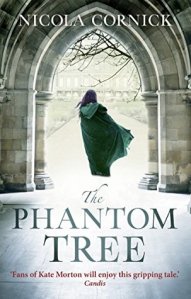
The Phantom Tree by Nicola Cornick

the-phantom-treeI have always found the concept of time-travel fascinating – and equally fascinating are the number of ways in which various authors choose to approach the subject when writing time-travel fiction.  The Phantom Tree is one of many dual time period time-slip novels I have read over the last few years, but I found it refreshingly different in that it deals not with the usual idea of a modern day character going back in time but a woman from the past coming forward to the present time.

The name of our time traveller is Alison Bannister (or Banastre, as she was known in her previous life) and she has been trapped in the 21st century for ten years, unable to find a way to get back.  We first meet Alison walking through the streets of Marlborough one day just before Christmas.  Stopping to look through the window of an art gallery, she is surprised to see a painting of a woman she once knew.  Investigating further, she learns that this is apparently a newly discovered portrait of Anne Boleyn – but she’s sure it isn’t; it’s Mary Seymour, who lived with Alison at Wolf Hall in the 1500s.  To complicate things further, the historian hoping to build his career around the discovery of Anne Boleyn’s portrait is Adam Hewer, Alison’s ex-boyfriend.  Without telling him the truth about her journey through time, how can she convince him that he’s wrong?   

The historical sections of the novel are written mainly from Mary Seymour’s perspective.  Unlike Alison, who is fictional, Mary is a real historical figure – but one whose story has been lost in the mists of time.  Mary is the daughter of Henry VIII’s sixth wife, Katherine Parr, and Thomas Seymour, whom Katherine married following Henry’s death.  Katherine dies shortly after giving birth and Thomas is executed a year later, leaving Mary an orphan in the care of the Duchess of Suffolk.  Mary disappears from historical records in 1550, but Nicola Cornick suggests that she was sent to live with her Seymour cousins at Wolf Hall.  This allows plenty of scope to create a storyline for Mary which is both imaginary and historically plausible.         

Of the two time periods, I found the sections set in the past more interesting – in particular, I enjoyed the supernatural elements of Mary’s story.  Almost from the moment she arrives at Wolf Hall rumours begin to circulate that she is a witch, especially after she has a vision which seems to come true.  She also has a telepathic connection with a secret friend called Darrell and this reminded me instantly of Mary Stewart’s Touch Not the Cat, (which may have been intentional, as Darrell’s nickname for Mary is ‘Cat’). 

The present day story was enjoyable too, though.  I couldn’t help thinking that Alison had adapted remarkably quickly to modern life, which wasn’t at all convincing, but otherwise I was kept entertained by her attempts to find a gateway back to her own time and to decipher a set of clues sent by Mary through the centuries.   

The Phantom Tree does require disbelief to be suspended on many occasions, which I know is not something that appeals to all readers, but I think anyone who likes reading time-slip novels by authors like Susanna Kearsley or Barbara Erskine should find plenty to enjoy here.  I will now be looking out for Nicola Cornick’s previous book, House of Shadows!

Thanks to the publisher for providing a copy of this book via NetGalley for review.