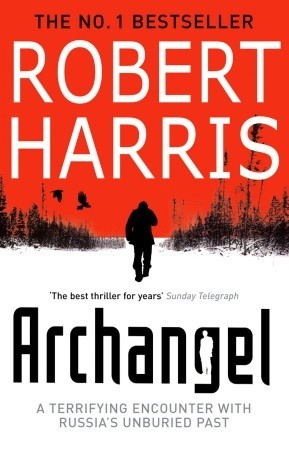
Archangel by Robert Harris

After reading Conclave recently and reminding myself of how much I love Robert Harris, I was pleased to find a copy of Archangel at the library. Although this was not one that sounded particularly appealing to me and I suspected it wasn’t going to be a favourite, I still wanted to read it – the other Harris novels I’ve read have been his newer ones and I was curious to see what his earlier books were like (Archangel was published in 1998).

The story is set in Russia in the 1990s, during the Boris Yeltsin years just after the dissolution of the Soviet Union. British historian Christopher Kelso – better known as ‘Fluke’, for reasons which are explained within the novel – is attending a conference in Moscow at which the recent opening of the Soviet archives will be discussed. During the conference, Fluke is approached by Papu Rapava, an elderly man who claims that he was present at the death of Joseph Stalin in 1953 and that he witnessed the theft of a black notebook which belonged to Stalin and was believed to be his secret diary.

This diary, if it really exists, could be the academic breakthrough Fluke needs to revive his career, but it will also be dangerous if it falls into the wrong hands. Choosing to believe that Rapava is telling the truth, Fluke begins a search for the notebook – but what he finds is not quite what he had expected. Following a trail of clues leading north to the remote city of Archangel, he makes a discovery that could affect not only his own future but Russia’s future as well.

The first thing to say is that this book, being more of a conventional thriller, is quite different from the other five Robert Harris books I’ve read. It’s also my least favourite so far, but I’d had a feeling that would be the case, so at least my expectations weren’t too high! I did find things to enjoy and at times I was completely gripped, but there were too many other aspects of the book that were a problem for me.

First of all, the characters: because of the nature of the story, most of the characters are very unlikeable – a mixture of ambitious politicians, unscrupulous journalists and people with dangerous ideas. As for Fluke Kelso, our hero, I found him bland and uninteresting, especially when compared with the protagonists of other Harris novels; he certainly lacked the depth and complexity of Cardinal Lomeli in my most recent Harris read, Conclave. The character who was potentially most engaging, Rapava’s daughter Zinaida, had an important role but we didn’t see as much of her as I would have liked.

In terms of plot, the novel gets off to a promising start, with Fluke learning about the night of Stalin’s death and then following clues which he hopes will lead him to the mysterious black notebook. However, the big revelation, when it comes, is something so far-fetched I just couldn’t believe in it, and the scenes which follow feel over the top and implausible too, which was a shame after so much care had been put into building the tension and creating a sense of mystery.

The descriptions of 1990s Moscow and snowbound Archangel are very well done and, as I’ve said, the book is quite a pageturner at times, so I still think it’s worth reading – particularly if you are more interested in Soviet history than I am. Apparently there was a BBC adaptation in 2005 starring Daniel Craig. Has anyone seen it?

The Winter Isles by Antonia Senior

One of the many things I love about reading historical fiction is that it gives me an opportunity to learn about lesser-known historical figures – the ones who were never mentioned in my school history lessons and of whom I could otherwise have gone through the rest of my life in complete ignorance. One of these is Somerled, whose story is told in Antonia Senior’s beautifully written The Winter Isles. Set in 12th century Scotland, we follow Somerled as he sets out to prove himself as a warrior and claim the right to call himself Lord of the Isles.

We first meet Somerled as a boy in 1122. The son of a minor chieftain from the Western Isles, he is already becoming aware of his father’s weaknesses as a leader – and in this unpredictable, dangerous world, strong leadership is vital. After his father’s hall is burned during a raid, Somerled gets his chance to step forward and take control and, despite his youth, he finds that is able to command the loyalty and respect of his men. But Somerled is an ambitious young man and if he is to achieve his dreams he must build alliances with lords and rulers of neighbouring islands while conquering others – as well as keeping an eye on the movements of Scotland’s king, David, in nearby Alba.

As you can probably tell from what I’ve said so far, The Winter Isles does include quite a lot of battle scenes and descriptions of raids by land and by sea, but there are other layers to the novel too. It isn’t a book packed with non-stop action; there are quiet, reflective sections in which Antonia Senior’s choice of words paint beautiful pictures of the sea and the Scottish islands, their landscapes and their wildlife. She also explores what Somerled is like as a person and how he grows and changes as his power increases.

Not all of the story is told from Somerled’s perspective. There are also chapters narrated by two women, his childhood friend Eimhear (known as ‘the otter’) and the beautiful Ragnhild, both of whom play important but very different roles in Somerled’s life. Eimhear and Ragnhild have strong and distinctive voices and I thought the decision to let them tell their own stories in their own words was a good one, showing what life was like for women during that period and also offering different views of Somerled’s character.

The Winter Isles is a lovely, poignant, intelligent novel which made me think, at times, of King Hereafter by Dorothy Dunnett. However, the comparison is mainly in the setting; the writing style in The Winter Isles is lighter and dreamier and there’s something about it that prevented me from becoming as absorbed in Somerled’s story as I would have liked. This is an impressive book but not one that I particularly loved. Still, I’m now curious about Antonia Senior’s other novels, Treason’s Daughter and The Tyrant’s Shadow, set during the English Civil War and rule of Oliver Cromwell respectively.

As for Somerled, it seems that his portrayal in The Winter Isles is based on a mixture of history, myth and legend; many of the facts regarding the real man have been lost in the mists of time, but the story Antonia Senior has created for Somerled and his children to fill in the gaps feels convincing and realistic. Now that I’ve been introduced to him, I would like to read more. Has anyone read Nigel Tranter’s Lord of the Isles? Are there any other books you can recommend?

Hemmed In edited by M.R. Nelson

This is another collection of classic short stories edited by M.R. Nelson. I have previously read two of her others – Love and Other Happy Endings and Small and Spooky – and enjoyed them both, so I was looking forward to finding out what was in store this time! Nelson calls her collections ‘taster flights’ because they give us a taste of each author’s writing; this particular book contains only one author (Willa Cather) whose work I have previously read – the other five were new to me. Although the stories are very different, they are all linked by a common theme. The title, Hemmed In, should be a clue as to what that theme is!

The opening story is A Jury of Her Peers (1917) by Susan Glaspell, in which a sheriff and a witness are accompanied by their wives on a visit to a house where, it appears, a woman has murdered her husband. This is a cleverly written story, showing how men and women can perceive the same situation differently. The two wives in the story pick up on things that their husbands would never have noticed and are able to use their own knowledge and experience to understand the misery and oppression that may have led the accused woman to commit murder. I have never read anything by Susan Glaspell before but I’m aware that two of her novels have been published by Persephone and now I’ll have to consider reading them.

Kate Chopin’s A Pair of Silk Stockings (1897) appears next and follows the story of Mrs Sommers, who unexpectedly finds herself in possession of fifteen dollars and the luxury of deciding what to spend the money on. She knows she should be sensible and buy things for her children, but when a pair of beautiful silk stockings catches her eye, she finds it hard to resist. Despite being so short, this is a powerful story about how a woman reacts when given the chance to escape her responsibilities and have just one day to herself.

The next story – probably the most famous of the six – is one that I’ve wanted to read for a while and I’m pleased that I’ve finally had the opportunity. It’s The Yellow Wallpaper (1892) by Charlotte Perkins Gilman, in which a woman is prescribed a rest cure for a ‘nervous complaint’. Spending hour after hour alone in a room at the top of the house, the narrator becomes obsessed with the patterns on the yellow wallpaper because she has nothing else to stimulate her mind. This is a disturbing and unsettling story, but also a fascinating one and I can see why it is considered a feminist classic.

In Little Selves (1916) by Mary Lerner we meet Margaret O’Brien, an elderly woman who is dying and looking back on her earlier life. Not having had any children, she thinks instead about the little girls who were her own younger selves and laments the fact that ‘there’s all those poor dear lasses there’s nobody but me left to remember, and soon there’ll not even be that’. This is an interesting and unusual story by an author I’ve never come across before.

Edna Ferber is yet another author I’ve never read until now and although her story The Leading Lady (1912) is probably my least favourite in this collection, I did still enjoy it. The main character is an actress on tour with a small company and suffering from loneliness and boredom. Like the woman in Kate Chopin’s story, she jumps at the chance to break out and do something different for the day.

Finally, we have a story by Willa Cather, The Bohemian Girl (1912). This one feels slightly different from the previous five as it features a male protagonist, Nils Ericson, who is returning to his hometown after an absence of many years. However, once his sister-in-law Clara Vavrika arrives on the scene and we learn a little bit about her life, I could see why this story had been included along with the others. It’s the longest and most developed story in the book – more of a novella, I would say – and I found it very reminiscent of My Ántonia.

I loved reading Hemmed In. It contains a great selection of stories, all six of which could be considered important works of feminist literature. Of course, I could have read them at any time as they have all been published in other books or are in the public domain and available online, but I wouldn’t have read them all together and that’s what makes M.R. Nelson’s anthologies so good. It’s always interesting to read her thoughts at the back of the book on why she chose each particular story and how it fits with the overall theme. Best of all, I have now been introduced to five new authors, all of whom I would like to explore further!

Soot by Andrew Martin

You know when you can tell as soon as you start reading that you’re going to enjoy a book? That’s how I felt about Soot, Andrew Martin’s new historical mystery set in 18th century York. The plot, the characters, the atmosphere, the writing style…I loved them all!

Let’s start with the plot, then. In August 1798, Matthew Harvey, a painter of silhouettes, is found dead – stabbed with his own scissors – in his house in Coney Street, York. Assuming that suicide can be ruled out, the only suspects are the six sitters who visited him during the previous week. The problem is, the page on which Harvey recorded their names has been torn out of his ledger, so that the only remaining clues are Harvey’s private duplicates of the silhouettes – or ‘shades’, as they are known.

Fletcher Rigge, a young gentleman who has found himself in financial difficulties, has spent three months in debtors’ prison in York Castle when he is approached by Captain Harvey, the silhouette-maker’s son. The Captain makes him an offer he can’t refuse: he will arrange Rigge’s release from prison, on the condition that Rigge can identify the people in the shades and help to track down the murderer. Rigge has previously used his detection skills to locate a missing book while working at Skelton’s Bookshop – this is what brought him to the Captain’s attention – but finding a killer could prove to be somewhat more difficult than finding a book…

As Rigge attempts to trace the people in the silhouettes, his search brings him into contact with a variety of colourful characters, including the clever and resourceful Maria Sampson, the temperamental young actor Jeremiah Smith – and my favourite, the London-based author Samuel Gowers, a proud, pompous man with an unfortunately large nose which lends itself to some comic scenes à la Cyrano de Bergerac. Rigge himself is another intriguing character, described at the beginning as having ‘a lowness of spirits, offset by a mordant wit and a prideful obstinacy’. Due to the structure of the book (more on that shortly) I was never quite sure exactly how reliable his narration was, but I did end up liking him and enjoyed accompanying him on his travels around York and beyond.

Georgian York provides a wonderfully atmospheric setting for the novel, particularly when covered in a blanket of snow (Rigge’s investigations take place in winter). From the slums of First Water Lane, home to Captain Harvey, to the Theatre Royal, the Black Swan coaching inn and the elegant townhouse belonging to one of the suspects, everything is vividly described. The language used in the book is appropriate for the 18th century too; I could tell the author had taken a lot of care to try to choose the right words and turns of phrase. This is particularly important because the book is presented as a collection of authentic documents gathered together by attorney-at-law Mr Erskine and sent to the Chief Magistrate of York.

Most of the novel is in the form of extracts taken from Fletcher Rigge’s own diary, but there are also diary entries written by Captain Harvey’s mistress Esther, newpaper reports, interviews with witnesses conducted by Erskine’s clerk, Mr Bright, and commentary from Erskine himself. Andrew Martin uses this structure very effectively to keep the reader guessing and wondering which accounts are reliable and which are not. The solution to the mystery is certainly not as black and white as Matthew Harvey’s shades!

Soot is a great book. At first Fletcher Rigge’s story reminded me of Thomas Hawkins’ in The Devil in the Marshalsea, but it quickly developed into something different and I thoroughly enjoyed every moment of it. Now I’m hoping for a sequel!

Thanks to the publisher for providing a review copy via NetGalley.

Historical Musings #28: Battle scenes – love them or hate them?

It’s an unfortunate fact that war and conflict have played important roles in shaping the history of just about every country in the world. It’s not surprising, then, that they also have a big part to play in many historical fiction novels. From Viking invasions to medieval sieges to the trench warfare of World War I, it can be difficult to avoid battle scenes of one sort or another when reading books set in the past.

I wouldn’t necessarily complain about books containing too many battle scenes – obviously, as I’ve said, the impact of war throughout history is something which can’t and shouldn’t be ignored, and it would be hard to write about certain time periods without covering at least some of the military history of that period. However, I don’t always find battle scenes particularly interesting to read and often find myself becoming confused, no matter how hard I try to concentrate and follow what is happening. Of course, there are plenty of exceptions: I will sometimes comment in a review that “I even enjoyed the battles”, which is high praise from me! I remember being completely gripped by Sharon Penman’s portrayal of the battles of Barnet and Tewkesbury in The Sunne in Splendour – and while I much preferred the peace sections of War and Peace, I found that some of the most powerful and memorable moments occurred in the war chapters.

In general, though, it’s fair to say that I am not really a big fan of battle scenes, which is why I tend not to be drawn to authors like Bernard Cornwell or Conn Iggulden very often. It’s not just the battles themselves that I sometimes struggle to engage with – it’s everything else that goes with them: discussing military tactics, planning campaigns, learning to use weapons etc. Again, there are exceptions and some authors still succeed in holding my attention with these scenes, but I would usually prefer them to be just one aspect of a novel rather than the main focus.

Sword fighting is a different matter. I love a good fictional duel! Rafael Sabatini’s Scaramouche has some great duel scenes – and there’s one in The Game of Kings by Dorothy Dunnett which has to be one of the most tense and exciting scenes I’ve ever read, partly because by the time the scene appears in the novel we are so emotionally invested in the two participants that it would be impossible not to be on the edge of our seats. And actually, I think that is why, in terms of larger-scale combat scenes, some of them work for me and some don’t – it’s all down to the emotional connection. If I can be made to feel that I’m there on the battlefield with a character I already care about and want desperately to survive, then I’m probably going to enjoy reading that scene.

Then, of course, there are sea battles – but I think that’s a topic for another post!

How do you feel about battle scenes in historical fiction? Do you love them or hate them? Which authors do you think write the best battle scenes?

~

New to my historical fiction shelves this month:

* Widdershins by Helen Steadman – I can’t wait to read this new novel about the 1650 Newcastle witch trials.
* Glendower Country by Martha Rofheart – The kindle version was free on Amazon last week and as I’ve enjoyed some of Martha Rofheart’s other books I couldn’t resist this one, set in Wales. (Also published as Cry God for Glendower.)
* The Mermaid and Mrs Hancock by Imogen Hermes Gowar – This one sounds fascinating so I was pleased to receive a review copy from NetGalley, but the publication date is not until January 2018 so you’ll have to wait a while to hear my thoughts on it!
* Fire From Heaven by Mary Renault – I’ve been interested in reading Mary Renault’s Alexander the Great trilogy for a while and was lucky enough to find a copy of the first book in my favourite bookshop, Barter Books, yesterday.
* The Flower Reader by Elizabeth Loupas – Another one from Barter Books. I have read and loved two other books by Elizabeth Loupas, so I’m looking forward to reading this one.

Have you added any interesting historical fiction to your shelves lately?

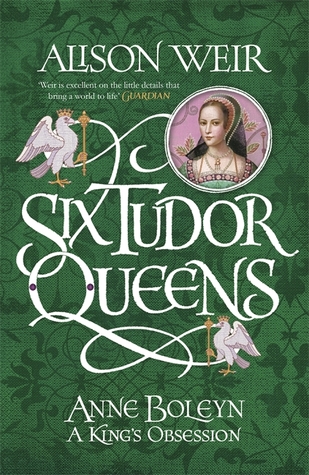
Six Tudor Queens: Anne Boleyn, A King’s Obsession by Alison Weir

This is the second novel in Alison Weir’s new series telling the stories of the six wives of Henry VIII. I read the first book last year – on Katherine of Aragon – and enjoyed it; now, as you would expect, it’s the turn of the second wife, Anne Boleyn.

Like the first novel, this is a straightforward account of Anne’s life, beginning with her early years and taking us right through to her beheading in 1536. Whether you only have a basic knowledge of Anne’s story or whether you’ve read about her many times before, you can expect to learn at least something new from this book as it’s very long, very detailed and very thorough, leaving little out. As with the Katherine of Aragon book, I question whether it was really necessary to include such a lot of detail, but I did enjoy the book overall so won’t complain about that too much!

I found the opening chapters of the book particularly interesting because this section covered the part of Anne’s life with which I was least familiar – her time spent in the Netherlands at the court of Margaret of Austria, and in France serving first Henry VIII’s sister Mary Tudor, then Queen Claude, wife of the French king Francis I. Her experiences at these courts had an important influence on Anne’s life and character; she was able to observe the rule of these three very different women, she was exposed to new ideas and literature – including the works of women writers such as Christine de Pizan – and she began to develop her interest in religious reform.

Once Anne returns to England and catches the eye of Henry VIII, I felt I was on much more familiar ground. Perhaps for this reason I found the middle section of the novel tediously repetitive as Henry attempts to have his marriage to Katherine annulled, leaving him free to marry Anne. Of course, Alison Weir is only following historical fact here: the King’s Great Matter, as it became known, did go on for years and must have been very frustrating, to say the least, for Anne and for Henry – but it doesn’t make for exciting reading.

While this is very much Anne Boleyn’s own story, all of the other historical figures of the period are here, from statesmen such as Cardinal Wolsey and Thomas Cromwell to Anne’s brother and sister, George and Mary. You may or not may be happy with the way these characters and others are depicted, depending on your own interpretation of events and on where your sympathies lie. When it comes to Anne, though, I think Weir has done a good job of making her feel convincingly human – not a heroine and not a villain, just a flawed and complex woman who loves the idea of being queen more than she loves the king himself.

As I’ve said, Alison Weir does stick closely to historical fact for most of the novel and I had no problems with the accuracy, although I accept that I am not an expert on Tudor history by any means – I read a lot of it, but not as much as some readers! She does take some liberties in imagining Anne’s feelings for Henry Norris – one of the men implicated in her trial – but with a lack of primary sources allowing us to access Anne’s own thoughts, how can we know how she really felt? There is also a scene in which Anne meets Leonardo da Vinci which I didn’t believe would be true, but in her notes at the end of the book Weir explains why she thinks it could have happened, while confirming that there is no real evidence for it.

The final chapters of the book describe Anne’s downfall and even though I knew what would happen to Anne, it was still sad to watch her story move towards its inevitable end. I found the closing scene slightly bizarre, but Alison Weir does talk about that in her author’s note! We also see the increasing prominence of Jane Seymour in the king’s life – Jane will be the subject of the third Tudor Queens book and I’m already looking forward to seeing how she will be portrayed.

Thanks to the publisher for providing a copy of this book for review via NetGalley.

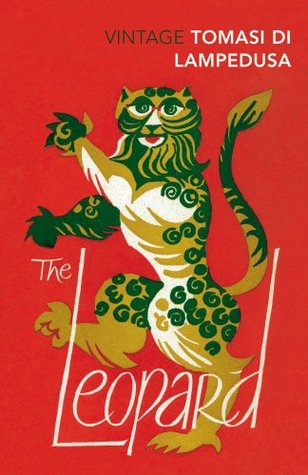
The Leopard by Giuseppe Tomasi di Lampedusa

This novel by Italian author Giuseppe Tomasi di Lampedusa, published posthumously in 1958, is one I had been interested in reading for a few years, having seen lots of very positive reviews, but it was including it on my 20 Books of Summer list that pushed me into picking it up towards the end of June. I have to confess, when I first started reading it I wasn’t at all sure whether I was going to like it, but I think that was mainly because I had no understanding of the historical context. Google came to the rescue and after I’d familiarised myself with the background to the novel I found it much easier to follow what was happening.

The Leopard is set in 19th century Sicily during the Risorgimento (the movement for the unification of Italy). We explore this period of Italian history through the eyes of a Sicilian nobleman, Don Fabrizio Corbera, Prince of Salina, who is forced to watch as the world around him changes beyond his control. Beginning in 1860, the year Garibaldi lands on the coast of Sicily, we see the gradual decline of the Prince’s family and the nobility as a whole.

While Don Fabrizio regrets the loss of values he once held dear and hopes that somehow, once Italy has been united, the class system will be able to survive, his nephew Tancredi has a very different outlook, explaining that “everything needs to change, so that everything can stay the same”. The relationship which develops between Tancredi and the beautiful Angelica, daughter of a wealthy businessman, is only possible because of the breakdown in the class structure; characters like Angelica represent the future, whereas those like Don Fabrizio are becoming part of history.

Although the novel is set in the past – and does immerse the reader in another time and place, with some elegant and vivid descriptive writing – the author occasionally reminds us that he is viewing events from a point many years in the future. For example, he lets us know that the palace he is describing with painted gods on the ceiling will be destroyed by a bomb in 1943. It all adds to the poignancy and to the atmosphere of decay and decline.

If you’re wondering about the title, it refers to the symbol of the Salina dynasty and, I think, the power and grace of the aristocracy. As the Prince himself muses, “We were the Leopards, the Lions; those who’ll take our place will be little jackals, hyenas…” The whole novel is rich in symbolism: a stone leopard above the door has the legs broken off in a sign of things to come, while the initals engraved on Don Fabrizio’s wine glass are fading away and even the fate of his dog Bendico is another reminder that everything must come to an end.

The Leopard is a beautifully written book and although it’s surprisingly short, there’s so much packed into its pages I think a re-read would be necessary to be able to fully appreciate it. After an uncertain start, I was very impressed with this book and can see why it is considered a classic Italian novel.

This is Book 4/20 for my 20 Books of Summer challenge.