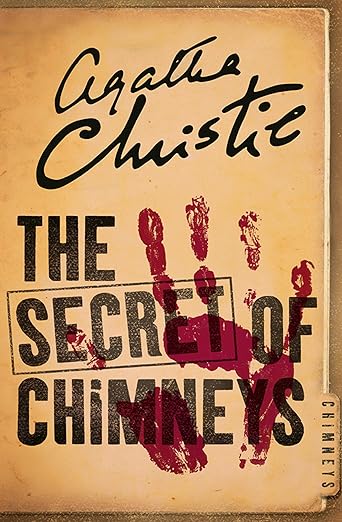
 I’m taking part in Read Christie again this year and the theme for 2024 is Agatha Christie: Through the Decades. Each quarter will focus on a different decade or decades – 20s, 30s, 40s/50s and 60s/70s. For my January read, I have chosen The Secret of Chimneys, which was published in 1925.
The Secret of Chimneys is the first of five novels featuring Superintendent Battle and is more of a thriller than a traditional murder mystery. I usually enjoy the lighter, more adventurous feel of Christie’s thrillers and although this one hasn’t turned out to be a favourite, I did find it very enjoyable. It involves political intrigue in the fictitious Balkan country of Herzoslovakia where attempts are under way to restore the monarchy.
The novel begins in Africa, where Anthony Cade is working as a tour guide when he meets an old friend, James McGrath, in Bulawayo. Anthony agrees to carry out two important tasks for McGrath – firstly, to deliver the manuscript of a memoir written by Count Stylptitch of Herzoslovakia to a London publisher, and secondly, to return a packet of letters to a woman who is being blackmailed. As soon as he arrives in England, however, he discovers that there are other people interested in both the manuscript and the letters, and they will stop at nothing – including murder – to get what they want.
Most of the action takes place at Chimneys, a country estate belonging to Lord Caterham, who invites Anthony to attend a house party at the request of George Lomax, a politician hoping to get his hands on the Stylptitch memoir. With a large and varied group of people gathered at Chimneys – including a beautiful widow, a French governess, a representative from a British oil syndicate and an American collector of rare books – there’s no shortage of suspects when a murder occurs and Superintendent Battle is called in to investigate.
As I’ve said, this is not just a straightforward murder mystery and Christie throws all sorts of things into the plot, from treasure hunts and coded letters to secret societies and international jewel thieves. It’s fun to read, but does need some suspension of disbelief! You also need to be prepared for a lot of racist language, which isn’t unexpected in a Christie novel – or many other 1920s novels – but it seems more excessive in this particular book, maybe because of the large number of characters of other nationalities and races. Other than that, this is an entertaining, fast paced read, written in a light and humorous style that reminded me of PG Wodehouse.
Although Anthony Cade seems to do a lot of the detecting in this book, Battle himself has a larger role than in some of the others in which he appears. He’s certainly no Poirot or Miss Marple, being rather stolid and unimaginative, with what is described as an ‘expressionless face’, but he gets on with his job quietly and unobtrusively and plays a small but important part in the final solving of the mystery. Did I solve it myself? Well, yes and no. I guessed the identity of the jewel thief, King Victor, but there were other revelations that took me by surprise.
This was a good start to a new year of Christie reading! Next month I’m hoping to read The Seven Dials Mystery, another 1920s novel which features some of the same characters.
 She Reads Novels
I haven’t read *any* of this series. Looks like fun. I must investigate…! [grin]
I have the next Miss Marple scheduled ‘soon’ as part of an ongoing set of books – along with a few more BLCC books in the same bunch. Presently reading a children’s classic I missed in my youth – *also* in the same bunch..!
There are only five books with Superintendent Battle and in one of them (Murder is Easy) he barely appears at all, so it was good to see more of him in this book. I’ll look forward to your next Miss Marple review!
I remember reading this one years ago an d not enjoying it that much. I think probably because it was so different to what I was expecting. Maybe I ought to give it another try.
It’s not really a typical Christie novel, so I can understand why you might not have enjoyed it much. Maybe you would like it better on a re-read.
I read a couple of ACs last year, and despite having enjoyed them in the past, they just didn’t hit the spot for me. My loss, I’m sure, but I think I’ll give her a rest for a while.
Well, tastes change over time. I’m sometimes reluctant to return to authors I enjoyed years ago in case they don’t hold the same magic for me anymore.
One thing that has come out of this project is that you have come up with some really obscure Christie novels! She wrote so many! I am surprised every year at how many come up that I haven’t heard of.
I think I’ve read most of the well known Christies now, so I probably have more of the obscure ones coming up this year!
A Christie title that I’ve Even heard of! But even with your assessment of this being entertaining, fast paced, and light and humorous, I don’t think I’d plump for this as my next read – probably it’ll be a Marple case or another of Christie’s novels written as Mary Westmacott.
It was quite enjoyable, but probably not one to prioritise if you still have plenty of others to read.
The Seven Dials Mystery is more entertaining and humorous than this one imo. I really love Bundle in that one. 😀
I’m pleased to hear that! I liked Bundle in this book and am looking forward to meeting her again.
I’m almost finished with The Mysterious Affair at Styles. This sounds good too.
I’ve already read The Mysterious Affair at Styles, so picked a different book this month, but I do remember enjoying that one!
This was my favourite challenge of last year and this year I haven’t really looked at it yet, but I feel encouraged to do so thanks!
The challenge is more flexible this year – we can read anything published in the 1920s in January, February and March, so lots of options!