Trying to tell my story is like trying to hold the smoke of a forest fire in your hands or force an ocean into a cup. I resist. I re-form. How could they succeed when even I didn’t know who I was from one moment to another?
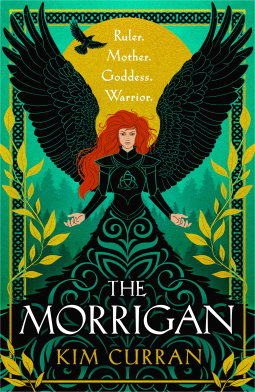 There have been so many Greek mythology retellings recently, it came as a nice surprise to see that this new novel by Kim Curran takes as its subject not another Greek goddess, but an Irish one. In Irish mythology, the Morrigan is known as the goddess of war and fate, a fierce, shapeshifting figure who leads warriors into battle and can foretell whether they will live or die. She is sometimes known as Badb, sometimes as Macha and sometimes as Nemain and often believed to be all three. In The Morrigan, Kim Curran sets out to tell her story.
The novel begins with the Tuatha Dé Danann, the supernatural race to which the Morrigan belongs, returning to Ireland having spent many generations ‘in the north of the world learning arts and magic’. Soon after their arrival, they defeat the Fir Bolg in battle to reclaim Ireland for themselves, only to be defeated in turn by the invading Milesians, who drive them underground. Rather than stay beneath the earth with her own people, the Morrigan goes out into the world where she discovers that even the power of a goddess is limited in a land ruled by men.
The Morrigan is beautifully written and as a debut novel, I thought it was very impressive. Having very little knowledge of Irish mythology, I found it fascinating and particularly enjoyed the first section about the Tuatha Dé Danann, where the writing style, together with the shapeshifting, magical beings and epic battles, makes it feel like a high fantasy novel. The later stages of the book are based on the Ulster Cycle – with the Morrigan crossing paths with Medb, Queen of Connacht; Conchobar, King of Ulaid; and the legendary warrior Cúchulainn – and feel slightly more grounded in reality, but less captivating for me personally. I did love the way Curran incorporates all of the Morrigan’s three parts into the novel, moving seamlessly from Badb to Macha to Nemain, showing how her personality and actions change as she takes on each persona, while at the same time retaining memories of her previous lives and experiences.
However, there was so much happening in this book that I started to feel overwhelmed. There seemed to be no real direction to the plot and it felt like a string of short stories and separate episodes rather than one cohesive narrative. I think there was easily enough material here for a trilogy, rather than trying to pack everything into a single book. Maybe readers more familiar with Irish myth and legend would have found it all easier to follow than I did, but as a newcomer it was just too much for me to process all at once.
I would still highly recommend this book to anyone interested in sampling some Irish mythology – or anyone with existing knowledge who wants to see how Kim Curran approaches the subject. It has certainly left me wanting to look into some of the stories and characters in more depth and wishing more authors would move away from Greek mythology to explore other parts of the world!
Thanks to Michael Joseph for providing a copy of this book for review via NetGalley.
 As this book is set in ancient Ireland and the author Kim Curran was born in Dublin, I am contributing this review to #ReadingIrelandMonth25 hosted by Cathy of 746 Books.
 She Reads Novels
Oh, this is *definitely* going on my List! [grin]
I hope you like it! It was good to find a mythology retelling set somewhere other than Greece.
I’m reading a Greek myth retelling ATM about the aftermath of the Trojan War. Parts of it are a bit pedestrian but I’m enjoying the intrigue and a VERY interesting twist on the reason for the war itself….
Sounds really good!
It was a nice change from all the Greek mythology books that are around at the moment!
I’ve got a vague idea of these myths, but only with Anglicised spelling! So I would write “Maeve, Queen of Connaught”. This sounds really interesting.
I did get a bit confused with all the unfamiliar Irish names – there’s a character list at the beginning with a pronunciation guide, but it’s not that easy to keep turning back when you’re reading on a Kindle!
It probably was just written from a book of Irish myths. Too bad.
It’s an interesting book, but definitely needed more focus!
This sounds like an interesting retelling but maybe needed a bit of an edit!
I enjoyed it, but there was too much for one book! It should have been expanded into two or three.
Good to see a retelling of a mythical Celtic figure that draws from its source material rather than the later retellings inspired as infinitum by other literary retellings.
As I’ve previously mentioned I’m finally getting to proper grips with Thomas Kinsella’s 1969 translation of the ‘Táin Bó Cúailnge’ in which Medb gets a decent walk-on part; hopefully I’ll get that finished and reviewed before the end of March!
I only had a basic knowledge of Celtic myth before reading this book, so I think it worked very well as an introduction. I’m not sure if I feel ready to tackle Táin Bó Cúailnge just yet, but will be interested to see your review.
I remember you saying you enjoyed this but it’s nice seeing your full review now too. I have to agree that this could have been spread over several books but I really enjoyed it and also thought the writing was wonderful. Like you it’s left me wanting to know more about Irish mythology and the characters mentioned here. I’ll be keeping an eye out for what the author writes next.
Yes, I loved Kim Curran’s writing and will definitely be interested in reading whatever she writes next. I hope more authors will consider writing about Irish mythology as well – it seems like such a fascinating subject.