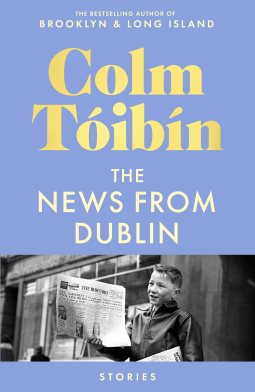
 This month, Cathy of 746 Books is hosting Reading Ireland Month, celebrating the work of Irish authors. I wasn’t sure if I would have time to contribute anything but have managed to fit in a review of Colm Tóibín’s latest book with a few days of March still to go! The News from Dublin, published this week, is a collection of nine short stories loosely linked by a theme of characters either living far from home or building a new life, putting a distance between their current and past selves.
The collection covers a range of topics and settings. The stories were all interesting, but I inevitably found some much stronger than others. The opening story, The Journey to Galway, was particularly moving. A woman receives a telegram informing her of her son’s death in the First World War, so she takes a train to Galway to break the news to her daughter-in-law. Tóibín perfectly captures the range of emotions she goes through during the journey: grief, loss, a sense of denial, and the trauma of being the one who has to deliver bad news.
Another of my favourites was Five Bridges, set in the present day and tackling a subject that is very relevant at the moment. It follows an Irish plumber, Paul, who is an immigrant living in America and, despite having been there for thirty years, he believes he will be a target of ICE because he came on a tourist visa and has no other documents. Before he leaves the country, probably forever, he reconnects with his young daughter, Geraldine, who lives with his ex-partner and her new husband. As Paul bonds with Geraldine at last, he is full of regret, both for the years she’s been missing from his life and for the future he faces without her. I also liked A Sum of Money, which is about a teenage boy whose parents have made sacrifices to be able to send him to an expensive boarding school. Conscious of not having as much money to spend as his friends, he begins to steal from the other boys – but what will happen when he’s found out? I enjoyed this one as it felt a bit different from the rest of the stories, which made it stand out.
I only really have two criticisms of this book. One is that most of the stories are very open-ended, leaving things unresolved and not providing any answers. As a sort of snapshot of life, giving a glimpse into a character’s world, they’re very effective, but I personally tend to prefer short stories with a more satisfactory ending or a clever twist. The other is that the final story, The Catalan Girls, is novella-length and takes up most of the second half of the book. Although I did enjoy that one, which follows the story of three sisters who move to Argentina from Catalonia as children, I thought it made the whole book feel unbalanced.
The stories in this collection were written at various times and first appeared in other publications rather than being written specifically for this book, but they fit together well (apart from the final one being so much longer). They all have a quiet, reflective tone and I found them very poignant. This was a perfect choice for Reading Ireland Month.
Thanks to Picador for providing a copy of this book for review via NetGalley.
 She Reads Novels