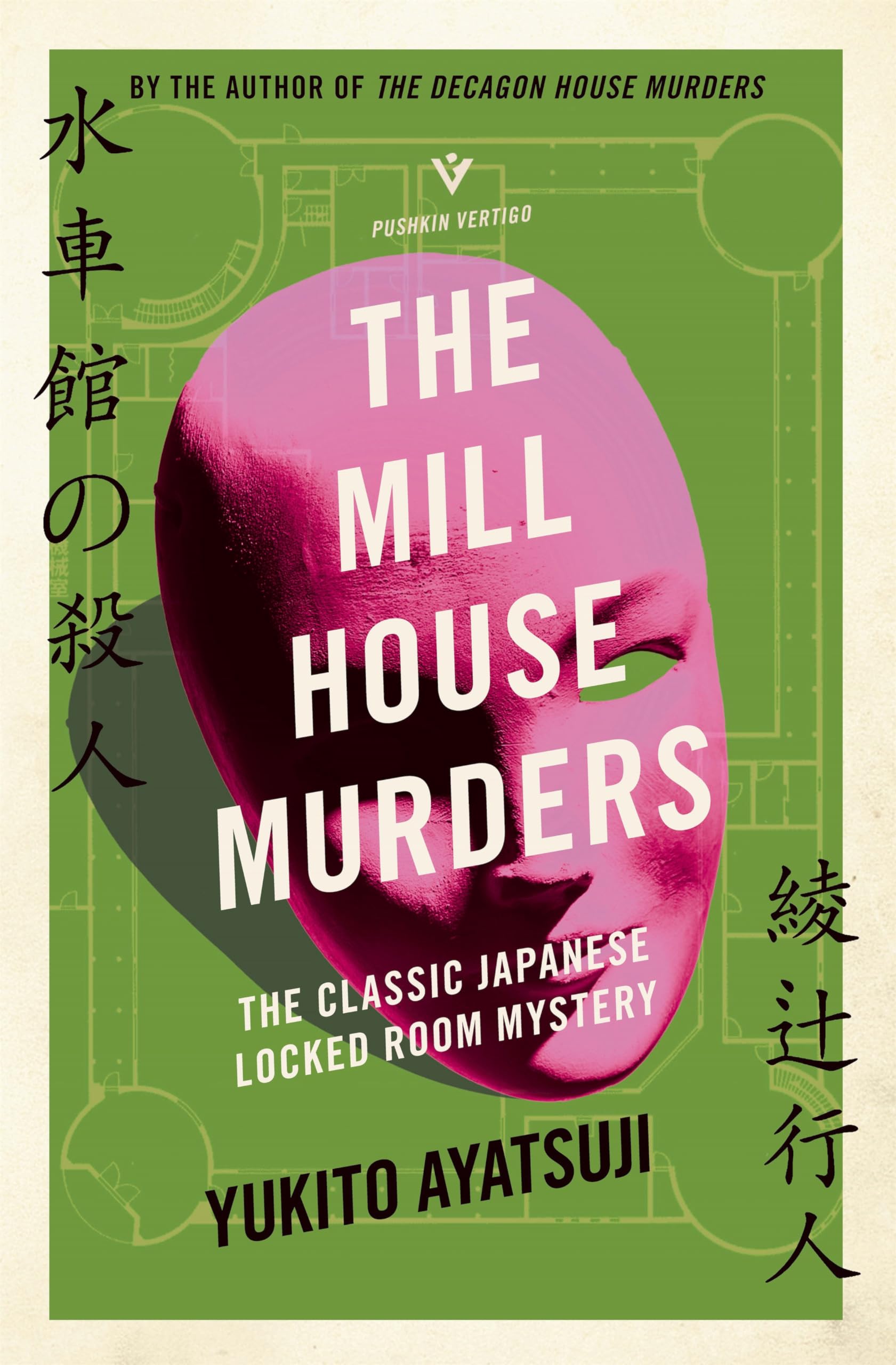
 Translated by Ho-Ling Wong
This is the third of Japanese author Yukito Ayatsuji’s books I’ve read – I loved The Labyrinth House Murders but found The Decagon House Murders disappointing, so I was curious to see what I would think of this one. All three books are part of Ayatsuji’s Bizarre House series and all of them feature the detective Shimada Kiyoshi and an unusual, sinister house designed by the architect Nakamura Seiji. The Mill House Murders was originally published in Japanese in 1988 and is available from Pushkin Press in an English translation.
This book is set entirely within the walls of the Mill House which, like the Decagon House and Labyrinth House, is one of Nakamura’s creations. It’s home to Fujinuma Kiichi, who sustained terrible injuries in a car accident several years earlier and is now confined to a wheelchair, with a mask and gloves covering the damage to his face and hands. Kiichi is the son of the late artist Fujinuma Issei, and although he normally lives a reclusive life with his wife, Yurie, and their servants, once a year he invites a group of acquaintances to the house to look at his father’s paintings.
In September 1985, the group are making their annual visit when several shocking events occur, all in the space of one night: a woman falls to her death from the tower, one of Issei’s paintings vanishes, one of the guests disappears without explanation and a gruesome discovery is made in the furnace room. A solution is suggested by the police, but it’s not very satisfactory and lots of questions remain unanswered. A year later, in September 1986, the same people have gathered at the Mill House again and this time they are joined by Shimada Kiyoshi, a friend of the man who disappeared (and was largely blamed for everything that happened). Shimada believes he can find out the truth about the events of 1985, but he’ll have to hurry before history begins to repeat itself.
The Mill House Murders is another Ayatsuji novel that I thoroughly enjoyed, so it does seem that it’s only The Decagon House that, for whatever reason, didn’t work for me and I’m glad I decided to give him another chance! Although I often find that Japanese mysteries focus very heavily on complex puzzle solving, often involving alibis, timetables and maps, with characters, relationships and motives pushed into the background, this particular book is more balanced. It does have some floor plans, but I was pleased to find that I could follow the plot quite easily without having to study them too carefully, and the characterisation is stronger than in the Decagon and Labyrinth books.
The timeline switches backwards and forwards throughout the book, with one chapter describing the events of 1985 and the next set in the present day of 1986. This could have become confusing, but as long as I paid attention to the chapter headings, I had no problem keeping them straight in my mind. The mystery itself is a clever one; I partly managed to solve it (mainly because some of Seishi Yokomizo’s novels have similar tropes), but I didn’t get it completely right and was content to let Shimada Kiyoshi, the series detective, explain the full solution for me.
The translator, Ho-Ling Wong, also translated the other books I’ve read in this series and does a great job of making everything very clear and readable. I see there’s a fourth book in the series already in print – The Clock House Murders – and another, The Black Cat House Murders, on its way. I’ll look forward to reading both!
 She Reads Novels