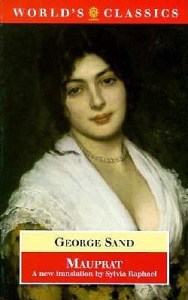
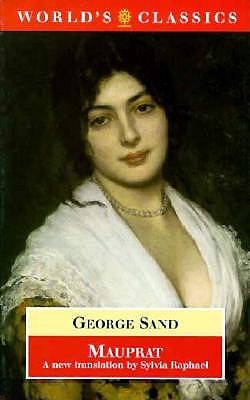
 When I was looking for suggestions for books to read for the Women’s Classic Literature Event, Camille de Fleurville suggested the French author George Sand (a pseudonym of Amantine Lucile Aurore Dupin) and pointed me in the direction of her 1837 novel, Mauprat. Having never read George Sand before, I had no idea what her books would be like, but whatever I was expecting, it wasn’t this!
The novel begins with a description of Roche-Mauprat, an abandoned château in the French countryside, once home to Bernard Mauprat, an orphan raised by his wicked grandfather and violent, brutal uncles:
On the borders of La Marche and Berry, in the district known as Varenne, which is naught but a vast moor studded with forests of oak and chestnut, and in the most thickly wooded and wildest part of the country, may be found, crouching within a ravine, a little ruined château. The dilapidated turrets would not catch your eye until you were about a hundred yards from the principal portcullis. The venerable trees around and the scattered rocks above bury it in everlasting obscurity; and you would experience the greatest difficulty, even in broad daylight, in crossing the deserted path leading to it, without stumbling against the gnarled trunks and rubbish that bar every step. The name given to this dark ravine and gloomy castle is Roche-Mauprat.
Mauprat is set in the eighteenth century, in the years leading up to the French Revolution, and in Varenne an ancient feudal system is still in place with the peasants living in fear of the powerful Mauprat family, who rule over them with tyranny and corruption. One night Bernard’s uncles take a young girl captive in the woods and bring her back to Roche-Mauprat. Her name is Edmée and she is a cousin of Bernard’s belonging to another, more civilised branch of the family. Instantly attracted to his beautiful cousin, Bernard helps her to escape, but not before making her promise to marry him in return.
Unfortunately for Bernard, he didn’t specify exactly when Edmée will have to marry him. Once she is free of Roche-Mauprat, she insists that she cannot possibly become Bernard’s wife until he proves himself worthy. And so Bernard begins a seven-year struggle to gain an education and transform himself into the sort of respectable, well-mannered man Edmée is happy to love. How much of a man’s character is due to heredity and how much to the way he has been brought up? In Mauprat, we see that even a man who has had the roughest of upbringings has the opportunity to change through love, guidance and his own desire to improve.
The novel is narrated by a much older Bernard, who is entertaining some visitors with the story of his life, but apart from the first chapter, the book is structured as a straightforward first person narrative. We are with Bernard through every step of his journey, from his flawed younger self – rough, impulsive, passionate and uneducated – to the more refined, cultured man he becomes after being shaped by Edmée’s influence. Along the way Bernard encounters several other men – from the reclusive philosopher Patience and the mole-catcher Marcasse to the Abbé Aubert and the American soldier, Arthur – all of whom provide help and advice and teach him some important lessons.
We see Edmée only through Bernard’s eyes and this makes it difficult to understand her motives. I had a lot of questions about Edmée as I read. Why was she determined to keep Bernard waiting for so many years? Did she truly love him – and if so, at what point did she begin to love him? And if you love someone, shouldn’t you be prepared to accept them for what they are? Some of these questions are answered, to some extent, by the end of the book but Edmée still intrigued and frustrated me.
Mauprat is also interesting from an historical perspective. Bernard spends some time in America fighting in the Revolution (this is where he meets Arthur, the soldier and natural scientist who becomes his friend and helps to continue his education), while France is also on the brink of revolution and society is already beginning to change:
The poor have suffered enough; they will turn upon the rich, and their castles will fail and their lands be carved up. I shall not see it; but you will. There will be ten cottages in the place of this park, and ten families will live on its revenue. There will no longer be servants or masters, or villein or lord.
As I’ve mentioned, Mauprat wasn’t quite what I’d expected (the Gothic atmosphere and the amount of melodrama surprised me) and I don’t know whether it’s typical of George Sand’s novels, but I did enjoy it. Sand herself sounds like a fascinating woman too. I would like to read more of her books, so any recommendations are welcome.
Finally, I should point out that I didn’t read the edition pictured above, but it was the only decent cover image I could find. I read the free version available through Project Gutenberg, translated by Stanley Young.














 She Reads Novels