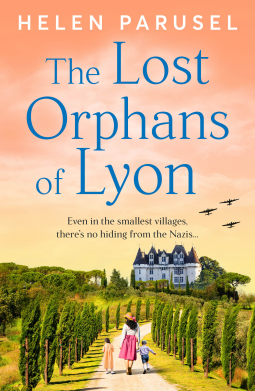
 There are so many books set during the two world wars, it can be easy to think that you’ve read enough of them and don’t need any more…but I’m so pleased I didn’t overlook The Lost Orphans of Lyon. Although I’ve read other novels about the French Resistance, this one touches on aspects that were new to me, such as the role of the Huguenot community of Le Chambon-sur-Lignon in sheltering hundreds of child refugees fleeing the Nazis.
Although the novel is inspired by real historical events, the story is told through the eyes of two fictional women. Yvette Dubois and her husband Armand have been married for just two weeks when they receive the news that Armand’s brother, Lucien, has died, leaving them to inherit his crumbling château and vineyard in the French countryside. Armand insists that he can’t leave his business in Lyon, so it falls to Yvette to take on the management of their new property. With only a hostile housekeeper for company, Yvette is annoyed at being abandoned so early into her marriage, but she soon finds a sense of purpose when she hears a knocking from behind a tapestry in the library. Pulling back the tapestry, she opens a hidden door to discover a young woman with two small children. It seems that Lucien was part of an escape network smuggling vulnerable children to safety in the nearby village of Le Chambon-sur-Lignon.
To put things in context, it’s September 1942 and a large part of France is under Nazi occupation. The area around Lucien’s château has remained part of the ‘free zone’, but will soon become occupied as well. When Yvette decides to continue Lucien’s work, she knows how dangerous it will be – particularly when she learns that Armand is collaborating with the Germans.
Part of the book is also written from the perspective of Marie, a seventeen-year-old girl who lives in Chambon. Marie is in love with Pierre, a man who has joined the maquis – the band of armed fighters hiding in the countryside and working on behalf of the French Resistance. Determined to play her own part in defying the Nazis, Marie takes on the job of collecting the children at the other end of the tunnel from the château and bringing them to the village to be housed.
Yvette and Marie are both very engaging characters – two women from completely different backgrounds, but dedicated to the same cause. I liked both of them and was equally invested in each of the two narratives. This is a book I didn’t want to put down…and when I did have to, I couldn’t wait to get back to it! With the stakes being so high, there’s a real sense of danger throughout the novel (the Nazi characters are as horrible and brutal as you would expect) and there’s no guarantee that any of the people involved in the escape chain are going to survive.
As well as the storyline with the children, Yvette and Marie both have their own personal stories – Yvette’s discovery that her husband isn’t the man she thought she knew and Marie’s love for Pierre, despite the disapproval of her parents – as well as some subplots involving other characters, such as the servants at the château. I thought the balance between the historical and the personal was just about right, although other readers may prefer more or less of one or the other. Overall, though, I found this a vivid and moving portrayal of life in Occupied France.
This is the first book I’ve read by Helen Parusel. I see she has written three others dealing with the resistance movements in other parts of Europe, so after enjoying this book so much, I would definitely like to try another one. I just need to decide which one to choose next!
Thanks to Boldwood Books for providing a copy of this book for review via NetGalley.


The French village I lived in ten years ago had a monument to a young woman who had helped many children escape from occupied France across the border to Switzerland (we were very close to the border), so I’m fascinated by those stories.
That’s interesting. There were some references in this book to the children from Chambon-sur-Lignon eventually being sent to the Swiss border, but we didn’t actually see that stage of the journey.
Huh. Might put this one on my list. It sounds interesting.
Yes, it’s an interesting subject.
Glad you enjoyed this one Helen and I hope you’re able to read some of Parusel’s other novels. 🤞😊
Thank you. I hope so as well – they all sound just as interesting as this one.
I have to admit I’d probably have overlooked this one based on the cover alone (its very pretty but doesn’t look like my kind of read) but everything that you’ve said about this one has definitely left me curious. I found the movie One Life fascinating with how it showed someones efforts to smuggle children to safety during the war so I’m sure I’d enjoy that side of the story. The personal drama of the wife finding out her husband isnt who she thought sounds intense too, especially given the Nazi ties.
I know what you mean about the cover – it didn’t really draw me to the book either and it was only after I read the description that I decided to read it. As you found One Life fascinating, I think you would enjoy the storyline involving the children.
After finishing the book, it leaves some questions to be answered. What happened to Yvette’s husband? Maybe I missed this, but sounds like a part 2?