The Walter Scott Prize 2021 Shortlist

Following the announcement of the 2021 longlist for the Walter Scott Prize for Historical Fiction in February, the shortlist has been revealed today. As you may know, I am slowly working my way through all of the shortlisted titles for this prize since it began in 2010 (you can see my progress here), so I will be trying to read all of the books below eventually. There are five books on this year’s list and here they are:
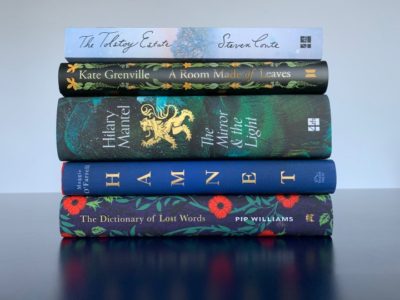
Image courtesy of The Walter Scott Prize

~

The Tolstoy Estate by Steven Conte

“In the first year of the doomed German invasion of Russia in WWII, a German military doctor, Paul Bauer, is assigned to establish a field hospital at Yasnaya Polyana – the former grand estate of Count Leo Tolstoy, the author of the classic War and Peace. There he encounters a hostile aristocratic Russian woman, Katerina Trubetzkaya, a writer who has been left in charge of the estate. But even as a tentative friendship develops between them, Bauer’s hostile and arrogant commanding officer, Julius Metz, becomes erratic and unhinged as the war turns against the Germans. Over the course of six weeks, in the terrible winter of 1941, everything starts to unravel…

From the critically acclaimed and award-winning author, Steven Conte, The Tolstoy Estate is ambitious, accomplished and astonishingly good: an engrossing, intense and compelling exploration of the horror and brutality of conflict, and the moral, emotional, physical and intellectual limits that people reach in war time. It is also a poignant, bittersweet love story – and, most movingly, a novel that explores the notion that literature can still be a potent force for good in our world.”

~

A Room Made of Leaves by Kate Grenville

“It is 1788. Twenty-one-year-old Elizabeth is hungry for life but, as the ward of a Devon clergyman, knows she has few prospects. When proud, scarred soldier John Macarthur promises her the earth one midsummer’s night, she believes him.

But Elizabeth soon realises she has made a terrible mistake. Her new husband is reckless, tormented, driven by some dark rage at the world. He tells her he is to take up a position as Lieutenant in a New South Wales penal colony and she has no choice but to go. Sailing for six months to the far side of the globe with a child growing inside her, she arrives to find Sydney Town a brutal, dusty, hungry place of makeshift shelters, failing crops, scheming and rumours.

All her life she has learned to be obliging, to fold herself up small. Now, in the vast landscapes of an unknown continent, Elizabeth has to discover a strength she never imagined, and passions she could never express.

Inspired by the real life of a remarkable woman, this is an extraordinarily rich, beautifully wrought novel of resilience, courage and the mystery of human desire.”

~

The Mirror and the Light by Hilary Mantel

“England, May 1536. Anne Boleyn is dead, decapitated in the space of a heartbeat by a hired French executioner. As her remains are bundled into oblivion, Thomas Cromwell breakfasts with the victors. The blacksmith’s son from Putney emerges from the spring’s bloodbath to continue his climb to power and wealth, while his formidable master, Henry VIII, settles to short-lived happiness with his third queen, Jane Seymour.

Cromwell is a man with only his wits to rely on; he has no great family to back him, no private army. Despite rebellion at home, traitors plotting abroad and the threat of invasion testing Henry’s regime to breaking point, Cromwell’s robust imagination sees a new country in the mirror of the future. But can a nation, or a person, shed the past like a skin? Do the dead continually unbury themselves? What will you do, the Spanish ambassador asks Cromwell, when the king turns on you, as sooner or later he turns on everyone close to him?

With The Mirror and the Light, Hilary Mantel brings to a triumphant close the trilogy she began with Wolf Hall and Bring Up the Bodies. She traces the final years of Thomas Cromwell, the boy from nowhere who climbs to the heights of power, offering a defining portrait of predator and prey, of a ferocious contest between present and past, between royal will and a common man’s vision: of a modern nation making itself through conflict, passion and courage.”

~

Hamnet by Maggie O’Farrell

“On a summer’s day in 1596, a young girl in Stratford-upon-Avon takes to her bed with a fever. Her twin brother, Hamnet, searches everywhere for help. Why is nobody at home?

Their mother, Agnes, is over a mile away, in the garden where she grows medicinal herbs. Their father is working in London. Neither parent knows that one of the children will not survive the week.

Hamnet is a novel inspired by the son of a famous playwright. It is a story of the bond between twins, and of a marriage pushed to the brink by grief. It is also the story of a kestrel and its mistress; flea that boards a ship in Alexandria; and a glovemaker’s son who flouts convention in pursuit of the woman he loves. Above all, it is a tender and unforgettable reimagining of a boy whose life has been all but forgotten, but whose name was given to one of the most celebrated plays ever written.”

~

The Dictionary of Lost Words by Pip Williams

“Esme is born into a world of words. Motherless and irrepressibly curious, she spends her childhood in the ‘Scriptorium’, a garden shed in Oxford where her father and a team of dedicated lexicographers are collecting words for the very first Oxford English Dictionary. Esme’s place is beneath the sorting table, unseen and unheard. One day a slip of paper containing the word ‘bondmaid’ flutters to the floor. Esme rescues the slip and stashes it in an old wooden case that belongs to her friend, Lizzie, a young servant in the big house. Esme begins to collect other words from the Scriptorium that are misplaced, discarded or have been neglected by the dictionary men. They help her make sense of the world.

Over time, Esme realises that some words are considered more important than others, and that words and meanings relating to women’s experiences often go unrecorded. While she dedicates her life to the Oxford English Dictionary, secretly, she begins to collect words for another dictionary: The Dictionary of Lost Words.

Set when the women’s suffrage movement was at its height and the Great War loomed, The Dictionary of Lost Words reveals a lost narrative, hidden between the lines of a history written by men. It’s a delightful, lyrical and deeply thought-provoking celebration of words, and the power of language to shape the world and our experience of it.”

~

The only one of these I’ve read so far is Hamnet and although I wasn’t a fan, I’m aware that most people have loved it so I won’t be at all surprised if it wins. I’m sure The Mirror and the Light will be another strong contender; I haven’t finished it yet, but will eventually! Of the remaining three books, The Dictionary of Lost Words doesn’t appeal to me much but I’m looking forward to reading the other two (although The Tolstoy Estate hasn’t been published here in the UK yet).

What do you think of this shortlist? Which book do you think will win?

The Walter Scott Prize 2021 Longlist

If you’ve been following my blog for a while you will know that I have been slowly working through all of the books shortlisted for the Walter Scott Prize for Historical Fiction since the prize began in 2010. I have discovered some great books and authors over the last few years thanks to this prize. You can see the progress I’ve made with this here – and I know there are other bloggers working on similar projects too.

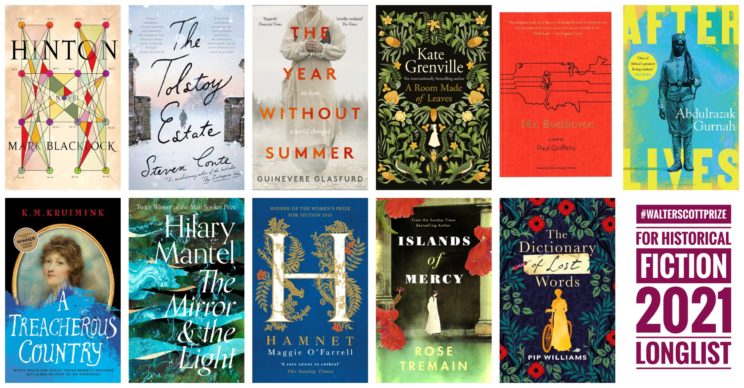
The longlist for the 2021 prize has just been announced and includes some titles that I would have predicted, as well as some that I’ve never even heard of! Here are the eleven books on this year’s list:

~

Hinton by Mark Blacklock (Granta)

The Tolstoy Estate by Steven Conte (HarperCollins Australia)

The Year Without Summer by Guinevere Glasfurd (Two Roads)

A Room Made of Leaves by Kate Grenville (Canongate UK, Text Publishing Australia)

Mr Beethoven by Paul Griffiths (Henningham Family Press)

Afterlives by Abdulrazak Gurnah (Bloomsbury)

A Treacherous Country by K L Kruimink (Allen & Unwin Australia)

The Mirror and the Light by Hilary Mantel (4th Estate)

Hamnet by Maggie O’Farrell (Headline)

Islands of Mercy by Rose Tremain (Chatto & Windus)

The Dictionary of Lost Words by Pip Williams (Affirm Press Australia, Chatto & Windus UK)

~

I’m not at all surprised to see Hamnet on the list – although I didn’t love it as much as most other readers seem to have done, I’m sure it will be shortlisted and possibly win the overall prize. I didn’t particularly enjoy Islands of Mercy either, but again I can see that it’s a well-written, multi-layered novel and deserves its place on the longlist. The only other one I’ve read is The Year Without Summer, which I did find interesting even though it seemed more like a collection of short stories than a novel.

Of the other eight books, I do have a copy of The Mirror and the Light which I started to read last year and abandoned as I wasn’t in the mood for it; I’m hoping to finish it soon! I was already interested in reading A Room Made of Leaves, but am not familiar with any of the others so will have to investigate.

Have you read any of these? Which ones do you think should be shortlisted?

Classics Club Spin #25: The Result

The result of the latest Classics Club Spin has been revealed today.

The idea of the Spin was to list twenty books from my Classics Club list, number them 1 to 20, and the number announced by the Classics Club represents the book I have to read before 30th January 2021. The number that has been selected is…

14

And this means the book I need to read is…

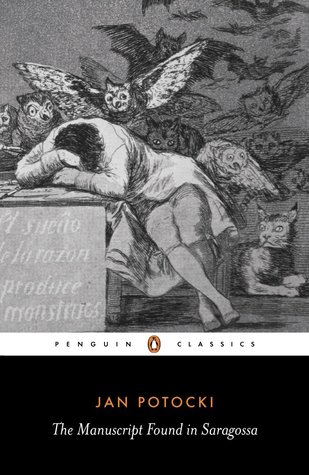
The Manuscript Found in Saragossa by Jan Potocki

Alphonse, a young Walloon officer, is travelling to join his regiment in Madrid in 1739. But he soon finds himself mysteriously detained at a highway inn in the strange and varied company of thieves, brigands, cabbalists, noblemen, coquettes and gypsies, whose stories he records over sixty-six days. The resulting manuscript is discovered some forty years later in a sealed casket, from which tales of characters transformed through disguise, magic and illusion, of honour and cowardice, of hauntings and seductions, leap forth to create a vibrant polyphony of human voices. Jan Potocki (1761-1812) used a range of literary styles – gothic, picaresque, adventure, pastoral, erotica – in his novel of stories-within-stories, which, like the Decameron and Tales from the Thousand and One Nights, provides entertainment on an epic scale.

~

I actually started to read this book by Polish author Jan Potocki earlier in the year but couldn’t give it the attention it deserved at that time. I’m looking forward to trying it again as I’m sure I’ll enjoy it. If anyone has read it, please let me know what you thought!

If you took part in the spin too, I hope you got a good result!

Classics Club Spin #25: My list

It’s time for another Classics Club Spin – the last one of 2020. Spin #24 was a success for me (I managed to read my chosen book, The Black Arrow, before the deadline), so I’m hoping for another good result this time!

If you’re not sure what a Classics Spin is, here’s a reminder:

The rules for Spin #25:

* List any twenty books you have left to read from your Classics Club list.
* Number them from 1 to 20.
* On Sunday 22nd November the Classics Club will announce a number.
* This is the book you need to read by 30th January 2021.

And here is my list:

1. Fire from Heaven by Mary Renault
2. Jane and Prudence by Barbara Pym
3. A Laodicean by Thomas Hardy
4. La Reine Margot by Alexandre Dumas
5. Armadale by Wilkie Collins (re-read)
6. Nicholas Nickleby by Charles Dickens
7. The White Guard by Mikhail Bulgakov
8. The Chrysalids by John Wyndham
9. Eugene Onegin by Alexander Pushkin
10. Goodbye Mr Chips by James Hilton
11. Pied Piper by Nevil Shute
12. Germinal by Emile Zola
13. I Will Repay by Baroness Emmuska Orczy
14. The Manuscript Found in Saragossa by Jan Potocki
15. The Brothers Karamazov by Fyodor Dostoevsky
16. Moonfleet by John Meade Falkner
17. The Turquoise by Anya Seton
18. Daniel Deronda by George Eliot
19. Shadows on the Rock by Willa Cather
20. The Fifth Queen by Ford Madox Ford

~

Have you read any of these? Which number do you think I should be hoping for?

Classics Club Spin #24: The Result

The result of the latest Classics Club Spin has been revealed today.

The idea of the Spin was to list twenty books from my Classics Club list, number them 1 to 20, and the number announced by the Classics Club represents the book I have to read before 30th September 2020. The number that has been selected is…

18

And this means the book I need to read is…

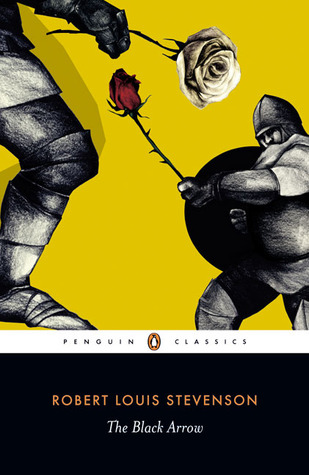
The Black Arrow by Robert Louis Stevenson

Originally serialized in a periodical of boys’ adventure fiction, The Black Arrow is a swashbuckling portrait of a young man’s journey to discover the heroism within himself. Young Dick Shelton, caught in the midst of England’s War of the Roses, finds his loyalties torn between the guardian who will ultimately betray him and the leader of a secret fellowship, The Black Arrow. As Shelton is drawn deeper into this conspiracy, he must distinguish friend from foe and confront war, shipwreck, revenge, murder, and forbidden love, as England’s crown threatens to topple around him.

~

This wasn’t one that I was particularly hoping for from my list, but I’m happy enough with the result. If you’ve read it, let me know what you thought.

Classics Club Spin #24: My list

I shouldn’t really be taking part in this Classics Club Spin as I still haven’t finished my book from the last Spin, Daniel Deronda (in fact, I’ve only just started it). We have until the end of September to read our books for Spin #24, though, so I will see what comes up – and hope it’s a short one this time!

If you’re not sure what a Classics Spin is, here’s a reminder:

The rules for Spin #24:

* List any twenty books you have left to read from your Classics Club list.
* Number them from 1 to 20.
* On Sunday 9th August the Classics Club will announce a number.
* This is the book you need to read by 30th September 2020.

And here is my list:

1. The Chrysalids by John Wyndham
2. Shadows on the Rock by Willa Cather
3. Nicholas Nickleby by Charles Dickens
4. A Laodicean by Thomas Hardy
5. The White Guard by Mikhail Bulgakov
6. The Cloister and the Hearth by Charles Reade
7. Armadale by Wilkie Collins (re-read)
8. I Will Repay by Baroness Emmuska Orczy
9. La Reine Margot by Alexandre Dumas
10. The Bride of Lammermoor by Sir Walter Scott
11. The Brothers Karamazov by Fyodor Dostoevsky
12. Germinal by Emile Zola
13. Moonfleet by John Meade Falkner
14. Eugene Onegin by Alexander Pushkin
15. Pied Piper by Nevil Shute
16. Goodbye Mr Chips by James Hilton
17. Fire from Heaven by Mary Renault
18. The Black Arrow by Robert Louis Stevenson
19. Jane and Prudence by Barbara Pym
20. Sandokan: The Tigers of Mompracem by Emilio Salgari

~

Have you read any of these? Which number should I be hoping for on Sunday?

20 Books of Summer – 2020

20 Books of Summer, hosted by Cathy at 746 Books, is a very simple idea: make a list of twenty books (there are also ten and fifteen book options) and read them during the summer months. However, it’s not as easy as it sounds, and although I’ve taken part for the last three years I have never managed to read all twenty books on my list. I don’t expect to succeed this year either, especially as I’m still struggling to concentrate and not reading as much as I normally would. I’m hoping that making a list of potential reads will help me to focus, even if I don’t end up reading many of them.

This year’s 20 Books of Summer starts tomorrow (Monday 1 June) and finishes on Tuesday 1 September and here is my list of books. 1-10 are review copies from my NetGalley shelf. The others are a mixture of re-reads, the next books in series I’m working through, long anticipated reads, books for other challenges and projects – and my Classics Spin book from April which I really did mean to start reading but never got round to!

~

1. Moonflower Murders by Anthony Horowitz
2. A Time to Die by Hilda Lawrence
3. The Silver Collar by Antonia Hodgson
4. The Honey and the Sting by EC Fremantle
5. Tsarina by Ellen Alpsten
6. The Sin Eater by Megan Campisi
7. The Land Beyond the Sea by Sharon Penman
8. When We Fall by Carolyn Kirby
9. Katheryn Howard, the Tainted Queen by Alison Weir
10. The Silken Rose by Carol McGrath
11. Sleeping Murder by Agatha Christie
12. City of Dragons by Robin Hobb
13. The Surgeon’s Mate by Patrick O’Brian
14. The Green Gauntlet by RF Delderfield
15. Confusion by Elizabeth Jane Howard
16. Greenwitch by Susan Cooper
17. The Wheel of Fortune by Susan Howatch
18. These Old Shades by Georgette Heyer
19. Daniel Deronda by George Eliot
20. The Horseman by Tim Pears

Have you read any of these? Will you be taking part in 20 Books of Summer this year?