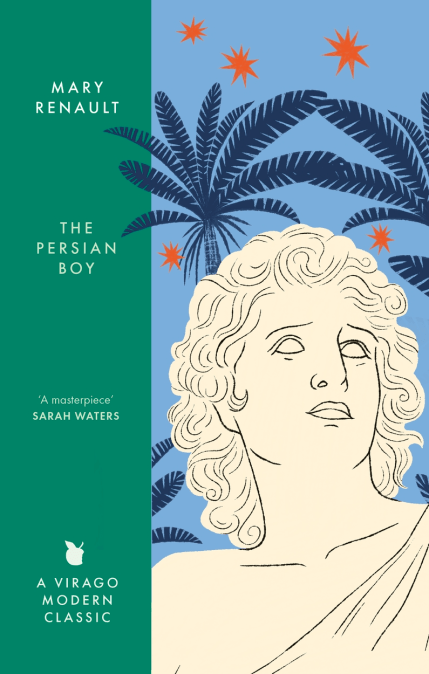
 First published in 1972, this is the second book in Mary Renault’s Alexander the Great trilogy, following Fire from Heaven, which I read last year. It was also the book chosen for me to read in the latest Classics Club Spin (the deadline was earlier this month, but I find that Mary Renault’s novels need a lot of concentration and shouldn’t be rushed, so I took more time to finish it).
Fire from Heaven covered Alexander’s childhood and early adult life, up to the death of his father, Philip II of Macedon, and his own accession to the throne; The Persian Boy takes us through the final seven years of his life and has a slightly different style and focus. Unlike the previous book, which was written in the third person, this one is narrated entirely by Bagoas, Alexander’s servant, friend and lover.
We first meet Bagoas as a young boy, the son of a Persian nobleman who is betrayed and killed by his enemies. Bagoas himself is captured, castrated and sold into slavery, eventually finding himself at the court of King Darius III. Having become a favourite of the king, his life is thrown into uncertainty again when Darius is defeated by the Macedonian army and Bagoas is presented to Darius’ conqueror, Alexander, as a gift. At first he is disgusted by what he sees as the barbaric ways of the Macedonians, but over time he becomes a trusted member of Alexander’s inner circle, with a close friendship and romantic relationship beginning to form between the two.
With the book being written from Bagoas’ perspective, the story has a more intimate feel than Fire from Heaven. As Bagoas is a courtier, not a soldier or a fighter, battles are seen from a distance; although he travels with Alexander and his men, Bagoas does not accompany them on the battlefield but waits in camp for them to return, sharing with us the outcome and some insights into the impact, both mental and physical, on the people involved in the battle. So although Alexander’s success as a great military leader is certainly not ignored, the focus here is more on Alexander as a human being. Through Bagoas’ eyes we see a more tender, vulnerable side of Alexander, a man who often feels lonely and isolated, so relies on Bagoas to provide love, warmth and friendship.
I do feel that because of the choice to tell this part of Alexander’s story from the perspective of someone who loved him, we get quite a one-sided view of him. It’s a very sympathetic, heroic portrayal and we don’t hear much of how his enemies viewed him or what his wife Roxane thought or felt – she is pushed completely to the sidelines of Bagoas’ account (understandably, as she tries to poison him, and he wants no more to do with her after that). Hephaistion, Alexander’s lifelong companion, also has a relatively small part in the novel as he and Bagoas mostly avoid each other, having an uneasy relationship as rivals for Alexander’s affection. Renault frequently compares Alexander and Hephaistion to Achilles and Patroclus, something they apparently publicly identified themselves with, but I felt that the emotional impact of Hephaistion’s death later in the novel was lost because of seeing so little of him, especially compared to the first book where he had a much bigger role.
One aspect of the book I found particularly interesting was seeing how both Alexander and Bagoas adapt to the differences between Greek and Persian culture. Alexander wishes to unite the Greek people with the Persian people he has conquered and as time goes by, Bagoas observes him wearing Persian dress and trying to introduce Persian customs such as prostration (which meets with strong opposition from his Macedonian men).
Although there’s obviously a limit to how much we can truly know about the world of the 4th century BC, Alexander’s life has been well documented and Renault discusses in her author’s note the sources she has used and decisions she has made. Bagoas himself only appears a few times in historical sources, but Renault is such a gifted writer she makes everything he says and does seem plausible. I’m looking forward to reading Funeral Games, the final part of the trilogy, which deals with Alexander’s death and its aftermath.

Book 10/20 of 20 Books of Summer
This is also book 6/50 from my third Classics Club list.


I read a lot of Mary Renault novels years ago now, probably including the Alexander trilogy. I must go back to them one day as I think they influenced my love of historical fiction
I’ve only started reading Mary Renault’s books in the last few years as they never really appealed to me before – I tend to prefer more recent periods of history – so I still have a lot to look forward to.
I hadn’t even heard of this trilogy. It does sound like a fascinating look into Alexander the Great’s life.
I knew very little about him before starting this trilogy, so I’m learning a lot!
I think you made an interesting point about only seeing Alexander from one point of view. I think you can draw some inferences, especially based on the boy’s personality, but it’s true that the view is limited.
Bagoas was an interesting narrator but including some other points of view would have given a more well rounded impression of Alexander’s character.
She’s one of the VMC authors on my shelves whose books I’ve done well with collecting and terrible with actually reading. But, as you say, even from the summaries, you can tell they require a certain sort of dedication and, well, also, interest, I suppose: I can imagine getting into a mood where reading about this era would become quite satisfying, but I’m rarely actually in that mood, I guess? Whereas, at a younger age, I found everything about “ancient times” fascinating.
I had the first two books in this trilogy on my shelf for years before getting round to actually picking them up. They certainly do require dedication and interest, so I wanted to wait until I was in the right mood for them. Ancient history has never really appealed to me as much as more recent periods.
I still think I’ll read the author’s Theseus series first but this definitely sounds like an interesting read. Its a shame that the perspective leads to a somewhat biased narrative and pushes some characters to the sidelines. But I’m also intrigued by the way the narrative shifts between books and very curious to hear that the finale will focus on the aftermath. I hope you enjoy the last one and will definitely keep an eye out for your thoughts on it in the future.
I found the Theseus books easier to read while this series is needing more concentration as there’s so much detail. It’s definitely interesting, though, that this second novel is written from a different perspective from the first and gives us a different view of Alexander, even if it’s quite a biased one. I’m looking forward to the third one.
Glad you enjoyed this second book and I hope you’re able to read the final book in the trilogy soon! 🤞😊
I think I’ll need a break before starting the final one, but am looking forward to reading it eventually!
I think I need to add this author to my classics list!
Thank you for sharing your review with the Historical Fiction Reading Challenge
She’s definitely worth reading!