
I have always loved the idea of being able to travel through time so with my interest in history it’s not surprising that I enjoy reading fiction with an element of time travel. My recent read of The Phantom Tree by Nicola Cornick (in which a young woman from Tudor England travels forward to the present day) made me think of other time travel – or time-slip – novels I’ve read over the years. Before I start to list them, let’s see what Wikipedia has to say about the difference between time travel and time-slip:
The difference is that in time slip stories, the protagonist typically has no control and no understanding of the process (which is often never explained at all) and is either left marooned in a past time and must make the best of it, or is eventually returned by a process as unpredictable and uncontrolled.
It would seem, then, that time travel is deliberate and time slip is accidental, but thinking about the books I’ve read, it’s not quite as simple as that – sometimes a book doesn’t fit neatly into either category or is a mixture of both.
The first time travel books I can remember reading as a child were Madeleine L’Engle’s Time Quintet. The one that stands out most in my memory is Many Waters, in which twins Sandy and Dennys travel back to Biblical times – the days of Noah’s Ark – in a world populated by supernatural beings such as the Seraphim and the Nephilim. I also read Tom’s Midnight Garden by Philippa Pearce, probably at around the same age, although I can remember very little about that book now. Most of my time travel reading has been as an adult.
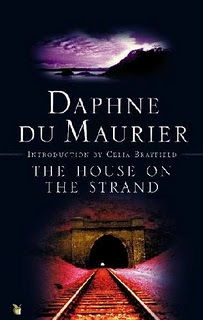 The House on the Strand by Daphne du Maurier is one of my favourite time travel novels. Interestingly, I found that with this book it was not so much the historical storyline (14th century Cornwall) which interested me as the method of time travel, the fascinating questions it raised and the impact it had on the life of the person doing the travelling.
Then there’s Anya Seton’s Green Darkness, a book I read years ago, before I started blogging. The movement between time periods in this novel takes place not as physical time travel but through reincarnation: a modern day American girl, Celia, relives a previous existence as a servant in Tudor England. Although most of the plot has faded from my mind, I still remember the atmospheric descriptions of the manor house, Ightham Mote.
Lady of Hay by Barbara Erskine is a similar story about a woman from the 1970s who undergoes hypnosis and is regressed to a former life as Matilda de Braose, a 12th century noblewoman. Sleeper’s Castle, published to mark the 30th anniversary of Lady of Hay, is the story of a woman in modern-day Wales who begins to have vivid dreams taking her back to the 1400s and Owain Glyndŵr’s rebellion against the English. Erskine has written a lot of other time-slip novels, although I haven’t read many of them yet.
 I can’t talk about time-slip novels without mentioning Susanna Kearsley, whose books have impressed me more than Erskine’s. Not all of them involve a form of time travel, but those that do include Mariana (which takes us back to the 17th century), The Rose Garden (18th century Cornwall) and The Firebird (18th century Scotland and Russia). I think Kearsley makes the time travel in her novels feel quite natural and believable; the transitions between one period and another are very smooth.
I have already mentioned The Phantom Tree; I haven’t read Nicola Cornick’s previous novel, House of Shadows, but I’m looking forward to it. I think readers who enjoy Cornick may also be interested in Pamela Hartshorne’s novels. The one I read – The Edge of Dark – follows the story of a present day woman who begins to experience the memories of a woman who lived in the Elizabethan period.
And finally, there’s Diana Gabaldon’s Outlander series in which World War II nurse Claire Randall walks through a circle of standing stones to find herself in 18th century Scotland. There are eight books in the series so far; I loved the earlier ones, but was slightly less enamoured with the last two. I’ve reviewed the most recent books, An Echo in the Bone and Written in My Own Heart’s Blood, on my blog, but I strongly recommend starting at the beginning and reading the series in order.
~
The titles above are the ones which came instantly to mind when I started to write this post. I was sure I must have read more, so I had a look back through my blog archives and was reminded of a few others:
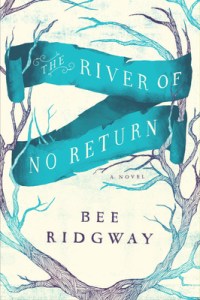 The River of No Return by Bee Ridgway – set partly in the modern day and partly in the Regency period. This would be a good choice for readers who are interested in the actual mechanics of time travel; I noted in my review that this is a novel “where the manipulation of time forms a big part of the plot – jumping forwards in time, jumping backwards in time, freezing time, speeding time up and slowing time down”.
Shadow of Night by Deborah Harkness – the second book in the All Souls Trilogy, in which our two main characters – a witch and a vampire – travel back in time to the year 1590. I remember finding the time travel aspect a bit confusing in this one.
Kindred by Octavia E. Butler – this is a great novel about a black woman in the 1970s who is pulled into the 19th century and finds herself on a Maryland plantation where she meets one of her ancestors, who happens to be a slave owner.
The Map of Time by Felix Palma – an unusual novel made up of three separate but interlinked stories which pull the reader backwards and forwards in time. HG Wells, author of The Time Machine, even appears as a character in this book.
Now it’s your turn.
Have you read any of the books I’ve mentioned above? What are your favourite time travel/time-slip novels? Which methods of time travel do you find most convincing? I am particularly interested in hearing about books which involve travel to or from the past, but if you prefer books which take us forward to the future – like The Time Machine – feel free to recommend those too.
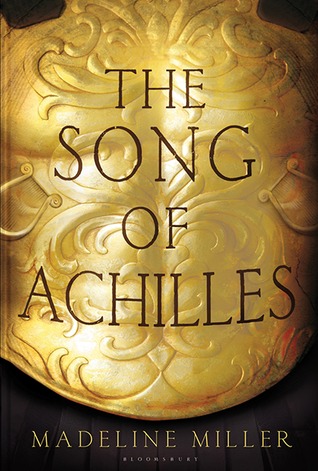 Based, like the Iliad, on the Trojan War, there’s The Song of Achilles by Madeline Miller, which tells the story from the perspective of Patroclus, and Hand of Fire by Judith Starkston, this time retelling events through the eyes of Briseis. Briseis is also one of the main characters – the other is Chryseis – in Emily Hauser’s For the Most Beautiful, which I read last year and enjoyed. I’ve recently received a review copy of the next book in the series, For the Winner, a book about Jason and the Argonauts and the Golden Fleece.
 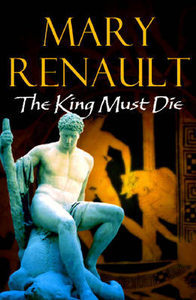 Finally, I must mention Mary Renault, a beloved author of many readers when it comes to historical novels set in Ancient Greece. So far I have only read The King Must Die, the first of her two novels telling the story of Theseus in a way which gives plausible explanations for elements of the Theseus myth. I enjoyed it, but didn’t fall in love with it the way I’d hoped to, and still need to read the sequel, The Bull from the Sea.






 She Reads Novels