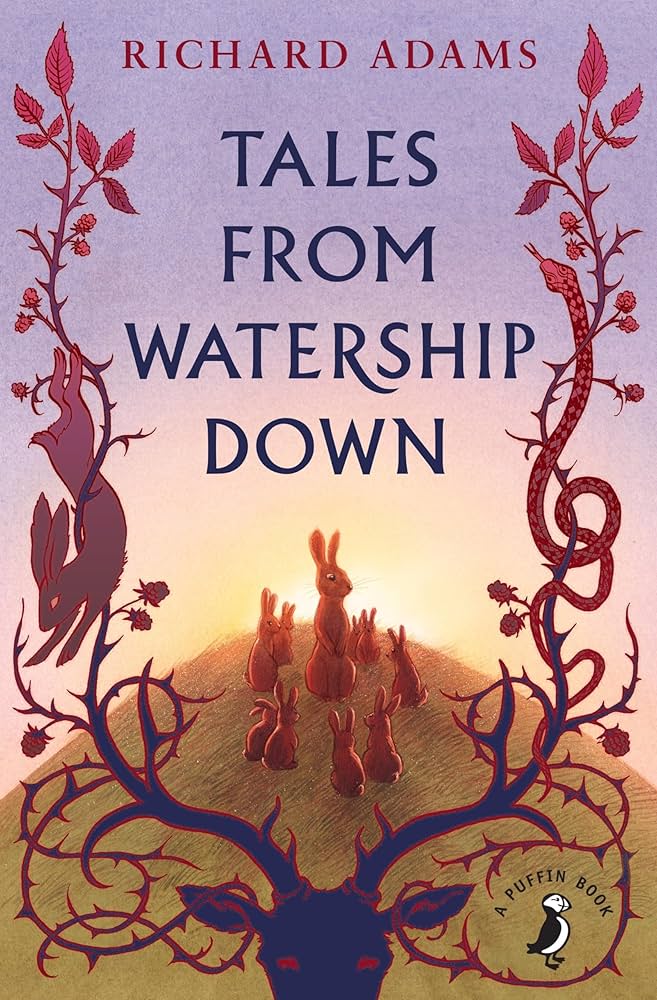
 Watership Down has been one of my favourite books since I first read it as a ten-year-old and when I re-read it in 2010 I was pleased to find I still loved it as much as I ever did (it’s a book that can be equally appreciated by both adults and children, I think). Despite that, the thought of reading the sequel, Tales from Watership Down, has never really appealed to me – it’s a collection of short stories rather than a novel like the first book and I’ve heard a lot of people say they were disappointed by it. Anyway, I decided to give it a try this Easter (I’ve always associated Watership Down with this time of year as the film often used to be shown on Easter Sunday until parents complained that it was too violent and not the nice cartoon about cute bunnies they’d assumed it was!).
The book is divided into three sections, beginning with a selection of stories featuring El-ahrairah, also known as ‘the Prince with a Thousand Enemies’, the legendary folk hero of the rabbit world. If you’ve read Watership Down, you’ll remember that the rabbits often entertain or comfort themselves by telling stories about El-ahrairah (whom Richard Adams himself described as a rabbit version of Robin Hood). These stories were always my least favourite parts of the novel as I felt they were just a distraction from the main narrative, so I wasn’t exactly thrilled about there being so many of them here. However, I really enjoyed the first one, The Sense of Smell, in which El-ahrairah goes on a journey to several faraway lands in search of someone who can give him the ability to smell, a sense which rabbits don’t yet have, making them vulnerable to predators. He is told that the sinister Ilips, who live in a cave in a land of perpetual darkness, will be able to give him this sense for himself and his rabbits, but things don’t go to plan and El-ahrairah is forced to travel on to the Land of Yesterday, a fascinating fictional world!
At the end of this section there are two stories which don’t involve El-ahrairah. One, Speedwell’s Story, is an intentionally silly story which Adams says in the introduction is ‘representative of the kind of nonsense tales which rabbits enjoy’. As I’m not a rabbit, I didn’t enjoy that one, but I did like The Rabbit’s Ghost Story, which is told by a rabbit called Coltsfoot. As he tells of his encounter with a ghostly rabbit, it’s very atmospheric and while Adams’ writing is often quite dark, this particular story comes close to the horror genre.
The second section of the book consists of four more El-ahrairah stories, but this time they are connected and describe what happened when El-ahrairah and his friend Rabscuttle return from visiting the Black Rabbit of Inlé (this journey was referred to in the original novel). I was intrigued by the first one, The Story of the Comical Field, in which the two rabbits are tricked into entering a man-made maze where they encounter an unspecified ‘evil’, but I found the other stories less interesting.
Finally, we come to the third section and the one I think most of us will have been waiting for: a continuation of the events of Watership Down, describing some of the things that happen to Hazel, Fiver, Bigwig and the others after they establish their new warren on the Down. They don’t have such dramatic adventures as in the first book, but do have to deal with various newcomers who disturb the stability of the warren, including Stonecrop, an escaped hutch rabbit who smells of man, and Flyairth, a doe who is convinced they are all going to die of the White Blindness (myxomatosis). Maybe in response to criticism of the first book being sexist, Adams gives a lot of attention to Hyzenthlay, Vilthuril and the other doe characters and explores the idea of warrens being run by female Chief Rabbits. I enjoyed this final part of the book, but was left feeling a bit sad because it gave us a glimpse of what a true sequel could have looked like.
So, do I think this book is worth reading? I wouldn’t recommend it as an introduction to Richard Adams, but if you enjoyed Watership Down and want to spend more time in that world, then you’ll probably like the third part of the book at least – but don’t set your expectations too high and be prepared for lots of El-ahrairah.


