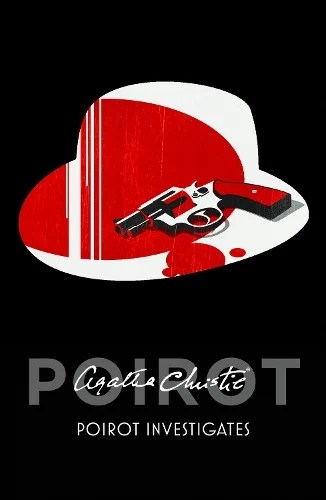
 This month’s theme for the Read Christie 2026 challenge is ‘Best Short Story Collection’. I’ve already read the suggested title, The Labours of Hercules, so I decided to choose a different one – and although I’m not sure whether Poirot Investigates would be considered one of her best short story collections, it was her first and it’s one I hadn’t read before. Originally published in the UK in 1924, it contains eleven stories all featuring Hercule Poirot and narrated by Captain Hastings. The US version published a year later includes three extra stories, which later appeared in the UK in Poirot’s Early Cases.
The stories in this book are quick and fun to read, although some of them feel a bit insubstantial and there’s a sense that Christie is experimenting with different types of plot and still finding her feet as a writer. Poirot himself also doesn’t feel entirely like the character we get to know later on, but Christie is beginning to develop his famous characteristics and mannerisms in these stories. I’ve always loved Hastings and his relationship with Poirot, so I was happy that he narrates this whole collection. It’s very endearing every time he gets excited thinking he has solved the mystery and tries to console Poirot for getting things wrong – only to find out, every time, that Poirot has been a step ahead all along!
I won’t discuss all of the stories here, but will mention a few of the highlights. I think my favourite story was The Disappearance of Mr Davenheim, in which Inspector Japp tells Poirot about the disappearance of a banker who went out to post some letters and hasn’t returned. Poirot makes a bet with Japp that he can solve the crime without even leaving his armchair. The solution to this one is clever and the way Poirot carries out his investigation from his own home makes it feel slightly different. I also really enjoyed The Adventure of the Cheap Flat. One of Hastings’ friends, Mrs Robinson, tells him how she and her husband have been searching for a flat to rent and have been offered a beautifully furnished one at a desirable address for a suspiciously low price. This entertaining little story brings in some elements of espionage and adventure and, of course, Poirot quickly discovers why the flat is so cheap!
The Adventure of the Egyptian Tomb is another I particularly liked, mainly for the setting and the atmosphere. It involves the deaths, one by one, of the people involved with the opening of the tomb of King Men-He-Rah. Poirot and Hastings travel to Egypt to try to unravel the mystery, which is clearly inspired by the real life opening of the tomb of Tutankhamun which took place just before the story was written.
This is an enjoyable collection, then – maybe not as strong overall as some of her others, but it was interesting to read some stories written so early in Christie’s career. I’m not planning to take part in Read Christie next month but have The Rose and the Yew Tree, one of her books published as Mary Westmacott, lined up for July.


It’s a while since I read these but what you say about the character not being quite developed chimes in a bit with what I felt about Marple in The Thirteen Problems, which was also an early collection. Christie was obviously still working on her characters!!
Yes, I also remember feeling like that about Miss Marple in the earlier books. It would have been interesting to read the series in order and see how she develops over time.
Totally off topic, but I read yesterday that the BBC is working on a reboot of Poirot and I’m internally screaming “buttttttt whyyyyyyyyy!!!!!”
Suchet was perfection as Poirot. Why would they mess with perfection? Don’t Phelps my Poirot.
Oh no! I hadn’t heard about that. I’m almost never happy with remakes and David Suchet was so perfect!
Given everything you’ve said about this one I feel like it would be a good one to check out further down the line. That way I could watch out for the hints of development that you’ve mentioned and appreciate how the characters changed since this early book. I do quite like the sound of the story set in Egypt too. Sounds like an interesting setting for definite.
Sometimes I wish I had read the Poirot series in order from the beginning rather than just jumping in at random, but it’s too late now! And yes, I loved the Egyptian setting of that story. Some of Christie’s other novels and stories are set in Egypt and the Middle East as well – she married an archaeologist so she was interested in that sort of setting.
Yes I can’t remember the title off of the top of my head but I remember you reviewing another of her books set in Egypt as that one left me intrigued too. I’m sure that must have been fascinating and helps bring the setting to life in her writing too.
I haven’t read any of her short stories but the Egyptian setting does sound fun, I’m sure I’ll get to them one day!
Yes, the Egyptian setting was interesting and made that story feel a bit different from the others in the collection. I hope you can get round to the short stories at some point – I do prefer her full length novels, but her stories are fun as well!
Sounds like a interesting collection of stories. I am pretty sure I have watched an episode of ITV’s Poirot television series which must be based on The Adventure of the Egyptian Tomb story. This has all reminded me that I really need to read more Christie! 😊
I don’t think I’ve seen that episode, though I would like to as it was a great story. I hope you’re able to read more Christie soon!