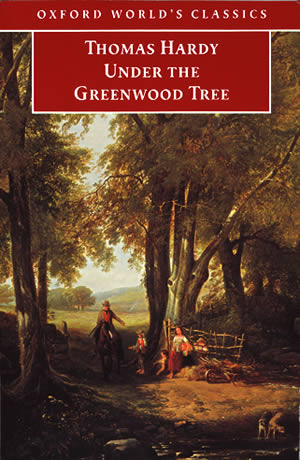
Under the Greenwood Tree by Thomas Hardy

Under the Greenwood Tree, set in the small village of Mellstock in Thomas Hardy’s fictional Wessex, is both a love story and a nostalgic study into the disappearance of old traditions and a move towards a more modern way of life. The book is divided into five sections, one for each of the four seasons of the year plus a final concluding section. The story begins in the winter, when we meet a group of villagers who play stringed instruments in the church choir. There’s a new vicar in Mellstock, the Reverend Maybold, and he has plans to replace the traditional choir with a new mechanical church organ. The organ will be played by another newcomer to the village, a pretty young schoolteacher whose name is Fancy Day.

The musicians are upset when they learn that they are going to be replaced, but one of them, Dick Dewy, finds himself falling in love with Fancy Day. However, unknown to Dick he has several rivals for Fancy’s love, including a rich local farmer and even the Reverend Maybold himself. The story of Dick and Fancy’s romance is played out over the course of a year, against a backdrop of the changing seasons and the changing landscape of Mellstock.

Hardy’s novels have a reputation for being bleak and depressing, but I can promise you that this one is neither. It’s actually quite an uplifting, optimistic story with an (almost) happy ending – very different from the other three Hardy books I’ve read (Tess of the d’Urbervilles, Jude the Obscure and A Pair of Blue Eyes). It doesn’t have the depth and complexity of Tess or Jude and to be honest, I do personally prefer Hardy’s tragedies, but I enjoyed this one too and it did make a nice change from the darker books I’ve been reading recently. The strengths of Under the Greenwood Tree are its gentle humour and its portrayal of life in 19th century rural England. As usual with Hardy, his pastoral descriptions are beautifully written and I love the way he paints four different portraits of country life appropriate to each season of the year, from singing carols and making cider in the winter to gathering nuts and collecting honey from beehives in the autumn.

Where the book was less successful, in my opinion, was with the characters of Dick Dewy and Fancy Day, because they just weren’t strong enough or interesting enough for me to really care about their romance. Fancy was actually quite an advanced and ‘modern’ character for the time and place, being well-educated and independent. However, she’s depicted here as being very silly and shallow and I felt that we never got to understand her properly. Dick was easier to like but his character wasn’t given a lot of depth either. I do think Hardy captured the naiveté of their relationship perfectly, but I would have preferred to have read more about the rest of the village community, with the love story pushed further into the background. Apparently Hardy had originally wanted to call the book “The Mellstock Quire” and it did seem to me that he was maybe more comfortable with that aspect of the book.

Although I’ve only read a few of Thomas Hardy’s novels he’s quickly becoming one of my favourite Victorian authors. I hope to read all of his books eventually, but I wish I’d left Under the Greenwood Tree until later as it’s turned out to be the first one I haven’t loved. There were a lot of things I liked about it, but it didn’t have the same emotional impact on me that the others had and it’s not a book I would want to read again and again.

Uncle Silas by Sheridan Le Fanu

Until now my only previous experience of the 19th century Irish author Joseph Sheridan Le Fanu was the short story, Laura Silver Bell, which I read for Mel U’s Irish Short Story Week in March. I was keen to see what I would think of one of Le Fanu’s full-length novels and decided to read Uncle Silas for the R.I.P challenge.

Uncle Silas is an 1864 novel which seems to incorporate almost every aspect of the Victorian sensation/gothic novel you can think of: gloomy, eerie mansions, graveyards, laudanum addiction, an evil governess, locked rooms and locked cabinets, poison, family secrets. I had high hopes for the book as it sounded like exactly the type of classic I usually enjoy, and after a slow start it didn’t disappoint.

Our heroine (and the narrator of the story) is Maud Ruthyn who lives with her father at Knowl, their family estate. Maud is fascinated by a portrait of her Uncle Silas which hangs on one of the walls inside the house – she has never met her uncle before and is intrigued by hints of scandal in his past. When Mr Ruthyn decides to find a governess for his daughter, the sinister Madame de la Rougierre comes to live at Knowl and a chain of events begins which will finally bring Maud into contact with her mysterious Uncle Silas.

And that’s really all I can tell you about the plot without beginning to give too much away! I had managed to avoid reading any big spoilers so I never had any idea what was coming next, and I think that was the best way to approach this book.

It did take me a while to really get into the story. It was fun and entertaining from the beginning and I was never actually bored with it, but it seemed to take such a long time before anything really happened. It wasn’t until about one hundred and fifty pages into the book that the pace began to pick up and then I could appreciate why Le Fanu had taken his time building the suspense and slowly creating a mood of menace and foreboding. It was a very atmospheric and creepy story (particularly any scene featuring Madame de la Rougierre, who must be one of the most horrible, grotesque villains in literature), though I didn’t find it as scary as I had expected to.

Maud may not be the strongest of female characters but she felt real and believable to me. Although she could be brave when she needed to be, she was young and naïve and I felt genuinely worried for her as she found herself becoming increasingly isolated, not sure who she could and couldn’t trust. And for me, this was where the story could be described as frightening: the complete lack of control Maud had over her own destiny and the way she was forced to depend on people who may not have had her best interests at heart.

If you enjoyed The Woman in White by Wilkie Collins then I think there’s a good chance you’ll like this book too. It doesn’t have as many surprising twists and turns as The Woman in White but it is a similar type of book, though with a much darker and more gothic feel. I think it’s a shame Le Fanu isn’t as widely read as other Victorian authors, as his work is definitely worth reading. I hope you’ll decide to give this book a try if you haven’t already.

Framley Parsonage by Anthony Trollope

Framley Parsonage is the fourth novel in Anthony Trollope’s Chronicles of Barsetshire series. I’ve been slowly working my way through these books during the last year and in my opinion this one is neither the best nor the worst of the four I’ve read so far.

A common question asked by people new to Trollope is whether this series needs to be read in the correct order. Well, I don’t think it’s necessary at all and I’m sure this book could be enjoyed as a first introduction to Trollope, but personally I would recommend beginning with The Warden and reading each book in the series in turn. Framley Parsonage draws together a lot of characters from the first three books, including the Grantly and Proudie families from Barchester Towers and the Thornes and Greshams from Doctor Thorne, as well as some that I hadn’t expected to meet again, including one of my personal favourites, Miss Dunstable. I’m glad I chose to read the series in order because it’s nice to be able to recognise references to people, places and events and to feel that I’m getting to know the whole Barsetshire community.

Framley Parsonage consists of two main storylines. In the first, we follow Mark Robarts, the vicar of Framley. Mark became vicar at a younger age than would normally be expected, due to the influence of his friend, Lord Lufton, and his mother, Lady Lufton of Framley Court. He is still very ambitious and to Lady Lufton’s dismay he begins to mix with unscrupulous politicians whom he believes can help him further his career. When one of these politicians, Nathaniel Sowerby, persuades him to sign his name to a note for five hundred pounds, Mark finds himself getting deeper and deeper into debt – which is not the way a respectable clergyman should behave!

The second storyline involves Mark’s sister, Lucy Robarts, who comes to live at Framley Parsonage following the death of their father. Lucy falls in love with Lord Lufton, who soon proposes to her. However, Lucy is aware that Lord Lufton’s mother does not consider her a suitable wife for her son, so she vows not to marry him until she wins Lady Lufton’s approval – even though it means sacrificing her own happiness.

I found this book harder to get into than the previous three that I’ve read – it seemed to have a very slow start and didn’t really pick up until the character of Lucy Robarts made her first appearance. But as with all Trollope’s novels, once I did get into the story I became completely absorbed in the moral dramas and dilemmas taking place. Based on the first three Barsetshire books, I had a strong suspicion that all of Mark’s and Lucy’s problems would be resolved by the end, and yet this didn’t stop me from enjoying the book and wondering exactly how those problems would be resolved. As usual, Trollope’s characters feel completely believable with understandable motives and emotions. We can have sympathy with Mark Robarts because he is not a bad person – just young and naïve. And even when a character is cast as one of the villains of the book, such as Mr Sowerby, Trollope still asks us to remember that they do have some good qualities.

Although Anthony Trollope is not my favourite Victorian author (that would be either Wilkie Collins or Thomas Hardy) he does have a wonderful warm and observant writing style all of his own and if you haven’t tried one of his books yet then I highly recommend spending some time in Barsetshire soon.

Thérèse Raquin by Émile Zola

Thérèse is a young woman trapped in an unhappy marriage to her sickly cousin, Camille Raquin. On the surface she appears quiet and passive, never voicing an opinion of her own. But underneath Thérèse is a passionate person who longs to break away from her boring, oppressive existence. When Camille introduces her to an old friend, Laurent, the two begin an affair. Desperate to find a way in which they can be together, Thérèse and Laurent are driven to commit a terrible crime – a crime that will haunt them for the rest of their lives.

If you think I’ve given too much away then I can tell you that this crime takes place quite early in the story and is not the climax of the book. The point of the story is what happens afterwards when Zola begins to explore the psychological effects this action has on the characters.

Thérèse Raquin, as you will have guessed, is a very dark book which becomes increasingly feverish and claustrophobic with scenes of violence and cruelty. I haven’t read much 19th century French literature, apart from a few books by Alexandre Dumas and Victor Hugo, and one thing that struck me about Zola’s writing was how much more daring and graphic this book is than British novels from the same period. The reader becomes locked inside the tormented minds of Thérèse and Laurent, sharing their fear and terror, their nightmares and sleepless nights, their inability to enjoy being together because the horror of what they have done stands between them. If you’ve read Dostoevsky’s Crime and Punishment or Edgar Allan Poe’s The Tell-Tale Heart, there are some similarities here.

This book could be enjoyed just for the dramatic plot (it’s as tense and gripping as any modern thriller) but I also thought the four main characters – Thérèse, Laurent, Camille and Madame Raquin – were fascinating and very vividly drawn. Zola apparently said that his aim was to create characters with different temperaments and see how each of them reacted to the situation they were in.

As the first book I’ve read by Zola, I wasn’t sure what I could expect from Thérèse Raquin but I thought it was excellent and I’ll certainly be reading more of his books.

Jude the Obscure by Thomas Hardy

Thomas Hardy really seems to be an author people either love or hate and Jude the Obscure must be the book that divides opinion more than any of his others. This is the third Hardy book I’ve read, the first two being Tess of the d’Urbervilles and A Pair of Blue Eyes and although this one didn’t have quite the same emotional impact on me that Tess did, I was still moved to tears in places.

Jude Fawley is eleven years old when he sees his schoolmaster, Mr Phillotson, leave the hamlet of Marygreen to go and study in the great city of Christminster. As a working-class boy it’s unlikely that Jude will ever be able to do the same. His only chance is to spend the next few years teaching himself Greek and Latin from books every night after going out to work through the day. Jude hopes that hard work, determination and a desire for knowledge will be enough to enable him to fulfil his dream of going to university in Christminster.

“It is a city of light,” he said to himself.

“The tree of knowledge grows there,” he added a few steps further on.

“It is a place that teachers of men spring from and go to.”

“It is what you may call a castle, manned by scholarship and religion.”

After this figure he was silent a long while, till he added:

“It would just suit me.”

What makes this so sad is that we, as readers, can see almost from the beginning that Jude is going to be disappointed. The class system in Victorian England meant it was almost impossible for someone in Jude’s position to go to university. The hopelessness of his situation becomes clear when the head of one of the Christminster colleges advises him that as a working man he should ‘remain in his own sphere and stick to his trade’. Jude’s response is to write on the college wall with a piece of chalk: “_I have understanding as well as you; I am not inferior to you: yea, who knoweth not such things as these?_”–Job xii. 3. That scene was one of many that made my heart break for Jude.

But education is not the only problem Jude faces. Following a disastrous marriage to a pig farmer’s daughter, he falls in love with his cousin, Sue Bridehead, who has also been unhappily married. Disillusioned with marriage, Jude and Sue decide to live together without marrying, but this unconventional arrangement could have tragic consequences.

I can see why this book was so controversial at the time of its publication (1895) as there are a few aspects of the story that must have been quite shocking for Victorian readers, particularly the way it challenges the way we think about Christianity and marriage. Hardy places Jude and Sue into a situation which he could use to explore England’s marriage and divorce laws as well as the problems that faced two unmarried people living together and how they could (or couldn’t) reconcile this with their religious and moral beliefs.

All of this eventually leads to a devastating tragedy which takes place towards the end of the book – anyone who has read it will know what I’m referring to and for those of you who haven’t, I can tell you it’s one of the saddest scenes you’re ever likely to read. A couple of pages before it happened I guessed (knowing Hardy) what was going to occur and yet I still wasn’t really prepared for it. One of the reasons people give for not liking Hardy is that he’s too depressing and while I can’t deny that this book is relentlessly tragic and heartbreaking, I still felt compelled to keep reading, to find out what happened next, to see what further ordeals Jude would have to face.

I can’t recommend Jude the Obscure highly enough, unless you really just don’t like this type of book. Now I need to decide which of his books I should read next…

Orlando by Virginia Woolf

Virginia Woolf is one of those authors who I’ve always felt slightly intimidated by but after finally reading one of her books I’m pleased to say I’m no longer afraid of her. I’m glad I chose to begin with this book because I found it witty, engaging and surprisingly easy to read, as well as being a very original and fascinating story. In Orlando, Woolf has surely created one of the most unusual protagonists in literature: a character who lives for four hundred years and changes gender midway through his/her life.

The book, although obviously a work of fiction, is presented as a biography. We first meet Orlando as a young sixteenth-century nobleman, during the final years of the reign of Elizabeth I, and the biographer follows our hero/heroine throughout the centuries. The book covers a period of four hundred years and during this time Orlando ages only slightly. At one point in the story Orlando sleeps for a week and awakens to find that he is now a woman – and gradually her perceptions of the world and the roles of males and females begin to change. No explanation is given for Orlando’s remarkable life span or gender change; it’s simply accepted that those things have occurred.

As you would expect, over the course of four hundred years Orlando has a lot of unusual experiences and adventures, both as a man and as a woman living through the Elizabethan age, the Great Frost (one of the most memorable episodes of the story, for me), the Restoration period, the 18th century, and the Victorian era. One thread that runs through the entire story is Orlando’s love of literature and attempts at becoming a writer. The story finally comes to its conclusion in 1928, at which point we can look back at everything Orlando has been through and what she has learned about gender, love and what it means to be an artist.

I’m not a fan of the stream of consciousness writing style but although there’s some of that in Orlando, particularly in the second half of the book, much of it was in the form of a more conventional narrative and I didn’t find it hard to read at all. I was aware that this book has been described as a love letter from Woolf to her friend, Vita Sackville-West, but I deliberately avoided reading the introduction first as I wanted to enjoy the book on its own merits as a novel first. But after I’d finished the story it was interesting to turn back and find out more about the inspiration behind it and how some of the events that take place in the story relate to aspects of Sackville-West’s and Woolf’s own lives.

Orlando is a very clever and imaginative piece of writing. I’ve heard that this is one of Woolf’s more accessible books and now that I’ve read it, I think I would advise other people who are new to her work to try this one first too.

The Master and Margarita by Mikhail Bulgakov

I’d been wanting to read The Master and Margarita for a long time but had always felt too intimidated to pick it up. I expect there are probably other people who feel the same, so I want to reassure you that there’s really no need to be scared! Yes, it’s Russian literature, but it’s a lot easier to read and understand than I thought it would be. After just a couple of pages I could tell I was going to love it – isn’t it great when that happens?

It’s best if you know as little as possible before you begin, so to put it as simply as I can, The Master and Margarita imagines that the devil, in the guise of Professor Woland, arrives in Soviet Moscow and proceeds to wreak havoc on the city’s literary world. Woland is accompanied by a retinue of memorable characters including his assistant, Koroviev – a tall, skinny man in a jockey’s cap and broken pince-nez glasses – and a giant, talking black cat known as Behemoth. This storyline is interwoven with the story of Pontius Pilate, giving us an insight into Pilate’s thoughts and feelings in the period leading up to the crucifixion of Jesus Christ. A third thread of the novel, closely connected to the other two, features a romance between the writer of the Pontius Pilate story, a mysterious man who is referred to only as ‘The Master’, and his lover, Margarita.

This was a fantastic book – it was breathtakingly different and original, with so many different layers to it. There were some scenes that were so surreal and bizarre I had to read them twice to make sure I hadn’t misunderstood. I’m sorry I can’t give any examples of what I mean, but I don’t want to spoil any of the fun for you! Admittedly there were a few parts of the book where the story seemed to lose its way for a while, but the engaging writing, weird and wonderful characters and the dark humour all helped to keep me interested. There were some excellent set pieces too: the séance in the theatre, Margarita’s moonlight flight, the Great Ball at Satan’s, to name just a few that have stuck in my mind.

A quick note on the translation: the version I read was the Pevear and Volokhonsky translation which, as far as I can tell from reading other reviews, may not be the best one. Personally I didn’t have any complaints about this translation, though obviously I can’t compare it with the others because I haven’t read them.

This is a book that I would definitely like to read again in the future; I might not find it as stunning the second time round but I’m sure I’ll be able to pick up on lots of little details that I missed the first time. I hope I’ve convinced you to give it a try too!