Classics Challenge – April: Book Covers

This year I am taking part in a Classics Challenge hosted by Katherine of November’s Autumn. The goal is to read at least seven classics in 2012 and every month Katherine will be posting a prompt to help us discuss the book we are reading. I missed answering last month’s question, on the subject of settings, but might go back and answer that one at a later date. This month the focus is on book covers.

The classic novel I’m currently reading is Ivanhoe by Sir Walter Scott, which I’m really enjoying and finding easier to read than I had expected. Now that I’m no longer intimidated by him I’m sure I’ll be reading more of his work in the future. I’ll be posting my thoughts on Ivanhoe after I’ve finished the book.

I’m reading this novel as a free ebook and it doesn’t actually have a cover image, so instead I’m going to look at the covers of a few different editions of Ivanhoe.

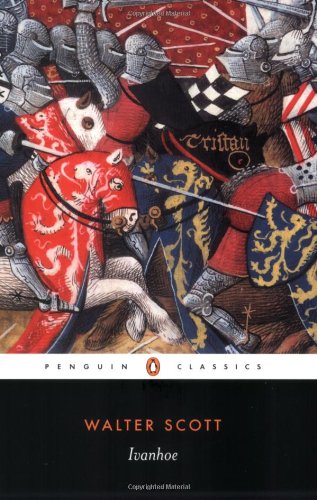
This is the cover of the Penguin Classics edition. The cover image shows ‘detail from a 15th century French illuminated manuscript showing a tournament‘.

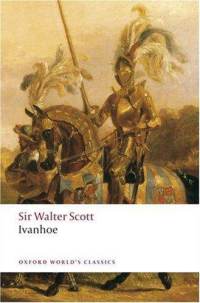
And here is the cover of the Oxford World’s Classics edition. The cover illustration is ‘Knight Enters the Lists at the Eglinton Tournament, of Archibald William Montgomery (13th Earl of Eglinton) by Edward Henry Corbauld (1815-1905)‘.

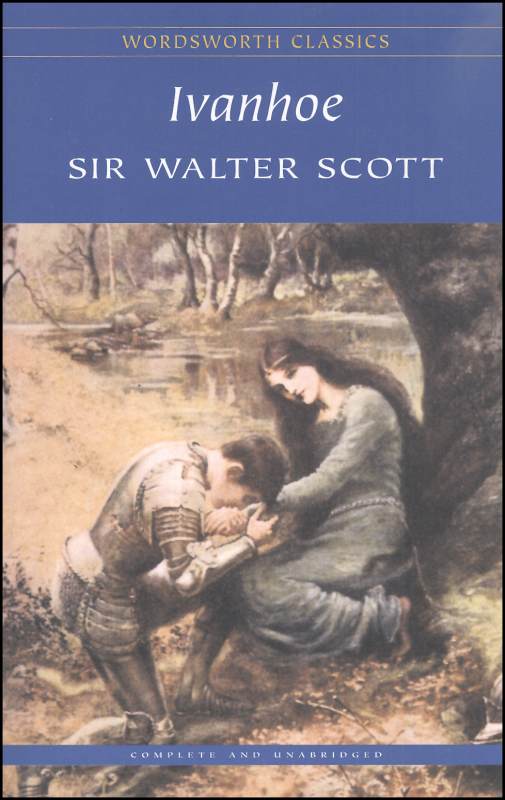
The third image I want to include here is the cover of the Wordsworth Classics edition. As you can see, this one is very different to the other two and shows ‘A medieval knight with his young lover (1898) by P. Clarke‘.

It’s interesting that only one of these three publishers has chosen to focus on the romantic aspect of the novel – if you picked up one of the other two without knowing anything about the story you would never guess there was any romance involved.

What do you think? Which of these covers would make you more likely to read the book?

Clarissa Group Read: March update

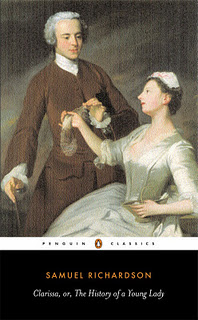
I’m taking part in a year-long group read of Clarissa by Samuel Richardson hosted by JoAnn and Terri. The story is told in the form of 537 letters, the first being dated 10th January and the last 18th December. The idea of reading Clarissa over an entire year is so that the letters can be read on or close to the dates mentioned in the book.

This is my first post on Clarissa since I started reading the book in January – I didn’t post an update in February as I wasn’t very far into the book at that point and felt I didn’t really have much to say about it. Following the group read schedule of reading the letters on or around the correct dates, January and February were lighter months in terms of the number of letters we needed to read (11 in total for those two months); March was much more intense (61 letters) and it didn’t surprise me at all that I soon found myself falling behind. This time last week I was starting to despair of ever making any progress with this book and was wondering whether I really wanted to continue with it – however, I decided to make a big effort to get caught up and I managed to finish the March letters this morning.

Like the January and February letters most of this month’s letters have been between our title character, Clarissa Harlowe, and her friend Anna Howe. Despite the fact that I’m now 3 months and 72 letters into the novel very little has actually happened in terms of plot advancement. Clarissa’s family are determined to keep her away from Lovelace and to force her to marry Mr Solmes, but Clarissa is equally determined not to marry him. It’s all getting very repetitive, with various members of the family pleading with her, commanding her or trying to bully her into doing as they request, and Clarissa refusing to give in to their demands. I was beginning to get impatient, wondering when Lovelace would eventually appear – and we finally heard from him in Letter 31.

Although Lovelace hasn’t yet done anything too bad (other than bribing one of the Harlowe’s servants to spy for him) it’s obvious that he really is going to be the villain Clarissa’s family and friends have suggested he is. He claims to love Clarissa, but it seems that he’s more interested in getting revenge on her family. I was interested to read Samuel Richardson’s footnote where he felt the need to explain some of Lovelace’s motives, as he was apparently disappointed that so many of his readers liked Lovelace and had been misinterpreting his letters. Personally I don’t there’s a single character in this novel that I actually like – though I do have sympathy with the position Clarissa is in and am very glad I’m not living in the eighteenth century!

After Lovelace’s appearance I thought the plot might start to move forward at last, but after Letter 72 things are still the same. The repetitiveness is very effective in showing how Clarissa is running out of options and how hopeless her situation is, but at the moment I feel as if the story is just going round in circles. I’m now ready to start reading the April letters and although I’m feeling much more positive about the book than I was a couple of weeks ago, I hope something is going to happen soon!

Three Men on the Bummel by Jerome K. Jerome

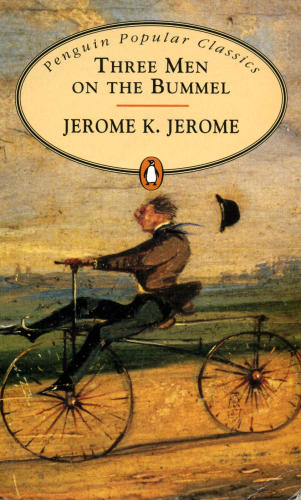
Last year I read Jerome K. Jerome’s Three Men in a Boat (To Say Nothing of the Dog) which was one of my favourite books of 2011 and one of the funniest books I’ve ever read. Three Men on the Bummel is the sequel, less well known but still worth reading. It’s set a few years after Three Men in a Boat but it’s not really necessary to read them in the correct order. In this book we join our old friends J, Harris and George again (this time without Montmorency the dog) on a bicycle tour across Germany’s Black Forest. There’s not much of a plot – like the first book, the whole story really just consists of a series of mishaps and disasters, funny anecdotes told by the three friends, descriptions of the places they visit, and some philosophical musings and observations from our narrator, J.

The humour in this book is very much the same as in the first and some of the stories are very similar too (if you remember reading about Uncle Podger in Three Men in a Boat, for example, there are more Uncle Podger stories here). But I did start to lose interest a little bit towards the end of the book and I couldn’t help feeling that maybe Jerome had used up most of his better ideas in the previous book. There’s nothing here that has stuck in my mind the way the pineapple incident or the Hampton Court maze did, to give just two examples. But there are still some moments that stand out: George being accused of embarking on a life of crime after getting on a train with the wrong ticket, the three of them being lost on a hillside arguing over which way was north, Harris and his encounter with a man watering the road, George’s experiment with a phrase book, and a few others. My favourite was the trick J and Harris play on George, leading him to believe a statue is following him around the town, appearing in four different places at once.

“Why, that thing,” said George; “look at it! There is the same
horse with half a tail, standing on its hind legs; the same man
without his hat; the same–”

Harris said: “You are talking now about the statue we saw in the
Ringplatz.”

“No, I’m not,” replied George; “I’m talking about the statue over
there.”

“What statue?” said Harris.

George looked at Harris; but Harris is a man who might, with care,
have been a fair amateur actor. His face merely expressed friendly
sorrow, mingled with alarm. Next, George turned his gaze on me. I
endeavoured, so far as lay with me, to copy Harris’s expression,
adding to it on my own account a touch of reproof.

“Will you have a cab?” I said as kindly as I could to George.
“I’ll run and get one.”

The German setting in my opinion didn’t work as well as a backdrop for the novel as the River Thames did in Three Men in a Boat but it does give Jerome an opportunity to have fun with British and German stereotypes (though in a gentle way, I thought) and the misunderstandings that could arise from differences in language and culture. He spends a lot of time discussing different attitudes to law and order for example:

Nowhere, and under no circumstances, may you at any time in Germany walk on the grass…The very dogs respect German grass; no German dog would dream of putting a paw on it. If you see a dog scampering across the grass in Germany, you may know for certain that it is the dog of some unholy foreigner. In England, when we want to keep dogs out of places, we put up wire netting, six feet high, supported by buttresses, and defended on the top by spikes. In Germany, they put a notice-board in the middle of the place, “Hunden verboten,” and a dog that has German blood in its veins looks at that notice-board and walks away.

Overall this wasn’t quite as funny as Three Men in a Boat and I can see why it’s not as popular, but I still enjoyed reading it. Both books were written in the late Victorian period (this one was published in 1900) but I would recommend them even to people who don’t usually like Victorian fiction as they do have quite a modern feel and a lot of the humour is still relevant today.

Oh, and if you’re wondering what the word ‘bummel’ means, it is explained but you’ll have to wait until the end of the book to find out!

Great Expectations by Charles Dickens

Despite my love of Victorian literature, Charles Dickens has never appealed to me as much as other 19th century writers and until recently the only Dickens novel I had actually read was A Christmas Carol. A couple of years ago I decided to give him another chance and although I still don’t think Dickens will ever be one of my favourite Victorians, I’m pleased to say that my opinion of his work is rapidly improving with every book of his I read!

Great Expectations is narrated by Pip, a young orphan who is brought up by his sister and her husband, Joe Gargery, a blacksmith. Near the beginning of the book two important incidents occur: first Pip meets an escaped convict in the graveyard near his home, and then soon after this he is invited to visit the eccentric Miss Havisham who lives at Satis House. When Pip unexpectedly receives a large sum of money he moves to London to become a gentleman and leaves his old friends behind. But who is the mysterious benefactor and will Pip’s ‘great expectations’ really change his life for the better?

I won’t go into the plot in any more detail for two reasons: firstly, because I suspect many of you will already be familiar with the story even if you haven’t read the book, and also because I wouldn’t want to spoil any of the surprises and plot twists the novel contains. But as well as the wonderful plot, Great Expectations is also full of strong and memorable characters. Miss Havisham, hidden away in her ruined mansion wearing her wedding dress, is probably the one most people will think of when they think of this book, but from the convict Abel Magwitch and Pip’s best friend Herbert Pocket to the lawyer Mr Jaggers and Miss Havisham’s adopted daughter Estella, the book is full of unforgettable characters. I posted a few weeks ago about one of my favourites, Joe Gargery, and how sad it is to see the way Pip’s relationship with Joe changes after he is given his great expectations.

If you’ve never read any Dickens before, I think this might be a good place to start. I’ve read four of his other novels (A Christmas Carol, Bleak House, Our Mutual Friend and The Mystery of Edwin Drood) and in comparison to some of those, I thought this one was much easier to read and understand. And I loved all the observations on life and human nature that Dickens scatters throughout his writing, like this:

“That was a memorable day to me, for it made great changes in me. But, it is the same with any life. Imagine one selected day struck out of it, and think how different its course would have been. Pause you who read this, and think for a moment of the long chain of iron or gold, of thorns or flowers, that would never have bound you, but for the formation of the first link on one memorable day.”

Or this:

“So, throughout life, our worst weaknesses and meannesses are usually committed for the sake of the people whom we most despise.”

Now I just need to decide which of Dickens’ books I should try next. I have three of his novels on my list for the Classics Club: David Copperfield, A Tale of Two Cities and Oliver Twist. Have you read any of those or is there another one you would recommend?

The Classics Club

Jillian of A Room of One’s Own has come up with a great idea to unite people who like to read and blog about classic literature. It’s called The Classics Club and the idea is to make a list of fifty or more classics you want to read within the next five years. Modern classics and re-reads can also be included.

My goal is to finish by 10 March 2017 and after a lot of thought I’ve chosen the sixty books listed below – though I suspect I’ll probably end up making some changes!

My list:

Emma by Jane Austen (re-read)
Pride and Prejudice by Jane Austen (re-read)
Aurora Floyd by Mary Elizabeth Braddon
Shirley by Charlotte Bronte
Jane Eyre by Charlotte Bronte (re-read)
Wuthering Heights by Emily Bronte (re-read)
Death Comes for the Archbishop by Willa Cather
Hide and Seek by Wilkie Collins
David Copperfield by Charles Dickens
Oliver Twist by Charles Dickens
A Tale of Two Cities by Charles Dickens
Crime and Punishment by Fyodor Dostoevsky
The Three Musketeers by Alexandre Dumas (re-read)
Twenty Years After by Alexandre Dumas
The Vicomte de Bragelonne by Alexandre Dumas
Rebecca by Daphne du Maurier (re-read)
Frenchman’s Creek by Daphne du Maurier
The Mill on the Floss by George Eliot
The Good Soldier by Ford Madox Ford
The French Lieutenant’s Woman by John Fowles
Wives and Daughters by Elizabeth Gaskell
Mary Barton by Elizabeth Gaskell
Sylvia’s Lovers by Elizabeth Gaskell
Cold Comfort Farm by Stella Gibbons
The Odd Women by George Gissing
The Return of the Native by Thomas Hardy
The Mayor of Casterbridge by Thomas Hardy
Far from the Madding Crowd by Thomas Hardy
The House of the Seven Gables by Nathaniel Hawthorne
The Hunchback of Notre Dame by Victor Hugo
The Remains of the Day by Kazuo Ishiguro
Washington Square by Henry James
The Haunting of Hill House by Shirley Jackson
The Princess of Cleves by Madame de Lafayette
The House by the Churchyard by Joseph Sheridan Le Fanu
The Painted Veil by W Somerset Maugham
Beloved by Toni Morrison
The Scarlet Pimpernel by Baroness Orczy
Excellent Women by Barbara Pym
The Romance of the Forest by Ann Radcliffe
Wide Sargasso Sea by Jean Rhys
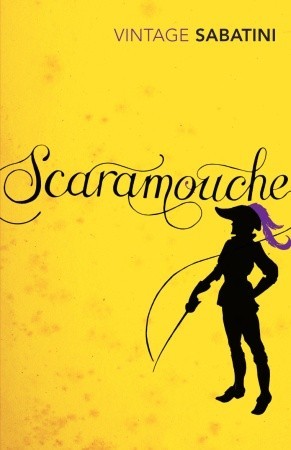
Scaramouche by Rafael Sabatini
The Heart of Midlothian by Sir Walter Scott
Frankenstein by Mary Shelley
Of Mice and Men by John Steinbeck
The Grapes of Wrath by John Steinbeck
The Strange Case of Dr Jekyll and Mr Hyde by Robert Louis Stevenson
Vanity Fair by William Makepeace Thackeray
The Small House at Allington by Anthony Trollope
The Last Chronicle of Barset by Anthony Trollope
Can You Forgive Her? by Anthony Trollope
Kristin Lavransdatter by Sigrid Undset
Around the World in Eighty Days by Jules Verne
The Time Machine by H.G. Wells
The Importance of Being Earnest by Oscar Wilde
The Age of Innocence by Edith Wharton
The House of Mirth by Edith Wharton
The Heir of Redclyffe by Charlotte M Yonge
La Bête Humaine by Emile Zola
Germinal by Emile Zola

Who else is joining the Classics Club?
Which books on my list do you think I should read first?

Mansfield Park by Jane Austen (re-read)

Mansfield Park is the story of Fanny Price who, at the age of ten, goes to live with her uncle and aunt, Sir Thomas and Lady Bertram. For Fanny, who has spent her early years in Portsmouth as part of a large working-class family, the Bertrams’ estate, Mansfield Park, is like a different world. While Fanny is grateful for the new opportunities she’s been given, she is made to feel inferior and insignificant by her cousins, Maria and Julia, and another aunt, Mrs Norris (surely one of the nastiest characters in any Austen novel). Only her cousin Edmund offers her any real kindness and friendship, and as the years go by Fanny begins to fall in love with him, although she doesn’t admit it and everyone, including Edmund, is unaware of it. And when Mary Crawford and her brother Henry come to stay at the nearby parsonage, Fanny’s peaceful life at Mansfield Park is suddenly thrown into turmoil.

I first attempted to read Mansfield Park when I was fifteen, immediately after finishing Pride and Prejudice, which I had loved. Compared to Pride and Prejudice I found this one very dry and boring, and gave up after a couple of chapters. Returning to it ten years later, I managed to read it through to the end but still didn’t like it very much. My recent re-read has been an entirely different experience and this time I found that I really enjoyed it!

Fanny Price is a shy, quiet person and seems to be Jane Austen’s least popular heroine, but I’ve never really had a problem with her personality. Not everyone can be witty and lively after all, and since arriving at Mansfield Park Fanny has constantly been reminded that she will never be equal to her cousins and treated almost like a servant, so it’s not surprising that she doesn’t have the confidence of some of the other Austen heroines. I would agree that she’s maybe not the most interesting of characters to read about, and I suppose I can understand why other readers might prefer Mary Crawford, but I personally don’t mind Fanny. I do think she has an inner strength and complexity which wasn’t really apparent to me the first time I read the book but which I could appreciate more this time – one of the reasons I think re-reads are so worthwhile!

I still didn’t like Edmund though, apart from at the beginning when he seems to be the only person who genuinely cares about Fanny. Without him her early days at Mansfield Park would have been a lot more miserable, but later in the book, particularly after the arrival of the Crawfords, he starts to really annoy me.

While Mansfield Park is never going to be my favourite Jane Austen novel, I’m glad I’ve given it another chance. If you’re new to Austen, though, I don’t think I would recommend starting with this one.

Clarissa Group Read: My thoughts so far

Throughout 2012 I’m taking part in the group read of Samuel Richardson’s Clarissa, hosted by JoAnn of Lakeside Musing and Terri of Tip of the Iceberg. I probably won’t be posting an update every month but I thought it would be a good idea to at least post at the beginning, at the end and a few times in between.

For those of you not familiar with Clarissa, the book was published in 1748 and has over 1500 pages. The story is told in the form of 537 letters, the first being dated 10th January and the last 18th December. The idea of reading Clarissa over an entire year is so that the letters can be read on or close to the dates mentioned in the book.

January’s letters form a series of correspondence between Clarissa Harlowe and her best friend Anna Howe. In the first letter we learn that Clarissa and her family are involved in some kind of scandal and Anna wants her friend to tell her the truth about what has happened. Clarissa then replies to Anna with an account of the events that followed her family’s introduction to Mr Lovelace. At first Mr Lovelace had been interested in Clarissa’s sister, Arabella, before turning his attentions to Clarissa herself. It seems that Clarissa’s entire family disapprove of Lovelace, particularly after her brother James gets into a fight with him and is wounded. In the last of the January letters Clarissa has been given permission to visit Anna and stay with her for a few days.

I love the concept of reading each letter on the correct date, but I’ll admit I haven’t been sticking exactly to the schedule. I’m concerned that although January and February have a manageable number of letters (6 in January and 5 in February) some of the other months have a lot more to read (61 letters in March, for example). I don’t want to fall behind later in the year so I’ve been reading slightly ahead of schedule to make sure that doesn’t happen. I know this isn’t quite the idea of the group read but I think it’s the only way I’m going to have time to read the whole book before the end of December.

As I didn’t already have a copy of Clarissa I considered buying the paperback for the readalong, but in the end I downloaded the Kindle edition of the book, which is divided into 9 volumes. There are a couple of advantages to this, I think. I know from my experience of reading other books with 1000+ pages that they can be physically difficult to hold, so at least I don’t have that problem with the ebook version. And it also seems less daunting somehow to be reading 9 separate shorter volumes instead of one thick book.

I was expecting Clarissa to be a difficult book to understand as I haven’t read a lot of 18th century literature, but I actually haven’t had too much of a problem with the language. I wouldn’t describe it as an easy read and I certainly haven’t understood every word, as there are some that are no longer in use or that had different meanings in the 18th century, but I’m trying not to worry about that as long as I can still follow what’s happening. I’m enjoying the story so far and looking forward to continuing with it throughout the rest of the year!