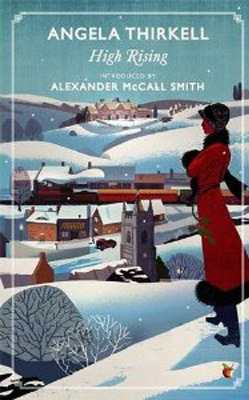
 Angela Thirkell is an author I’ve never read but have been meaning to try for a long time, so when I put my list together for this year’s 20 Books of Summer I decided to include High Rising. Originally published in 1933, this is the first of her Barsetshire novels, a series of twenty-nine books set in the fictional English county of Barsetshire which was created by Anthony Trollope in the 19th century. I loved Trollope’s Barsetshire novels, so I hoped for a similar experience with Thirkell’s.
The book begins with novelist Laura Morland, a widow with four sons, collecting her youngest, Tony, from school and bringing him home to the village of High Rising for Christmas. High Rising, together with nearby Low Rising, is the sort of small 1930s middle-class community in which everyone knows everyone else’s business and where the arrival of a newcomer causes a great deal of gossip and excitement. The newcomer in this case is Miss Una Grey, who has come to work as a secretary for Laura’s friend and fellow author George Knox. It seems that Miss Grey – or the Incubus as Laura calls her – has set her sights on marrying George and will do whatever it takes to get her wish. As well as trying to save George from the clutches of the Incubus, Laura spots the seeds of a romance between her publisher, Adrian Coates, and George’s daughter Sibyl, and decides to do what she can to push them together.
There’s not really much more to the plot than that, but what makes this book worth reading is not the plot but the characters and the interactions between them. Although some of the characters, such as Adrian and Sibyl, seemed to lack depth, others interested me much more – for example, Anne Todd, Laura’s secretary, who is trying to make a living through typing manuscripts while caring for her invalid mother. It took me a while to warm to Laura herself, but eventually I became quite fond of her; I can’t say the same for Tony, whom I found unbearably irritating with his incessant talk about his toy trains, which carriages and engines he should buy next and the model railway he wants to build in the garden. To be fair, though, I think there are a lot of children like Tony and he was probably the most convincing character in the book!
I couldn’t quite manage to love this book, but I enjoyed it overall. It does have some of the problems common to novels of this period, such as attitudes to race and class, and I also felt that it didn’t have a lot of substance, but otherwise it was a quick, light, entertaining read at a time when that was just what I needed. I don’t think I want to start the next book, Wild Strawberries, immediately, but I’m sure I will read it at some point.

Book 3/20 of my 20 Books of Summer 2021
This is also book 20/50 read from my second Classics Club list.



 She Reads Novels