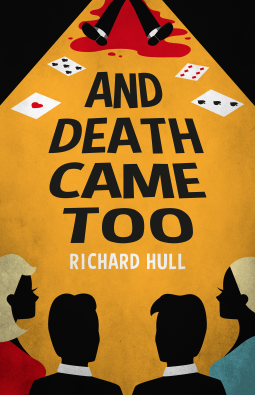
And Death Came Too by Richard Hull

Richard Hull’s The Murder of My Aunt was one of my favourite books read in 2018; I loved the humour, the narrative voice and the clever plot twists and couldn’t wait to read more of the author’s classic crime novels. The one I chose next was And Death Came Too, which has recently been reissued by Agora Books.

First published in 1939, the novel gets off to a very intriguing start, introducing us to four friends who are attending a series of charity balls at Trevenant Hall when they receive an invitation from a neighbour, Arthur Yeldham, who has recently moved into nearby Y Bryn House. The four – Martin Hands and his sister Patricia; Patricia’s fiancé Gerald Lansley; and a friend, Barbara Carmichael – don’t really want to go, but reluctantly accept and set off together for Y Bryn.

On their arrival, they are surprised to find that there is no sign of their host. Instead, there are two strangers sitting at the table: a man playing a game of solitaire who says his name is Mr Salter, and a mysterious woman whose name nobody knows. As you can imagine, the conversation is extremely awkward, especially when the unknown woman suddenly stands up and leaves with no explanation. Next, a police constable enters the room and helps himself to a drink before announcing that there has been a murder: Arthur Yeldham has been found dead in his study but no weapon has been found and the time of death is unclear. With at least six suspects to choose from – and a range of clues which could point the way to the truth or be complete red herrings – it’s not going to be an easy mystery to solve.

At this point I was anticipating another unusual and original novel like The Murder of My Aunt, but apart from the fascinating opening scenes this was a much more conventional detective story. I still enjoyed following the investigations and sorting through the clues, but in the second half of the novel it became quite obvious who the murderer was and I wasn’t at all surprised when the truth was revealed. The ending was very abrupt as well; the story just seemed to end in the middle of a conversation!

The main characters in the novel – the four friends and the two strangers they encounter at Yeldham’s house – have interesting backgrounds and motives, although none of the six are very likeable. We don’t see any of them getting very involved in amateur investigations – all of that is left to the police, and one element of the book which I did find slightly unusual is that we meet so many different policemen! There are several of them, some local and some from Scotland Yard, of different positions and ranks, all working on separate aspects of the crime. The competition and rivalry between them added another layer of interest to the novel, although on the other hand I think I prefer having just one or two detectives to follow and get to know.

This is a perfectly good, solid murder mystery novel, but I was slightly disappointed with it because, based on my previous experience of Richard Hull, I had hoped for something more imaginative. I will probably still try one or two more of his books. I like the sound of The Ghost It Was and Keep It Quiet, also from Agora Books. Has anyone read either of those – or any other Richard Hull novels?

I received a copy of this book for review via NetGalley.
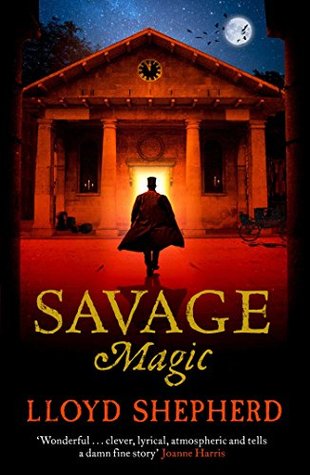
Savage Magic by Lloyd Shepherd

Savage Magic, published in 2014, is Lloyd Shepherd’s third historical mystery to feature Charles Horton of the Thames River Police. The books all stand alone, so if you’ve never come across this series before you could easily read this one first without having read the previous two. Having said that, I found the other two – The English Monster and The Poisoned Island – much stronger and wouldn’t recommend starting here.

After a brief prologue, Savage Magic opens in London in 1814 with Abigail Horton entering Brooke House, a ‘private madhouse for the deranged’. She has made the decision to do this voluntarily as she has been suffering from visions of a wild, savage woman, haunting her dreams and pursuing her through her waking hours. Afraid she is losing her sanity, Abigail hopes she can receive the help she needs at Brooke House, but her husband, Constable Horton, is hurt when he discovers that she has done this without confiding in him first.

Meanwhile, Horton’s superior, the magistrate Aaron Graham, is also concerned about his own wife, who has left him to go and live with her new lover, taking their young daughter with her. Graham has heard some very disturbing rumours about Thorpe Lee House, where his wife and daughter are now living, and he sends Horton off to investigate. Horton has barely left London when a murder takes place, under the strangest of circumstances. A wealthy, aristocratic gentleman is found dead in his own bed, wearing a satyr’s mask on his face. This is only the first in a series of similar murders in which all of the victims are from the same social circle and all disguised by a mask. With Horton gone, Graham is left to investigate the killings himself.

At first, the separate strands of the story feel quite unconnected, with Graham trying to solve the London murders and Horton, miles away, becoming embroiled in accusations of witchcraft and hauntings at Thorpe Lee House. Eventually, everything begins to fall into place and we see how they are linked – and how the key to the entire mystery may lie in the events which occur behind the walls of Brooke House Asylum.

Reading back over what I’ve written above, I know this sounds like the sort of book I would usually enjoy…and yet I was disappointed. It’s possible that if I hadn’t loved Lloyd Shepherd’s first two novels so much, I might have liked this one more, but I’m not sure. The English Monster combined an investigation into the Ratcliffe Highway Murders with a pirate adventure in the Caribbean, while The Poisoned Island featured the story of a Tahitian prince. By comparison, I found this book less exotic, less exciting and lacking the originality of the previous two. It seemed like a much more conventional novel and, although I was pleased to see Abigail given a larger role to play, the asylum storyline is something I feel I’ve read several times before.

I do still like Lloyd Shepherd’s writing (despite the annoying use of present tense) and I love the way he creates atmosphere – the scenes which take place at the supposedly haunted Thorpe Lee House are particularly good and, knowing how Shepherd has used supernatural elements in his other books, I was kept wondering whether there really were witches at work or whether there was a more logical explanation. There was too much switching between one storyline and another, though; there were too many different threads to keep hold of and it took too long for them to start coming together.

The fourth book in the series, The Detective and the Devil, sounds more promising. I haven’t been put off reading it, but I’m not in any hurry either.

Blood & Sugar by Laura Shepherd-Robinson

This new historical mystery – Laura Shepherd-Robinson’s first novel – deals with one of the darkest subjects in our history. Set in 1781, it follows the investigations of former army officer Captain Harry Corsham into the disappearance of his friend, the lawyer and abolitionist Tad Archer. It seems that Tad had been about to uncover a secret that, once exposed, could damage the reputations of those involved in the British slave trade. Could someone have killed Tad to prevent him from telling what he knows?

Captain Corsham is determined to find out what has happened to his friend, but to do so he will need to continue Tad’s enquiries into a shocking incident which took place onboard a ship carrying slaves across the Atlantic. This brings him into conflict with some very powerful men who could destroy his hopes of a political career. But Harry Corsham is a man with principles and even when he, like Tad before him, begins to receive threatening letters and warnings, he refuses to walk away until he has discovered the truth.

There are many things I liked about Blood & Sugar. The setting and atmosphere are wonderful; with the action taking place partly in London, where Harry Corsham lives with his wife, Caro, and their young son, and partly in the nearby slaving port of Deptford, we see Harry move between both locations in search of answers to his questions. I loved the contrasting descriptions of Deptford, from the elegant homes of the wealthy slave merchants to the notorious dockside alleys with their brothels and opium dens.

We also meet a wide range of characters from very different backgrounds, including magistrates, politicians, mayors and surgeons, prostitutes, innkeepers, sailors and servants. Many of the latter group are black, which is interesting because I think we tend to forget (or are not aware of) how many black people there were living in eighteenth century Britain. It is estimated that there were more than twenty thousand in London alone, yet they rarely appear in fiction set during that period. As for the slavery aspect of the story, there are parts that are not easy to read, as you can probably imagine – particularly when we hear about what happened on the ship, something which is based on a real incident. But unpleasant as it is, we can’t ignore the fact that slavery did happen and I think it’s important that we remember and learn from it.

I was very impressed with this book at the beginning. I liked Laura Shepherd-Robinson’s writing, the mystery seemed intriguing and I was starting to draw comparisons with one of my favourite historical crime authors, Andrew Taylor. However, as the plot continued to develop, I thought it became far too complicated and I struggled to remember who had said what to whom and what the various motives of the characters were. Towards the end, there were so many threads to tie up that everything seemed to take forever to be resolved (and there were one or two revelations which added very little to the overall story and weren’t really necessary, in my opinion). I also felt that as there were so many characters to keep track of, they really needed to be better defined – instead, I thought they were thinly drawn and not very memorable.

I’m disappointed that I didn’t enjoy this book as much as I thought I would at first, but I still think there were more positives than negatives and as this is the author’s first novel I would be happy to read more.

Thanks to Pan Macmillan for providing a copy of this book for review via NetGalley.
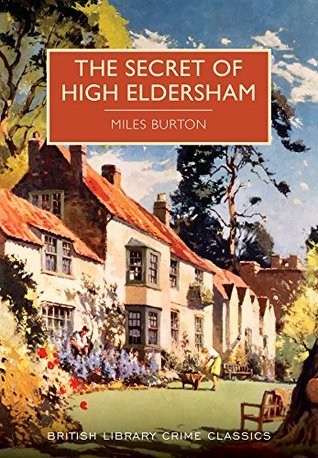
The Secret of High Eldersham by Miles Burton

This is one of two Miles Burton novels currently available as British Library Crime Classics (the other is Death in the Tunnel). The reviews of this one seemed to be very mixed so I wasn’t expecting too much from it – and although I did find it enjoyable enough, it hasn’t become a favourite from the BLCC range.

Published in 1930, The Secret of High Eldersham seems at first to be a typical Golden Age murder mystery and High Eldersham itself to be a typical English village. We soon discover that neither of those things are true. The novel opens with the murder of Samuel Whitehead, the landlord of the Rose and Crown – and a newcomer to the village. Whitehead has been stabbed to death inside the inn and in the absence of any clues as to the motive or suspect, the local police call in Detective Inspector Young of Scotland Yard.

As Young begins to investigate, he can’t help feeling that there’s something sinister about High Eldersham. Why has it acquired such a strange reputation? Why do outsiders ‘never prosper’ in this quiet little East Anglian village? When, in the course of his inquiries, he notices something that makes him question what is really going on in High Eldersham, he summons his friend Desmond Merrion to come and help him uncover the truth.

This is apparently the first in a whole series of novels featuring the character of Desmond Merrion, amateur detective and former military intelligence officer. I found him quite bland in comparison with other fictional detectives, but in some ways that was probably a good thing as there was nothing annoying about him either – he just quietly gets on with the job of detecting! He also has a very likeable valet, Newport, who is as much a friend as a servant and who goes off and does some investigating of his own. It’s a very male-dominated novel, but there is one female character, Mavis Owerton, who has an important part to play in the story – beyond just providing a convenient love interest for several of the male characters.

Despite the murder which is committed at the beginning of the novel, this is much more of a thriller than a murder mystery and Merrion and Young become more concerned with discovering what the people of High Eldersham are trying to hide rather than finding out who killed Samuel Whitehead. I didn’t really have a problem with this as I do like either sort of crime novel, but I was still disappointed that the other elements of the story started to dominate to the point where we lost sight of the murder almost completely.

I found it very easy to guess what sort of crime was taking place in the village, but maybe it would have been less obvious to 1930s readers. There’s also another subplot, which has a hint of a supernatural element. I understood the relevance of this to the story and it does contribute to the eerie atmosphere of High Eldersham, which was already a creepy place due to its isolation and hostility to strangers, but I thought it was just one layer too many. There was too much time spent racing around on yachts and speedboats for my liking as well, although that’s probably just me – I’ve written before about my aversion to books about sailing!

I did like Miles Burton’s writing and I would read more of his books, but The Secret of High Eldersham wasn’t really for me. Death in the Tunnel sounds more appealing so maybe I’ll try that one.

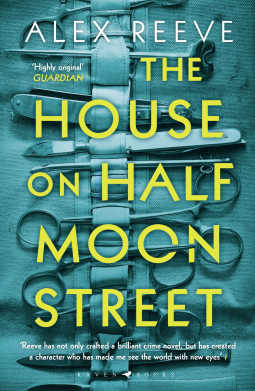
The House on Half Moon Street by Alex Reeve

The House on Half Moon Street is both an interesting historical crime novel set in Victorian London and a sensitive exploration of what it means to be transgender in a less enlightened time. This is apparently the first in a planned series and I will certainly be looking out for the next one.

Our hero, Leo Stanhope, is a coroner’s assistant in 1880s London. As the novel opens, the body of a man washed up by the Thames has been brought to the hospital where Leo works. Identified as Jack Flowers and believed to have fallen into the river accidentally, the man’s death seems to be an unfortunate tragedy, but not something which affects Leo personally. However, the next body to arrive is that of a woman – a woman who happens to be the love of Leo’s life, Maria Milanes, and who appears to have been murdered.

Before her death, Maria was a prostitute at a brothel on Half Moon Street, but that didn’t matter to Leo. He loved her and knew that she loved him. Maria was one of the few people he had trusted with his secret, one of the few people who knew that Leo Stanhope was born Charlotte Pritchard. Now Maria is gone and Leo vows to find out who has killed her. Joining forces with pie maker Rosie, Jack Flowers’ widow, he begins to uncover some links between both deaths – but at the same time he must ensure that his own secret is not uncovered, because the truth could have serious consequences.

On one level, as I’ve said, this is a compelling and well-constructed murder mystery. Although I found the pace a bit slow at times, I did enjoy watching Leo move around Victorian London, looking for clues in the Half Moon Street brothel, playing chess with his friend Jacob and word games with his landlord’s daughter in the pharmacy where he lodges, or paying a visit to the midwife and abortionist Madame Moreau, whom he hopes may be able to shed some light on the situation. All of these people and locations are vividly described and all play their part in Leo’s investigations.

Leo himself is easy to like and to warm to; he narrates his story in the first person, letting us into his mind and his heart. I know things are not perfect for transgender people today and that they still face a lot of prejudice, obstacles and challenges, but I can hardly imagine how difficult life must have been for people like Leo who lived more than a hundred years ago. I admired him for his courage in being true to himself and not just continuing to be someone he was not; I was sorry for the sacrifices he’d had to make in adopting his true male identity and the lack of support he received from those he should have been able to rely on; and I was afraid for him too, because he is in such a vulnerable position.

I should warn you that due to the nature of the story, the type of mystery it is and Leo’s vulnerability, the novel does become very dark in places. Although I didn’t find it unnecessarily graphic or violent, there are still a few scenes which are quite disturbing. The Victorian era was certainly not the safest time in which to live if you were seen as different in any way. I’m sure Leo will have more ordeals to go through as the series progresses, but I hope there will be some happiness in store for him too.

Thanks to Raven Books for providing a copy of this book for review via NetGalley.
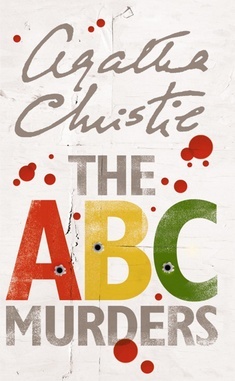
The ABC Murders by Agatha Christie

When I read about the Read Christie 2019 Challenge hosted at www.agathachristie.com – the idea being to tick off twelve books from twelve different categories over the course of the year – I was immediately tempted to join in. I didn’t want to think of it as a challenge as such, or make a definite commitment, but I thought I could use the monthly prompts to get through some of the many Christies I still haven’t read. This month’s category is “a recent TV adaptation” and the suggested book is The ABC Murders. I had started to watch the new BBC adaptation of The ABC Murders which was shown at Christmas, but struggled to get into it, so I thought I would try the book instead. And what a great book it is!

The murder of Alice Ascher in her small tobacconist shop in the town of Andover seems as though it should be an easy one to solve. There is an obvious culprit – the woman’s drunken husband – and he would certainly have been the prime suspect, if not for a mysterious coincidence which happened just days before the murder. Hercule Poirot had received a typewritten letter signed simply A.B.C. and warning of a crime to be committed in Andover on that particular date – and beside the body of the dead woman was a copy of the ABC Railway Guide.

But this will not be the only murder to take place:

‘I admit,’ I said, ‘that a second murder in a book often cheers things up. If the murder happens in the first chapter, and you have to follow up everybody’s alibi until the last page but one – well, it does get a bit tedious.’

When a similar letter arrives soon afterwards giving advance warning of a second murder which will happen in Bexhill, it doesn’t come as a surprise to Poirot when the second victim has a name beginning with B and when another ABC Guide is found next to the body. Convinced now that the killer is following an alphabetical pattern, Poirot must uncover his or her identity before they get all the way to Z.

This is one of several Poirot novels narrated by Captain Hastings (although there are a few chapters written from the perspective of other characters). I always seem to enjoy the ones with Hastings, partly because he, like the reader, is often in the dark and needs Poirot to explain things to him, but also because I think Poirot having a friend to discuss things with gives these books a different dynamic to the ones where he is working entirely on his own amongst strangers. Sometimes Hastings can make an observation or suggestion which proves to be useful later on, as he does once or twice in this book. Inspector Crome is investigating too, and a ‘legion’ of the victims’ families and friends is also formed to see whether they can shed any light on the situation.

What makes this book so intriguing is that each of the murders which takes place seems unrelated to the others, apart from the ABC theme and the letters sent to Poirot. They each have a separate set of suspects, all with their own motives, but what Poirot needs to do is find something which links them all to one man or woman – the mysterious A.B.C. I found this a particularly clever Christie novel and didn’t come close to solving it. I allowed myself to be sent in completely the wrong direction by the red herrings and took everything at face value; in fact, for a long time I thought I was reading a different sort of mystery entirely.

I loved this one and I think I did the right thing in reading it before trying to watch the adaptation again. I’m planning to read another Christie novel in February, although I don’t know what it will be yet – I’m waiting to see what the chosen category will be for the next stage of the challenge.

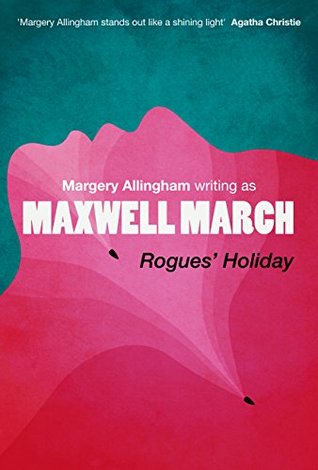
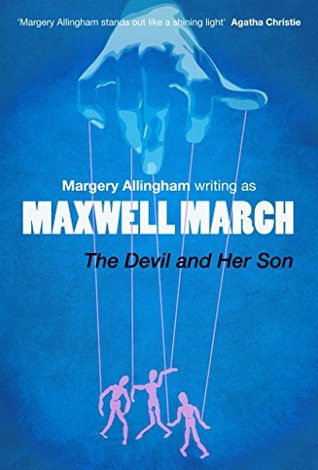
Margery Allingham writing as Maxwell March: Rogues’ Holiday and The Devil and Her Son

A while ago I read an early novel by Margery Allingham published under the pseudonym Maxwell March. It was called The Man of Dangerous Secrets and, although it was undoubtedly silly and over the top, I enjoyed it so much I knew I would be reading her other two Maxwell March books as soon as the time was right. Well, the time was right this month and I have now read both Rogues’ Holiday (1935) and The Devil and Her Son (1936).

Rogues’ Holiday begins with the death of a young man found dead in a locked room at his London club. Suicide is assumed, but Inspector David Blest of Scotland Yard is not convinced. Having learned that the dead man had been seen arguing with Sir Leo Thyn, an older and highly respected member of the club, shortly before his death, David wonders whether there is a connection. He shares his suspicions with his superior officer, who tells him to keep his opinions to himself and sends him off on his scheduled two-week holiday as planned.

But David has no intention of taking a holiday. Instead, he heads for the Arcadian Hotel in the seaside resort of Westbourne – the same hotel where Sir Leo Thyn is now staying with a friend, a man whom David immediately recognises as a notorious criminal known as The Major. Another guest has also just arrived at the hotel: this is Judy Wellington, a young heiress who claims to be a permanent invalid, but David suspects that she is not in such poor health as she pretends. When another murder takes place, he discovers that he has walked into a whole nest of rogues – but how is Judy mixed up in it all and could she be in danger?

As I’d already read The Man of Dangerous Secrets, I had a good idea of what to expect from this book. I knew it would be more thriller than detective novel, I knew there would be wicked villains, far-fetched plot twists, last-minute escapes and coincidences galore, and I knew there would be a beautiful girl with whom our hero would fall in love at first sight. And yes, Rogues’ Holiday has all of those things. You probably wouldn’t describe it as a fantastic piece of literature and I’m sure it doesn’t represent Margery Allingham at her very best, but accept it for what it is and it’s a lot of fun to read.

I thought The Devil and Her Son (originally published as The Shadow in the House) would be similar and in some ways it is. The ridiculous plot, the coincidences, the villains and the unbelievable plot twists are all here again – but this is a much darker novel than the other two and, I thought, a better written one.

The novel opens with Mary Coleridge feeling very sorry for herself. She has lost her job as a governess, her love interest has left town with no explanation after their first date, and she has no family or friends to turn to. So, when Marie-Elizabeth Mason, another lodger in the boarding house where Mary lives, makes an outlandish suggestion, Mary feels she has nothing to lose. Miss Mason has recently arrived in England from Australia and an elderly aunt whom she has never seen is expecting her to go and visit. Preferring to stay in London to pursue an acting career, Miss Mason’s idea is that she and Mary switch identities and Mary goes to stay with the aunt instead.

This is clearly a ludicrous plan, but somehow it works (and Mary’s lack of Australian accent is not even remarked on). However, she gets more than she’d bargained for when Aunt Eva persuades her to marry her dying son to prevent the house from being lost to the family. Feeling sorry for the old woman, Mary agrees, despite her guilt at marrying under a false name and deceiving everyone. But soon she discovers that she herself is the victim of an even bigger deception and that Eva and her family are not what they appear to be. Can Mary escape from the terrifying situation in which she has placed herself?

Once you’ve accepted the premise of the story, this is a very enjoyable novel. Eva de Liane is a truly chilling and sinister woman and I was genuinely afraid for poor Mary – although I also wanted to scream at Mary for walking blindly into danger over and over again! This is a novel where nobody at all can be trusted, where even a stranger in the street or on a train could be somehow wrapped up in the de Lianes’ nefarious schemes. There’s also a romance which wasn’t quite as obvious as the one in Rogues’ Holiday and rather than being love at first sight, is much more satisfying because it takes longer to develop.

Maxwell March has been a great discovery for me and I’m sorry Margery Allingham only wrote three books under that name!