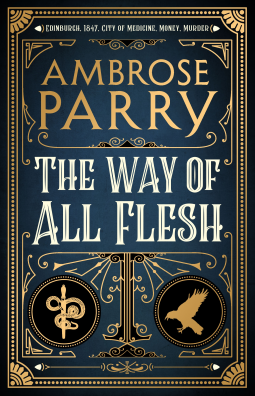
The Way of All Flesh by Ambrose Parry

The Way of All Flesh is the first in a new historical mystery series written by husband and wife team Chris Brookmyre and Marisa Haetzman under the pseudonym Ambrose Parry. Brookmyre is an established crime novelist, while Haetzman is a consultant anaesthetist with a Master’s in the History of Medicine – the perfect combination when writing a crime novel set in the medical world!

It’s 1847 and young medical student Will Raven has secured a position as apprentice to the renowned Scottish obstetrician Dr James Simpson. Simpson is one of Edinburgh’s leading doctors and Raven intends to make the most of this wonderful opportunity to gain experience in the fields of midwifery and anaesthesia. Unfortunately, he doesn’t get off to the best of starts: just before he is due to begin his apprenticeship he discovers the dead body of his friend Evie, a prostitute whom he has being trying to help financially. Stumbling away through the dark streets of Edinburgh’s Old Town, he is attacked by a gang sent after him by a moneylender and turns up battered and bruised for his first day at work – definitely not the impression he had hoped to give!

Settling into his work with Dr Simpson and his colleagues, Raven is required to assist at some difficult births and quickly comes to appreciate the role ether can play in easing the pain of childbirth. During his visits to other households, and in his conversations with other doctors, Raven begins to hear about other women from the Old Town who have been found dead, like Evie, under suspicious circumstances. Determined to find out what really happened to Evie, he decides to investigate…

But this is not just Raven’s story. We also meet Sarah Fisher, Dr Simpson’s housemaid. Sarah is an intelligent young woman who would love to have the opportunities that have been given to Will Raven, but as a career in medicine is not available to her because of her gender and class, she has to resign herself to reading the doctor’s medical books and helping out in his clinic as much as she can. Sarah and Will take an instant dislike to each other, but as they continue to work together – not just in the same household, but also to track down the murderer – they begin to find some common ground.

The Way of All Flesh is a fascinating read for anyone who is interested, as I am, in the history of medicine. Some of the doctors and scientists who appear in the book, including James Simpson, are real historical figures and the novel recreates some of the experiments, discoveries and research that led to the development of anaesthetics, as well as some of the challenges they faced – such as the opposition of the Scottish church leaders, who believed it was natural for women to feel pain in childbirth and that using drugs to relieve it was against the will of God. Remembering that one of the authors of this book is an anaesthetist herself, everything feels very authentic and convincing. I should warn you, though, that the descriptions of childbirth and other medical cases and operations are very detailed and occasionally a bit gruesome!

It was actually the crime element which was the least successful aspect of the book for me. I felt that it took second place to the medical procedures and scientific discussions and after a while I lost track of who had been killed and what the circumstances were; it just wasn’t the sort of mystery I prefer, where I find myself looking for clues and trying to guess who the culprit could be. The setting makes up for it, though – the descriptions of Victorian Edinburgh are wonderfully atmospheric.

Although I thought the secondary characters could have been given more depth, I did enjoy getting to know both Will Raven and Sarah Fisher. This was a promising start to a new series and I will be looking out for the second book.

This is book 13/20 of my 20 Books of Summer.

Thanks to Canongate Books for providing a copy of this book for review via NetGalley.

Michael Innes: The Secret Vanguard and The Daffodil Affair

I don’t think you could accuse Michael Innes of being formulaic – each book of his that I’ve read has been entirely different from the last! I’ve read two recently (The Secret Vanguard and The Daffodil Affair) and thought I would write about both of them in this post.

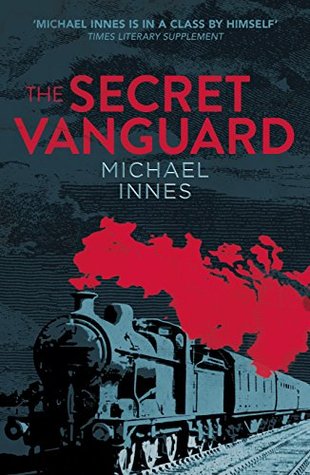
The first one, The Secret Vanguard, was published in 1940 and is the fifth in the Inspector Appleby series. It is set just before the beginning of World War II and is much more of a spy thriller than a detective novel. Our heroine, Sheila Grant, is on her way to Scotland to visit family when she overhears a conversation between some fellow passengers on the train, one of whom is reciting a poem by Swinburne. Sheila, who happens to be familiar with the poem, knows that it has been misquoted and can’t resist saying so – but when she is captured and held prisoner after disembarking from the train, she wishes she had said nothing. It seems that the misquoted poem contained a secret message and that Sheila is now in possession of information which could make her a threat to some very dangerous enemies.

It’s not long before Inspector John Appleby gets involved and begins to link Sheila’s abduction with the recent murder of a minor poet, Philip Ploss, and the disappearance of a scientist who has been working on a secret formula which could help the war effort. There are lots of twists and turns as Appleby tries to track Sheila and the missing chemist through the Scottish Highlands and Sheila tries to escape from her kidnappers, unsure of who she can and can’t trust. Although it’s all very melodramatic and unlikely, I did find it quite a fun, fast-paced read. However, the constant chase scenes, last-minute escapes and cases of mistaken identity became a bit tedious after a while. A good entry in the series, but not a great one.

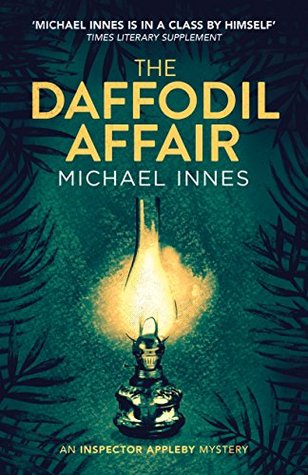
The Daffodil Affair isn’t a typical detective novel either. Published two years after The Secret Vanguard, in 1942, the war is an influence on this novel too, but I won’t say much more about that as I would be risking giving away too much of the plot.

In The Daffodil Affair, Appleby and his colleague Hudspith are investigating three separate mysteries, none of which are the sort of thing you would expect two Scotland Yard detectives to become involved in. First, there is the theft of Daffodil, an extraordinary horse who seems able to count and to read minds. Next, there’s the disappearance of Lucy Rideout, a vulnerable young girl who appears to have been lured away from home by promises of a trip to the island of Capri. Finally, and strangest of all, an entire house has vanished from a street in London – a house which is said to have been haunted.

These three strange occurrences may seem at first to be unconnected, but links soon start to emerge and an adventure begins which sends Appleby and Hudspith on a voyage to South America in the company of the sinister Mr Wine. All sorts of paranormal phenomena are incorporated into the story, including telepathy, séances, witchcraft, hauntings and possession by demons. Some of the situations in which our detectives find themselves are quite surreal and implausible, but there are darker undertones too, which is where the war influence comes in. I think Mr Wine’s schemes and actions would have been frighteningly relevant to readers in the 1940s.

Again this is an entertaining novel, but I found it too bizarre to be truly enjoyable. On the plus side, we do see a lot of Appleby, who has a much bigger role to play than he does in some of the other books in the series. Of these two novels, I preferred The Secret Vanguard, but I don’t think I would recommend either of these as a first introduction to Innes. I would start with Hamlet, Revenge! for a good literary murder mystery or Lament for a Maker if you’re in the mood for a novel in the style of Robert Louis Stevenson with multiple narrators and plenty of Scottish dialect. Those are my two favourites so far.

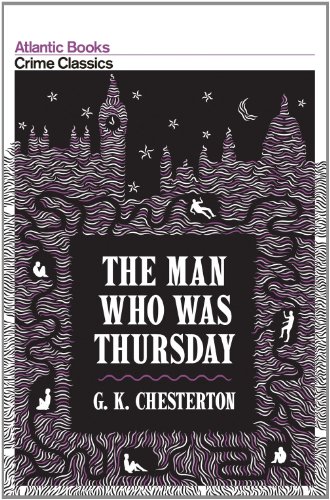
The Man Who Was Thursday by GK Chesterton

This 1908 novel from the author of the Father Brown mystery series is subtitled A Nightmare and it certainly does have a dreamlike feel. I picked it up expecting a vintage detective novel and emerged at the other end wondering what on earth I had just been reading and what it meant.

The novel opens with a conversation between two men who meet for the first time one evening in Saffron Park in London. One, Lucian Gregory, is an anarchist poet; the other, Gabriel Syme, is a member of the secret anti-anarchist police. They spend the whole of the first chapter debating the meanings of anarchy and of law and order, using arguments like this:

Gregory struck out with his stick at the lamp-post, and then at the tree. “About this and this,” he cried; “about order and anarchy. There is your precious order, that lean, iron lamp, ugly and barren; and there is anarchy, rich, living, reproducing itself—there is anarchy, splendid in green and gold.”

“All the same,” replied Syme patiently, “just at present you only see the tree by the light of the lamp. I wonder when you would ever see the lamp by the light of the tree.”

And this:

“An artist disregards all governments, abolishes all conventions. The poet delights in disorder only. If it were not so, the most poetical thing in the world would be the Underground Railway.”

“So it is,” said Mr. Syme.

“Nonsense!” said Gregory, who was very rational when anyone else attempted paradox.

It seems they will never agree, but to at least prove that he is serious about his cause, Gregory invites Syme to accompany him to an underground meeting of anarchists. Gregory gets more than he bargained for, however, when Syme puts himself forward for a position in which he himself had been interested: one of seven coveted seats on the Council of the Seven Days, the central council of the European anarchists.

Elected to the council and given the code name Thursday, Syme is introduced to his fellow days of the week, but will he be able to prevent them from guessing that he is an undercover policeman? And who is Sunday, their mysterious and sinister leader who is so big, so powerful and so much larger than life?

I don’t think there is much more I can say about the plot without spoiling the story. I can’t discuss the themes of the novel either, or the symbolism it contains, because those things are also spoilers. It’s such a strange and unusual book that I really think it’s best not to know too much about it before you begin. Just be aware that it’s not a conventional mystery or detective novel (or a conventional anything). There are parts that I loved, such as a scene where Syme is followed through the streets of London in the snow; there are funny moments too, some witty and amusing dialogue, and lots of thought-provoking philosophical ideas. At other times it becomes a little bit too bizarre, particularly after the action moves to France halfway through the book.

There are plot twists throughout the novel, some of which are quite predictable – but the revelations near the end of the book were not what I had been expecting at all. Looking back, there were plenty of hints and clues, but I didn’t pick up on them. I’m sure I didn’t fully grasp what Chesterton was trying to say, but I think there are probably different ways to interpret this book anyway. It certainly left me with a lot to think about and I love it when that happens – when you continue to engage with a story even after you’ve turned the final page.

I don’t have any more of Chesterton’s books, but I see there are some I could read for free at Project Gutenberg. I have previously read two of his Father Brown short stories (included in Miraculous Mysteries and Murder Under the Christmas Tree); should I read more of those or is there another of his books that you would recommend?

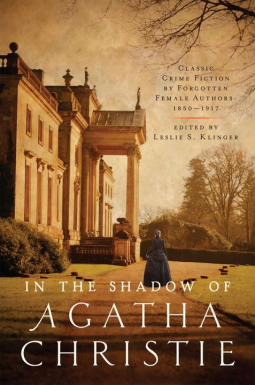
In the Shadow of Agatha Christie, edited by Leslie S. Klinger

Agatha Christie is an author most people have heard of, whether or not they’ve ever read any of her books. Ask someone to think of a female crime writer and she is probably the first name that will come to mind. Christie’s first novel, though, wasn’t published until 1920 – and she was by no means the first woman to write in the crime genre. This new collection of short stories, edited by Leslie S. Klinger, features some of the lesser known women crime writers who came before Agatha and could even have inspired her work.

The book is subtitled Classic Crime Fiction by Forgotten Female Writers: 1850-1917 and although I wouldn’t personally describe all of these authors as ‘forgotten’, there were certainly quite a few whose names were new to me. Of the sixteen stories included in the book, I had already read one of them – A Jury of Her Peers by Susan Glaspell (1917), which shows the different ways in which men and women evaluate the same situation and the different clues they pick up on – but it’s such a good story I was happy to read it again. Other names who may be familiar to many readers are Victorian novelist Elizabeth Gaskell and Scarlet Pimpernel author Baroness Orczy, although the stories included here – The Squire’s Story (1853) and The Regent’s Park Murder (1901) – didn’t particularly stand out to me.

As a fan of Victorian sensation novels, I was intrigued to come across stories by Ellen Wood and Mary Elizabeth Braddon, two authors whose work I’ve loved in the past. The Braddon one, The Winning Sequence (1896), is more of a ghost story than a mystery and I found it disappointingly weak, but Wood’s story, Mrs. Todhetley’s Earrings (1873), was very enjoyable. It is narrated by her young hero, Johnny Ludlow, who is apparently the subject of a whole series of short story collections, although I had never heard of him until now.

Others that I think deserve a special mention include The Statement of Jared Johnson (1899) by Geraldine Bonner, a murder mystery with a twist I’ve come across several times in crime stories recently but which I always find clever, The Ghost of Fountain Lane (1893) by C.L. Pirkis, in which a link emerges between two seemingly unconnected mysteries, and The Case of the Registered Letter by the Austrian author Augusta Groner. There’s also A Point in Morals (1899) by Ellen Glasgow, an unusual story which considers whether murder is always morally wrong, The Blood-Red Cross (1902) by L.T. Meade which features a sinister villain called Madame Sara, and Anna Katherine Green’s Missing: Page Thirteen (1915), an eerie tale of a house with a secret room.

The other authors represented in the book, whose work made less impression on me, are Catherine Crow, Mary Fortune, Harriet Prescott Spofford, Elizabeth Corbett and Carolyn Wells – whose The Adventure of the Clothes-Line (1915) is a parody of a Sherlock Holmes story which I think a lot of readers would enjoy even though I didn’t.

There’s nothing here, in my opinion, which resembles an Agatha Christie story in any way, so the title of this book could be slightly misleading if someone picked it up expecting a selection of Christie-style mysteries. I didn’t find any new authors here that I liked enough to want to explore further, but it was still interesting to read this collection and see how crime fiction has developed over the years.

Thanks to Pegasus Books for providing a copy of this book for review via NetGalley.

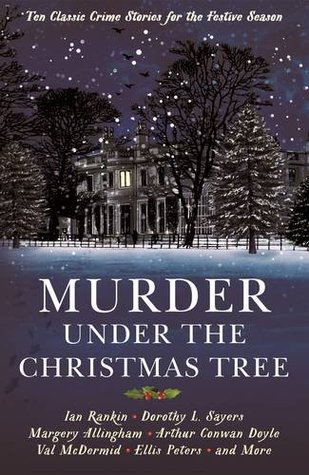
Murder Under the Christmas Tree, edited by Cecily Gayford

Murder Under the Christmas Tree contains ten stories by a variety of crime authors, all with a Christmas theme or set during the festive period. I don’t often choose to read short story collections (although I seem to have read more of them this year than ever before, so maybe that is beginning to change) but I picked this one up in the library a few weeks ago because I was intrigued by the mixture of authors – some modern, some classic, some that I was familiar with and some that I wasn’t.

I’m never sure of the best way to write about books like this, but as there are only ten stories I think I should be able to give all of them a brief mention. The book opens with The Necklace of Pearls, a Lord Peter Wimsey mystery by Dorothy L. Sayers, one of the five authors in the collection I had read before. The story involves a search for a valuable pearl necklace which goes missing as a party of guests gather to celebrate Christmas. I always like Sayers’ writing, but this particular story is not very strong and not a great start to the book, in my opinion. It is followed by The Name on the Window by Edmund Crispin, a locked room mystery set in winter and featuring his detective Gervase Fen. Crispin is another author I have previously read – I highly recommend The Moving Toyshop if you haven’t read it yet – and again, this story is not the best example of his work but it’s still enjoyable and I didn’t guess the solution.

Now we come to one of the authors who were new to me: Val McDermid. Yes, there are some huge gaps in my reading when it comes to more recent crime fiction! A Traditional Christmas is a short and simple murder mystery with a nice twist at the end. I really liked this one, although it felt odd coming straight after Sayers and Crispin – especially as the next story is an even older one: The Adventure of the Blue Carbuncle by Arthur Conan Doyle. This is a classic Sherlock Holmes mystery involving a Christmas goose and a precious jewel. I feel sure I must have read it before, but I couldn’t remember it at all!

The Invisible Man is next: a Father Brown mystery by GK Chesterton. I first encountered Father Brown in a British Library Crime Classics anthology I read earlier this year (Miraculous Mysteries), but I enjoyed this story much more than that one. It made me think about the things we never notice and the things that we do! This is followed by another modern story, Cinders by Ian Rankin. During rehearsals for a performance of Cinderella, the Fairy Godmother is found dead and Rankin’s detective Rebus is called in to investigate. I have never read anything by Ian Rankin before and although there was nothing wrong with this story, I don’t think he’s an author for me.

The next two stories are my favourites. The first, Death on the Air by Ngaio Marsh, is a fascinating story set during the early days of radio. On Christmas morning, ‘Septimus Tonks was found dead beside his wireless set’, presumably having been electrocuted – but was it an accident or was it murder? This is my first introduction to Marsh’s work, but I would love to read more. The next story, Persons or Things Unknown, is by Carter Dickson, a pseudonym of John Dickson Carr. A host entertains his house guests with an atmospheric tale of murder set in the 17th century. I loved it – and again, I will be looking for more by this author.

The penultimate story in the book is Margery Allingham’s The Case is Altered. It’s an Albert Campion mystery and while I had hoped it would be one of the highlights of the book, I found it quite forgettable. The last story, The Price of Light by Ellis Peters, was good but felt out of place in this collection, being a Brother Cadfael mystery set in 1135. I’ve never read anything by Peters before and I liked this enough to want to try one of her full-length Cadfael novels.

This is an uneven collection, then, and I don’t think the mixture of Golden Age, historical and contemporary mysteries really worked. I’m pleased I read it, though, if only because it has given me my first taste of Ngaio Marsh, John Dickson Carr and Ellis Peters. Another book in this series, Murder on Christmas Eve, also edited by Cecily Gayford, has just been published and seems to include many of the same authors.

Lament for a Maker by Michael Innes

After reading Hamlet, Revenge! recently, I have been wanting to read more by Michael Innes, so I was pleased to find his next Inspector Appleby mystery, Lament for a Maker, available through NetGalley. Having read the previous book in the series I thought I knew what to expect from this one, but I was wrong – this book has a very different feel and structure and despite being published in 1938, it’s not a typical Golden Age mystery novel at all.

The title is taken from a 16th century Scottish poem by William Dunbar (the word maker, also spelled makar, means a poet or court poet). The Latin refrain Timor mortis conturbat me – fear of death disturbs me – is repeated throughout the poem and sets the tone for Innes’ novel.

This is such a complex, convoluted mystery it’s difficult to know where to begin, but the best place to start is probably with the crime itself – assuming that a crime has actually been committed, of course! Ranald Guthrie, the miserly laird of Erchany Castle has been killed falling from the ramparts of his own tower on a cold winter night, but was he pushed, was it an accident or could it have been a suicide attempt? If it was murder, then the culprit seems obvious: Neil Lindsay, the young man who wants to marry Ranald’s niece and whose family have been feuding with the Guthries for generations. There is much more to the situation than meets the eye, however, and as the story unfolds more suspects and possible scenarios begin to emerge.

The novel is written from the perspectives of five different characters who each take it in turns to narrate their part of the story. My favourite was the first, Ewan Bell, a shoemaker who lives in Kinkeig in Scotland. It is Ewan who sets the scene, introduces us to the other main characters in the novel and describes the events leading up to Guthrie’s death – all in his own distinctive voice, complete with plenty of Scots dialect!

“If an unco silence had fallen upon nature with the snow those weeks there were plenty of human tongues in Kinkeig to make good the deficiency. The less work always the more gossip, and there must have been even more claiking than usual about the meikle house.”

The second narrator is Noel Gylby, a young Englishman who appeared in Hamlet, Revenge! He is visiting Erchany Castle with his American girlfriend and immediately his narration (which takes the form of letters) has a very different feel from Ewan Bell’s:

“Diana darling: Leaves – as Queen Victoria said – from the Journal of my Life in the Highlands. Or possibly of my Death in the Lowlands. For I don’t at all know if I’m going to survive and I don’t know – I’m kind of guessing, as my girl-friend here says – where I am.”

And there are several more! Lots of authors have written books with multiple narrators but I haven’t come across many (apart from Wilkie Collins) who actually succeed in giving each narrator a unique voice of their own. This is one of the best attempts I’ve read for a while. It’s not just the style and structure which make this such an enjoyable novel, though; the mystery itself is also a good one, with twist following upon twist as the end of the book approaches.

As for Inspector Appleby himself, he doesn’t appear until two thirds of the way through the book when the mystery is already half solved and theories have been suggested. Although the novel is clearly set in the 1930s, there are times when both the story and the book itself feel as though they belong to a much earlier period (it reminded me very strongly of The Master of Ballantrae by Robert Louis Stevenson and it seems I’m not the only one to make that connection). This makes me wonder whether Innes may really have wanted to write a historical mystery but couldn’t as he needed to make it part of the Appleby series. That would explain why Appleby makes such a late appearance, almost as an afterthought.

Anyway, I loved this one. Thanks to Ipso Books for the review copy.

Rum Affair by Dorothy Dunnett – #1968Club

I am, after all, the only really photogenic coloratura soprano alive. My only problem, just about then, was in staying alive.

It’s been a while since I read my first of Dorothy Dunnett’s Johnson Johnson mysteries and this week’s 1968 Club (hosted by Simon and Karen) seemed the perfect opportunity to read another one. Rum Affair – originally titled Dolly and the Singing Bird and then The Photogenic Soprano – was the first in the series to be published (in 1968 obviously), although Tropical Issue, the other one I’ve read, was the first chronologically.

Dunnett is better known for her historical novels, some of which have recently been reissued, but the seven books in her mystery series have contemporary settings. They are each narrated by a different young woman and all feature the portrait painter Johnson Johnson and his yacht Dolly.

Rum Affair opens with Tina Rossi, a Polish-Italian opera singer, arriving in Scotland where she is due to give two performances at the Edinburgh Festival. During a break in her schedule, she has arranged to meet her lover, Kenneth Holmes, at his friend’s Rose Street flat. However, there’s no sign of Kenneth – just a card with the three handwritten words, “Darling, I’m sorry”. Searching for clues to explain his absence, Tina opens a wardrobe door to reveal the body of a man, a stranger, who has been shot in the chest. When the police unexpectedly arrive, making enquiries about a robbery in the neighbourhood, she quickly makes the decision to conceal what has happened – to try to save her own reputation, she tells us, and Kenneth’s.

Instinct is a marvellous thing, I dare say; but I prefer to use my good sense. You, perhaps, with a strange man lying dead at your feet would have welcomed the police with an exhibition of nervous relief. I, on the other hand, kept my head.

On the same night, Tina’s path crosses for the first time with that of Johnson, who is staying nearby. Tina is immediately intrigued by Johnson, a mysterious man who wears bifocals and introduces himself as “thirty-eight. Painter. London. On holiday.” When Johnson invites her to join him on a yacht race to the Isle of Rum, she is quick to accept. Rum is where Kenneth is currently based, working on a highly sensitive project for his employers, although she doesn’t admit this to Johnson. However, it seems that Johnson has a reason of his own for wanting Tina to sail with him on board Dolly – and it’s not just so that he can paint her portrait!

I won’t go into any more detail regarding the plot because I wouldn’t like to inadvertently give too much away and spoil the mystery – and I don’t want to say much more about Tina Rossi either as I’m finding that part of the fun of reading the Johnson novels is in getting to know the woman who is narrating the story. What I will say is that Tina is very different from Rita Geddes of Tropical Issue and that their narrative voices reflect their different personalities and backgrounds (while I liked Rita immediately, I never connected with Tina at all, but I suppose you can’t like every character in every book). As for Johnson himself, even though I have now read two books in this series, he is still very much an enigma to me. Of course, we only see him through the eyes of the narrators so we only know what they choose to tell us and are reliant on their observations and interpretations of his character, which may not always be correct or true.

I also found the setting interesting; the race in which Johnson and Tina are participating takes them around the west coast of Scotland, visiting several islands of the Inner Hebrides, of which Rum is one.

In the summer night, the Inner Hebrides lay all about us, black on the indigo sea. Above us, the uninterrupted sky stretched, a light, dense ultramarine, its ghostly clouds and small, sharp white stars suspended over the bright winking lights, near and far, of a constellation of lighthouses, and the grey, dimly voyaging waves here below.

I particularly enjoyed the scenes set at Fingal’s Cave on the island of Staffa!

Although I don’t think these books come close to the brilliance of Dunnett’s Lymond or Niccolò series, or King Hereafter, they are still quite enjoyable in a different way. I am looking forward to reading the rest and meeting the other five narrators.