The Six Murders of Daphne St Clair by MacKenzie Common

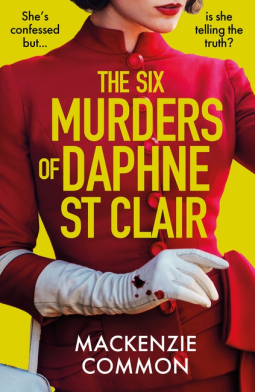
Daphne St Clair is a ninety-year-old grandmother in poor health who lives at Coconut Grove Senior Home in Florida. Probably not anyone’s idea of a typical serial killer, but when another elderly resident is found dead in the home, Daphne calls the police and confesses to not only this murder but several more, spanning four states, two countries and seven decades. The police, Daphne’s family and the public are both shocked and intrigued – what could have made Daphne want to kill so many people? And why has she chosen to confess now, at this late stage of her life?

When the news of Daphne’s confession begins to spread, she is contacted by journalists and reporters wanting to be first to tell her story, but she turns them all down – except one. Ruth Robinson hopes to start a podcast about Daphne’s life and even has a title ready for it – The Murders of Daphne St Clair. Something draws Daphne to the younger woman and she agrees to be interviewed for the podcast, but as her story unfolds she begins to discover that there’s more to Ruth than meets the eye. Who is Ruth Robinson and what’s the real reason for the podcast?

I had never heard of MacKenzie Common (it seems she has previously written a YA mystery novel, although this is her first book for adults), but I was attracted by the elegant, eye-catching cover and the premise of a ninety-year-old serial killer who had spent her whole life literally getting away with murder! I did enjoy the book, with a few reservations which I’ll mention later in this review, but overall it was quite an entertaining read.

Daphne’s tale begins in Canada in the 1930s, where she grew up on a farm near a small town in Saskatchewan. After a difficult childhood, Daphne runs away from home at the age of sixteen and makes her way to Winnipeg, where she meets the man who will become her first victim. He’s an unpleasant, violent man and his death is more of an accident than a murder, so at this stage of the book, Daphne seems a sympathetic character. This quickly changes as Daphne’s actions become more senseless and inexcusable and she shows no repentance for what she has done. I disliked her more and more as the novel progressed, but at the same time, she’s a clever, witty narrator and her story is engaging.

The structure of the book was a problem for me. Daphne’s narrative is broken into short sections, some of which are written in her own first person perspective and some in the form of dialogue for the podcast. These are then interspersed with chapters from Ruth’s perspective as she carries out some investigations of her own into Daphne’s background and one particular murder that is of special interest to her. I felt that the switches from one character to the other happened too quickly and too often, which stopped the story from flowing as well as it could have done. On top of this, there are also frequent interruptions from true crime fans discussing the show on Reddit and speculating on who Daphne is going to kill next, and a fashion blogger on TikTok who imagines outfits Daphne may have worn at key moments in her life. I could have done without these as well, but they do illustrate the moral issues of treating criminals like celebrities.

The ending of the novel leaves an important question unanswered; we can decide for ourselves what happened (or what we would have liked to have happened) but I would have preferred to know for certain! This wasn’t a perfect book, then, but not many are and there were definitely more things I liked than disliked.

Thanks to Headline/Mountain Leopard Press for providing a copy of this book for review via NetGalley.

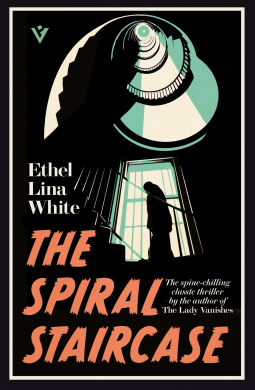
The Spiral Staircase by Ethel Lina White

Originally published as Some Must Watch in 1933, this is a reissue by Pushkin Vertigo under the title The Spiral Staircase – the name of the 1946 film adaptation. I’ve previously read two other novels by Ethel Lina White – The Wheel Spins and Fear Stalks the Village – and enjoyed both, although I found the former slightly disappointing in comparison with Alfred Hitchock’s wonderful The Lady Vanishes, which is based on it. This book has turned out to be my favourite of the three!

Almost the entire novel is set within the walls of the Summit, a lonely country house near the Welsh/English border. Adding to the sense of tension and claustrophobia, the main events of the story also take place over the course of a single evening. As the novel opens, we learn that four murders have recently been committed – the first two in the nearest town, which is over twenty miles away, the next slightly closer, and the fourth in another country house just five miles from the Summit. All four victims were young women and their deaths are on Helen Capel’s mind as she returns to the Summit after her afternoon off and is convinced that she sees a man hiding behind a tree in the dark.

Helen has just started a new job as ‘help’ to the Warren family – Miss Warren and her brother, known as the Professor, and their elderly, bedridden stepmother, Lady Warren. At the start of the novel, the Professor’s son and his wife are staying at the house, as is a student of the Professor’s, Stephen Rice. The rest of the household is made up of two more domestic servants, Mr and Mrs Oates, and the newly arrived Nurse Barker, who has been employed to look after Lady Warren.

When news of another murder, closer than ever this time, reaches the family, the Professor orders that all the doors are locked and everyone stays inside until morning. These should be easy enough instructions to follow, yet for a variety of reasons, one person after another leaves the house or becomes otherwise incapacitated. As a storm rages outside and the tension builds inside, Helen is forced to confront the idea that one of the remaining people in the house could be the murderer.

This book is good fun, but you do need to be able to suspend disbelief now and then (Helen is one of those heroines typical of this genre of book, who, despite knowing there’s a murderer on the loose, tries to open the front door every time someone knocks and spends most of the night wandering around the house on her own, along dark passageways and up and down dimly-lit staircases). Still, Ethel Lina White does a great job of creating an atmosphere of foreboding and fear, not just through stormy weather and shadows, but also through hints that various characters may not be as they seem. Is Lady Warren really unable to walk – and why does she have a gun in her room? And what if Nurse Barker isn’t really a nurse?

I found this a quick, entertaining read, let down slightly by the ending because the killer’s identity wasn’t particularly surprising and their motive was unconvincing. If you’re looking for a cleverly plotted mystery, I think you’ll be disappointed as I would describe this as much more of a psychological horror/suspense novel than a crime novel. It reminded me a lot of Benighted by J.B. Priestley and I think if you enjoyed one there’s a good chance you would enjoy the other. After finishing this book, I watched the film for the first time (it’s currently available on YouTube) and while it’s worth watching in its own right, I didn’t feel that it had much in common with the book!

Thanks to Pushkin Vertigo for providing a copy of this book for review via NetGalley.

Book 8/20 for 20 Books of Summer 2025.

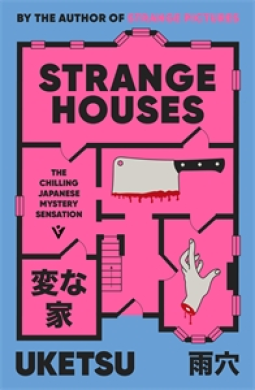
Strange Houses by Uketsu

“I can’t tell you how many people have told me their scary house stories.

But none of them can compare to the houses in this story. These strange, strange houses.”

I loved Uketsu’s Strange Pictures when I read it earlier this year, so I was excited to see another of his books, Strange Houses, available on NetGalley. Like the first book, this one has been translated into English from the original Japanese by translator Jim Rion. Also like the first book, it contains a number of illustrations and diagrams that form an important part of the story.

The novel begins with our narrator, a freelance writer, being approached by his friend Yanaoka, who is searching for a suitable house in which he and his wife can raise their first child. Having viewed a house in a quiet residential area of Tokyo, Yanaoka and his wife have both fallen in love with it but are confused by the floor plan which shows a ‘dead space’ – in other words, a tiny hidden room with no doors. The narrator has another friend, Kurihara, who is an architect, so he decides to ask his opinion.

When Kurihara studies the floor plans, he picks up on several other unusual features of the house. These, together with the hidden room, lead him to form a bizarre but terrifyingly logical explanation for the design of the building. Yanaoka chooses not to buy it, but the narrator is intrigued and continues digging into the house’s history, uncovering connections with some other equally strange houses!

I really enjoyed the first half of this book, almost as much as Strange Pictures. It has a similarly interactive feel, where we are encouraged to look at the illustrations and identify the clues in them along with the narrator. Although Kurihara’s theory about the design of the Tokyo house seems ridiculously far-fetched, it does also make sense when you consider the layout of the rooms, the positions of doors and windows and the location of the house itself. I would never have imagined that floor plans could be creepy, but the ones in this book certainly are!

A difference between this book and Strange Pictures is that the other book is made up of several separate but interconnected stories, while this one consists of just one plot and one set of characters. The change in format means this book feels less varied and innovative, but it also allows us to follow the story of one family – the family who built the houses – through to the end. In the second half of the book, the focus moves away slightly from the plans and layouts and concentrates more on the history of the family. Things become quite convoluted, with complex relationships between the family members, rivalries between different branches and tales of curses and traditions going back several generations. I was reminded of Seishi Yokomizo’s mystery novels and I wonder if these, as well as Yukito Ayatsuji’s Bizarre House series, have influenced Uketsu.

In an interview, translator Jim Rion has talked about how Uketsu wants his writing to be easy to read and accessible to all readers and I think Rion has done a great job of keeping that same clarity in his translations. I’ve also discovered that a third book, Strange Buildings, is coming soon. Something to look forward to!

Thanks to Pushkin Vertigo for providing a copy of this book for review via NetGalley.

Book 6/20 for 20 Books of Summer 2025.

The Other People by C.B. Everett

Imagine you wake up in an unfamiliar room with no idea where you are or how you got there. Venturing through the door you discover that you’re locked inside an old country house with nine strangers, none of whom know what’s going on either. Once you’re all gathered in one room, a woman enters and introduces herself as Amanda. She explains that a girl has been abducted and is imprisoned somewhere within the house. Twelve hours from now her oxygen will run out and she’ll die; if you can find her, you’ll save her life and will also find the way out of the house. Amanda has barely finished speaking when she is shot dead. Unless you want to be next, it seems you have no choice but to find the missing girl as soon as possible.

This is what happens to student Kyle Tanner, executive Diana Landor, retired policeman Len Melville, mother and baby Cerys and Monica Herbert, military man Captain Saint, warehouse clerk Sylvia Moult, thief Iain Wardle-Roberts, stripper Ramona O’Rourke and child molester Desmond Blaine. As these ten people begin to search the house for the hidden prisoner, they start to get killed off one by one. Is the murderer one of the ten – or are there other people in the house as well?

This book is being compared to Agatha Christie’s And Then There Were None – and there are some obvious similarities – but it reminded me more of The Seven Deaths of Evelyn Hardcastle by Stuart Turton. Like the Turton novel, this one requires the reader to accept an unlikely scenario that feels contrived and implausible, which is something some readers will be happy to do and some won’t. In this case, it does all make perfect sense by the end of the book, but in the meantime you have to be prepared to be patient and just go along with the plot.

The novel is narrated by all ten characters (well, nine – baby Monica only gets a few sentences), with the perspective switching rapidly between them throughout the book. We hardly get to know some of them before they are killed, but the ones who survive further into the book become more developed as characters. None of them are very pleasant people, though, and I can’t say that I really enjoyed being inside any of their minds – particularly not Desmond’s! There’s also another narrator, one who’s known only as The Beast in the Cellar, who interrupts the story now and then to speak directly to the reader, make observations and, I suppose, provide some humour. I found these chapters fun at first, but they quickly started to irritate me.

I was expecting a stronger murder mystery element to the book, so I was surprised to find that the characters don’t actually seem to have much interest in looking for the abducted girl and just wander around the house arguing with each other and wasting time. It’s not really the sort of book that has clues and red herrings and where you can try to work out who the murderer is. The real mystery is the one surrounding the house itself, why the characters have been brought there and why those ten in particular have been chosen. I came up with lots of theories while I was reading, but didn’t come close to the correct answer.

This is definitely a book that needs to be read right to the end to be fully appreciated, then. It was only when the truth was revealed that I understood some of the things that had confused or annoyed me earlier on. It would be interesting to read it again from the beginning, with the knowledge of how it ends, but I’m not going to do that as I have far too many other books waiting to be read! It’s a fascinating book, though, even if it didn’t entirely work for me.

Thanks to Simon & Schuster UK for providing a copy of this book for review via NetGalley.

The Tiger in the Smoke by Margery Allingham – #1952Club

I’ve read a lot of Margery Allingham’s books but, maybe surprisingly, not many of the Albert Campion ones and not the book that is often described as her best, The Tiger in the Smoke. When I saw that it was published in 1952, it seemed an ideal choice for this week’s 1952 Club, hosted by Karen and Simon.

The Tiger in the Smoke is the fourteenth novel in the Albert Campion series – although Campion himself barely appears in it. Despite the exotic title, the Tiger refers to an escaped prisoner, Jack Havoc, and the Smoke is a nickname for London. At the beginning of the book, we meet Meg, who has believed herself to be a war widow since her husband, Major Martin Elginbrodde, was reported dead in Normandy during the D-Day landings. Meg has recently become engaged to another man, Geoffrey Levett, but has started receiving mysterious photographs which seem to show that Martin is still alive. As a thick fog descends on London, Meg asks her cousin Albert Campion and Chief Inspector Charlie Luke to help her find out who is sending the photos and what they mean.

The connection between all of this and the escape of Jack Havoc – whom Campion’s friend Superintendent Oates describes as ‘a truly wicked man’ – is not immediately obvious, but gradually becomes clear as the story progresses. First, though, we meet a gang of ex-Army men trying to make a living as a band of street musicians, all with some kind of disability or war injury. They are also criminals and associates of Havoc, so portraying them all with disabilities is something I’m sure a modern author would avoid, even if Allingham got away with it in the 1950s. Havoc himself is a great villain, surrounded by a real aura of danger due to his unpredictability and ruthlessness.

This book is much more of a thriller than a mystery. In fact, there’s very little mystery at all, beyond the question of who is responsible for the photographs and how Martin Elginbrodde is linked to Havoc and his gang. There’s nothing for the reader to really try to solve, so you just have to sit and watch as the story unfolds. This probably explains why we see so little of Campion, as there’s not much for him to do from an investigative point of view. I have to admit that I was quite happy with his absence as I’ve found so far that I tend to prefer Allingham’s books without Campion to the ones with him – although having said that, this is one of the later books in the series and he seems to have matured a lot since the earliest book I’ve read (Mystery Mile).

I loved the atmospheric descriptions of London in the fog in the first half of the book, with the limited visibility making it easier for the criminals to avoid capture. Allingham finds so many evocative ways to describe the fog and it really adds to the sense of tension and confusion. I’m pleased I decided to read this one for 1952 Club – and I have another Campion novel, The China Governess, on the TBR which I hope to get to soon as well.

The Impossible Thing by Belinda Bauer

I loved this! I remember enjoying Belinda Bauer’s first two books, Blacklands and Darkside, around the time they were published in 2009 and 2011 respectively, but I seemed to lose track of her work after that. When this one caught my eye, I decided to give it a try and I’m very pleased that I did. The plot is completely different from any other crime novel I’ve read.

The Impossible Thing is a novel set in two different periods almost one hundred years apart and linked by the same crime – the theft and illegal trading of wild birds’ eggs. In 1926, gangs of ‘egg-climmers’ gather on the Yorkshire coast and lower each other from ropes over the cliffs to steal eggs from the seabirds nesting there. Traders and collectors are willing to hand over large sums of money for the most rare and beautiful eggs, so when little Celie Sheppard from Metland Farm makes the dangerous descent through a crack in a ledge of rock and obtains a perfect red guillemot egg, it creates a sensation.

In the present day, in rural Wales, Patrick Fort decides to visit his friend, Nick, and arrives just in time to discover that both Nick and his mother have been tied up and robbed. The only thing stolen is an old wooden box containing a red egg. Nick had found the egg in the attic and put it on eBay, only for it to be taken down almost immediately for breaching eBay’s policy on selling illegal items. It seems that, even in the short space of time it was advertised, someone saw it, tracked it down to Nick’s address and decided they must have it no matter what. Although Nick had no idea that owning birds’ eggs was illegal, he is afraid to admit to the police that he had one, so he and Patrick set out to find the thief themselves.

This is definitely the first book I’ve read about egg trafficking! It’s an unusual subject for a crime novel, but Bauer builds a story around it that I found completely fascinating and unexpectedly exciting. I assumed that everything in the book was fictional, so I was interested to learn that the red Metland Egg really existed – or to be more accurate, Metland Eggs, as one was collected every year for over twenty years from the same location on the Bempton Cliffs near Bridlington. Something I learned from the novel is that female guillemots lay only one egg a year and if it is stolen, they will return to the same spot the following year to lay an almost identical egg. It made me feel sad to think of the bird that laid the red eggs never actually getting to see one hatch and I’m so glad that the Protection of Birds Act 1954 made egg theft illegal in the UK – even though it hasn’t stopped it completely, it’s a big step in the right direction.

Patrick Fort, the main character in the present day sections of the novel, was apparently introduced in a previous Belinda Bauer novel, Rubbernecker, which I haven’t read. I can see why she decided to bring him back for a second book, because he’s a very engaging, intelligent and likeable character. Patrick has a form of autism which affects his social interactions, but he has a good friend in Nick, who understands why he sometimes behaves the way he does. I loved seeing them work together to hunt down the egg thieves and I must go back and read about their earlier adventures in Rubbernecker!

The historical sections are also very well done and the scenes where young Celie Sheppard is dangled over the cliff in search of the eggs are very dramatic; I can’t imagine how dangerous and terrifying that would be, yet Celie did it year after year from such an early age. At least she was rewarded financially for her efforts, at a time of poverty when her family desperately needed the money. It was interesting to see how big and well organised the egg trafficking industry was in those days, with collectors and traders prepared to go to great lengths – and great expense – to obtain the rarest and most unusual eggs.

I picked a great book for my return to Belinda Bauer after such a long time and am looking forward to reading the others that I’ve missed.

Thanks to Bantam for providing a copy of this book for review via NetGalley.

Strange Pictures by Uketsu – #ReadIndies

Translated by Jim Rion

Strange Pictures is a strange novel, but it’s also a completely fascinating one. I’ve been reading a lot of the classic Japanese crime published by Pushkin Vertigo recently, but this is a modern crime novel, first published in Japan in 2022 and made available in an English translation last month. I had never heard of the author, but apparently he’s a ‘YouTube sensation’ known only by the single-word pseudonym Uketsu. He always appears in his videos wearing a mask and his true identity has not been revealed to the public.

In this book, Uketsu takes as his premise the idea that studying drawings made by victims or perpetrators of crime can give us important insights into the psychological state of those people, which could provide clues to help solve the mystery. Strange Pictures consists of three interconnected short stories based around this concept. The links between the stories are not clear at first, but gradually an overall narrative starts to form, raising questions that are answered in a final, fourth section of the book.

Each of the three stories involves some ‘strange pictures’. First, a series of drawings made by a pregnant woman before her death, which her husband posts on his blog. Then, a disturbing picture of a house drawn by a child at school. And finally a sketch of the mountains drawn by a murder victim in the final moments of his life. These pictures are reproduced in the book, along with various other illustrations, and Uketsu interprets them for us step by step as the characters begin to uncover the clues they contain. He discusses the symbolism in some of the pictures and in other cases the physical drawing itself – the paper it was drawn on; the way images can be digitally resized, rotated and layered; the use of gridlines to help with proportion and perspective; coloured crayons that smudge and blur. All of these things and many more are significant to the plot.

The first two stories in the book help to introduce the characters and provide context, but the third one is a great little murder mystery in its own right. I loved the interactive feel, with not just the main drawings but also other sketches, maps and diagrams helping to clarify what’s happening and lead us to the solution. There are also some very creepy moments, particularly a scene with a woman and child convinced they are being followed home to their apartment, and another where a man awakes in his tent in the mountains to discover that he’s no longer alone.

Although I found this book very enjoyable, it’s not one that you would choose to read for the beauty of the prose as the writing style is very plain and simplistic. However, it’s easy to read and while it’s obviously better if you can experience the book in its original language, I think Jim Rion has done a good job with the translation. A second Uketsu book, Strange Houses, revolving around a series of floorplans, is due to be published in English later this year. I’m already looking forward to it!

As Pushkin Press are an independent publisher, I am counting this book towards this year’s #ReadIndies event hosted by Kaggsy’s Bookish Ramblings and Lizzy’s Literary Life.