Dead Men Don’t Ski by Patricia Moyes

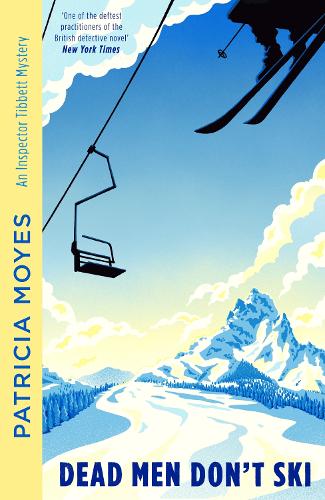
This is the first in a series of mysteries published between 1959 and 1993 and featuring Inspector Henry Tibbett. I had never come across them, or their author Patricia Moyes, until now, but I really enjoyed this one and will definitely be looking for more.

Dead Men Don’t Ski begins with Henry Tibbett and his wife, Emmy, setting off on a skiing trip to Italy. It’s a much-needed holiday for the two of them, but Henry is also planning to mix business with pleasure. The hotel they’ll be staying at in Santa Chiara is suspected of being the centre of operations of a ring of drug smugglers and Henry has been asked by Scotland Yard to work with the local Italian police to find out who the culprits are. Of course, he doesn’t admit this to his fellow guests as he wants them to speak and act freely around him. These guests include a party of young English tourists – Jimmy, Roger and Caro; a retired military man, Colonel Buckfast and his wife; a beautiful Italian baroness and her possessive Austrian husband; and a German couple with their daughter and her prospective husband, as well as an assortment of hotel staff, skiing instructors and local residents.

At first, Henry and Emmy manage to blend in with everyone else, enjoying the scenery, attending skiing lessons and relaxing around the hotel. But when one of the guests boards the ski lift at the top of the mountain and is found dead by the time he reaches the bottom, Henry’s detective skills are needed to solve the crime and he will no longer be able to stay undercover.

This is an entertaining novel with a beautiful setting. Santa Chiara is described as a small village close to Chiusa near the border of Italy and Austria and drawing from the cultures of both countries. There are lovely descriptions of snow-covered peaks and valleys, pine trees and pink rock, Alpine houses with wooden balconies – and the Bella Vista Hotel perched high in the mountains. I was reminded of another ski resort mystery, Death in Kashmir by M.M. Kaye, although I thought that book was darker than this one.

I liked Henry Tibbett and it was also good to see so much of Emmy. Often the detective’s wife is kept very much in the background, maybe popping up now and then to make a cup of tea or answer the phone, but in this book Emmy is present from beginning to end. It would have been nice to see her play a bigger role in helping to actually solve the mystery, but maybe she will in one of the later books in the series. The other characters are also interesting; with such a mix of different nationalities you do need to be prepared for some slightly dated attitudes, but no worse than in most other books of this period. I was particularly drawn to Maria-Pia, the Baroness, and her cold, controlling husband Hermann, who turns out to have hidden depths.

As for the mystery itself, it’s a good one with plenty of suspects, although my heart sank when Spezzi, the Italian policeman working with Henry, draws up a detailed timetable of events, which is reproduced in the book. I find mysteries that focus on timings and alibis to be tedious and difficult to follow, so I was pleased that this book didn’t dwell too much on that after all – it was just part of Spezzi’s approach to crime solving and although his timetable did prove very useful, the interviews he and Henry conduct with the witnesses and suspects were just as important.

The first two books in this series are available now in attractive new editions from Farrago Books and with the next two advertised for publication later this year I hope that means they’ll be reissuing the whole series. I suspect it’s probably not essential to read them in order but I’m planning to try the second one, The Sunken Sailor, soon.

Thanks to Farrago Books for providing a copy of this book for review via NetGalley.

A Deadly Episode by Anthony Horowitz

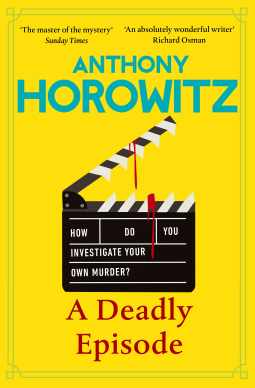
The Word is Murder, the first book in Anthony Horowitz’s series chronicling his partnership with the detective Daniel Hawthorne, is being adapted for film. Although Anthony, to his disappointment, has not been asked to write the script or participate in any other way in bringing his own story to life, both he and Hawthorne have been invited to visit the set in Hastings. Here they meet the cast and crew, including the two actors in the main roles – David Caine, playing Hawthorne, and Ralph Seymour, playing Horowitz himself. It’s clear that there are tensions between the two, so when Caine is found stabbed to death, Ralph is one of the prime suspects. However, it quickly emerges that almost everyone else on the set also has a motive for the murder. It seems that Hawthorne and Horowitz have found themselves with yet another crime to solve…

None of the above is true; it’s entirely fictional, but part of the fun (at least for me – I know not everyone likes it) is that Anthony Horowitz uses himself as a character throughout this series, in a clever blend of reality and imagination. Hawthorne is not a real person and neither are most of the others, but Horowitz occasionally refers to his real-life wife, Jill, his own books, and other aspects of his own life and career. He’s very self-deprecating and portrays himself as the Watson to Hawthorne’s Sherlock Holmes, often completely missing important clues and coming up with theories that turn out to be entirely wrong. A Deadly Episode is the sixth book in the series and although I would recommend reading them all in the correct order to fully understand the relationship between Horowitz and Hawthorne, it’s not really essential and each book has a self-contained plot.

The mystery in this book is an interesting one, with plenty of suspects as David Caine has made enemies of everyone involved with the film: his co-star Ralph Seymour, with whom he’s had a long professional – and often personal – rivalry; the screenwriter Shanika Harris who has known Caine since they were both young eco-warriors; his agent James Aubrey whom he’s been threatening to break ties with; and the runner (production assistant) Izzy Mays, who has lost her job because of Caine. Even the director and the producer have good reasons to want him dead, so there’s a lot for Anthony and Hawthorne to untangle here. The real Horowitz has had experience of working in film and television and I think it shows in his descriptions of life on set.

Halfway through the book, a second mystery begins to unfold, revolving around a crime that took place more than a decade earlier. I found this a bit jarring at first, as it meant getting to know a whole new set of characters, but eventually connections between the two mysteries start to form and the eventual solution gives an explanation for both.

After the previous book, Close to Death, where our two main characters were separated for most of the novel, it was good to see them spending more time together again in this one. Hawthorne has never been the most pleasant of people – he’s secretive, prickly and tactless – but I do think he’s a fascinating character, partly because we know so little about him. In this particular novel, Anthony tries to dig into Hawthorne’s past, in a diversion that takes him to the village of Reeth in the Yorkshire Dales, but still doesn’t manage to shed a lot of extra light on things. Will we ever know the full story? Well, it seems there will be more books in the series, so there’s still hope!

Thanks to Century for providing a copy of this book for review via NetGalley.

The Killer Question by Janice Hallett

I love Janice Hallett; her books have an unusual style and format that I know doesn’t work for everyone, but it does for me and I’ve enjoyed all of her adult novels so far. The Killer Question is another good one, this time with a plot revolving around one of the staples of British culture: the pub quiz.

Mal and Sue Eastwood have recently become landlords of a country pub called The Case is Altered (the name refers to a new piece of evidence that emerges in court and could change the outcome of a case). The pub is in a lonely location at the end of a road that leads nowhere and previous landlords have struggled to attract customers, but the Eastwoods are sure they can make a success of it. One of their plans is to start hosting a weekly quiz – Mal loves trivia and is looking forward to compiling his own sets of questions.

Mal’s Monday night quizzes prove popular and soon several teams are coming back week after week to join in. Some of them just see it as a chance to have fun with their friends, but others are much more competitive. Then, one night, a new team arrives, calling themselves The Shadow Knights, and they win the quiz with an almost perfect score. They win again the next week and the next, until Mal becomes convinced that they must be cheating – if only he could find a way to prove it. But soon Mal and Sue will have bigger things to worry about, because a man’s body has been pulled from the nearby river and the police have come to question them…

Like Hallett’s previous novels, this one is written entirely in the form of texts, emails, WhatsApp messages, transcriptions of conversations and other forms of media. Having read other reviews, this definitely seems to be something people either love or hate, and as her books are all written in the same way I think trying one or two of them should be enough to give you an idea of whether her style is for you or not. Personally I find it very clever, because only getting to know the characters through what they choose to reveal of themselves in a text or an email allows for all sorts of surprising twists and revelations. And the twists come one after another throughout the second half of this book, none of which I saw coming in advance!

Although there is a subplot set several years earlier, involving a kidnapping and a police investigation known as Operation Honeyguide, I found this book less complex than some of Hallett’s others so it could be a good place for new readers to start. I also loved the quiz element of the story, seeing how seriously some of the teams take their performances and the lengths they go to in their efforts to win. The arrival of the mysterious Shadow Knights causes a lot of disruption, with some of the existing players becoming angry and determined to beat them. There’s also a lot of humour; I particularly liked the WhatsApp group formed by Mal, Sue and the other local pub landlords, where they share one-star reviews posted by disgruntled customers!

I certainly won’t be giving this book a one-star review as I thought it was excellent – maybe slightly too long, but the format made it a quicker read than it would otherwise have been. I’m looking forward to her next book, The Silent Appeal, coming later this year.

Suspicion by Seichō Matsumoto

Translated by Jesse Kirkwood

For this year’s Japanese Literature Challenge (hosted by Meredith at Dolce Bellezza), I wanted to read something by an author who was new to me and decided on Suspicion by Seichō Matsumoto. It turned out to be an excellent choice!

Suspicion was originally published in Japanese in 1982 and is now available from Penguin Classics in a new English translation. It’s a short novella at 112 pages, but it’s satisfying and I didn’t feel that it needed to be any longer. Loosely based on a true crime, the plot revolves around the trial of Kumako Onizuka, a woman accused of murdering her husband. She had only been married to Shirakawa for a few months when their car plunged into the sea one rainy July evening. Onizuka, who later claimed to have been in the passenger seat, managed to escape, but Shirakawa was drowned.

The story is told mainly from the perspective of the journalist Akitani, who is covering the case for the Hokuriku Daily. Akitani believes Onizuka is guilty and has written several pieces for the newspaper making his opinion very clear. Onizuka has a shady background, having already committed two or three other crimes, and the fact that she took out a large insurance policy on her husband’s life just before his death makes the whole thing look even more suspicious. Akitani is convinced that it was Onizuka and not Shirakawa who drove the car into the sea and in his newspaper articles he draws attention to her past, her character and even her name, Oni, which is associated with demons in Japanese.

However, all the evidence against Onizuka is purely circumstantial and when her original lawyer steps down due to illness, the court appoints a new one, Takukichi Sahara, who believes he’ll be able to prove her innocence. Akitani is horrified – Onizuka has links with the Yakuza (Japan’s version of the Mafia) and if she’s freed she’s sure to want revenge on everyone who has spoken out against her.

This is such a fascinating book. On one level, it works as a detective novel, with Sahara doing the ‘detecting’, looking through the evidence, considering the witness statements and trying to determine what really happened that evening in July. Then there are all the other layers: the role of the media in influencing public opinion; the way preconceived ideas can lead us to make unfair assumptions; and how personal bias can make two people interpret a situation in completely different ways. The characters don’t have much depth – and we never even really ‘meet’ Onizuka, with our knowledge of her coming mainly from other characters’ conversations – but that didn’t bother me too much in such a short book with so many other things to interest me. There’s also a twist at the end, which leaves us to decide for ourselves what probably happened next!

I would like to read more of Matsumoto’s books. It seems that Tokyo Express is considered his masterpiece, but it’s described as a mystery revolving around train timetables and alibis and I’m not sure how I would get on with that. Should I try it or can anyone recommend another one?

Penitence by Kristin Koval

Penitence is a beautifully written novel, tackling one of the darkest subjects imaginable: the murder of a teenage boy by his own younger sister.

It happens in the small town of Lodgepole, Colorado in 2016 and the murderer is thirteen-year-old Nora Sheehan, who calls the police herself to confess that she has just shot and killed her brother Nico. Before the incident, Nora had seemed depressed and withdrawn, which may or may not have been related to Nico, who was less than a year older, being diagnosed with Huntington’s disease. Huntington’s is a degenerative condition with no cure, so it’s possible that Nora may have thought she was helping her brother avoid a terrible fate – but is this true or is there another reason for what she did?

Martine Dumont, a seventy-two-year-old lawyer, is looking forward to her retirement when Nora’s parents, David and Angie Sheehan, ask her to take on one last case and defend their daughter. Martine accepts, but knows she is out of her depth and contacts her estranged son, Julian, whose speciality is criminal law. Julian has lived in New York for many years, but Angie was once his girlfriend, which makes the situation awkward. Although he agrees to return to Lodgepole and help with Nora’s case, being around Angie again brings back difficult memories for both of them.

When I first started to read, I was expecting this to be a crime novel, but that’s not really how I would describe it. The murder of Nico Sheehan is actually a relatively small part of the story; there’s never any doubt that Nora did it deliberately and it’s quite obvious why she did it, so there’s no mystery involved. We do get a lot of information on the laws surrounding the prosecution of child murderers, how they can sometimes be tried as adults rather than juveniles, and the sentences they can expect. We’re also given some insights into what life is like for Nora in the juvenile detention facility she is sent to while she’s awaiting trial.

The main focus of the novel, though, is on the topic of forgiveness and the various questions that arise from this. Why do we feel we have to assign blame when something tragic happens? How can we move on from this and find forgiveness for ourselves and others? How much penitence is enough? These things are explored not just through the story of Nico’s murder – in fact, I felt that relatively little time was spent on showing how David and Angie truly felt about one of their children killing the other – but also on the relationship between Julian and Angie and how it was affected by another tragedy decades earlier. This second storyline plays out in another timeline set in the 1990s/early 2000s and alternates with the Nora/Nico thread. However, I thought too many pages were devoted to this backstory and it made the whole book feel longer and slower than it really needed to be.

I did love the portrayal of Lodgepole, a small Colorado ski resort, and the way life there differed from Julian’s (and for a while, Angie’s) life in New York. An interesting setting, then, and an interesting subject – if only it had been more tightly plotted, it would have been an excellent book. I did like it, though, and found it quite thought-provoking. It’s Kristin Koval’s debut novel and I’ll be happy to read more.

Thanks to Simon & Schuster UK for providing a copy of this book for review via NetGalley.

The Token by Sharon Bolton

Sharon Bolton’s latest novel, The Token, begins with eight people on a yacht heading for the Scilly Isles. The skipper had promised it would be an uneventful crossing, with perfect sailing conditions, but his seven passengers are growing increasingly nervous as the wind strengthens and rain starts to fall. Soon they are caught in a storm, the boat is taking in water, the electronics have stopped working and two people have been swept overboard…

And that’s where we leave them, until much later in the book. First, we have to go back several weeks to find out why this group of people have come to be on this fateful journey in the first place. We learn that each of them has received an envelope containing a token and a letter stating that the billionaire Logan Quick is leaving them a share of his huge fortune. All they need to do is keep the token safe until they hear news of his death. However, none of the seven has ever heard of Logan Quick and none of them has any idea why they’ve been chosen.

The seven token recipients come from all walks of life and seem, at least at first, to have nothing in common. There’s Holly, a single mother trying to juggle her law career with caring for her son; Robin, a wedding planner in love with his latest client; Sabri, an ambulance driver whose family are struggling financially; Tara, an artist whose ex-husband just won’t leave her alone; Craig, a fire safety consultant who is sleeping with his best friend’s girlfriend; Cheryl, who cares for her spiteful, controlling mother and has no life of her own; and Tug, a former military man suffering from PTSD.

Seven people all with interesting stories to be told, but I felt that trying to tell all of them in one book was far too much! The perspective kept switching from one to the other throughout the novel, which quickly became overwhelming. I think five main characters at the most would have been enough; Holly, Cheryl and Tug were the ones I found the most engaging.

This is also not really the exciting, fast-paced sort of thriller I’ve come to expect from Sharon Bolton. It takes a very long time to develop the stories of all seven characters and to reach the point where they come together and board the yacht for the Scilly Isles. It was only the final 30% of the book that I found truly gripping and where we were treated to some of the big plot twists and surprises that Bolton readers know and love. That doesn’t mean I didn’t enjoy the rest of the book at all, but it did definitely have a different feel from some of the other Bolton novels I’ve read, being much more character driven than plot driven.

What I did find fascinating was the way the novel explores how different personalities react to the prospect of fame and fortune. The seven token recipients are all told to keep quiet and tell no one, yet some of them can’t resist and soon the whole thing has been made public and is being reported on the news. Each of them has to find a way to deal with the media attention and the difficulties of trying to keep the token safe from theft, while also trying to decide whether, despite the opportunities the inheritance would bring, they really want to become fabulously rich.

Not a personal favourite Bolton novel for me, then, but they can’t all be and I still felt more positive about this one than negative.

Thanks to Orion for providing a copy of this book for review via NetGalley.

The Art School Murders by Moray Dalton – #DeanStreetDecember25

Dean Street Press December is back, hosted again by Liz of Adventures in Reading, Running and Working From Home. The rules are simple – just read and write about at least one book published by Dean Street Press during the month of December! I have several DSP books on the TBR and decided to start with a detective novel by Moray Dalton, a new author for me although I’ve seen other bloggers give her books very positive reviews.

The Art School Murders opens with the murder of Althea Greville, an artists’ model who has been employed to pose for the students at Morosini’s School of Art. Althea had briefly worked at the school the year before, causing a stir and capturing the hearts of many of the young male students, but on arriving for her second engagement she appeared very different: old, tired and desperate for money and opportunities. When the caretaker’s wife finds Althea’s body behind a screen in the life classroom one November morning, Inspector Hugh Collier of Scotland Yard is called in to investigate.

Assisted by Sergeant Duffield, Collier begins to question the staff and students, looking for any clues that will point him towards the murderer. That same evening, however, another girl from the art school is found dead in the darkened balcony of a cinema. Convinced that she must have been silenced by Althea’s killer to prevent her from giving information to the police, Collier now has two murders to solve – and if he doesn’t hurry, the killer could strike again.

The Art School Murders is the tenth of fifteen books featuring Hugh Collier, but it works perfectly as a standalone and it’s definitely not necessary to have read any of the previous books – although, having enjoyed this one, I will be doing so now! I liked Collier as a detective; he may not be as interesting as a Poirot or a Holmes, but he’s polite, good-natured and intelligent, handling his investigations with fairness and compassion.

Originally published in 1943, this book uses the war as a backdrop very effectively. The story is set in a village a short drive away from London, and nightly blackouts are in force, making it easier for crimes to be committed under the cover of darkness. It’s November, when the days are short and the nights are long, and Dalton makes good use of this to show what it’s like walking through the streets at dusk when the light you would normally see shining from windows is blacked out and invisible.

I enjoyed this book as much or more than some of the Golden Age mysteries I’ve read by better known authors. My only criticism is that the solution seemed to come out of nowhere and I doubt many people would have guessed the culprit based on the information we are given, but otherwise Dalton held my interest from beginning to end. It’s sometimes hard to know why some authors fade into relative obscurity while others remain popular, so well done to Dean Street Press for rescuing Moray Dalton’s books and making them available to a new audience!