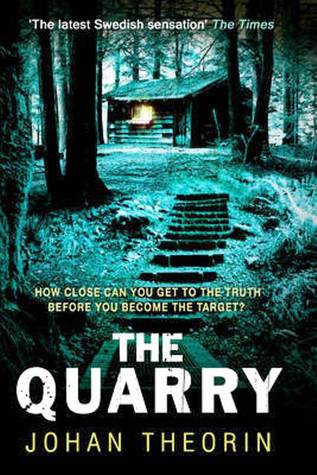
The Quarry by Johan Theorin

This is the third in Johan Theorin’s Öland Quartet, a series of four crime novels set on the Swedish island of Öland. Each book in the series is set during a different season, with the changes in weather and landscape affecting the mood and atmosphere of the story. I loved the first two books, Echoes from the Dead and The Darkest Room, so I was looking forward to my third visit to Öland. I couldn’t wait to meet my favourite character, Gerlof Davidsson, again and to find out what life on the island was like during the spring months.

In The Quarry, Gerlof is now eighty-three years old and, deciding he doesn’t want to spend the remainder of his life in the residential care home he’s been living in, he moves out and returns to his old cottage in the village of Stenvik. Once back in his own home, he finds some of his late wife’s old diaries written while he was away at sea many years earlier. What he discovers in the diaries could be connected to the story of Vendela Larsson, who has recently moved into a luxury house nearby with her husband, Max. Vendela grew up on the island listening to her father’s tales of myths and legends, and returning to Öland as an adult she finds herself wondering whether the elves and trolls she believed in as a child might really exist.

Meanwhile, Gerlof and Vendela also have another new neighbour: Per Mörner, a divorced father, who has inherited his uncle’s cottage beside an abandoned quarry. Per is looking forward to spending the Easter holidays there with his two children, but he has to change his plans when his daughter becomes seriously ill and his father, Jerry, is almost killed in an arson attempt. Per has barely spoken to Jerry for years but feels obliged to help him, and when he begins to investigate he becomes drawn into his father’s sordid past.

“If you like Stieg Larsson, try a much better Swedish writer” it says on the back cover of this book. I can’t comment on that as I’ve never read Stieg Larsson and am not an expert on Swedish crime fiction, but I would certainly be happy to recommend Theorin’s Öland novels. They are all standalone stories and with the exception of Gerlof, they have different characters so can be read in any order, though I would suggest leaving The Quarry until you’ve read the previous two as I found this one the weakest book of the three.

I still love Gerlof and enjoyed being reacquainted with him. I can only hope that I’m as independent, alert and intelligent as he is when I’m in my eighties! I also liked Per, who was doing his best to deal with his various problems including his daughter Nilla’s illness and his difficult relationship with Jerry. And as usual, the descriptions of the island of Öland are beautifully written. This book is set in the spring, as the last of the winter snows are melting away, so the story is not quite as dark as the first two but there’s still a feeling of loneliness and isolation. The translator, Marlaine Delargy, deserves a word of praise for not losing any of the atmosphere or sense of place.

So why didn’t I enjoy this book as much as the others in the series? The reason, I think, was that Vendela’s story, filled with folklore and magical stories of battles between elves and trolls, didn’t really work very well with the other main storyline. Although I was interested in the fates of both Vendela and Per, I thought their stories could have been the subjects of separate books rather than being combined in the same novel and because of this, I found The Quarry less satisfying than Echoes from the Dead and The Darkest Room (the best of the three, in my opinion). I was disappointed after loving the first two so much, but that won’t stop me reading more Johan Theorin books in the future.

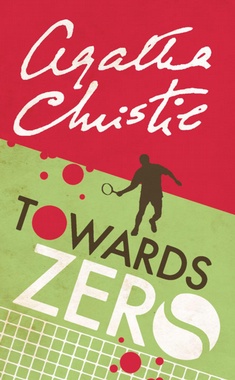
Towards Zero by Agatha Christie

Towards Zero is one of only a few Agatha Christie novels to feature the detective Superintendent Battle. There’s no Poirot or Miss Marple in this one (although there is a TV adaptation – which I haven’t seen – where Miss Marple does appear) but even without them I thought this was an excellent murder mystery novel that deserves to be more popular. The story revolves around the murder of an elderly woman, Lady Tressilian, who has invited a group of guests to her seaside home at Gull’s Point.

With this novel, Christie takes a slightly different approach to normal. Instead of beginning with a murder and then following the detective’s attempts to solve it, she chooses to spend half the book describing the backgrounds of the characters, some seemingly unconnected episodes from their pasts, and the sequence of events that lead to the murder finally being committed and the murderer’s objective being achieved (what one of the characters refers to as ‘Zero Hour’).

“I like a good detective story,” he said. “But, you know, they begin in the wrong place! They begin with the murder. But the murder is the end. The story begins long before that – years before sometimes – with all the causes and events that bring certain people to a certain place at a certain time on a certain day.”

So by the time the murder takes place halfway through the book, the characters are quite well-developed and we know a lot about each of the possible suspects. Could the murderer be the tennis player, Nevile Strange, one of Lady Tressilian’s guests? Or his beautiful wife, Kay? Or could it be his first wife, Audrey, who happens to be visiting at the same time? Maybe it’s Thomas Royde, who is secretly in love with Audrey – or Ted Latimer, a friend of Kay’s. And what about Mary Aldin, Lady Tressilian’s companion?

I thought the mystery was a difficult one to solve and I think I suspected all of the above people at some point in the story! I thought I’d figured it out once or twice but was proved wrong and there were at least two big plot twists towards the end of the book that took me by surprise. Looking back, there were plenty of clues, but plenty of red herrings too.

Towards Zero is atmospheric, very cleverly plotted, and although it’s not one of my favourite Agatha Christie novels it’s still one that I would highly recommend.

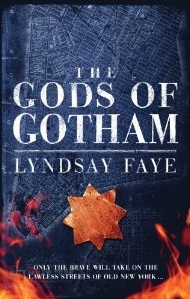
The Gods of Gotham by Lyndsay Faye

New York City, 1845: When Timothy Wilde loses everything in a fire that destroys a large part of Manhattan, his brother Valentine helps him get a job as a ‘copper star’ in New York’s newly formed police force. Due to his knowledge of ‘flash’, a slang spoken largely by criminals, Timothy is assigned to the Sixth Ward, one of the city’s most notorious areas where crime rates are high and where racial and religious tensions are increasing with the influx of Irish immigrants fleeing the potato famine.

Timothy is unenthusiastic about his new job until one night when he’s walking home from work and a ten-year-old girl runs into him, covered in someone else’s blood. Soon Tim finds himself on the trail of a child killer and discovers that he has an unexpected talent for detective work.

I must admit that when I received a copy of The Gods of Gotham from the publisher, I wasn’t sure this was going to be the type of book I would enjoy. Well, I couldn’t have been more wrong, because I loved it! I could tell from the first page that I liked the writing style and by the end of the first chapter I knew I was going to like the narrator too. But the thing I enjoyed most about The Gods of Gotham was the wonderful setting. Every time I picked up this book and started to read I felt I had left the modern world behind for a while and was actually there, walking through the streets of 19th century New York, which is the highest praise I can give to any historical fiction novel. I’ve read so many books set in Victorian London, and it made a nice change to read one set in New York during the same period.

We also meet lots of strong, interesting characters – Mercy Underhill, the reverend’s daughter and the woman Timothy loves; Bird Daly, the little Irish girl he met in the street at the start of the novel; and Silkie Marsh, who runs the brothel at the centre of the murder investigations. And at the heart of the story is the relationship between Tim and his brother Valentine. Timothy himself is easy to like but he isn’t perfect and has enough flaws to make him a believable character. Although he doesn’t always interpret things correctly, he’s intelligent, observant and compassionate. Val is a very different type of person – tough, aggressive, addicted to morphine and drinking – but by the end of the book we learn that there’s more depth to Val than there seemed to be at first.

The use of flash is something that you will probably either love or hate – personally I thought it added to the atmosphere of the book and made the dialogue feel lively and fun. I was surprised to find that I was already familiar with some of the words and it was interesting to see how many of them have now come into everyday use. But there were other words and phrases that meant nothing to me and so the glossary at the front of the book (based on George Washington Matsell’s Vocabulum, or The Rogue’s Lexicon) was very helpful, especially at first!

For me, the actual crime plot was secondary to the setting, the atmosphere and the characters but it was still good enough to keep me guessing until the truth was finally revealed. The Gods of Gotham was something different and original – I loved it and was pleased to discover that there’s going to be a sequel!

I received a review copy of this book from Headline Review.

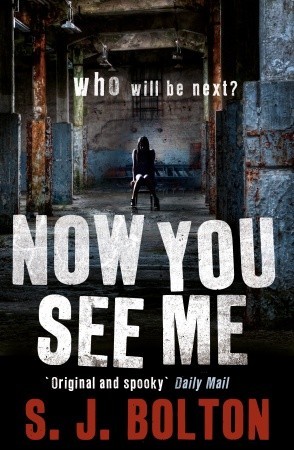
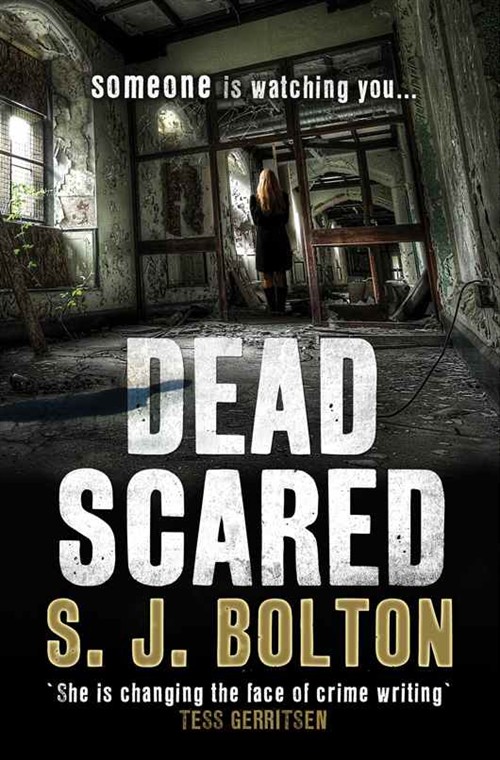
Two from S.J. Bolton: Now You See Me and Dead Scared

I don’t read a lot of contemporary crime fiction, but one author whose work I’ve been enjoying recently is S.J. Bolton. Last year I read Sacrifice and Awakening and loved both of them. But while those two books had atmospheric settings and a gothic feel (both things which appeal to me in a book) Now You See Me sounded like a more conventional crime novel and I wasn’t sure how I would feel about it. I had been putting off reading it for a while but finally picked it up a couple of weeks ago to read in preparation for reading the sequel, Dead Scared. I’ve decided to combine my thoughts on Now You See Me and Dead Scared into one post as I read them so close together.

Now You See Me introduces us to DC Lacey Flint, a young police detective based in London. After interviewing a witness one evening, Lacey returns to her car to find a dying woman slumped across it. The woman has been stabbed but there’s no sign of her attacker. As more murders take place across the city it starts to appear that they are the work of a serial killer copying the crimes of Jack the Ripper – who happens to be Lacey’s favourite historical figure. Lacey uses her knowledge of the Ripper to guess the killer’s next moves, but it soon becomes obvious that there’s a connection between the murders and Lacey herself, and she’s forced to confront some secrets from her past that she would prefer to keep hidden.

I needn’t have worried that I wouldn’t like this book because I enjoyed it almost as much as the others. What I loved most about Now You See Me was the character of Lacey Flint. As the story’s narrator we’re relying on her to give us all the facts but we quickly discover that there are a lot of things she’s not telling us. I liked Lacey but she’s very flawed and secretive, and the truth about her past is only revealed very slowly as the story progresses. Towards the end of the book, the plot takes a lot of unexpected twists and turns and I loved the fact that S.J. Bolton managed to surprise me after I thought I’d figured everything out!

In Dead Scared we join Lacey again as she goes undercover at Cambridge University to investigate an unusually high number of suicides among the students, most of them attractive young women. Many of these students had reported having problems sleeping and waking from nightmares feeling that someone had been in their room. Posing as a depressed, vulnerable student, Lacey tries to find out what’s going on, but could she be putting her own life at risk?

The only person at Cambridge who knows Lacey’s true identity is Evi Oliver, a psychiatrist with an interesting past of her own. Although most of the book is again narrated by Lacey, there are also some chapters written in the third person from Evi’s perspective. Apparently Evi first appeared in Blood Harvest, the only book by Bolton that I haven’t read yet, and I felt there were a lot of things I didn’t understand about her background – I will have to read Blood Harvest soon!

Now that we’ve had the chance to get to know Lacey better she’s much more open with us and I felt her character had developed a lot since the first book. It would probably be best to read Now You See Me first as it will help you understand Lacey and the way she interacts with the other characters, but this book does stand alone quite well so if you do find yourself reading this one first it shouldn’t spoil things too much.

Both novels also explore Lacey’s relationship with one of her male colleagues, DI Mark Joesbury. It’s obvious almost from their first scene together that they have feelings for each other but neither wants to admit it to the other. There’s a real chemistry between the two of them and this adds another interesting angle to the story.

Like S.J. Bolton’s other novels, Now You See Me and Dead Scared are quick and exciting reads due to the combination of fast-paced plot, short chapters and cliffhanger chapter endings. Bolton is great at creating a dark, menacing atmosphere and building the tension as her characters find themselves becoming increasingly isolated and in danger. These books are not for the faint hearted as the descriptions of the murders and suicides are quite graphic, but if you enjoy reading this type of crime novel I can recommend either or both of these.

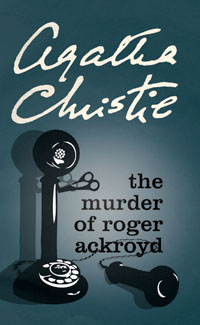
The Murder of Roger Ackroyd by Agatha Christie

2011, among other things, was the year I discovered that I do actually like Agatha Christie, having read a few of her books in the past which I didn’t enjoy very much. I think I had obviously just been choosing the wrong books because I read five in 2011 and loved all but one of them (The Mystery of the Blue Train).

This one, The Murder of Roger Ackroyd, is set in the fictional village of King’s Abbott, home to our narrator, Dr James Sheppard, and the retired detective Hercule Poirot. When Roger Ackroyd is found stabbed to death in his study, Poirot comes out of retirement to investigate the murder. The suspects include Ackroyd’s stepson, his secretary and butler, a big-game hunter and one of the parlourmaids. With Dr Sheppard’s assistance, Poirot begins to piece together the evidence to solve the mystery.

I loved this book and it might even have become my favourite Christie novel so far, if not for one little problem: I guessed the solution to the mystery very early in the story. Now, this is not something that usually happens – I’m normally completely mystified by Agatha Christie’s novels and don’t even bother trying to solve them. This is the first one I’ve ever figured out correctly, but it did mean that in some ways the book was spoiled for me. Not completely spoiled – it was still fun watching for more clues that would confirm whether I was right or not – but it would have been nice to have been surprised when the solution was finally revealed, as the author had intended.

As most Poirot novels are written either in the third person or narrated by Captain Hastings (who does not appear in this book) it took me a while to get used to the new narrator. It gave this book a slightly different feel to the other Poirots I’ve read. I also thought the characters had a bit more depth than usual and I loved the scenes with the doctor’s irritating gossip-loving sister, Caroline, who added some humour to the story. And even though the ending of the story didn’t have quite the impact for me that I would have liked it to have done, I could still appreciate how cleverly constructed the mystery was. There were plenty of suspects, all hiding secrets of their own, lots of red herrings and some plot twists. I’m looking forward to reading more Poirot throughout the year ahead!

The Water Room by Christopher Fowler

The Water Room is the second in a series of novels about two elderly detectives, Arthur Bryant and John May, who work for the Peculiar Crimes Unit, a branch of the London Metropolitan Police specialising in unusual cases. Bryant and May have been working together since the 1940s and have formed a strong and effective partnership, combining Bryant’s eccentricity and lateral thinking with May’s common sense and more logical approach.

When Mrs Singh is found drowned in the seemingly dry basement of her home in Balaklava Street with her mouth full of river water, her brother, who is an old friend of Arthur Bryant’s, asks the Peculiar Crimes Unit for help. But no sooner have Bryant and May begun to investigate than another bizarre incident occurs in the same street. Meanwhile, the new owner of Mrs Singh’s house is being plagued by the sound of rushing water in the basement and damp patches appearing and disappearing on the walls. What is going on?

I read the first book in this series, Full Dark House, a couple of months ago and loved it, but I thought this one was even better. This is a series that I would particularly recommend to people who love London. I’m not familiar enough with London to fully appreciate everything in these novels, but Christopher Fowler’s love and knowledge of the city is obvious on every page. Full Dark House looked at the city’s theatrical world; in this book the focus is on the underground rivers that run under the streets of London. During the course of Bryant and May’s investigations we learn lots of little facts about these lost rivers and the mythology surrounding them. The historical information is woven into the plot throughout the book and I thought the balance between education and entertainment was just right.

This is not a very fast-paced book and does require some concentration, but the story moves along steadily and has a few surprising twists. The mystery plot was quite a good one, with plenty of clues and red herrings that seemed to implicate almost everybody in the street at one point or another. But the highlight of these books for me is the partnership of Bryant and May themselves and the dialogue between them.

As well as being part of a series, The Water Room is a complete mystery novel in itself and it’s not necessary to have read Full Dark House first. However, if you’re concerned about coming across spoilers it would be a good idea to start at the beginning of the series. After enjoying the first two books so much I’m sure I’ll be reading the others and am looking forward to meeting Mr Bryant and Mr May again in Seventy-Seven Clocks.

I received a copy of this book for review from Transworld as part of the Transworld Book Group.

Awakening by S.J. Bolton

If you’re scared of snakes you might want to avoid this book! There are lots and lots of snakes in Awakening, from the harmless grass snake to the British adder and the venomous taipan. And in an isolated English village someone is breaking into people’s houses and leaving some of these snakes behind for the unsuspecting residents to find.

Luckily one of the villagers happens to be an expert on reptiles: her name is Clara Benning and she’s our narrator. Due to something that happened in her childhood, Clara has decided she’s more comfortable with animals than people and is working as a vet at a wildlife hospital. And so when the village becomes overrun with snakes, her neighbours come to her for advice. Clara begins to investigate, although she finds communicating with people difficult and would prefer to be left alone. With the help of two very different men – one a local policeman and the other a celebrity snake-handler – Clara is gradually drawn into a fifty year-old mystery which may explain where the snakes are coming from and at the same time she is forced to confront her own fears and insecurities.

Awakening is the second book I’ve read by S.J. Bolton. The first was Sacrifice, which I read earlier in the year and loved. This book had all the things I liked about Sacrifice – the fast pace, the gripping mystery plot, the interesting and independent female protagonist – but I enjoyed this one even more because I was able to connect with Clara more than I did with Tora Hamilton in the previous book. She seemed a more believable and well-developed character. Her personal background intrigued me immediately and the balance between this part of the story and the snake storyline was perfect.

Something else that I loved about this book was the setting. A lot of the action seems to take place at night and the small rural village feels very eerie and sinister in the dark. There are some gothic elements too, including graveyards, abandoned houses, old churches, underground tunnels and possible sightings of ghosts. As for the snakes, if you actually have a phobia about them you probably wouldn’t want to read this book, but otherwise you should be okay. I don’t particularly like them and certainly wouldn’t want to find one in my bedroom, but reading about snakes isn’t a problem for me and I enjoyed all the little facts about them that were dropped into the story without slowing the plot down at all.

Now I’m looking forward to reading Bolton’s other books, Blood Harvest and Now You See Me.