The Darkest Room by Johan Theorin

“Those who have lived here in times gone by are still here,” said Gerlof, his coffee cup in his hand. “Do you think they rest only in graveyards?”
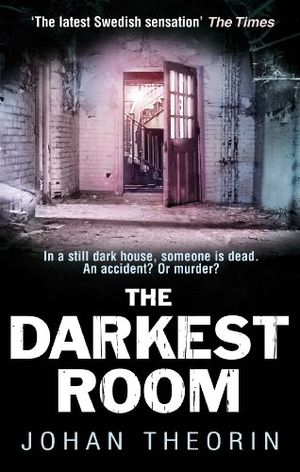
The Darkest Room is the second in a planned quartet of novels by crime writer Johan Theorin, all set on the Swedish island of Öland. In March I wrote about how much I enjoyed the first book in the series, Echoes from the Dead, and I thought this one was even better. So far I have been very impressed by these books. I would describe them as intelligent, well-written mystery novels with believable characters and one of the most vivid and atmospheric settings I’ve come across. There are surprises, revelations and plot twists but nothing that I’ve found too hard to believe. And in this second novel there’s a touch of the supernatural too, as well as some Swedish folklore.

There are three main threads which alternate throughout the novel. The first follows Joakim and Katrine Westin who have recently moved to Öland with their two young children, Livia and Gabriel. Their new home, the isolated manor house at Eel Point, has an interesting history which is slowly revealed through a number of flashbacks. The second thread features Henrik Jansson and his involvement with a pair of criminals, the Serelius brothers, who are planning a series of burglaries. And the third storyline introduces us to Tilda Davidsson, a police officer who is another new arrival on the island. Add a couple of abandoned lighthouses and a ‘sacrificial peat bog’ and it soon becomes clear that this is much more than just another haunted house story.

Although I personally prefer to read a series in the correct order if possible, it wouldn’t be necessary to read Echoes from the Dead before this one; they don’t really follow on from each other in any way. The only links that connect the two books are the Öland setting and the character of Gerlof Davidsson, a retired sea captain. He’s Tilda Davidsson’s great-uncle and with his knowledge of Eel Point and the superstitions surrounding it, she decides to enlist his help with her investigations. Gerlof, at eighty years old, again plays an important part in solving the mystery as he did in the previous book. I love Gerlof; with his independence, his quiet confidence and his ability to listen he’s a great character and it was wonderful to meet him again.

On the author’s website, Theorin states that his aim in writing the Öland quartet is to set each novel in a different season, so that the atmosphere of the story is influenced by the weather and the changing landscape. Having now read the first two books in the quartet, I can say that so far he has done this very well. The Darkest Room is set in the winter after all the summer tourists have left Öland and the island is at its most deserted. Snow storms, blizzards and relentless cold all add to the mood of the book. Theorin doesn’t give us pages and pages of lengthy descriptions of the scenery; instead, the descriptions are woven into the fabric of the story conveying both the beauty of the island and the sense of loneliness and isolation that give the setting its eerie feel. I’m now looking forward to starting the third book, The Quarry, and finding out what Öland is like in the spring!

Darkside by Belinda Bauer

When an elderly woman is found murdered in her own home in the sleepy village of Shipcott, local policeman Jonas Holly begins to investigate. A team of detectives soon arrive to take over the case, however, and Jonas finds himself pushed into the background. As the snow falls in Shipcott and tension builds in the village, the killer strikes again and again. Then Jonas himself starts to receive anonymous notes taunting him for his incompetence and he begins to grow concerned that his wife, Lucy, could be in danger…

Darkside is the second novel by crime writer Belinda Bauer. After finding her first book, Blacklands, so impressive when I read it last year I was looking forward to reading this one – and I wasn’t disappointed. But this is a different type of crime novel – while Blacklands featured a highly original plot involving a child killer communicating with a young boy from his prison cell, Darkside is more of a traditional murder mystery.

I hadn’t realised that this book was going to be set in the same village as the previous novel so it was a nice surprise to see one or two old friends making a brief reappearance. However, both books do stand alone and Darkside is not really a sequel. It’s set four years later, the plot is entirely different and the focus is on a new group of characters. The only thing the two novels really have in common is the setting. And the setting, by the way, is one of the strong points of both books. Shipcott feels like a real English village and its inhabitants are so realistic they feel like they really could be the people you live or work with. I love the world Belinda Bauer has created and I’m glad she decided to revisit it.

Jonas Holly was an interesting character. We are told that as a young police officer he had once been very ambitious, but had given up his hopes of career advancement to care for his beloved wife, Lucy, who was diagnosed with multiple sclerosis. I thought Bauer’s portrayal of their relationship, with both husband and wife trying to come to terms with Lucy’s diagnosis, was very moving and believable. The other person with whom we spend a lot of time is the head of the murder investigation, DCI Marvel, one of those obnoxious characters who, despite being completely unlikeable, is great to read about.

The only slight problem I had with this book was that the ending felt very dramatic and didn’t really match the tone of the rest of the story. But I didn’t guess who the murderer was until near the end, so it worked in that respect. Looking back the clues were there, but I didn’t pick up on them straight away as I had expected the killer to be someone entirely different to who it actually turned out to be! I loved this gripping novel and can’t wait to see what Belinda Bauer’s next book is like.

Death in the Clouds by Agatha Christie

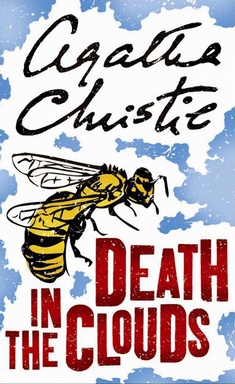
Death in the Clouds, first published in 1935, is one of Agatha Christie’s many novels featuring the Belgian detective Hercule Poirot.

Ten people are travelling on a plane flying from Paris to London. During the flight a woman is found dead in her seat – apparently a murder has taken place without anyone seeing it happen. Among the other passengers is Poirot, who can’t believe a crime has taken place right under his nose! The mystery proves a difficult one to solve and after landing in England the suspects are allowed to go back to their everyday lives. As Poirot continues to investigate, he uncovers some secrets about the murdered woman and discovers that more than one of her fellow passengers had a reason to want her dead…

Like many classic mysteries, the crime takes place in a confined space so that we know from the beginning who the suspects are. The fact that this novel is set on a plane makes a nice change from the usual country house! The suspects include a beautiful aristocrat with a cocaine addiction, two prominent archaeologists, a doctor, a dentist, a businessman, a hairdresser – and my personal favourite, a crime novelist, whose inclusion gives Christie a chance to have some fun at the expense of her own genre. The characters don’t have a lot of depth and there are only a few that we get to know well, yet Christie makes it easy to remember who is who. There are plenty of red herrings to make the reader suspect first one person and then another; it’s even possible that Poirot himself could have committed the murder!

I enjoyed studying the seating plan at the front of the book and the list of the contents of the passengers’ luggage in an attempt to work out what had happened – but as usual, I didn’t even come close to solving the mystery. In a way I’m glad that my crime-solving skills are so bad because it means I can be surprised by all the twists and turns of the plot as the author intended.

I’m having fun working through all the Agatha Christie books available from my library’s ebook section, so you can expect some more Christie posts from me in the near future. It’s funny because her books had never held much appeal for me in the past, though maybe I was just unlucky with the ones I was choosing to read. Although Death in the Clouds is not one of the best that I’ve read so far, it was still an enjoyable read.

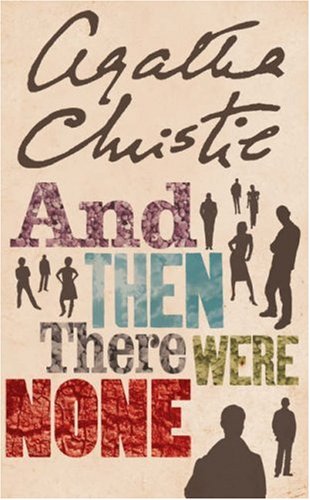
And Then There Were None by Agatha Christie

Although I usually enjoy mysteries, I’ve never considered myself to be a big fan of Agatha Christie. I didn’t really like the Poirot books I’ve read (though admittedly I’ve only tried a few of them) and Miss Marple didn’t appeal to me either. If only I had started with this one instead!

At the beginning of the book we are introduced in quick succession to ten people who have all been invited to a house on Soldier Island, off the coast of Devon. Each person has been given a different reason as to why their presence on the island is required, but on arriving at the house the group discover that their hosts are mysteriously absent. When, one by one, they begin to suffer gruesome deaths in accordance with the children’s rhyme “Ten Little Soldiers” it becomes obvious that one of the ten is a murderer.

The thing that makes this book such an exciting and suspenseful read is that all ten characters seem suspicious and the more you learn about them the more it appears that any one of them could be the killer. Halfway through the book I thought I had worked it out as there was one character in particular that I had suspected from the start (although it was more just an instinct rather than anything specific that he or she had done). As the story moved towards the conclusion it looked as if I was going to be right…

Do I need to tell you that I got it entirely wrong? I admit that solving whodunits is not one of my strong points, but I think most people would be baffled by this one! Christie expertly leads you to believe one thing, then a few pages later proves you wrong. I was sure that as more and more of the ten were eliminated one of them would emerge as the most obvious suspect, but that didn’t happen.

Have you read this book? Did you guess the solution to the mystery?

Naming the Bones by Louise Welsh

In Naming the Bones, the first book I’ve read by Louise Welsh, university lecturer Dr Murray Watson takes a sabbatical from work in order to research a new book on the life of Archie Lunan, a little-known Scottish poet. Lunan drowned in a sailing accident decades earlier and his death is still surrounded by mystery. Murray’s investigations take him from his home in Glasgow to the Isle of Lismore – where he learns more about Lunan’s life and death than he could ever have imagined and begins to ask himself the question: does knowing what an artist is like as a person really add to our appreciation and understanding of their work – or is the work best left to stand on its own?

Although I did end up enjoying this book, it wasn’t really what I was expecting at all – from the blurb and the quotes on the back of the book it sounded like it would be a fast-paced thriller. Unfortunately I really struggled to get through the first half of the book – it was very slow and there were too many sub-plots that didn’t seem to add much to the story – Murray’s affair with his head of department’s wife, for example, and his estrangement from his brother. But I did like Murray as a character – I found him a likeable and wryly funny narrator who seemed to stumble from one disaster to another – and I wanted to find out what had happened to Archie Lunan, so I was happy to keep reading.

In the second half of the book, when Murray arrived on the island of Lismore, the pace started to pick up and the story became very compelling. The island with its ruined castle, abandoned cottages and ancient broch provided an atmospheric setting for this part of the novel. Welsh increased the tension with every chapter, threw in some twists and surprises (though nothing too unbelievable) and left me feeling satisfied with the way the book had ended.

Echoes from the Dead by Johan Theorin

One foggy afternoon in 1972, a little boy went missing on the Swedish island of Öland. Twenty years later, his mother, Julia Davidsson, is still trying to come to terms with the loss of her son. She has left Öland and is living alone in Gothenburg, depressed, drinking too much and barely speaking to her elderly father, Gerlof. One day she receives an unexpected telephone call from her father, who now lives in an old people’s home on the island, saying he has received new evidence regarding the disappearance: one of the sandals little Jens was wearing on that fateful day. Julia immediately returns to Öland and together she and Gerlof attempt to discover what really happened to Jens.

Gerlof believes his grandson may have been abducted by Nils Kant, a notorious criminal who fled Öland at the end of the Second World War. But Nils Kant is known to have died in the 1960s – his body was sent back to the island from Costa Rica and is now buried in the churchyard there – so how could he possibly have been involved in the events of 1972?

Echoes from the Dead has all the ingredients of a great crime novel: a gripping, well-structured plot, believable characters and an atmospheric setting. I thought the pacing was perfect – slower at the beginning and steadily building in suspense and tension towards the end. Although I didn’t guess the solution to the mystery, I’m not sure whether it would have been possible to work it out before the final chapter anyway – there were some surprising twists towards the end that were completely unexpected.

There were three main characters: Julia, Gerlof and Nils Kant. I didn’t find Julia very engaging, but I loved Gerlof and his stubborn determination to do things in his own way and on his own terms. Nils Kant’s story unfolds slowly through a series of flashbacks interspersed with the present day storyline and I found him another intriguing character. And the Swedish island of Öland is almost a character in itself. Beautiful but cold and lonely, it provided a wonderful setting for the novel. Despite never having been to Öland (or any part of Sweden) Theorin’s descriptions of this island were so vivid I could visualise exactly what it must look like.

I’m glad I’ve now discovered Johan Theorin and am looking forward to reading his second book set on Öland, The Darkest Room.

I received a copy of this book from Transworld as part of their Great Crime Caper.

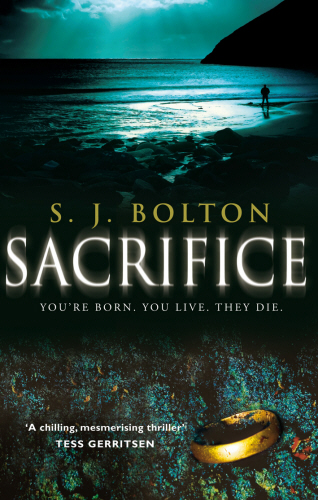
Sacrifice by S.J. Bolton

A few weeks ago I mentioned that I’d signed up for Transworld’s Great Crime Caper reading challenge. Sacrifice, the debut novel by S.J. Bolton, is the first book I received from Transworld for the challenge.

Our narrator is Tora Hamilton, an obstetric surgeon who has recently moved to the Shetland Islands with her husband, Duncan. Tora has been told that the Shetlands are ‘one of the safest places to live in the UK’, so the last thing she expects is to find a dead body in a peat bog in the field beside her new home. To make things even more shocking the body has had the heart removed and is carved with symbols which match the ancient runes on the wall in Tora’s cellar. As Tora becomes more and more determined to find out what’s going on she discovers that someone else is equally determined to put an end to her investigations.

If you’re going to read this book you should be aware that it’s very gory in places, particularly at the beginning of the novel, when Tora finds the mutilated corpse. If you can get through this part you’ll be all right because the story then becomes much less gruesome, though increasingly dark and eerie, and soon develops into a fascinating and well-structured murder mystery. Tora, with the help of police detectives Dana and Helen, uses a whole range of resources to investigate the mystery and piece information together, from medical records and birth registers to bank statements and books of folklore.

The most interesting aspect of this book for me was the Shetland setting and the exploration of Shetland myths and legends. I’ve never been to the Shetlands and have never read a book set there either, so this was something new for me, and I thought S.J. Bolton perfectly evoked the atmosphere of these remote and ruggedly beautiful islands with their jagged cliffs, flooded valleys and the Aurora Borealis illuminating the night sky.

Although the Shetlands are part of Scotland they are deeply rooted in Norse history and folklore and some of these myths and legends become integral to the story, giving it a slightly supernatural aura. There’s a scene where Tora is reading about a particular myth for the first time which really sent shivers down my spine. In fact, the whole book is genuinely quite scary. There are a few chapters that you really wouldn’t want to read if you were alone in the house at night!

On a more negative note, sometimes I felt I was being given too much information all at once when it could probably have been woven into the plot more gradually. A lot of it was also hard to believe. Tora seemed unrealistically brave, taking needless risks and sneaking around murder scenes in the middle of the night. Of course, fiction doesn’t always need to be realistic and it wouldn’t have been much of a story if Tora had reacted the way I would have done and run a mile at the first sign of danger! And none of this really mattered to me anyway because the plot was so exciting and gripping.

Sacrifice was just what I needed after reading a lot of slower paced books recently. Perfect if you’re looking for a fast-moving, atmospheric mystery with a unique setting.