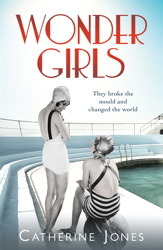
Wonder Girls by Catherine Jones

“It’s always the boys who get the heroes, as though girls can’t do brave things too,” says one of the characters in Catherine Jones’ Wonder Girls, a moving and inspirational novel which succeeds in showing that girls can be just as heroic as boys.

In 1928 when Ida Gaze, a sixteen-year-old schoolgirl, announces that she’s going to become the first person ever to swim the Bristol Channel between Wales and England, nobody takes her seriously. Nobody, that is, except her best friend, Freda Voyle. Inspired by the American aviator Amelia Earhart who had recently landed on the coast of Wales after becoming the first woman to fly across the Atlantic, Ida is determined to prove that she can do what no man has ever been able to do.

Years later, Freda’s partner, Cecily, finds an old black and white photograph of Ida amongst Freda’s things. Encouraged by Sarah, a younger woman who has befriended her, Cecily begins to investigate and learns more about the girl in the picture. Throughout the novel we move backwards and forwards in time as Cecily’s story, taking place in 2009, becomes linked with the story of Ida and Freda all those decades earlier.

All of the women we meet in this book are interesting, complex people. They all have a lot of strength and courage, but also some weaknesses that make them more human and more believable as characters. I loved Cecily (I think it would be difficult not to), was alternately impressed and frustrated by Ida, but the character who I found most memorable and who has stayed in my mind a couple of weeks after finishing the book is Freda. I didn’t like Freda at first as I thought she seemed hard and obnoxious, but I quickly discovered that underneath she was a very sensitive, loving person and I felt so sorry for her as she and Ida grew older and started to want different things out of life.

The novel explores other relationships too – some are good and some are bad, some are romantic and some are not. One of my favourites was the friendship that develops between Cecily, in her eighties, and the thirty-four-year-old Sarah. It was so nice to read about two women of different generations and different backgrounds becoming such good friends and being able to give each other the support and advice each of them needed.

I was surprised by how much I enjoyed Wonder Girls. I received a review copy from the publisher, Simon & Schuster, and I’m glad I did because it’s probably not a book I would have chosen for myself. Wonder Girls has its sad, poignant moments, but in the end it’s an uplifting and inspiring novel, as well as a fascinating one. At the back of the book the author has included some information on some ‘real life wonder girls’. Reading these true stories along with the stories of Ida and Freda, Cecily and Sarah, couldn’t fail to make you feel proud of all the things women have achieved.

The Map of Lost Memories by Kim Fay

As a woman in 1925, Irene Blum feels that her work does not get the recognition it deserves. When she misses out on the position of curator at Seattle’s Brooke Museum, she dreams of making an important historical discovery, one that she can build her own museum around. Since her childhood she has been fascinated by Cambodia and its ancient Khmer civilisation, so when she learns of the possible existence of ten copper scrolls recording the history of the Khmer people she sets off on an expedition to Cambodia to search for them.

Irene begins her journey in Shanghai where she hopes to enlist the help of Simone Merlin, a revolutionary activist and Cambodian scholar who shares Irene’s interest in the Khmer. Despite the disapproval of her abusive husband Simone agrees to join her. At first Irene is pleased to have Simone’s support, but soon begins to wonder whether she might have reasons of her own for wanting to find the lost scrolls.

The novel is divided into three sections. The first is set in Shanghai, China, the second in Saigon, Vietnam and in the third Irene, Simone and their companions finally arrive at their destination, the Cambodian jungle. None of these are places that I know very much about (Cambodia was a completely new setting for me and the other two I only have a very limited knowledge of) and I loved all the descriptions of the three locations. It’s always interesting to read about cultures that are entirely different to your own and by the time I’d finished the book I felt I’d learned a little bit about what life might have been like in China, Vietnam and Cambodia in the 1920s, as well as learning some facts about the Khmer civilisation.

The Map of Lost Memories is not a fast-paced thriller filled with non-stop action and adventure, although it might sound like one from the synopsis. Instead, the story develops quite slowly (a bit too slowly for me, to be honest, especially throughout the first half of the novel) and although Irene and Simone do have some adventures and things get more exciting later in the book, there’s also a lot of focus on the personal lives of the two women, their relationships and their motives for searching for the legendary scrolls.

It was good to read a book set in the 1920s with strong female protagonists at a time when women didn’t have the same career opportunities they have today. However, although I sympathised with Irene’s frustration at her achievements constantly being overlooked or ignored and I admired her dedication and determination, I was never able to warm to her as a character. Unfortunately I didn’t feel much connection to any of the other characters either, which meant that even when they were heading into danger I found I didn’t really care what happened to them. The plot and the setting almost made up for my lack of interest in the characters so I did still enjoy the book, but not as much as I might otherwise have done. This was a promising debut novel, though – it was obvious that the author must have a real passion for Cambodia and Khmer history and that she knows the subject well.

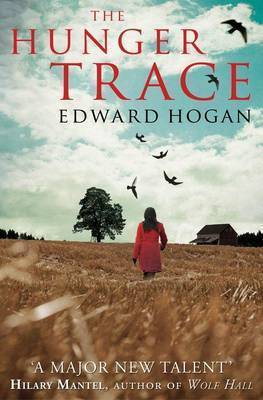
The Hunger Trace by Edward Hogan

The Hunger Trace is set in a small English village where three very different people are all trying to cope with the death of wildlife park owner David Bryant. There’s David’s wife, Maggie; his son from a previous marriage, Christopher; and their neighbour, Louisa. Throughout the pages of this novel we see how each character comes to terms with losing David and how they gradually learn to get along with each other.

Although there are some moments of drama when a fourth character, Adam, is introduced and when Derbyshire is hit by the worst floods in years, The Hunger Trace is definitely more of a character-driven novel but despite it being quite slow paced I was never bored. All of the main characters are interesting, three-dimensional people each with his or her own set of problems and secrets.

As David’s widow, Maggie is left to run his business which has been having financial difficulties, to take responsibility for the welfare of his animals, and to look after her stepson Christopher. Feeling lonely and isolated, she tries to befriend Louisa, a falconer who lives alone with her birds of prey. However, Louisa has never liked Maggie, who she sees as just one of a long series of women who have passed in and out of David’s life over the years. Louisa herself was connected to David by a terrible secret the two had shared since they were teenagers and now that he’s gone she has little interest in anything apart from her hawks.

Christopher, although it wasn’t actually stated in the book, seems to have a form of autism or something similar which he is taking medication for. He sometimes has trouble relating to other people (including his stepmother) and is often misunderstood; he’s also obsessed with Robin Hood and spends most of his time at college trying to prove that his hero was a real historical figure! Christopher has a habit of saying ‘erm’ before almost every word, which did get a bit irritating to read, but it’s this kind of attention to detail that made all of Edward Hogan’s characters feel so realistic and believable. I initially found Maggie the easiest to like of the three, but eventually I began to warm to the others, particularly Louisa, who I thought was a wonderful character and so much more complex than just the unfriendly, hostile woman she appeared to be at the beginning of the book.

If you’re wondering what the title of the book means, it’s a term relating to falconry and its significance is explained during the course of the story. I loved the whole falconry aspect of the book, which is surprising as it’s not something I would have expected to find so fascinating to read about. This was quite an unusual novel and maybe not one that I would normally have chosen to read, but I’m glad I did as I was very impressed by The Hunger Trace and by the quality of Edward Hogan’s writing!

Thanks to Simon & Schuster for providing a review copy of this book

The Land of Decoration by Grace McCleen

The Land of Decoration is narrated by ten-year-old Judith McPherson. Judith’s mother is dead and she lives with her father, who is very religious. The religion to which they both belong is not named but they appear to be Jehovah’s Witnesses or something very similar. They read the Bible together, attend weekly meetings, knock on doors to spread their message and believe that the end of the world is coming soon.

Judith is lonely, friendless and has convinced herself that her father doesn’t love her. She spends most of her time playing in her bedroom, where she has created a ‘Land of Decoration’ from scraps of paper, pipe cleaners, felt, boxes, buttons and any other bits and pieces she can find. One day Judith adds some snow to the Land of Decoration– and when it suddenly starts snowing in the real world too she believes she’s performed a miracle. And when Judith begins to hear the voice of God, she decides to use her new powers to deal with the school bullies and some of the other problems in her life.

The Land of Decoration was not quite what I was expecting and if I had known more about it, it probably wouldn’t have been a book I would have chosen to read. It quickly became obvious that it was going to be a much darker story than I had thought it would be.

I did like Judith – she’s bright and intelligent but also quite innocent and naïve (although there were times when her voice seemed too ‘old’ and I thought she stopped feeling like a believable ten-year-old). The bullying scenes felt sadly realistic and so did her father’s experiences (he is breaking a strike at the factory where he works and he’s also starting to have some doubts about his religion).

I really cared about both Judith and her father and I actually thought the story of their relationship, his problems at work and her problems at school would have been strong enough on its own to form quite a compelling novel. I was less interested in the parts of the book that dealt with the miracles and the conversations with God, and I admit I found some of it very confusing. A lot of my questions were left unanswered at the end and I’m not sure I really understood everything that had happened.

The Land of Decoration is a very imaginative and original book, but not one that I personally enjoyed very much. I’m sure it’s going to be a success though, and it will be interesting to see what Grace McCleen writes next.

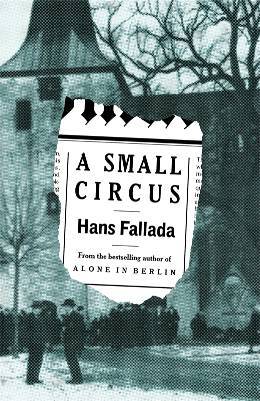
A Small Circus by Hans Fallada

Of all the books I read last year, my favourite was Hans Fallada’s Alone in Berlin (US title Every Man Dies Alone), the story of a German couple who decide to resist the Nazi regime after their son is killed fighting in the war. It was such an exciting, moving and powerful book, and when I saw that Penguin Classics were publishing a new translation of another of Fallada’s novels, A Small Circus, I couldn’t wait to read it.

A Small Circus is set in and around Altholm, a fictional German town, in 1929. Within the town there are lots of different groups and factions who are all in conflict with each other, including the mayor, various political parties, farmers, journalists and the police. None of these opposing groups are able to cooperate and work together. The novel describes the events leading up to and following a demonstration by the protesting farmers which ends in violence, causing things to quickly spiral out of control.

I have to admit, based on the synopsis alone this was not the kind of book I would normally have chosen to read but I decided to give it a chance anyway, remembering how much I had loved Alone in Berlin. And I really wanted to love A Small Circus too, but I have to be honest and say that, for me, this book was a big disappointment. I found the plot confusing and difficult to follow, partly because of my lack of knowledge of early 20th century Germany and the politics involved, but also because so much of the story was told through dialogue. Almost two thirds of the novel is written in the form of dialogue (according to the Foreword) and it was just too much for me.

I also disliked the translation style. Obviously I haven’t read the original German edition of this book from 1931 so I don’t know what Fallada’s actual writing was like, but this translation feels too modern and full of words and phrases that I wouldn’t have thought would have been used at the time. I’m sure there will be a lot of other readers who will love this lively, slang-filled style, but it didn’t have any appeal for me personally. Alone in Berlin was translated by the same person, Michael Hofmann, but for some reason the language in that book didn’t bother me at all, maybe because I was so gripped by the story.

A bigger problem for me was that there wasn’t a single character in the book that I liked. I can see that I probably wasn’t intended to like them, and this was maybe the whole point of the story (to show the effects of hatred, violence and corruption on a small town and how this was being replicated across Germany, opening the way for the Nazis), but it didn’t make it much fun to read. It’s really important for me to have at least one or two characters that I can enjoy reading about or connect with in some way, but without exception I found everyone in A Small Circus greedy and selfish, with few or no redeeming qualities. And not only were there no heroes to side with, there were no great villains that I could love to hate either – just a lot of very unpleasant people.

I want to finish this very negative post by pointing out that although I didn’t enjoy it very much I didn’t actually think this was a bad book. For the right type of reader, A Small Circus would probably be a fascinating read and the other reviews I’ve seen have been mostly very positive. Unfortunately I was obviously not the right type of reader for this book, though I think I would still be prepared to try more of Fallada’s novels in the future.

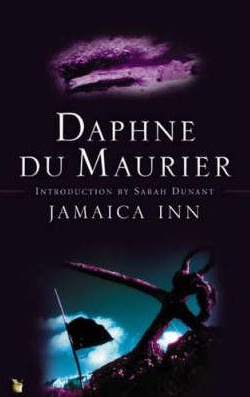
Jamaica Inn by Daphne du Maurier (re-read)

After her mother’s death, Mary Yellan goes to live with her Aunt Patience and Uncle Joss at their inn on Bodmin Moor in Cornwall. But during the coach journey to her new home, Mary hears some disturbing things about Jamaica Inn and its landlord. Soon Mary makes her own shocking discoveries about Joss Merlyn’s activities and finds herself drawn into his villainous schemes while trying to protect her frightened, nervous Aunt Patience. And when Mary is befriended by two very different men – one of them her uncle’s horse thief brother, Jem Merlyn, and the other Francis Davey, the albino vicar of Altarnun – she must decide which, if either, she can trust.

This was actually a re-read for me, although it’s been so long since I first read it that all the details of the plot had completely faded from my mind. What I did remember was being disappointed. When I read it for the first time it was immediately after finishing Rebecca (which I loved – and which is still one of my favourite books ever) and Jamaica Inn just wasn’t as good. This was more than ten years ago though, so I recently decided to give it a second chance. And I did enjoy the book much more this time than I did the first time, maybe because now that I’ve read so many of du Maurier’s other novels it meant I could consider Jamaica Inn in the context of a wider body of work rather than solely in comparison with Rebecca.

Like many of du Maurier’s other books, this one is dark, gothic and atmospheric. Published in 1936 but set in the early 1800s, it has a lot of the traditional elements you would expect to find in a gothic novel (stormy weather, smugglers, locked rooms, shipwrecks, desolate moors, a remote, lonely inn). There are also some memorable characters – Mary herself is an intelligent and courageous heroine, and I know I said that I couldn’t remember much from my previous read, but I certainly hadn’t forgotten the character of her violent, brutal Uncle Joss!

So, Jamaica Inn is not one of my favourite du Maurier novels but not my least favourite either. It does not have the depth and complexity of Rebecca or some of her later novels, but then this one was written near the beginning of her career and is a good early example of her work. The plot is not particularly complicated and I found it quite predictable but du Maurier’s skill at creating tension and suspense meant that I still enjoyed reading it.

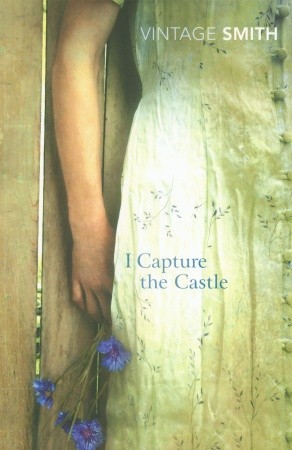
I Capture the Castle by Dodie Smith

This is a book I feel I should have read long before now, but for one reason or another I just never got round to it. So when Iris suggested a readalong in January I decided it was time I finally read it! And yes, I loved it, and really wished I hadn’t waited so long.

I Capture the Castle has one of those famous opening lines you may have heard of even without having read the book: “I write this sitting in the kitchen sink”. ‘This’ being the diary of seventeen-year-old Cassandra Mortmain, written first in a ‘sixpenny book’ then a ‘shilling book’ and finally a ‘two-guinea book’.

Cassandra lives in a crumbling castle in the English countryside with her eccentric novelist father, her glamorous stepmother Topaz who works as an artist’s model, her beautiful older sister Rose and younger brother Thomas – and Stephen, the son of one of the Mortmains’ old servants, who has become almost part of the family. Cassandra’s father wrote one very successful book, Jacob Wrestling, many years earlier but has been suffering from writer’s block ever since and the family are struggling financially. But when they meet the two rich American brothers, Simon and Neil Cotton, who have inherited the estate of which the castle is part, everything begins to change for the Mortmains.

This novel was published in the 1940s but the feelings and emotions Cassandra describes in her journal are timeless. Cassandra is having the usual problems and concerns that any teenager might have: coming to terms with growing up, falling in love, a changing relationship with her sister and other family members, and wondering what the future might hold. There are many novels with teenage narrators that deal with the same issues, but there are two things that really set this one apart: one is the unusual setting – the castle and its eccentric inhabitants – and the other is the voice of Cassandra herself.

Cassandra is such an engaging narrator, it would be difficult not to like her. Although she is very observant and perceptive, she also has an endearing innocence and vulnerability that leads one character to describe her (unfairly) as ‘consciously naïve’. Of all the things I liked about this book, it was Cassandra’s voice and personality that I loved the most. Through the pages of her journal she really does succeed in ‘capturing’ the castle and everyone who lives there. Some of the stories she shares with us are very funny, for example there’s a hilarious scene involving Rose and a big black fur coat, but along with the humour there are also some moments of sadness and poignancy. I was quite happy with the way the book ended too – not all of the loose ends are tied up, but I liked the fact that Dodie Smith chose a slightly unexpected way to finish the story.