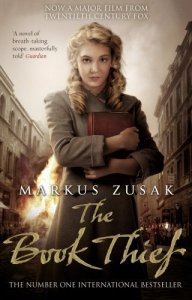
 I know what you’re thinking: how could I possibly have not read The Book Thief until now? My answer is that I really don’t know. My excuse is that I wasn’t paying much attention to new releases at the time when the book was published in 2005 so I missed all the hype surrounding it. Since then I have just never felt like reading it; there has always been another book calling to me more loudly. Now that I’ve finally read it, of course, the next question is: was it worth waiting for? And my answer to that is, sadly, no. Not only am I one of the last people in the world to have read The Book Thief, it seems that I’m also one of the only people not to have loved it.
The novel is narrated by Death, who is experiencing one of the busiest times of his career – World War II. Death is everywhere during the war, but he has chosen to focus on the story of a nine-year-old German girl called Liesel Meminger. Liesel’s parents are communists and as the novel begins in 1939, Liesel and her brother, Werner, are being sent to live with a foster family in the small town of Molching. Werner dies during the journey and this is when Death has his first encounter with Liesel – and when he first witnesses her stealing a discarded book, which happens to be called The Grave-Diggers Handbook.
Liesel can’t read but she is fascinated by books and words and this is what sustains her as she faces the challenges of settling into a new home. Her kind-hearted foster father, Hans Hubermann, teaches her to read and with the help of her new friend, Rudy Steiner, Liesel soon begins to add to her small library, becoming the ‘book thief’ of the title. Despite the atrocities going on in the world around her, Liesel’s life on Himmel Street, Molching, is relatively peaceful until the arrival of Max Vandenburg, a Jew in need of help – and a basement to hide in.
I said that I didn’t love the book, but this doesn’t mean I didn’t like it at all, because I did. My problem was the writing style – or I should say, styles, as there are so many all incorporated into one book. There are some very short sentences, some partial sentences, nouns used as verbs, dictionary definitions dropped into the text, and parts of the story told in the form of illustrations and cartoons. Sometimes Death interrupts his narration to talk directly to the reader, to make an observation or to hint at something that will happen later in the book.
It’s certainly creative and unique – I’ve never read anything quite like it – and I can see that a lot of readers will absolutely love it, but I am just not a fan of writing that feels experimental or gimmicky. I don’t even like it when a book is written in the present tense! I find that when a novel is written in an unusual way I end up being distracted by the writing instead of being drawn into the story and the lives of the characters. While I was reading The Book Thief I felt that I was never quite there on Himmel Street with Liesel and Rudy and the others; I could never forget that I was reading a book.
I did like the idea of the story being narrated by Death. I’m aware that this is not a very original concept and that there are other books that also use Death as a narrator (some of Terry Pratchett’s, for example) but I haven’t personally read any so it was something different as far as I was concerned! There were other things that I liked – the development of Liesel’s relationship with her foster parents; the stories Max writes while he’s hiding in the basement; watching Liesel discover the joys of reading – and by the time I started to approach the final chapters of the book, I found that Zusak had made me care about the characters and their fates. There’s no doubt that this is a very moving book and I was close to tears once or twice near the end.
Despite being a little bit disappointed by this book, I completely understand why it is so popular and why so many people love it. I know I’m in a tiny minority, so please, if you haven’t read it yet don’t let me put you off – try it for yourself and see what you think!

 She Reads Novels