Hand of Fire by Judith Starkston

perf6.000x9.000.indd In this wonderful combination of historical fiction and Greek mythology, Judith Starkston reimagines events from the Iliad, telling the story of the Trojan War through the eyes of Briseis, a woman who plays an important role in Homer’s epic despite being only briefly mentioned. In Hand of Fire, Briseis is finally given the attention she deserves.

At the beginning of the novel, Briseis is a young priestess of the healing goddess Kamrusepa, but is sadly unable to prevent her own mother from dying. There is more sadness to follow for Briseis when she is married off to Mynes, a prince of Lyrnessos, and finds him to be a violent and abusive man. Sustained by the compassion of her elderly nurse, Eurome, and by visions of the handsome, half-immortal Greek warrior, Achilles, the turning point comes when the city of Lyrnessos falls to the Greek army and Briseis is taken captive. How can she reconcile her love for Achilles with her new position as slave?

Hand of Fire surprised me; I really didn’t expect to enjoy it quite as much as I did. I love reading historical fiction but tend not to choose books set in the ancient world. I often find that I have trouble identifying with the characters – I sometimes feel that even the non-mythological ones seem more like mythological beings than real people. That was not a problem here: this is a very human story with characters I could love and care about. Briseis herself is a great protagonist and I liked her from the beginning. She has great strength and resilience, all the more impressive when you consider everything she has to endure – the loss of her mother, marriage to a man who treats her badly, personal tragedy in the face of war, life as a captive slave, and her tumultuous relationship with Achilles.

Achilles is more difficult to understand. His personality is complex and conflicted; in battle he is a fierce, mighty warrior gripped by an unstoppable rage, but when he is alone with Briseis we see the gentler, more sensitive side of his nature. Of the secondary characters, there are two in particular that I found very well developed and memorable. One is Eurome, Briseis’ elderly maid, a caring, warm-hearted person and a devoted friend Briseis can trust and rely upon. The other is Patroklos, the beloved companion of Achilles, the only person apart from Briseis who is able to quell his rage.

This is a novel that has been thoroughly researched, which is evident from Judith Starkston’s author’s note in which she describes her reasons for writing this story, the things she discovered during the writing process and the decisions she needed to make. She does an excellent job of drawing on her knowledge of the period to create a convincing picture of what life may have been like for a woman who lived during the Bronze Age. The history of medicine is something I’ve always found very interesting, so I enjoyed the parts of the book that describe Briseis’ work as a healer (which consists mainly of using herbs and magical rituals as unlike her brother, Iatros, she is unable to study to be a physician).

Even for a reader like myself who only has a limited knowledge of Ancient Greece and hasn’t actually read the Iliad, I found this novel very accessible and easy to follow. I appreciated the fact that the author takes the time to flesh out the background to the story and doesn’t just assume that every reader will be familiar with the time period and the mythology. I was also pleased to find that there’s not too much emphasis on the battle scenes! This is Briseis’ story and the focus is on her personal life and on her relationships with Achilles, Mynes and the others. I really enjoyed spending time in her world and will be looking out for more novels from Judith Starkston in the future.

Hand of Fire tour graphic I read Hand of Fire as part of a Fireship Press Virtual Book Tour. You can find the tour schedule here.
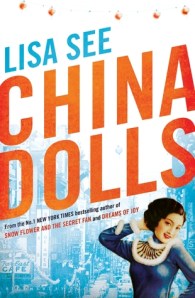
China Dolls by Lisa See

China Dolls Lisa See is a Chinese-American author whose books deal with various aspects of Chinese history and culture. I had mixed feelings about the first one I read, Snow Flower and the Secret Fan, but I loved Shanghai Girls and its sequel Dreams of Joy, so I was looking forward to reading her new novel, China Dolls.

Beginning in 1938, China Dolls is a fictional account of three young women who meet at an audition for dancers at San Francisco’s Forbidden City nightclub.

First there’s Grace Lee, who grew up in a small town in Ohio – a town so small that, apart from her parents, Grace has never met another Chinese person and has never even tasted Chinese food. She has come to San Francisco to escape from her abusive father and is hoping to build a career for herself in show business.

Then there’s Helen Fong, whose family is one of the richest and most respected in Chinatown. Her strict parents disapprove of her decision to work in a nightclub…until Helen points out that she will be earning much more than in her current job at the Chinese Telephone Exchange. Helen appears to have led a sheltered life, but is hiding some secrets which she is reluctant to reveal even to her friends.

Finally, there’s Ruby Tom from Hawaii. Ruby, who is the most outgoing and flamboyant of the three, also has a big secret: although she has allowed everyone to think she is Chinese, she is actually Japanese. If the authorities learn the truth, Ruby could be in trouble, especially when anti-Japanese sentiment increases following the bombing of Pearl Harbor.

Three girls with very different personalities and from very different backgrounds! Despite having little in common, they are drawn together that day at the audition and become friends, helping and supporting each other as they try to fulfil their ambitions. As the months and years go by, though, the girls find that their friendship is tested by a series of lies and betrayals, disagreements and withheld secrets.

China Dolls was compelling enough to keep me interested right to the end but I found it quite disappointing after Shanghai Girls and Dreams of Joy. The main reason for my disappointment was something which should have been the strong point of the book: the friendship between Grace, Helen and Ruby. It just wasn’t convincing at all! The three of them didn’t even seem to like each other and were certainly not ‘like the Three Musketeers’, as they claimed. They said and did some terrible things to each other and I couldn’t understand why they didn’t just go their separate ways in life.

The structure of the novel, with the three girls taking turns to narrate chapters, was also a problem for me. I got the impression that the story Lisa See really wanted to write was Grace’s – she is the easiest character to like and identify with, and she seemed to get a few more chapters than the others too – so I think I would rather have had the entire book written from Grace’s perspective. Having said that, Ruby’s story had the potential to be the most interesting, particularly after Pearl Harbor, and she was also the only one whose narrative voice felt significantly different (filled with some of the lively slang of the period); the other two were interchangeable and sometimes it was easy to forget who was narrating.

Grace, as I’ve mentioned, was my favourite of the three girls but she didn’t have much competition as I really disliked both Helen and Ruby – particularly Helen, whom I never really felt I understood or could have any sympathy for, despite some of the ordeals she had been through. Of the novel’s other characters, only one or two play a significant part in the story, and the rest are just secondary – though I was interested to discover, after finishing the book, that some of the characters I’d assumed were fictional were actually people who really existed.

The historical backdrop of the story is excellent; everything feels thoroughly researched and we are given lot of great insights into the entertainment world of the 1930s and 1940s, in particular what it was like to work in a Chinese nightclub and the challenges facing the Chinese performers. The book deals with lots of serious issues – from racism and prejudice to domestic violence and wartime atrocities – but because the main characters were so shallow, I felt that these issues weren’t explored in as much depth as they could have been.

So, not a favourite Lisa See novel, but still worth reading for its depiction of Chinese American life in the first half of the twentieth century.

Gutenberg’s Apprentice by Alix Christie

Gutenbergs Apprentice I think it’s safe to assume that if you’re reading this post you’re someone who likes to read books. You will probably agree that the printing press was one of the most important inventions in history and you’re probably already familiar with the name Gutenberg. But have you ever heard of Peter Schoeffer or Johann Fust and do you know what part they played in developing the art of printing?

This novel, Alix Christie’s first, takes us to the German city of Mainz in the year 1450. Peter Schoeffer, a talented young scribe, has been called home from Paris by his adoptive father, Johann Fust, who is investing in an exciting new project: Johann Gutenberg’s mission to produce the first printed copy of the Bible. Fust has agreed to help finance this new enterprise and is keen for his son to become apprenticed to Gutenberg in return. Peter’s first reaction to Gutenberg’s printing press is one of horror and distrust; as a trained scribe he takes a lot of pride in the beauty of the handwritten word. In the end, though, Fust gets his way and Peter begins his apprenticeship in Gutenberg’s workshop.

What follows is the story of the long, slow process of creating the world’s first book to be printed with movable type. It’s a journey that will take four years and result in the printing of around one hundred and eighty copies of the Bible. Johann Gutenberg’s name will be remembered by history, but Gutenberg’s Apprentice shows us that Gutenberg did not work alone and Peter Schoeffer and Johann Fust are given the attention they deserve.

I was not at all surprised to learn that Alix Christie herself was apprenticed to master printers and can operate a press – I could tell that this book was written by someone with not only an excellent knowledge of printing but also a love and passion for the subject. We are given lots of detailed information on printing techniques, the design of alphabets and the creation and casting of metal type. Because these methods were so new and innovative, Peter, Gutenberg and the other craftsmen in the novel are learning as they go along, improvising and modifying things where necessary. It was all very interesting, but there were times when I would have liked a little less technical information and a little more story. With Peter and the others facing opposition from certain members of the church, the need to enlist the help of the town guilds, and the possibility of their secret project being discovered, this could have been an exciting and dramatic novel, but instead I found it slightly dry and unemotional.

I couldn’t help wondering if a non-fiction book on the same subject would have worked better for me because although I never managed to fully engage with Peter’s story, there’s no doubt that it’s a fascinating subject. Some of the themes the novel covers are timeless and universal, such as the conflict between new technology and traditional methods. From Peter’s perspective, after spending years perfecting the art of hand lettering, he initially sees the use of metal type as soulless and lacking skill and beauty. Gutenberg and Fust, however, insist that the printing press will allow books to be created cheaply and quickly, making them accessible to a much wider readership and Peter gradually begins to understand this point of view.

I learned a lot from Gutenberg’s Apprentice, so despite having one or two problems with it, I still thought it was worth reading. I have come away from this novel with a better understanding of something I knew very little about and an appreciation for the history behind the printed books I take for granted.

I received a special limited edition of this book from Bookbridgr for review.

The Twentieth Wife by Indu Sundaresan

The Twentieth Wife This story of seventeenth century Mughal India is the first in a trilogy of novels describing the history behind the construction of the Taj Mahal. In The Twentieth Wife, Indian author Indu Sundaresan introduces us to Mehrunissa, later known as the Empress Nur Jahan. The Taj Mahal was actually built in memory of Nur Jahan’s niece, but that part of the story must be told in the other two books of the trilogy as this one concentrates on the tale of Mehrunissa and her love for Prince Salim, the future Emperor Jahangir.

Born to Persian refugees who are fleeing their country, Mehrunissa is abandoned by her impoverished father, Ghias Beg, on the road to India because with no money, no job and no home, he fears that he and his wife will be unable to take care of her. Luckily, fate steps in and Mehrunissa is rescued by the merchant, Malik, who befriends her parents and helps Ghias Beg find a position at the court of the Emperor Akbar. Growing up at court, Mehrunissa is taken under the wing of Akbar’s favourite wife, Ruqayya, and spends a lot of time in the zenana (harem) listening to gossip and witnessing the rivalries between the Emperor’s other wives and concubines.

Mehrunissa is only eight years old when she has her first glimpse of Prince Salim, who is marrying his first wife. That first glimpse is enough for her to make up her mind that one day she too will marry Salim and become Empress. When Salim falls in love with her several years later, it seems that Mehrunissa’s wish could come true…but of course, things don’t go exactly as planned! The Twentieth Wife follows Mehrunissa and Salim (or Jahangir as he becomes known) through years of separation, unhappy marriages and political intrigue. Do they eventually marry? Well, the title of the novel gives us a big clue so there are no surprises there, but the path that leads to Mehrunissa becoming Jahangir’s twentieth wife is a long and eventful one, and you can expect plenty of drama along the way: rebellions, assassination attempts and the scheming of Mehrunissa’s rival, Jagat Gosini.

I found a lot to like in this novel, but not everything worked for me. My biggest problem was that with the romance between Mehrunissa and Jahangir forming such a central part of the story, I didn’t find that romance convincing enough. I struggled to see the attraction of Jahangir during the first half of the novel. He was an alcoholic and an opium addict, too easily influenced by unscrupulous advisers and was even plotting to have his father murdered. He started to redeem himself later in the book, but is still not high on my list of favourite romantic heroes!

As for Mehrunissa, I found it difficult to accept that she could fall so passionately in love at the age of eight with a man she didn’t even know and that her love for him could continue into her adult life despite only meeting him once or twice more in all that time. I got the impression that she just wanted to marry him because he was a prince rather than who he was as a person and I didn’t start to really believe in their romance until near the end of the book.

I did like the way Sundaresan writes about India. The Twentieth Wife is a very descriptive book: the clothes, the buildings and gardens, the food and drink, the traditions and rituals of court and the zenana are all described in vivid detail. I do enjoy reading historical fiction novels set in India, though I’m sorry to say that most of the others I’ve read were written by non-Indian authors (M.M. Kaye’s The Far Pavilions is my favourite). I wasn’t aware of Indu Sundaresan until I saw The Twentieth Wife listed as one of Aarti’s suggestions for A More Diverse Universe and I’m pleased I decided to give it a chance. I’m not sure I like this book enough to want to continue with the sequel, but it was good to have learned a little bit about a period of Indian history I knew nothing about. While I didn’t love this particular book I would still be happy to try one of Sundaresan’s others outside of the Taj Mahal trilogy.

amdubanner-col2

This was my second read for A More Diverse Universe hosted by BookLust.

The Garden of Evening Mists by Tan Twan Eng

The Garden of Evening Mists The Garden of Evening Mists is set in Malaya and is narrated by Teoh Yun Ling, a Straits Chinese woman who, at the beginning of the novel, has retired after a long and successful career as a Supreme Court Judge in Kuala Lumpur. Returning to the Cameron Highlands area of the Malayan Peninsula – a very special place for Yun Ling, being the site of both the garden of Yugiri (‘evening mists’) and her friends’ tea plantation, Majuba – she makes the decision to write her memoirs, even if that means remembering things she would rather forget.

In a series of flashbacks, we go back with Yun Ling to the 1950s, during a time of conflict known as the Malayan Emergency. This is when she first comes to Yugiri and meets its creator, Nakamura Aritomo, the former gardener to the Japanese emperor. Yun Ling hopes Aritomo will design a garden in memory of her sister but he refuses, offering instead to take her on as an apprentice so that she can learn how to do it herself. At first, she finds it difficult to be near Aritomo (she and her sister, Yun Hong, were both imprisoned in a Japanese camp during World War II) but as they work together in the garden Yun Ling slowly begins to come to terms with the traumas of her past.

This is the second novel by Malaysian author Tan Twan Eng and enjoyed a lot of success following its publication in 2012 – the book was shortlisted for the Booker Prize and won both the Man Asian Literary Prize and the Walter Scott Prize for Historical Fiction. Having now read it, I agree that it’s an excellent book and deserved its success. Until recently, I had very little knowledge of Malaya (or Malaysia as we now know it). Now I have read two books in two months (The Separation by Dinah Jefferies was the first) and I’m finding it a very interesting country to read about. The Garden of Evening Mists covers three different periods in the country’s history: the Japanese Occupation of the 1940s, the Emergency of the 1950s, and the more recent past, probably the 1980s, in which Malaysia is an independent country.

We wait a long time to hear what exactly happened to Yun Ling and Yun Hong in the Japanese camp, but we do find out eventually – although certain details continue to be withheld or only hinted at. It’s understandable as this is Yun Ling’s own story to tell and she can choose what to say and not to say; some memories may be too painful or uncomfortable to bring to the surface. It was the wartime sections of the book that I found the most gripping and emotional, however. I was particularly moved by the story told by Tatsuji, a Japanese art collector who visits Yun Ling in the present day, about Japan’s kamikaze pilots.

This is not just a book about war and suffering, though. Gardening, as you might have guessed from the title, also plays a big part in the story. Gardens are usually peaceful places to sit or to walk – and reading about gardens feels peaceful too. I don’t have a lot of interest in gardening myself but I was fascinated by the descriptions of Yugiri and the techniques used by Aritomo to create illusions of depth and distance. He puts so much thought into where to place every rock, every stone. As well as gardening, Aritomo is also a master of other art forms including woodcuts (ukiyo-e) and tattooing (horimono), and these were interesting to read about too. Other aspects of Japanese, Chinese and Malaysian culture are also covered in the novel, such as storytelling and mythology. But most of all, this is a book about memory: memory and the act of forgiving and forgetting.

There are so many ideas and themes packed into this wonderful novel and I’ve only managed to discuss a few of them here. I haven’t even mentioned how beautifully written it is and how cleverly it is structured. As I read, I wanted to go back and read earlier passages again because things were taking on more and more meaning as more layers were revealed. It’s that sort of book.

amdubanner-col2

I read The Garden of Evening Mists as part of A More Diverse Universe hosted by Aarti of BookLust. The event doesn’t end until Saturday 27th September so there’s still time for you to join in.

Harvest by Jim Crace

Harvest I often find myself beginning a review by stating where and when the novel is set. With Harvest I can’t do that, because we aren’t told. All we know is that it’s a small rural community where for generations the people who live there have worked on the land, ploughing, planting and harvesting. This is the way of life they have always known and this is how they have always supported themselves and their families.

Things begin to change when a ‘chart-maker’ whom the villagers refer to as Mr Quill arrives and proceeds to measure and map the land. Soon it becomes clear that their new landowner (the Master’s cousin-in-law) has plans to enclose their fields and convert them to sheep farming. Meanwhile, three more strangers have settled on the outskirts of the village and have lit a fire, sending up plumes of smoke to let people know that they are there and planning to stay there. That same day, smoke is also seen coming from the manor house. When it is discovered that Master Kent’s dovecote has been burned to the ground, the newcomers are blamed and the way the villagers react to this crime will have greater consequences than they could ever have imagined.

We see all of these developments through the eyes of Walter Thirsk, who has lived in the village for twelve years but is still seen as an outsider because of his close relationship with Master Kent. Although he refers to himself and his neighbours as ‘we’ there’s always a sense that he is slightly distanced from what is going on. Walter is in the unique position of being part of the community and not part of it at the same time, which makes his story even more interesting.

When reading a novel that appears to be set in the past, it’s natural to want to know exactly which period we are reading about. My guess is that it’s England in the sixteenth century, though it could be slightly earlier or later than that. It is certainly a time of agricultural change, when common land is being fenced off and enclosed. It’s also a superstitious time when strangers are viewed with suspicion and anyone different risks being accused of witchcraft. Other than these facts, we are given very few clues – no names of nearby towns and cities, no mentions of historical figures or events that we could use as a point of reference.

So why does Jim Crace not just tell us when the story is set? The obvious answer is that he doesn’t want us to think of this book as ‘historical’, fixed in the past in a time that has been and gone. He wants us to think beyond this, to consider how some of the ideas in the novel are timeless and still relevant to us today. In Walter Thirsk’s village, the wheat and barley farming that has sustained the people for many years is being replaced with wool production because this will be more cost-effective for the landowner. Anyone who has ever lost their job, lost their home or been forced into a new way of life because of change and progress will know how that feels. This story (or one very similar) could just as easily have been set during the Industrial Revolution or in more recent times when tasks that were once performed by human beings were being replaced by computers.

Harvest is also a beautifully written book. I am not usually a fan of novels written in the present tense, but this is an example of one where it works well and is very effective. The novel only covers a week in Walter Thirsk’s life but it is a very eventful week and the present tense helps to convey the sense that things are moving quickly and happening now. It’s also a book with a lot of atmosphere and an underlying darkness, with the story building in tension towards the end.

This is not the first Jim Crace novel I’ve read. I have vague memories of reading Quarantine, probably soon after it was published in 1997, but I can’t remember very much about it now. That story hasn’t stayed with me but I’m sure this one will.

A Triple Knot by Emma Campion

A Triple Knot There are some historical women whose lives have been covered many times in fiction – Elizabeth I is one example and Anne Boleyn is another. The heroine of Emma Campion’s latest novel, A Triple Knot, is a less popular choice: she is Joan of Kent, cousin of King Edward III and once described as “the most beautiful woman in all the realm of England”.

Joan is the daughter of Edmund, Earl of Kent, and his wife, the Countess Margaret. Edmund, the younger half-brother of the deposed Edward II, is executed for treason several years before our story begins, leaving Joan and her brother to grow up in the household of their cousin, Edward III, and his wife, Philippa of Hainault. Joan’s Plantagenet blood and her great beauty give the King reason to hope that he can negotiate a marriage for her that will be useful to him from a political perspective. When he and Philippa notice that their own son, Ned (who will become known as the Black Prince), seems to be showing too much interest in Joan, they decide that she needs to be married off sooner rather than later. However, Joan has other ideas.

On a journey to the Low Countries to see the father of a potential husband picked out for her by Edward and Philippa, Joan meets and falls in love with Sir Thomas Holland. Thomas is twenty-six and Joan is only twelve, but while their relationship would be shocking by modern standards, this is the fourteenth century and an age difference like this is not too uncommon. They marry in secret, knowing that the King would not approve, but are soon parted when Thomas has to return to the army. Back at home with her family, Joan is forced into a second marriage with William Montague, the Earl of Salisbury’s son, and faces a long, difficult battle to prove that her marriage to Thomas was legal. But as she and Thomas struggle to have their marriage recognised, the Black Prince waits for his chance to win back the woman he has always wanted more than any other.

A Triple Knot is the first book I’ve read by Emma Campion, but I’m aware that she has also written a novel about Alice Perrers, mistress of Edward III, as well as a series of historical mysteries published under the name Candace Robb. Having read this one, I’m not sure I would want to try any of her others, as I didn’t really enjoy it very much. While it was good to learn more about a woman I previously knew very little about, I was left thinking that maybe there’s a good reason why not many novels have been written about Joan of Kent – her story just wasn’t interesting enough to sustain a novel of this length. Apart from her relationships with Thomas, William and Ned (I’m assuming this is what the ‘triple knot’ of the title refers to) other aspects of Joan’s life aren’t given much attention. As for Joan herself, I was surprised every time her age was mentioned as she didn’t feel like a child to me – in fact, she didn’t seem any older at the end of the book than she did at the beginning, even though many years had gone by!

There were some things that I did like, of course, otherwise I wouldn’t have been able to continue reading. The novel felt very well-researched and there were lots of details of fourteenth century life, both at court and away from it. The historical background is quite complex and it was sometimes difficult to untangle the relationships between various members of the royal family, especially in the first few chapters of the book, but I love reading about medieval history so I didn’t mind this. Overall, though, I was quite disappointed with this book – and as a side note, I really dislike the cover. It’s definitely not an image I would have chosen to represent the story and the time period!

I received a copy of this book via NetGalley for review.