The Streets by Anthony Quinn

The Streets In 1882, twenty-one-year-old David Wildeblood comes to London to begin his new job working as a reporter for Henry Marchmont’s weekly newspaper, The Labouring Classes of London. The idea of the paper is to highlight the suffering of some of the city’s poorest people and David’s task is to visit some of London’s worst slum areas, such as the notorious Somers Town, to speak to the inhabitants and report on their living conditions.

Having grown up in rural Norfolk, David is instantly an ‘outsider’, inexperienced in London ways and unfamiliar with the slang. This makes his job very difficult, but things improve when he is befriended by Jo, a young costermonger who can introduce him to people and places he would never have been able to access on his own.

As David continues his investigations into living standards at Somers Town, he is shocked by the state of the housing and the poverty of the people who live and work there. Soon he uncovers something even worse – a network of corruption and exploitation by unscrupulous landlords – and finds that he has gained some very powerful enemies.

The story also has a romantic element and there are two main female characters whom David gets to know throughout the novel. One is Kitty, the daughter of David’s godfather, and the other is Roma, the sister of his new friend, Jo: two very different women. Kitty, with her valuable jewels and pet monkey, comes from a rich, privileged background and while she does take an interest in the welfare of those who are less fortunate than herself, she seems to view them as a project or a problem to be solved. Roma, on the other hand, has endured hardships and made sacrifices from an early age to support herself and her brother: she and Jo are the type of people Kitty considers to be in need of help. David himself doesn’t quite fit in with either of these social groups and it was interesting to see his relationships with both Kitty and Roma develop.

Looking at other reviews of this book I see the word ‘Dickensian’ being used a lot, and while there’s nothing in the writing style or atmosphere that reminds me of Dickens, it is certainly a novel that draws attention to some of the same issues that were obviously very important to Dickens. I could appreciate the huge amount of research Anthony Quinn must have carried out while writing this novel (in the acknowledgments he mentions two 19th century sources: London Labour and the London Poor by Henry Mayhew and Life and Labour of the People in London by Charles Booth) and I found it fascinating from a social history perspective. Fascinating, but disturbing too; the plans of the wealthy for social engineering, segregation of the lower classes and the creation of rural labour camps were uncomfortable to read about.

As a work of fiction, though, I didn’t enjoy The Streets very much at all; the pace was slow and the plot, despite sounding so promising, was not very entertaining. I didn’t feel I was fully engaging with David or any of the other characters (apart from Roma on occasions) and the ‘back slang’ used throughout the book, which I know must have been intended to add some authenticity to the story, really irritated me. What made it even more disappointing is that this book really did sound like something I should have loved: a Victorian setting, a mystery to be solved, and references to Dickens and Eliot on the cover. I didn’t regret persevering to the end, but I was still quite pleased when I reached the final page and could move on to something else.
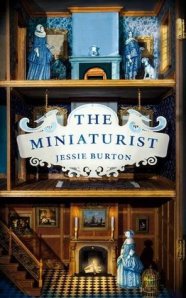

The Miniaturist by Jessie Burton

The Miniaturist In October 1686, eighteen-year-old Petronella (Nella) Oortman travels from Assendelft to Amsterdam to join the household of her new husband, Johannes Brandt. Johannes is a merchant with the VOC – the Dutch East India Company – and spends a lot of time away from home, leaving his young wife in the company of his sister, Marin, and their two servants, Cornelia and Otto. Disappointed with the lack of affection from her husband and confused by Marin’s cold, unwelcoming reception, Nella quickly finds that married life is certainly not what she had hoped and expected it would be.

Unable, for various reasons, to give Nella the attention she deserves, Johannes presents her with a special wedding gift to help her pass the time: a cabinet containing a dolls’ house that resembles the Brandts’ own home. The little rooms are empty and it is up to Nella to decide how to furnish them. Responding to an advertisement by a ‘miniaturist’, she sends a letter with her requests, but when the tiny items and figures begin to arrive, Nella is amazed by how accurately they reflect life within the real Brandt household. How can the miniaturist possibly know so much about Nella and her family?

I was drawn to The Miniaturist by its striking cover and although the book itself didn’t quite live up to my expectations, it was certainly an unusual and intriguing story. I have seen comparisons with Tracy Chevalier’s Girl with a Pearl Earring and it’s easy to see why, as both books tell the story of a young woman living in 17th century Holland, but apart from this I don’t think the two novels really have a lot in common. While I found that Girl with a Pearl Earring felt realistic and true to life, The Miniaturist has an element of magical realism that makes it very different – and this supernatural aspect was possibly the reason why I didn’t love the book as much as I wanted to. I thought the mystery of the miniaturist’s creations was a great idea, but I felt that it was never sufficiently explained or resolved, which left me wondering if I’d missed the point.

I found a lot to like about The Miniaturist, though, particularly the setting – not a common one in historical fiction, but very interesting to read about. I learned a lot about Amsterdam in the 1600s and the world of trade and commerce in which Johannes Brandt and his fellow merchants operate. It’s quite an atmospheric novel too, and a bit darker than I’d expected; bad things happen to some of the characters in the story and not everyone gets a happy ending. Nella herself is a character who grows and changes, from an innocent, nervous young girl at the beginning of the book to a strong, mature woman at the end. And I must mention Marin, secretive and hostile, but with much more depth than is obvious at first.

I had assumed this was a purely fictional story, so I was surprised to find that Petronella Oortman was a real person and her miniature house can be seen in the Rijksmuseum in Amsterdam. As for the true story behind the house and its contents, who knows?

I received a copy of this book for review via NetGalley

An Officer and a Spy by Robert Harris

An Officer and a Spy “Is it possible that innocence is not recognised in an age of enlightenment and truth? Let them search. I ask no favour, but I ask the justice that is the right of every human being. Let them continue to search; let those who possess powerful means of investigation use them towards this object; it is for them a sacred duty of humanity and justice.”

In 1894, Alfred Dreyfus, a Jewish officer in the French army, is found guilty of spying and passing on France’s military secrets to the Germans. After being publicly degraded and stripped of his rank at a ceremony in Paris, he is exiled to Devil’s Island to live in solitary confinement in a tiny stone hut. One of the men involved in the conviction of Dreyfus is Georges Picquart, the narrator of An Officer and a Spy.

At first, Georges is sure that Dreyfus is guilty, but after being promoted to Colonel and made head of the Statistical Section (French military intelligence) he starts to have doubts. And when evidence of a second spy comes to light, Georges begins to wonder…what if Dreyfus was innocent all along?

An Officer and a Spy may be a work of fiction, but the events I’ve described above really happened. Known as the Dreyfus Affair, it was a serious miscarriage of justice that caused a huge scandal and divided public opinion in France. The author Emile Zola was even inspired to write an article in support of Dreyfus which was published under the title J’accuse…! and led to him being brought to trial for libel. The most shocking aspect of the case was the extent to which military officials had attempted to cover up the truth and fabricate evidence to hide the fact that mistakes had been made and that an innocent man had been used as a scapegoat.

This fictional account of the Dreyfus Affair is closely based on historical fact. The first half of the novel follows Georges Picquart as he discovers that there’s more to the case than meets the eye; in the second half we see what he decides to do with the information he has uncovered. Every step of the way he is thwarted by the very people he should have been able to depend upon for help and it becomes obvious that some members of his department are more interested in protecting their reputations than in seeing justice prevail.

This is the first book I’ve read by Robert Harris; for a long time he’s been an author I’ve been aware of without ever thinking I might enjoy, but when I saw that this novel had won this year’s Walter Scott Prize for Historical Fiction it convinced me to give it a try. And guess what? I loved it! Not having much previous knowledge of the Dreyfus story (it was touched on in Paris by Edward Rutherfurd but this is the first time I’ve read about it in any depth), I was completely gripped by Georges Picquart’s investigations.

From the historical fiction perspective, this book is excellent. It’s packed with information but never becomes boring or overly detailed and it’s firmly set in its time period – Georges travels by steam train, he communicates via telegram, and during a posting in Tunisia he can only rely on out-of-date newspapers as a way of following the progress of the case at home in France. But I would also recommend this book to readers of spy novels and thrillers and to anyone who enjoys well-written, well-researched fiction in general. Although the pace is slow at the beginning, it soon becomes quite a page turner, especially if you’re not very familiar with the facts of the Dreyfus Affair.

An Officer and a Spy really is a fascinating novel and took me through a range of emotions from shock to frustration to absolute outrage! Now I would like to try another book by Robert Harris. Any suggestions?

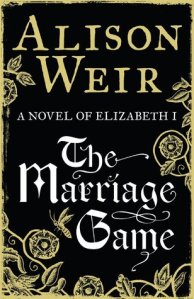
The Marriage Game by Alison Weir

The Marriage Game Elizabeth I faces many challenges during her time on the throne of England: the threat of the Spanish Armada, for example, and the question of what to do about Mary, Queen of Scots. The most pressing issue for ‘the Virgin Queen’, however, is the need to secure the succession to the throne. Afraid of what might happen if their Queen was to die with no heir, her councillors advise her to marry and have children as quickly as possible. Elizabeth, though, has other ideas.

Month after month, year after year, Elizabeth promises to consider one suitor after another – her brother-in-law Philip of Spain, the Archduke Charles of Austria (son of the Holy Roman Emperor), Prince Eric of Sweden, and the Earl of Arran, just to name a few – and finds a reason to turn down every one of them. The most likely candidate, many people believe, is Robert Dudley, Elizabeth’s childhood friend and the man she truly loves. But Elizabeth prefers to keep the whole of Europe in suspense, using the possibility of marriage as her bargaining power…so Robert must wait with the rest of his rivals as Elizabeth continues to play ‘the marriage game’.

In Alison Weir’s new novel, The Marriage Game, she gives a fictional account of Elizabeth’s reign with a focus on the Queen’s marriage negotiations and her relationship with Robert Dudley. Although she does stick to the known facts where possible, there are some ‘unsolved mysteries’ that are left open to interpretation, such as the death of Robert’s wife, Amy Dudley (was she murdered or was it an accident?), the question of what exactly happened between the teenage Elizabeth and her stepmother’s husband, Thomas Seymour – and of course, the mystery of why the Queen was so reluctant to marry.

Historians can’t be completely sure as to why Elizabeth never married, but Weir gives several possible explanations in this book. The most obvious reason is that, as a female monarch, Elizabeth believes that if she takes a husband he will expect to rule as King and she will have to share her power. As a Protestant, she also needs to consider the religion of any potential husband. Then there’s the possibility that she is afraid of marriage and childbearing, having witnessed her father Henry VIII’s many unhappy marriages, the fate of her own mother and the deaths of Jane Seymour and Katherine Parr in childbirth. Of course, for Elizabeth’s advisers, none of these objections to marriage seem reasonable to them; the most important thing as far as they are concerned is to find Elizabeth a suitable husband and secure England’s future. And as for poor Robert Dudley, he simply wants to marry the woman he loves.

I don’t think I’ve read a fictional representation of Elizabeth yet that I’ve actually liked and this one was no different. At the beginning of The Marriage Game, I did feel that I might be able to like this version of Elizabeth: she seemed very human and I had sympathy for a young woman who had already suffered so much unhappiness in her short life, with her mother (Anne Boleyn) being beheaded and enduring months of imprisonment herself. As the story progressed, though, I began to feel as frustrated with her as everyone else in the novel did. When Robert Dudley decided that “He had had enough…He was weary of strife and the intrigues of the court, and Elizabeth’s endless, tortuous games” I knew exactly how he felt!

This was not a bad book and I enjoyed it more than the last Alison Weir novel I read, A Dangerous Inheritance. For readers new to Elizabeth-based historical fiction it will probably be a fascinating read, but if you have read about Elizabeth’s reign before you might feel, as I did, that there’s nothing very new or different here. The most interesting parts of the book for me were the scenes in which Elizabeth’s complex relationship with Mary, Queen of Scots is discussed, with Elizabeth torn between fear of the threat Mary poses to her throne and her desire to support a fellow queen. I wonder if Alison Weir will consider writing a novel about Mary at some point in the future.

I received a copy of this book for review from the publisher via NetGalley

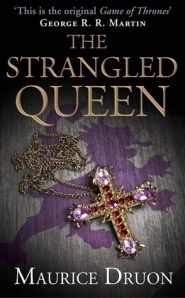
The Strangled Queen by Maurice Druon

The Strangled Queen This is the second book in Maurice Druon’s Accursed Kings series (Les Rois Maudits in French). There are seven novels in the series, all published between 1955 and 1977, telling the story of the monarchs of medieval France. The front covers of these new HarperCollins editions tell us that The Accursed Kings inspired George R.R. Martin’s A Game of Thrones, but be aware that this is not a fantasy series!

In the first book, The Iron King, we saw how Philip IV the Fair of France brought about the destruction of the Knights Templar. Before being sent to burn at the stake, the Grand Master, Jacques de Molay, cursed Philip and his descendants to ‘the thirteenth generation’. Philip was the first victim of the curse, but now he is dead and in The Strangled Queen we see how his son, Louis, becomes the next to suffer. Unlike his father, the newly crowned Louis X proves to be a very weak king and allows himself to be manipulated by his uncle, the Count of Valois, who is engaged in a power struggle with Enguerrand de Marigny, the former king’s chief minister.

Louis’ personal life is also a disaster – his wife, Marguerite of Burgundy, has been imprisoned for adultery following the Tour de Nesle Affair (described in the previous book) and as there is currently no Pope, he is unable to obtain a divorce so that he can find a new queen. Valois is hoping to arrange a marriage between his niece, Clemence of Hungary, and Louis, but first a new Pope will have to be chosen. However, Enguerrand de Marigny has other ideas and will do whatever it takes to thwart Valois’ plans.

I enjoyed The Strangled Queen, though not as much as The Iron King which I read more than a year ago and loved. I wished I hadn’t let so much time go by between reading the first book and the second as this really does seem to be a series that needs to be read in order with each book following on directly from the one before. Storylines that were begun in The Iron King were picked up again and continued in this book and I found myself struggling to remember exactly what had happened previously. I had forgotten all about Tolomei, the Lombard banker and his nephew Guccio, for example, but I was very pleased to see Guccio again as he is one of the few likeable characters in the series.

My only real complaint with this book is that, as someone who doesn’t know much about this period of French history, the title is a very big spoiler in itself. Knowing that the queen was going to be strangled took away some of the suspense! Luckily, though, the queen’s fate only forms a part of the story. Most of the novel is actually devoted to the rivalry between Charles of Valois and Enguerrand de Marigny…so you can expect lots of plotting, scheming and intrigue! And these are not the only plotting, scheming characters – there’s also Robert of Artois, still hoping to find a way of reclaiming his lands from his detested Aunt Mahaut.

I think the element of the book I found most interesting, though, is the portrayal of a young man (Louis X) who is unexpectedly forced to accept responsibilities that he is not ready for and not able to deal with. While I certainly didn’t like Louis (I find it difficult to have sympathy for someone whose idea of fun is shooting doves in an enclosed barn), I could understand his fears and insecurities and could see why it was so easy for the people around him to take control.

The third book in the series is called The Poisoned Crown so it sounds as if there’s still more trouble ahead for the sons of Philip the Fair!

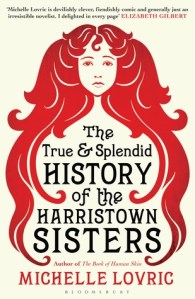
The True and Splendid History of the Harristown Sisters by Michelle Lovric

Harristown Sisters Manticory Swiney and her six sisters are born into poverty in rural 19th century Ireland and brought up by their mother, a laundress. They have never known their father (he visits once a year in the middle of the night) but from him they have inherited some very special gifts: their wonderful names and the abundance of long, thick hair which proves to be their route to fame and fortune. Bullied by the eldest sister, Darcy, into performing on the stage, the girls entertain their audiences by singing, dancing and, as a finale, unleashing their luxuriant cascades of ankle-length hair.

Approached by Augustus Rainfleury and Tristan Stoker, both of whom can see the money-making potential of seven long-haired sisters, the ‘Swiney Godivas’ leave their impoverished Harristown lives behind to find success in first Dublin then Venice. But for black-haired, sharp-tongued Darcy, the rival twins Berenice and Enda, quiet Pertilly, gentle, blonde Oona, wild Idolatry and our narrator, red-haired Manticory, fame doesn’t necessarily bring happiness.

I loved this book, the first I’ve read by Michelle Lovric, and I would agree that it really is a ‘splendid history’. It’s not quite a true one – Manticory and her sisters are fictional – but it was inspired by the story of the real-life Sutherland Sisters, an American family who really did become celebrities due to their long hair. If you have trouble imagining what seven sisters all with floor-length hair would look like, lots of pictures of the Seven Sutherland Sisters can be found online.

With so many Swineys to get to know, I was pleased to find that each sister is given a strong and distinctive personality of her own. I liked some of the girls and disliked others, but they were all great to read about, particularly the fierce, devilish Darcy who takes control of every scene in which she appears. One of my favourite characters, though, was not a Swiney sister at all, but their childhood enemy, Eileen O’Reilly (or the Eileen O’Reilly as she is always described) who enjoys exchanging very imaginative insults with Darcy – and who claims to hate the Swineys yet can’t seem to stay away from them.

Manticory herself has a wonderful narrative voice: strong, poetic and unmistakably ‘Irish’. She manages to bring a lot of humour into her ‘true and splendid history’ but it’s really a very dark story. There’s a vulnerability about the sisters, even Darcy, in that they are manipulated and taken advantage of by ruthless businessmen and men who are…well, attracted to girls with long hair. The Swineys are betrayed and exploited by the very people they have placed their trust in and what makes this even more tragic is that the reader can see this from the beginning while the sisters can’t.

Finally, I want to mention the excellent descriptive writing in this book. Every time Manticory thinks of her childhood in Harristown, County Kildare, she remembers the ‘turf stoves, thin geese and slow crows’ until Harristown becomes almost a character in itself. Later in the book, the descriptions of Venice are particularly beautiful…

The palazzi and churches let their fretted stones hang down into our faces like beautiful, insitent ghosts. Beckoning lanterns hung at arched water-gates. Inside their houses, equisitely dressed Venetians displayed themselves in glowing tableaux so that each palace seemed to host a puppet theatre performing just for us. The city was mystical and barbaric all at once, a floating fortress so delicate that the fairies would hesitate to place the weight of their wings on it.

I also loved the images of the girls hanging their hair from the windows of the bell tower of San Vidal like seven Rapunzels and each of them standing in the bow of a gondola with her hair trailing into the boat behind. I could tell this book was written by someone who knows and loves Venice!

The True and Splendid History of the Harristown Sisters is one of my favourite books of the year so far and I’m now looking forward to investigating Michelle Lovric’s previous novels.

I received a copy of this book from NetGalley for review.

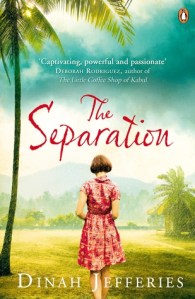
The Separation by Dinah Jefferies

The Separation Imagine that you’ve returned home from visiting a friend to find that your house is empty – your husband and children have disappeared, the servants have vanished and when you pick up the phone the line is dead. You set out in search of your family, determined to find them no matter what, but it’s not going to be an easy task because this is Malaya in 1955: a country at war.

This is what happens to Lydia Cartwright in this wonderful debut novel by Dinah Jefferies. As Lydia leaves the family home in Malacca and heads north to Ipoh believing that her husband (who works for the British Administration) may have been posted there, we discover that Alec and the two girls – Emma, aged eleven, and Fleur, eight – have gone somewhere else entirely. Will Lydia ever see her daughters again?

The Separation is divided into two distinct storylines told in alternating chapters. In one we follow Lydia as she makes the discovery that her children are missing. As she embarks on her nightmarish journey through the dangerous Malayan jungle, she faces terrorist attacks, gunfire and overcrowded buses and trains, as well as the possibility that she has been betrayed and deceived. In the other thread of the story we join Emma as she and Fleur try to settle into their new lives while coming to terms with the loss of their mother. Things are not easy for Emma and she too is forced to go through some terrible ordeals, all the while clinging to the hope that her mother is still alive and one day they will be reunited.

I thought the structure of the novel worked well; I enjoyed reading both Lydia’s chapters and Emma’s and never felt that we were spending too much time on one character at the expense of the other. Lydia’s story is more dramatic (and full of beautiful, exotic descriptions of Malaya) but of the two I think I preferred Emma’s. That could just be due to the fact that I felt closer to Emma as she narrates in the first person while Lydia’s chapters are written in the third person – or maybe it’s because although I’m not a mother I am a daughter so it was easier for me to identify with Emma. I did like and sympathise with both main characters, though, and desperately wanted them to be together again. Of course, I’m not going to tell you whether that happens or not!

I have never read anything about the history of Malaya (as it was still known in the 1950s before becoming Malaysia) so that was another aspect of the book I found interesting. The story isn’t weighed down with too much historical detail but by the time I’d finished the book I felt that I’d learned a little bit about The Emergency (the name given to the war) and what it was like to be a woman and a European living in Malaya during that period. I was interested to read that Dinah Jefferies was born in Malaya and lived there until the age of nine, which means she was able to draw on some of her own experiences and memories.

This was a very impressive first novel and I’m already looking forward to the second book from Dinah Jefferies, The Tea Planter’s Wife, which is going to be set in Sri Lanka.

Thanks to the author for sending me a copy of this book for review.