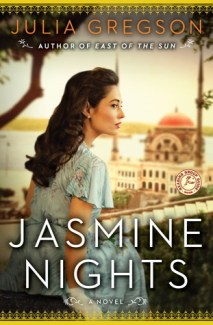
Jasmine Nights by Julia Gregson

Jasmine Nights It’s 1942 and World War II fighter pilot Dom Benson is recovering in hospital after being injured in a plane crash. It is here that he meets Saba Tarcan, a talented young singer who has come to entertain the wounded soldiers in Dom’s hospital ward. Saba and Dom are instantly attracted to each other but before their relationship has a chance to develop, Saba passes an audition to join ENSA (Entertainments National Service Association) and is sent to North Africa to perform for the troops.

Soon after her arrival in Cairo, Saba is approached by the Secret Service and finds herself agreeing to spy for them. She is under strict orders not to tell anyone about her mission, but when Dom returns to action with the Air Force and is also sent to Egypt will their relationship be able to withstand Saba’s secrets?

I love reading novels set during World War II and I particularly enjoy those that approach the subject from an unusual perspective or cover aspects of the war that we don’t often hear about. Jasmine Nights does both, so it really should have been a book that I loved. Unfortunately it wasn’t. I had no problems with the style of Julia Gregson’s writing, I thought the settings – wartime Cairo, Alexandria and Istanbul – were fascinating to read about and there was certainly enough material here to form a compelling story. It just lacked that special spark that would have transformed it into a book that I could wholeheartedly recommend.

Individually, both Saba and Dom are interesting, complex characters. Despite her strict Turkish father disapproving of her choice of career, Saba is ambitious and determined to fulfil her dreams of becoming a successful singer and escaping the monotony of her life in Wales, even if it means losing contact with her family. After joining ENSA, Saba is forced to juggle her relationship with Dom, her singing career and her desire to serve her country and help the war effort. Over the course of the novel, she has to make some difficult decisions and try to decide which of these things is most important to her. Dom also has an interesting story of his own and we see him struggling to come to terms with the idea of flying again after his crash and his guilt about escaping death when some of his close friends were not so lucky.

I liked both main characters but their romance never felt very natural or believable to me. A wartime love story should be very emotional but this one left me unmoved and I would have preferred more focus on the spying storyline instead. I knew female entertainers sometimes acted as spies during the war, but I’ve never read about the subject in a novel before and this was what had initially attracted me to this book. Sadly, I found this aspect of the story disappointing too. There was a lot of build up but it seemed to take such a long time before Saba found herself in any real danger and for a book about war and espionage it was strangely unexciting, without any of the suspense and tension I would have expected.

I did enjoy the descriptions of life as part of ENSA and the variety of colourful characters Saba meets in the troupe, including Janine the dancer, Willie the comedian and one of the other singers, Arleta, who becomes a good friend of Saba’s and was probably my favourite character. But this was not enough to rescue the book for me and I just felt that there was not enough depth, not enough emotion and none of the magic I was hoping for in a book that had sounded so promising.
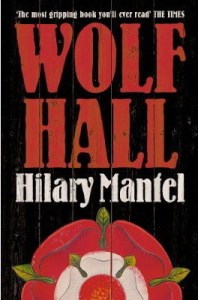
Wolf Hall by Hilary Mantel

Wolf Hall The year is 1500 and in the London suburb of Putney, young Thomas Cromwell lies on the ground being kicked by his father, who is drunk. Thomas recovers from the beating this time, but he knows he needs to get away from Putney before it happens again and so he runs away to sea. After returning to England several years later, Cromwell enters the service of the Lord Chancellor, Cardinal Wolsey, and begins to play an increasingly important political role. Wolf Hall follows Cromwell as he rises in power to become Henry VIII’s chief minister and helps to negotiate the King’s divorce from Katherine of Aragon and his marriage to Anne Boleyn.

This is one of those books I have thought about reading many times over the last few years but have never got around to actually doing it despite its popularity and Booker Prize success. Joining a readalong in the summer gave me the motivation to read it at last and although I didn’t keep up with the readalong schedule after the first couple of weeks I did still finish the book and am pleased to be able to say that I enjoyed it.

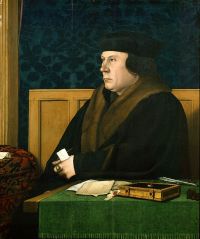
I didn’t know much about Cromwell before reading this book, but he has appeared as a secondary character in other historical novels I’ve read and he has always been portrayed very negatively – ruthless, cold and calculating. The famous portrait by Hans Holbein (shown below) does nothing to dispel this image! And so it was good to read a novel that showed Cromwell not as a villain (if anyone is portrayed as a villain in this book it’s actually Thomas More) but as an intelligent, charismatic, complex human being with both positive and negative qualities. Something that really comes across strongly is how well Cromwell has done to rise above his unhappy childhood and humble origins as the son of a blacksmith to become a confident, accomplished man people turn to for advice and leadership – one of the most powerful men in England. But while it was fascinating to read about the important historical events of the period and the political machinations that were going on behind the scenes, I also loved reading about Cromwell’s life at home. As well as his wife and children, Cromwell’s household expands over the years to include an assortment of other family members, servants, wards and employees and in Cromwell’s interactions with all of these people we see another side of his character: a kinder, more compassionate side.

Thomas CromwellMantel’s writing is descriptive without being flowery and she really brings her Tudor world to life. Every little piece of information she gives us, however trivial it may seem, helps to slowly build a full and vivid picture of daily 16th century life – what people ate, how they dressed, the books they read and the games they played. To say the book was well-researched would be an understatement – I couldn’t believe how incredibly detailed it was! As someone who has read a lot of Tudor novels I’m already familiar with this period and many of the historical figures who appear in Wolf Hall and I found this to be an advantage, as Mantel assumes the reader has at least some knowledge of the period. If it’s been a while since you’ve read anything about the Tudors, it might be a good idea to remind yourself of some of the historical facts surrounding Henry VIII’s divorce, marriage to Anne Boleyn and the resulting separation from Rome before you start reading.

Before I read this book I had heard a lot about Mantel’s excessive use of pronouns – specifically, the word ‘he’ being used without making it clear who ‘he’ was. I quickly discovered that it was usually safe to assume that ‘he’ was Cromwell but ‘he’ was also frequently used to refer to two or three other people who were taking part in the same conversation, which could sometimes cause confusion. The dialogue itself is modern enough to be easy to understand without feeling too inappropriate, though sometimes Mantel uses quotation marks to indicate speech and sometimes she doesn’t, leaving you to decide whether a character is speaking or just thinking. As I’m not usually a fan of experimental or quirky writing styles this was one of the reasons I had resisted reading this book for such a long time, but it actually didn’t bother me as much as I thought it might. It didn’t stop me from enjoying the book and I wish I hadn’t let it put me off.

I’m now looking forward to reading Bring up the Bodies, hopefully before the final book in the trilogy is released!

Signing up for the 2013 Historical Fiction Challenge

It’s that time of year again when plans are being made for 2013 and next year’s reading challenges are being announced! I prefer not to sign up for too many challenges as in the past I’ve been so bad at actually completing them, but there are one or two I can never resist – and the Historical Fiction Reading Challenge is one of them.

The Historical Fiction Challenge is again being hosted by the wonderful Historical Tapestry and runs from 1 January to 31 December 2013. There are five different levels of participation to choose from:

20th century reader – 2 books
Victorian reader – 5 books
Renaissance Reader – 10 books
Medieval – 15 books
Ancient History – 25+ books

This is one challenge I never have any trouble completing, so I will be signing up at the Ancient History level, which means reading at least 25 historical fiction books next year. As historical fiction is my favourite genre and forms such a large percentage of my reading every year anyway, it’s not too ‘challenging’ for me, but I still love taking part as I enjoy discovering new historical fiction blogs and seeing what everyone else has been reading each month.

If you’re interested in joining too, see this post at Historical Tapestry.

Madensky Square by Eva Ibbotson

I felt a sudden longing to record…to retain…my everyday life here in Madensky Square. I shall remember my tragedies, my follies and my joys – everyone remembers those. But what of the ordinary things, the little happenings? What of the ‘dailiness’ – who has a care for that?

I think this is the first Eva Ibbotson book I’ve read. I say ‘think’ because it’s possible that I’ve read one or two of her children’s books (Which Witch? sounds very familiar), but this is definitely the first time I’ve read one of her adult or young adult books. Ibbotson is an author I’ve been wanting to try for a long time as so many of the bloggers I follow keep mentioning how much they love her. Madensky Square isn’t one that I’ve heard much about so probably wouldn’t have been the one I would have chosen to start with, but Amazon were offering it as their Kindle Daily Deal a few weeks ago and I couldn’t resist!

The book is set in Austria just a few years before the start of the First World War. Our narrator, Susanna Weber, is a dressmaker with a small but busy shop on Vienna’s Madensky Square. At the beginning of the novel, Susanna tells us that for the next twelve months she is going to keep a journal recording the lives of her friends, her customers and the other inhabitants of Madensky Square. She starts her story in the spring of 1911 and in the pages that follow we meet and get to know the people who populate Susanna’s world.

Being a dressmaker gives Susanna the opportunity to meet a wide range of people from different walks of life. She hears all of their gossip and becomes involved in the various dramas taking place in each of their lives. There’s Frau Schumacher, for example, who already has six daughters and whose husband is hoping for a son to inherit his timber business; how will he react if their next child is another girl? Then there’s Nini, Susanna’s Hungarian assistant, who is an anarchist and needs to decide whether her political beliefs are more important than her chance of love. Others include the Countess von Metz, a proud, sharp-tongued old lady who still loves buying dresses despite living alone and in poverty, the beautiful and very religious Magdalena Winter, and the eccentric Professor Starsky, an expert in Reptile Diseases. There are a large number of characters, but they are all so different and described in so much depth I never had any difficulty remembering who they all were. Some did feel a bit stereotypical (particularly the plain and awkward ‘bluestocking’, Edith Sultzer, and the fat butcher, Herr Huber) but I could overlook that as they were still so well-written and memorable. Even Rip the dog, whose owner sends him out every day with a little purse tied around his neck to buy the newspaper, has a distinct personality of his own!

Susanna herself is a lovely, warm person who others frequently look to for help and advice. However, her own life is no less interesting and complicated than that of any of the other characters I’ve mentioned. She has experienced a lot of sadness and loss in her past, but I don’t want to give too much of her personal story away as it’s only revealed to the reader slowly as the book progresses. Of all the other storylines in Madensky Square, my favourite was the one involving Susanna’s relationship with Sigismund Kraszinsky, a young Polish orphan. Sigi is a talented pianist and his uncle has brought him to Vienna in the hope of furthering his career as a musician, which unfortunately comes at the expense of allowing him to have a normal childhood. The story of how Susanna befriends this lonely, nervous little boy and tries to bring some happiness into his life is one of the most moving of the novel’s many subplots.

I loved reading the descriptions of Madensky Square itself, with its fountain, café and statue of Colonel Madensky, as well as the countryside, the opera houses and all the other places Susanna visits; I especially enjoyed reading about Susanna and Sigi’s trip to the magical Grottenbahn in Linz! I was satisfied with the way the book ended too – it wrapped things up nicely for all the characters we had been following in so much detail and had grown to love and care about over the course of the novel. There are happy endings for some of them, but not for others, which is realistic and more effective than if there had been a fairytale ending for everyone.

I loved this book and I’m hoping that maybe those of you who are Eva Ibbotson fans can tell me which of her books I should try next?

Tipping the Velvet by Sarah Waters

Over the last few years I’ve been slowly working through Sarah Waters’ novels, beginning with Affinity, then moving on to Fingersmith, The Little Stranger and The Night Watch, all of which I’ve enjoyed. Her debut novel, Tipping the Velvet, was the only one I still hadn’t read so I was pleased to have the chance to read it as part of the Virago Book Club.

Tipping the Velvet is narrated by Nancy Astley, an eighteen-year-old girl who lives with her parents and sister in Whitstable, an English seaside town famous for its oysters. During the day Nancy works hard in her family’s oyster parlour but she also has a passion for the music hall and enjoys visiting the Canterbury Palace of Varieties to watch the dancers, acrobats and magicians. Nancy’s life changes forever one night in 1888 when she sees a new act at the Palace: a female singer, Kitty Butler, who dresses as a boy. Nancy is fascinated and decides Kitty is the ‘most marvellous girl’ she’s ever seen. She returns night after night to watch her performances, until eventually Kitty notices her.

The two become friends and travel to London together where Nancy joins Kitty on stage as part of her act and is transformed from Nancy Astley, oyster girl, into Nan King, music hall star. As the days go by, Nan finds her feelings for Kitty developing into love and at first it seems that Kitty might feel the same way about her. But soon Nan’s happiness is destroyed and having lost everything she sets out to start a new life, doing whatever she needs to do to survive.

As in her two later novels also set in the 19th century (Fingersmith and Affinity), Sarah Waters has created a wonderfully vivid and believable Victorian world, from the descriptions of the music halls – the songs, the costumes, the colourful characters – to the slang used on the streets of London and the portrayal of the Victorian gay and lesbian scenes. As a fan of historical fiction, every time I read one of Waters’ novels I’m impressed by the way she always includes enough historical detail to perfectly evoke the atmosphere of the period she is writing about (whether it’s the 1890s or the 1940s), while still keeping the focus on the story and the characters.

Tipping the Velvet describes a side of Victorian society that you would be unlikely to read about in the contemporary fiction of the period and explores themes such as sexuality, gender, lesbianism and prostitution. I should probably warn you that the sex scenes are very explicit – and there are a lot of them (a few too many for me, though I’m probably just a prude!) Having said that, these scenes never feel gratuitous; they are an important part of Nan’s story and add to our picture of who she is and what her life is like. Although she can sometimes be frustrating, Nan is an engaging narrator and her emotions are very real – we follow her through all her highs and lows, we experience her joy at falling in love and we feel her pain when her heart is broken. I didn’t always agree with the choices she made but I could admire her ability to completely rebuild her life over and over again in the hope of finally finding the true love and happiness she deserves.

I have now read all five of Sarah Waters’ novels and although I did enjoy this one, I think it suffered from being read last. As a debut novel it is mature and well-written and does compare well to her later work, but the others had plots that were more interesting to me personally which is why this one is probably my least favourite.

Tipping the Velvet is the latest Virago Book Club choice. I received a copy from Virago for review.

The Unicorn Hunt by Dorothy Dunnett

The Unicorn Hunt is the fifth book in the eight-volume House of Niccolò series which follows the adventures of former dyer’s apprentice Nicholas de Fleury (also known as Nicholas vander Poele or Niccolò) now a successful banker and merchant. I loved all of the previous four books – although it took me a while to really get into the first one, possibly because I read it too soon after finishing the Lymond Chronicles and couldn’t avoid making comparisons – but I think this one has just become my favourite of the series so far, surpassing even the brilliant Scales of Gold.

A warning before I go any further: as followers of my blog will know, I usually make an effort to avoid spoilers in my posts, but I think it’s going to be almost impossible to discuss the fifth book in a series without spoiling anything. Unless you’ve already read the first four instalments, I would suggest starting at the beginning with Niccolò Rising and not reading the rest of this post until you’ve caught up.

In The Unicorn Hunt Nicholas is searching for two things: the gold which was stolen from his ship in the previous book and a child that may or may not be his. The search for both will send Nicholas and his companions on a journey across Europe and North Africa – but before the hunt begins, we are taken to Scotland where Nicholas is setting some elaborate schemes in motion.

Scotland, I suppose, may be a less exotic setting than the Black Sea port of Trebizond, the island of Cyprus or the African city of Timbuktu – but much as I’ve enjoyed learning about the places Nicholas and his entourage have visited in the previous books, it was good to be back on more familiar territory and in one of the few Dunnett locations I have actually visited many times! Later in the book the action returns to Bruges and Venice, incorporating trips to Cairo and Alexandria, the mountains of the Tyrol, and another brief visit to Cyprus, though for once I think I would have preferred the whole book to have been set in one place – after leaving Scotland I thought the story suffered slightly from the lack of geographical focus. There also seemed to be less focus on trade and business in this book than in the others; instead, the driving force of the plot is the conflict between Nicholas and his wife, Gelis.

I think this is the only series I’ve ever read where I feel I’m understanding the main character less with every book rather than more! The warmth and sense of fun he often displayed in the earlier novels is almost completely gone now, which is understandable considering some of the things he has gone through, but even so Dunnett really made me dislike Nicholas in this book, especially in the first half. I couldn’t help comparing his behaviour to Lymond’s in The Ringed Castle – both of them seem to deal with their pain by cutting themselves off emotionally from the people around them and the way Nicholas’s men were trying to keep him away from Scotland reminded me of the way Lymond’s friends were reluctant to let him return to Russia. Anyway, I’m fortunately not a reader who needs to like the characters to be able to enjoy a book – and Nicholas is still as complex and fascinating as ever, even if not very likeable at the moment, so we’ll see how I feel about him in the next book, To Lie with Lions.

Dunnett really excels at writing exciting set pieces and there were some great ones in The Unicorn Hunt, including a dramatic fight at the salt-pans in Scotland and a confrontation during an ascent of Mount Sinai (there were lots of ascents and descents of various types in this book, I noticed). But as usual, in what is otherwise a very dark book, the drama is balanced by some delightfully funny scenes – one involving a parrot, a mirror and a hat, and another with a gum-covered kite and a priest’s beard. The introduction of Anselm Adorne’s niece, Katelijne Sersanders (Kathi), also helps to lighten the mood and I think she’s part of the reason I enjoyed this book so much.

I did have one small problem with this book and that was the fact that we are asked to believe that Nicholas is now a diviner and has the ability to find people and objects by divining. I’m still not sure how I feel about this; I don’t really mind Dunnett adding a paranormal angle to the story (the Dame de Doubtance and her prophecies in the Lymond Chronicles didn’t bother me too much, for example) but I do prefer to see Nicholas solving problems using his own intelligence and powers of logic and reasoning, rather than using what appear to be magical abilities. It just seemed a bit too convenient that he suddenly discovers he is able to use divination to find things in a book where ‘finding things’ is the central plot point.

And hunting, as the title suggests, is a major theme of this book. The dowsing and divining are linked to this, but there are also lots of other ways in which hunting is incorporated into the story: hunting with hounds in Scotland, hunting chamois in the Tyrol, hunting for the stolen gold, and of course, hunting for the baby. The unicorn of the title and who or what it refers to could also be interpreted in several different ways. Like the unicorn, which is a mythical beast, for most of the novel we are never quite sure whether or not the existence of the child is also a myth and I thought it was wonderful that Dunnett was able to keep the reader in suspense so masterfully right until the very end of the book.

For a very different view of The Unicorn Hunt, see Leander’s post from a few weeks ago. I think it’s interesting that each individual reader can have different favourites and least favourites while still agreeing on the overall quality of the series.

The Queen’s Confidante by Karen Harper

One of the things I like about Karen Harper’s books is the fact that although she writes about a period of history that has been covered many times before – the Tudor and Elizabethan era – she manages to find new and original ways to approach the subject. The first book I read by Harper, The Queen’s Governess, told the story of Kat Ashley, who was governess to Elizabeth I and an important part of the Queen’s life, but who is usually reduced to just a brief mention in other historical novels. Her next book, Shakespeare’s Mistress, was the story of Anne Whateley (probably a fictitious character) and her relationship with William Shakespeare. This latest novel, The Queen’s Confidante, is set in 1501 and follows the adventures of a young woman with her own candle making business who becomes embroiled in two historical mysteries.

Her name is Varina Westcott and she’s a candlemaker who specialises in making angel-shaped candles for funerals and who also has a talent for carving wax likenesses of real people. When Queen Elizabeth of York, wife to Henry VII, hears about Varina she secretly commissions her to make effigies of her dead children and also of her two younger brothers, the Princes in the Tower, who it is rumoured were murdered by Richard III. Elizabeth has always wanted to learn the truth behind the disappearance of her brothers, but if she delves too deeply into the mystery will she discover something she would rather not know?

Meanwhile, Elizabeth and Henry’s eldest son, Prince Arthur, has just married the Spanish princess, Catherine of Aragon. When Arthur dies suddenly of a mysterious illness, Elizabeth asks Varina to investigate on her behalf. Varina has lost a child of her own so she understands the Queen’s suffering and agrees to help. She is joined in her investigations by Nick Sutton, a courtier whose family fought against Henry VII at the Battle of Bosworth and who is now trying to prove his loyalty to the new King.

The story is told in two alternating narratives, Varina’s and the Queen’s, though Varina’s forms the largest part of the book. I could see why it was necessary to have the Queen narrate some of the story because it allowed us to see things from another viewpoint and filled in some information that Varina did not have access to, but I think I would have preferred to stay with Varina for the whole book as I thought her character was better written than Elizabeth’s. I particularly enjoyed learning about Varina’s work as a candlemaker in the early 1500s. As a woman, Varina is not allowed to join the Worshipful Guild of Wax Chandlers and although she owns her own business, she is at the mercy of decisions made by men – she is even prevented from selling her beautiful angel candles until the guild members decide how to price and distribute them. Yet another example of how frustrating and difficult it must have been for a woman trying to make an independent living for herself in the 16th century!

The theory Harper suggests which explains the mystery of the Princes in the Tower was satisfactory enough. Considering nobody knows what actually happened or who was responsible for the disappearances, I found it no less believable than any other I’ve read. But the book’s other mystery, the death of Prince Arthur, is something I don’t know as much about – I’ve never given any thought to whether he could have been murdered and have always assumed he died of natural causes. Nothing I read in this book did anything to convince me that Arthur really had been murdered, though it was interesting to read Karen Harper’s comments on this in her author’s note.

I’ve enjoyed all three of the books I’ve read by Harper, but this one is my least favourite. I just found it too hard to accept the idea of the Queen of England asking a candlemaker to act as an undercover detective. Also, as someone who believes Richard III has been unfairly treated by history, I didn’t like the fact that he and his supporters are viewed as villains by most of the characters in the story and this meant I enjoyed the book less than I might otherwise have done. I admit that I’m biased though, and this probably wouldn’t be a problem at all for readers less familiar with the period than I am and who haven’t already formed their own opinions of the historical figures involved!

Note: The US title of this book is Mistress of Mourning.