The Conductor by Sarah Quigley

It’s 1941 and Russia is now at war with Germany. As the Nazis surround Leningrad with the aim of starving the city into submission, the composer Dmitri Shostakovich begins work on his Seventh Symphony. While other important musicians are being evacuated, Shostakovich insists on remaining to help defend his city. To his wife, Nina, the real reason he doesn’t want to leave is because he doesn’t want to be disturbed while writing his symphony and it seems to her that he is putting his music before the welfare of his family.

During the siege, the government orders that the Seventh Symphony be performed to raise the morale of the Soviet troops at the front. Since the members of Leningrad’s famous Philharmonic Orchestra and their conductor Mravinsky have already been removed from the city, the job of performing the Seventh Symphony falls to another, less highly regarded conductor, Karl Eliasberg and the second-rate Radio Orchestra. Eliasberg finally has the chance to do something great, but it’s not going to be easy…of the musicians who have stayed in Leningrad through the long, cold Russian winter some of them are dead and the others barely have the strength to lift their instruments.

Alongside the stories of Shostakovich and Eliasberg is the story of a third man, Nikolai Nikolayev, and his beloved nine-year-old daughter, Sonya. Nikolai must make the heartbreaking decision of whether to risk sending Sonya out of Leningrad on her own while he stays behind to continue his work as violinist in the orchestra.

The Siege of Leningrad was surely one of the most horrific episodes of the Second World War. This book was maybe not quite as emotional as other novels I’ve read on the same subject (The Bronze Horseman by Paullina Simons, for example) but it was still very moving. The idea of people being so hungry they’re driven to boiling down leather briefcases for protein or mixing water and hair oil to make soup, while watching as their family and friends die one by one of starvation or cold, is horrible to think about. And yet the story is not too bleak or depressing because it’s not just about war and suffering – it’s also about the power of art and music and how something good can come from even the worst circumstances imaginable.

The characters Sarah Quigley has chosen to focus on in this novel are all interesting, three-dimensional people who each have their own set of problems and obstacles to overcome during the siege. My favourite was Karl Eliasberg, the conductor of the book’s title. Based on a real person but one who we don’t know much about, the author imagines him as a shy, awkward man with low self-esteem, desperate to have his talents recognised and to be accepted by the cultural elite. Shostakovich is his idol but every time he comes face to face with him he finds himself saying the wrong things and failing to give the impression he was hoping to give. Eliasberg’s character is so well-written and believable I felt I could really understand him and empathise with him.

Despite Shostakovich being one of the central characters and the story revolving around one of his compositions, you don’t need any knowledge of classical music to enjoy this novel. However, I would highly recommend listening to the Seventh Symphony after finishing the book – it’s definitely worth it and it really adds to the reading experience. I loved this book and I have a feeling that when I make my list of favourite books of the year in December this might be one of them.
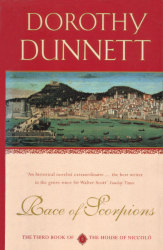
Race of Scorpions by Dorothy Dunnett

This is the third book in the House of Niccolò series, the first two being Niccolò Rising and The Spring of the Ram. The series is set in the 15th century and follows the adventures of Nicholas vander Poele as he travels throughout Renaissance Europe and beyond. By the time this third volume begins, Nicholas’s spectacular rise from dyer’s apprentice to head of a successful trading company, bank and mercenary army has not gone unnoticed and has brought him to the attention of various people who are hoping to use his skills for their own purposes.

In Race of Scorpions Nicholas finds himself kidnapped and taken to Cyprus, an island torn apart by civil war. Cyprus is in a strategically important location and has become the centre of power struggles between various groups including Christians and Muslims, Genoese and Venetian merchants, Egyptian Mamelukes, Portuguese traders, the Pope, the Sultan, the Knights of the Order of St John – and the two Lusignan siblings who are fighting for the crown. Both of the claimants to the throne, Queen Carlotta and her half-brother James de Lusignan (known as Zacco), are determined to recruit Nicholas and his army to their side and are prepared to use any means possible to do so. Nicholas must choose which of them, if either, to support in their battle to gain control of Cyprus, but as well as being drawn into the conflict between Carlotta and Zacco, Nicholas faces some problems of a more personal nature when he is reacquainted with Katelina van Borselen, who we first met in Niccolò Rising.

Many of the characters we have been getting to know over the previous two books are here again – including Tobie, Loppe, Astorre and John le Grant – and we are also introduced to some new ones. A lot of the other characters in the book are real historical figures and one of the most fascinating, I thought, was Zacco’s mother Marietta (known as Cropnose after her nose was bitten off by her rival). Nicholas also meets his young cousin Diniz Vasquez for the first time, contends with a new villain in the form of the Mameluke emir, Tzani-bey al-Ablak, and tries to unravel the complex motives of Primaflora, a beautiful courtesan who is working for Queen Carlotta…or is she really working for Zacco?

Luckily, with his talent for solving puzzles and coming up with labyrinthine plots and schemes, Nicholas is adept at getting out of the difficult situations he finds himself in and although his plans don’t always work out exactly as he wanted them to, he usually manages to stay at least one step ahead of everyone else, including the reader – or this reader at least, and I don’t mind admitting that! But despite not quite understanding everything that is happening or being said, I still loved this book. It also features one of the best scenes in the series so far, certainly one of the most eerie and atmospheric. I’ll never be able to see a moth again without thinking of it!

I loved the setting too – I haven’t been to either Cyprus or Rhodes (Dorothy Dunnett’s books always make me aware of how little of the world I’ve actually seen) but as usual every location is described so thoroughly I can form a vivid picture of them without ever having been there. And not only have I never visited these countries, I know almost nothing about their histories either so it was good to have an opportunity to learn about the Cyprus civil war – a fascinating piece of 15th century history I’d never read anything at all about before.

However, I wouldn’t recommend reading Race of Scorpions unless you’ve read the previous two novels in the series first. These books are complicated enough as it is without reading them out of order and you would also miss watching the development of Nicholas’s character over the course of the series. I really enjoyed this one, and luckily for me I still have five more House of Niccolò books to read. Scales of Gold is next!

Lion of Alnwick by Carol Wensby-Scott

Set in the 14th century during the reigns of Edward III and Richard II, Lion of Alnwick tells the story of Henry (Hal) Percy, 1st Earl of Northumberland. The novel begins in the year 1357 and ends in 1409, covering all the major events of Hal’s adult life including his marriage to Margaret Neville, sister of his bitter enemy and rival Northern lord, his conflict with John of Gaunt, the Duke of Lancaster, and his relationship with his son Harry “Hotspur” Percy.

Before I say any more about this great historical fiction novel, I should point out that this book has now sadly gone out of print, but for anyone who loves fiction set in medieval England it is definitely worth reading if you can manage to find a copy. Please don’t let the cover (pictured above) put you off – it has to be one of the worst covers I’ve ever seen and is really not representative of the quality of the story!

I can’t remember how this book first came to my attention, but the reason it appealed to me is because I only live an hour away from Alnwick and have been there several times (usually to visit the castle, the gardens or Barter Books) so I was attracted by the mention of Alnwick in the title. There are so few books that focus on the north east of England that whenever I do come across one I always feel I should read it (though of course, with this novel being so epic in scale, the action is not just confined to Northumberland but also sweeps down to York and Westminster and across to Wales).

The story concentrates on Hal, his son Harry, and their respective wives, Margaret Neville and Elizabeth Mortimer, but we also meet lots of other fascinating characters, most of them real historical figures of the period. One of the most intriguing characters, I thought, was Hal’s enemy from over the border in Scotland, Archibald Douglas, known as The Black Douglas. His rivalry with Hal is a recurring theme throughout the novel and I looked forward to all of their encounters. I also thought the characterisation of Richard II as a young and incompetent king unable to command the respect of his men while bestowing gifts and titles on his favourites, was very well done.

The author does seem to assume that the reader already has a good knowledge of the period; the history becomes very complex and detailed, so this is the type of historical fiction novel I would recommend only to readers who really do love history! It’s such a shame this book is out of print; it was very well-written and well-researched, maybe not as much fun to read as a Sharon Penman or Elizabeth Chadwick novel, but almost as good. If you’re interested in reading this book I would suggest trying to get a copy of this one and the other two in the trilogy (Lion Dormant and Lion Invincible) as soon as you can, before they become impossible to find!

In a Treacherous Court by Michelle Diener

There are already so many historical fiction novels set in the Tudor court that for a book to stand out from the others the author really needs to find a new way to approach the subject. Michelle Diener’s In A Treacherous Court is refreshingly different because it features two interesting but little-known historical figures – John Parker and Susanna Horenbout – both of whom really existed, yet aren’t characters that you would usually find in Tudor novels. Despite having read a lot of books set during this period, I had never come across either of these people until now.

Susanna Horenbout is a Flemish artist who travels to the court of Henry VIII in 1525 to become the king’s illuminator. During the journey to England, a man dies on board the ship and Susanna is at his side as he whispers his dying words, a secret message that he wants her to deliver to the King. It seems that someone is afraid of what Susanna may have learned, because as soon as she arrives in England an attempt is made on her life. One of the King’s most trusted courtiers, John Parker, Yeoman of the Crossbows, has been sent to meet the ship and after discovering how much danger Susanna is in, he vows to protect her while at the same time trying to unravel a plot that could threaten Henry’s throne.

In a Treacherous Court is the first in a series and after reading this one, I think both Susanna Horenbout and John Parker have a lot of potential as characters. As historians know so little about their lives, it gives the author some freedom to create exciting adventures for them without being too restricted by what really happened (the story does stick to the historical facts where possible though, and there is an author’s note at the end of the book that explains which parts of the novel are based on truth and which are purely fictional). I did find the romance between Susanna and Parker a bit hard to believe as it all seemed to happen so quickly, but who can say whether or not their relationship might really have developed the way it did in the novel?

The plot is very fast-paced with lots of action in every chapter which makes the story fun to read, although I thought the constant murder attempts and attacks on Susanna did become a bit repetitive. This book is definitely at the lighter end of the historical fiction spectrum, but it’s certainly an entertaining read with some original ideas that give it a different feel from most of the other Tudor court novels I’ve read.

I received a review copy of In a Treacherous Court from Simon & Schuster

The Spring of the Ram by Dorothy Dunnett

This is the second book in the eight-volume House of Niccolò series. In the first book, Niccolò Rising, we saw how Nicholas, a young dyer’s apprentice, rose in the world to become head of the Charetty trading company. In The Spring of the Ram, Nicholas and the other men of the Charetty company – including the doctor Tobias, notary Julius, priest Godscalc, engineer John le Grant and mercenary leader Astorre – journey to the Black Sea port of Trebizond to establish a trading post. With them every step of the way is Pagano Doria, a sea adventurer who has married Nicholas’s thirteen-year-old stepdaughter, Catherine de Charetty, and is now in a position where he may be able to seize control of the company through his marriage.

One of the things I love about Dorothy Dunnett’s books is that they give me an opportunity to learn about people and places I might never have known anything about otherwise. Dunnett’s novels open up whole new worlds, focusing on periods of history and geographical locations that are usually ignored in historical fiction. This is the first book I’ve read about Trebizond, a final outpost of the Byzantine Empire which at the time the story is set (1461) is under threat of falling to the Turkish army at any moment, and I thought it was a fascinating setting. I loved all of the beautiful descriptions of Trebizond and the other places Nicholas and his companions pass through on their journey to and from the Black Sea coast. This, for example, is the moment when the two ships belonging to Doria and Nicholas finally arrive at Trebizond:

So there came to the poisonous honey of Trebizond the two vessels from barbarian Europe, the four months of their travelling over, and winter turned into spring. One after the other, they crossed the wide, irregular bay towards the green amphitheatre which lined it. In its midst, the classical City gleamed on its tableland, alight with marble and gold against the dark mountain forests behind. There stood the fabled City, treasure-house of the East.

I enjoyed The Spring of the Ram much more than the first book, Niccolò Rising, possibly because I’m more familiar with the characters now and so found it easier to get straight into the story. And of course when I first started to read Niccolò Rising it was inevitable that I was going to compare it with Dunnett’s other series, the Lymond Chronicles, however hard I tried not to, and although I liked Nicholas and Marian de Charetty, most of the other characters seemed to me to be less interesting than the ones in the Lymond Chronicles. It seems that I just needed to give myself time to get used to them though, because now that I’ve read two Niccolo books I feel that I’m starting to get to know and understand some of the characters better. Nicholas himself continues to amaze me with his complex machinations and intricate trading deals, but despite the amount of time we spend inside his head in this book (which is more than we were ever allowed to spend inside Lymond’s) his character and motivations still remain a bit of an enigma to me. Most of what we learn about him is through the observations of the people around him – Tobie, Godscalc and the others – but we have to remember that none of them truly understand Nicholas either and have a tendency to misinterpret his actions.

All of Dunnett’s books are clever, complex and intricately plotted; this one, I thought, was particularly complicated because there seemed to be so much happening behind the scenes, so many different forces and factions all vying against each other, pulling in different directions and trying to turn things to their own advantage. The main trading powers – Venice, Florence and Genoa – are all rivals with conflicting business interests, then there are the various rulers and leaders – Emperor David of Trebizond, Uzum Hasan of the White Sheep Tribe, Sultan Mehmet II of the Ottoman Empire, and others. Members of Nicholas’s family also seem to have agendas of their own, and finally there are Violante of Naxos and the mysterious Greek with the wooden leg, both of whom are also trying to control Nicholas’s actions. With so much going on, I won’t pretend that I fully understood everything that was happening in the book because I certainly didn’t, but as with all of Dunnett’s novels I’m looking forward to reading this one again!

It has taken Niccolo a bit longer to win me over than it took Lymond but I’ve been pulled into his world now and have already started the third in the series, Race of Scorpions.

Wolf Hall Readalong: Week 1

During August and September I am taking part in a readalong of Wolf Hall, Hilary Mantel’s Booker Prize-winning novel about Thomas Cromwell. The readalong is hosted by Michelle of The True Book Addict and Kai of Fiction State of Mind. This week we have been reading Part One, which consists of three chapters.

Here are my answers to this week’s discussion questions:

1) What prompted you to join this read-a-long?

As an avid reader of historical fiction I should probably have read this book before now, but for some reason, despite its success and popularity, I never got around to reading it. Now that the sequel, Bring Up the Bodies, has been released and getting so much praise and attention too, it seemed like the perfect time to finally read Wolf Hall, and when I saw that there was going to be a readalong it helped motivate me to actually pick the book up and start reading. I also like the way this readalong is structured and hopefully I won’t have any problems keeping up with the schedule!

2) What do you think of Thomas so far?

I don’t feel that I know Thomas Cromwell very well yet, but as I’ve still only read the first three chapters I’m sure I’ll get to know and understand him better as I read on. However, each of these first three chapters has given us an insight into a different side of Thomas’s character. In the first, we get a glimpse of what appears to have been a very unhappy childhood, living with a cruel and abusive father. In the second, we meet Thomas again as an adult and we are shown his public persona, the part he is playing in the politics of the country, and his interactions with other important historical figures such as Stephen Gardiner and Cardinal Wolsey. And in the third we see Thomas in his role as a husband and father.

3) What do you think about Thomas’s feelings towards his son Gregory? Do you think he is too indulgent? Do you think his treatment of Gregory now will affect Gregory’s future?

I think it’s a good thing that Thomas is trying to avoid treating Gregory the way his own father treated him. This quote gives us a good idea of his feelings on this subject:

Bawling, strong, one hour old, plucked from the cradle: he kissed the infant’s fluffy skull and said, I shall be as tender to you as my father was not to me. For what’s the point of breeding children, if each generation does not improve on what went before?

I don’t think Thomas is being too indulgent, but it’s too early to say at this point in the novel what effect his treatment of Gregory will have on Gregory’s future.

See Kai’s post for other participants’ thoughts on Part 1 of Wolf Hall.

The Second Empress by Michelle Moran

This historical fiction novel by Michelle Moran is set during the final years of Napoleon’s reign, between 1809 and 1815, and explores the French Emperor’s relationships with his second wife, Marie-Louise, and his sister, Pauline. I have only read one of Michelle Moran’s previous novels, Cleopatra’s Daughter, which is set in Ancient Rome and although I enjoyed it, I thought this new one, The Second Empress, was much better – the quality of her writing seems to have improved and the characters felt more developed too.

The story is told by three very different characters who take it in turns to narrate one chapter each. The first is Maria-Lucia, the eighteen year old daughter of Francis I, Emperor of Austria. Abandoning her dreams of marrying Count Adam von Neipperg, the man she loves, and one day ruling Austria as her brother’s regent, Maria-Lucia agrees to a marriage with the Emperor of France, Napoleon Bonaparte, as it will help to keep her father’s throne safe. Napoleon hopes she will be able to give him a legitimate heir, which his first wife Josephine was unable to provide. Maria-Lucia, or Marie-Louise as she became known in France, is a lovely, compelling character, intelligent, well-educated and talented. The portrayal of Napoleon is very negative (not that I had really expected anything else) but despite his cruelty to her throughout their marriage, Marie-Louise continues to perform her duties with dignity and grace.

Our second narrator is Pauline, Princess Borghese, Napoleon’s sister. She dreams of marrying Napoleon herself so that they can rule Egypt together like the ancient pharaohs and she is bitterly jealous of both her brother’s first wife, Josephine, who she encouraged him to divorce, and his second, Marie-Louise. Pauline is a spiteful, malicious person but of the three narrators, I thought her voice was the strongest and the most fun to read. She’s not a completely unsympathetic character because she is so obviously unhappy and miserable. She also has a lot of eccentricities – she’s obsessed with Egypt, she likes to bathe in milk, and she even uses her servants as footstools to rest her feet on. Although Pauline was a real historical figure, she’s not someone I’ve ever read about before so I’m not sure how accurate this portrayal is, but I thought she was a fascinating character.

Finally there’s Paul Moreau, Pauline’s Haitian servant, who accompanied her back to France after Haiti gained its independence from the French. Despite his loyalty to Pauline (and the fact that he has been in love with her for many years) Paul is aware of her faults and is able to feel sympathy for Marie-Louise too. He also still has hopes of returning to Haiti to help rebuild his war-torn country and this adds another interesting aspect to the story.

Although I have read other books set during Napoleon’s reign, this is the first one I’ve read which concentrates on the lives of Napoleon and the Bonaparte family. Before I started to read, I was worried that I might struggle because I don’t know a lot about this period of French history, but luckily this was not a problem. The focus is on the lives of the three narrators and their relationships with each other and the people around them; details of politics, battles and military campaigns are kept to a minimum (which could be either a good or a bad thing, I suppose, depending on your personal tastes in historical fiction). I was fascinated by the characters in this novel, particularly Pauline and Marie-Louise and was inspired to do some research and find out more about them – though as I had no idea how their stories would play out and didn’t want to spoil the book for myself, I waited until I had finished before I looked anything up. The author’s notes at the back of the book were helpful too and explained what happened to each of the main characters after the novel ends.

As I have so little knowledge of this subject, it wouldn’t be fair of me to comment on the historical accuracy of this book but I could tell that it had been well-researched – Moran had even included some extracts from real love letters sent between Napoleon and Josephine. A huge amount of information has obviously had to be condensed into 300 pages, so the book doesn’t really go into a lot of depth but would be a good choice if you’re looking for an enjoyable, entertaining historical fiction novel and don’t want to be overwhelmed with too many details.

I received a review copy of The Second Empress from the publisher via Netgalley