The Creation of Eve by Lynn Cullen

I think most people have probably heard of famous Renaissance artists such as Michelangelo and Leonardo da Vinci. But what about Sofonisba Anguissola? In The Creation of Eve, Lynn Cullen introduces us to this talented female artist who was prevented from reaching her full potential simply because she was a woman. Sofonisba, who spent many years in the Spanish court, was not allowed to sign her paintings with her own initials and some of her works were even credited to other people.

At the beginning of the book, Sofonisba is studying in Rome with Michelangelo. She leaves Rome following an affair with another student and travels to Spain where she joins the royal court as lady-in-waiting and art instructor to the fourteen-year-old Queen, Elizabeth of Valois. Here she becomes caught up in a scandal involving the Queen and the King’s half brother, Don Juan.

This book was not quite what I had thought it would be. I was expecting it to focus on the story of Sofonisba Anguissola and was looking forward to learning about her training as an artist and the challenges she faced as a woman working in a male-dominated field. As it turned out though, the book was as much about the relationship between King Felipe II and his young French wife, Elizabeth, as it was about Sofonisba. For much of the book Sofonisba is little more than a passive observer, a witness to the events that are unfolding in the Spanish court.

I thought The Creation of Eve was an interesting and entertaining read but it lacked any real emotional impact for me. Looking at other reviews of this book (as I usually do after writing my own) opinion seems to be overwhelmingly positive, so if you like reading historical fiction revolving around intrigue in royal courts there’s a good chance that you’ll love this book. The novel does appear to be very well-researched. Cullen manages to incorporate a large amount of historical detail, but this never gets in the way of the plot. I appreciated the author’s note at the end of the book which tells us which parts of the book are historical fact and which are fiction.

I actually won this book in last year’s Readathon (April 2010) and am glad I’ve finally read and enjoyed it, as I was starting to feel very guilty about not reading it sooner!

Some examples of Sofonisba Anguissola’s paintings can be seen on her Wikipedia page.

The Lost Book of Salem by Katherine Howe

Note: This book was also published under the title The Physick Book of Deliverance Dane.

This book got a lot of attention when it was first published a couple of years ago and I couldn’t wait to read it as I thought it sounded like something I would really enjoy. But after seeing quite a few negative reviews I wasn’t so sure and decided that maybe I wasn’t in such a hurry to read it after all. I finally picked it up in the library last month and thought I’d give it a try.

The Lost Book of Salem (I’m not sure why it was necessary to change the title) is a dual time-frame novel, with part of the story set during the Salem witch trials in the 17th century and the rest of the story taking place in 1991. The modern day storyline follows Connie Goodwin, a history graduate who is attempting to track down a spell book belonging to Deliverance Dane, one of the Salem women accused of witchcraft in 1692. Connie believes the book has been passed down through the generations and could still be in existence. Through a number of flashbacks we meet Deliverance Dane herself and some interesting questions begin to arise: could she really be a witch – and does magic really exist?

I wish I could say I had enjoyed this book, but I didn’t. I had trouble with Katherine Howe’s writing style, which was overly descriptive and made the story drag in places. I also found the plot too predictable – it was interesting enough to keep me turning the pages, but there were no real surprises.

As the main character, I found Connie very irritating. Considering she was a PhD student and supposedly an expert in colonial American history she was very slow to pick up on clues that were obvious even to me. She didn’t appear to have much knowledge of the period she was studying either – I’d have thought she would have known that ‘receipt’ used to mean ‘recipe’, for example, and she seemed to be mystified by the word ‘bottel’ before it finally dawned on her that it was just the phonetic spelling for ‘bottle’. Deliverance Dane was a more interesting character and I would have preferred to have spent longer in the 17th century, rather than just the brief interludes that we were given.

There were still a lot of things to like about this book, though. The historical sections were atmospheric and appeared to have been well-researched. And for anyone with an interest in the Salem witches, the book goes into a lot of detail about the trials and the events that lead up to them. So, although I was disappointed by it, I’m sure other people would enjoy it more than I did.

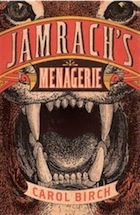
Jamrach’s Menagerie by Carol Birch

When young Jaffy Brown comes face to face with an escaped tiger in the streets of London, it leads to him being offered a job with Mr Jamrach, a dealer in wild animals. For the next few years Jaffy works at Jamrach’s menagerie, helping to take care of the animals – until one day he gets the chance to go to sea in search of a very special creature…

This novel, the first I’ve read by Carol Birch, grabbed me from the very first page. It was everything I love in a book: historical fiction set in the Victorian period with a fast-paced plot and quirky, interesting characters. When a few chapters into the novel Jaffy set off on his voyage and it became clear that most of the book was going to take place at sea I was slightly worried as I often find seafaring stories boring – but not this time! I was pleased to find that I enjoyed reading about Jaffy’s adventures on board the Lysander, visiting distant lands and battling against storms, starvation and superstition as much as I enjoyed the chapters set in working-class 19th century London.

From tigers and whales to exotic birds and giant reptiles we encounter a large number of animals, both at Jamrach’s London menagerie and in their natural habitat (and be warned that Birch doesn’t shy away from describing the cruel ways in which these creatures were treated in the 19th century). But more importantly, we learn a lot about human nature, about friendship, love and loyalty. Jaffy, as our narrator, is the character around whom all the others revolve including Ishbel, the girl he loves; Tim, his childhood friend and rival; and Dan Rymer, the older sailor who becomes a father figure to the boys.

Birch’s writing is atmospheric and descriptive, giving the story an almost supernatural, mystical feel at times. And although there were a few occasions where I thought the plot suffered slightly from taking second place to the detailed descriptions, for the most part I found the book completely gripping. A good old-fashioned adventure story and a very enjoyable and entertaining read!

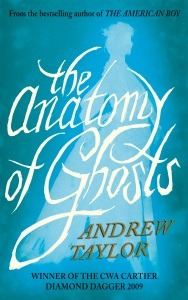
The Anatomy of Ghosts by Andrew Taylor

The Anatomy of Ghosts is an entertaining historical mystery set in and around Cambridge University in the late 18th century. I should read historical mysteries more often because I almost always enjoy them – and this one was no exception.

When London bookseller John Holdsworth’s son is drowned in a tragic accident, his wife insists that their little boy is communicating with them from the spirit world. Holdsworth doesn’t agree and is so disgusted by his wife’s claims that he decides to write a book in which he attempts to prove that ghosts don’t exist. The title of Holdworth’s book is The Anatomy of Ghosts and it soon brings him to the attention of Lady Anne Oldershaw. Her son, Frank, has suffered a nervous breakdown after apparently seeing the ghost of a friend’s wife, Mrs Whichcote, at Jerusalem College, Cambridge. Holdsworth agrees to help Frank – and at the same time he begins to uncover the truth behind what really happened to Mrs Whichcote.

This is the first book I’ve read by Andrew Taylor and I really liked his writing style – it’s detailed yet flows nicely and is easy to read. Some might find the book too slow to begin with, but it does pick up pace. Something that really impressed me about Taylor’s writing was the way he managed to bring his settings so vibrantly to life. Whether he was describing John Holdsworth pushing his barrow of old books through the bustling streets of 18th century London or a couple of students in their caps and gowns strolling through the quiet courtyards and gardens of Cambridge, the sounds, sights and even the smells are incredibly vivid. As a historical novel, though, I think it would have benefited from a few points of reference to anchor the story in the 1700s, as it did at times feel more like the Victorian period to me.

The characters, unfortunately, were not the most likeable of people. In fact, I didn’t like any of them, not even Holdsworth, but it didn’t matter too much – the strength of this book was definitely its plot rather than its characters. And I’ve been left intrigued about what was actually in John Holdsworth’s book, The Anatomy of Ghosts. It would have been a nice addition to the story if we could have read a few excerpts!

Are Andrew Taylor’s other books as good as this one?

The Guernsey Literary and Potato Peel Pie Society by Mary Ann Shaffer and Annie Barrows

Everyone seemed to be reading this book a couple of years ago, apart from me! It had never appealed to me before, but recently I’ve been reading a lot of World War II fiction so I thought it was time I gave it a try – and I’m glad I did.

In The Guernsey Literary and Potato Peel Pie Society we meet Juliet Ashton, who has become famous as a result of the witty newspaper column she wrote during the war. When the war is over, Juliet receives an unexpected letter from a man called Dawsey Adams. Dawsey, who lives in Guernsey, one of the Channel Islands, tells Juliet about the Guernsey Literary and Potato Peel Pie Society, a group he and his neighbours had formed to enable them to meet without arousing the suspicion of the German soldiers who occupied the island. Through Dawsey, Juliet corresponds with the other members of the society. They all have their own stories to tell about both literature and wartime Guernsey, so each member writes to Juliet individually to talk about their favourite books and the joys of reading.

Despite the popularity of this book I had somehow managed to avoid hearing very much about it, so I wasn’t aware until I started reading that it was going to be told entirely in the form of letters. At first I was concerned that this wasn’t going to work for me, but I actually thought the use of letters to tell the story was very effective. It meant we were given a wide variety of different narrators and it allowed each of their stories to unfold slowly and gradually through their correspondence.

I’m ashamed to say that I’ve never even thought about what it was like to live in Guernsey during the war when the island was occupied by German troops and effectively cut off from Britain for five years – and I’m glad that, having read this book, I’ve now learned something about it. There are both happy scenes, such as when all the children who had been evacuated from the island came home to Guernsey at the end of the war, and sad ones – people’s pets being put down because there wasn’t going to be enough food for them, for example. And I enjoyed reading how the islanders managed to outwit the German officers who insisted that all livestock should be handed over to them.

This is a lovely, inspiring story of how in times of hardship and tragedy, people can make the best of a bad situation and work together to help each other survive – and even to have fun.

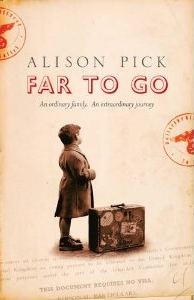
Far to Go by Alison Pick

Far to Go is the moving story of a secular Jewish family, the Bauers, living in the former Czechoslovakia during the build up to the Second World War. Marta is nanny to the Bauers’ beloved little boy, Pepik, and at the beginning of the book, she is quite happy with her position – she gets along with both Pavel, a rich factory owner, and his wife, Anneliese (although Anneliese’s insensitivity annoys her at times) and she loves taking care of Pepik. But in 1938, when the Germans take control of the Sudetenland – the border region of Czechoslovakia where the family live – they find their peaceful existence is under threat. It doesn’t matter to the Nazis that the Bauers don’t consider themselves to be particularly religious – anyone with even a trace of Jewish ancestry is in serious danger. In an attempt to keep six-year-old Pepik safe the Bauers consider sending him to safety on the Kindertransport – but can they go through with it, knowing that they might never see their little boy again?

Far to Go is the first novel I’ve read that covers the lead up to World War II from the Czechoslovakian perspective, so a lot of the historical information was new to me. But instead of confusing the reader with a lot of names, dates and politics, Pick has chosen to concentrate on the lives of an ordinary Czechoslovakian family – a family who at first don’t realise how much danger they are in. Through Marta’s eyes we see how each member of the family tries to cope with the challenging times they are facing and the difficult decisions they are forced to make.

This is also the first time I’ve read about the Kindertransport (a scheme to help Jewish children escape from Czechoslovakia and other occupied countries by train, where they were then placed with foster families in Britain). I had tears in my eyes at the images of children being forcibly removed from their parents’ arms and pushed onto the trains, where they stood looking out of the windows as their families disappeared into the distance. Pick’s writing perfectly evoked the fear and confusion these poor children must have felt.

Although most of the book is written in the third person and focuses on Marta and the Bauers in the late 1930s, there are some sections which are set in the present day and from the viewpoint of an unnamed narrator who is carrying out research into the Holocaust and the survivors of the Kindertransport. At first I was slightly confused and wasn’t sure exactly who or what I was reading about, but eventually everything became clear and I could appreciate the clever structure of the book.

Far to Go is a beautiful, heartbreaking novel and one I would recommend to anyone interested in learning more about such an important period of Czech history.

I received a copy of this book from Headline for review.

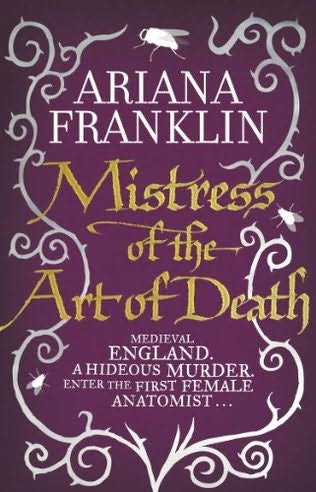
Mistress of the Art of Death by Ariana Franklin

This is my second book for the Great Transworld Crime Caper and is the first in a series of historical mysteries by the late Ariana Franklin. I knew nothing about this series but Mistress of the Art of Death appealed to me because of the medieval setting (I love books set in medieval England).

This book has an unusual heroine. Her name is Adelia Aguilar and she is a trained doctor, very rare in the year 1171. Adelia is from Salerno, where women are allowed to attend medical school. Her speciality, however, is as a ‘doctor of the dead’ – in other words, she is skilled in performing autopsies and finding out the causes of death. When several young children go missing in Cambridge and the city’s Jews are blamed for the disappearances, Adelia is sent to England to investigate.

As I said, I love reading about medieval history and Franklin touches on many different aspects of the period – from the big things, such as the relationship between the church and the monarchy, to the small, such as the clothes people wore and the food they ate. Adelia, being Italian, is unfamiliar with the politics and customs of 12th century England, which allows the reader to learn along with her – so no need to worry if you don’t have much knowledge of the period. Despite some very modern dialogue and Adelia’s distinctly 21st century thought processes, everything else felt suitably ‘medieval’. Setting and atmosphere are so important in fiction and this is an area in which I thought Franklin excelled. It wouldn’t really be fair for me to comment on the historical accuracy as I haven’t studied the 12th century in any detail but I would say that if you’re looking for a serious piece of historical fiction which is correct in every detail then you need to look elsewhere. Accept this book for what it is though, and it’s an enjoyable read.

The writing in the prologue and opening chapters feels quite light and humorous and I expected the whole book to have the same tone, but when Adelia begins to investigate the mystery things start to feel a lot darker. I should point out that the story does revolve around the abduction and murder of children which isn’t nice to read about; it’s quite graphic in places and a bit disturbing. As for the mystery itself, I didn’t guess who the murderer was, but then I wasn’t really trying to guess. Sometimes I prefer not to attempt to work things out and just enjoy the story – and this was one of those occasions.

I found Adelia a fascinating and engaging character although, as I mentioned earlier, she thought, spoke and behaved more like a woman from the 21st century than the 12th. She’s a strong, independent person who is constantly questioning the role of women in society and has a very modern outlook on medicine, the law and life in general; I liked her but she wasn’t a believable medieval woman. Most of the secondary characters are well-rounded and interesting, particularly Adelia’s housekeeper, Gyltha, and her surly but endearing grandson, Ulf – and I loved the depiction of Henry II.

I enjoyed Mistress of the Art of Death and I look forward to being reacquainted with Adelia Aguilar in the other three books in the series. Sadly, Ariana Franklin (Diana Norman) died in January this year aged 77.

I received a copy of this book from Transworld for review.