The Postmistress by Sarah Blake

It’s 1940. Frankie Bard is an American radio reporter working in London for CBS, broadcasting news on the Blitz into American homes. Frankie is right in the heart of the action, spending her nights sheltering from the bombs and her days reporting on homes that have been destroyed, families torn apart and children left orphaned.

Meanwhile on the other side of the Atlantic, we see the effects the war is having on the small town of Franklin, Massachusetts. In Franklin, we meet the postmistress (or actually, postmaster, as she prefers to be called): Iris James, a middle-aged single woman. And we also meet Emma Fitch, the doctor’s wife. When Emma’s husband travels to London to offer his medical skills to the war effort, it sets a chain of events in motion which will affect the lives of all three women.

I seem to have been reading a lot of books about World War II recently – books written during the war, set during the war and about the aftermath of the war. The Postmistress is a book I’ve had my eye on for a while and I was looking forward to reading it. Unfortunately, it turned out not to be one of the better WWII books I’ve read. In fact, it’s probably the most disappointing book I’ve read so far this year and I very nearly gave up on it after a few chapters. Although the writing was very elegant, it felt impersonal somehow and scenes that I’m sure should have made me cry left me unmoved.

The biggest problem I had was that I didn’t feel a real connection to any of the characters. The only one who came alive for me at all was Frankie Bard. I thought the book lacked focus and might have worked better if it had concentrated more on one central character. As it was, I’m not sure The Postmistress was the best title for this book. It implies that the postmistress (i.e. Iris) would be the main focal point of the book, which she wasn’t – this was really Frankie’s story in my opinion – and although Iris does play an important part in the plot, her character’s potential was never fully explored. As for the third main female character, Emma, she seemed very two-dimensional and I never felt that I got to know her at all.

It’s not all bad, though: there were some things that I did like about this book. I enjoyed the section where Frankie was sent to report on the refugee trains departing from Berlin and to attempt to interview some of the Jewish families who were leaving the city. I’m sure she wouldn’t really have found it quite so easy to travel by ferry from England to France in the middle of the war and then to catch a train to Berlin, though! Despite this and a few other inaccuracies (in the author’s note, for example, Sarah Blake admits that the recording equipment Frankie was carrying hadn’t been invented until 1944), I thought this was easily the most compelling part of the novel. This was around 150 pages into the book and was the first time I’d found myself becoming absorbed in the story, which made me glad I hadn’t abandoned it. Sadly though it didn’t continue to hold my attention and I quickly started to lose interest again when the focus returned to Iris and Emma.

I did find it interesting to read about the various ways in which the war was affecting the lives of people in Massachusetts, thousands of miles away from the fighting. We see people worrying about loved ones in Europe, people feeling frightened and expecting a German U-boat to land at any minute, people tuning into the radio every day to hear the latest news and wishing there was some way they could help. Most of the WWII books I’ve read have been from a European perspective so this was something different and I really liked that aspect of the book.

The Postmistress didn’t work for me personally, but I’ve seen a lot of reviews that are much more positive than mine, so clearly other readers have been able to connect with the characters and the story better than I have. I do however think it would make a good book group choice, as it raises some issues which would be perfect for a discussion, such as the importance of truth and whether the truth should always be told – and what happens to the people we hear about on the news after the reporter stops speaking and the radio is turned off.

The Virgin Blue by Tracy Chevalier

The Virgin Blue was Tracy Chevalier’s debut novel, first published in 1997. The only other book I’ve read by Chevalier is her most recent one, Remarkable Creatures, but I found both the writing style and atmosphere of this one entirely different.

The Virgin Blue follows two separate storylines, one from the present and one from the past, which eventually become woven together. In the modern day story, we meet Ella Turner who leaves her home in California and moves to the small French village of Lisle-sur-Tarn when her husband is offered a new job in France. Ella has trouble fitting into her new community – the local people are hostile and unwelcoming, and only the librarian Jean-Paul makes any attempt at friendship. As she begins to dig deeper into her family history, Ella’s hair begins to turn gradually red and, haunted by dreams of a brilliant blue, she starts to become aware of the parallels between her own life and that of her 16th century ancestor, a girl called Isabelle.

Isabelle de Moulin was a young peasant girl, known as La Rousse in reference to her red hair, who married Etienne Tournier, a man from a Huguenot family. With her red hair, her skills as a midwife and her love of the Virgin Mary and the colour blue, Isabelle is an object of suspicion. When the Tourniers find themselves under threat from their neighbouring Catholics, they are forced to flee France for Geneva in Switzerland, where they can follow their religion in freedom. It’s Isabelle’s tragic story that forms the second thread in The Virgin Blue.

I thought the alternating time periods in this book were handled well and they were each written in a distinctive style so that there could be no confusion. The Isabelle chapters had a dreamlike feel, almost like reading a fairytale. These chapters were also very sad and dark. Poor Isabelle was surrounded by cruel, vindictive people and seemed to have very little happiness in her life. Her story unfolded very slowly, being interspersed with Ella’s, and from the beginning there was always a sense of foreboding, a feeling that something bad was going to happen to Isabelle or her children.

I loved the setting of rural France, with its beautiful countryside and picturesque villages. Chevalier gives just enough detail to bring the landscape to life, without weighing the story down with too much description. The one thing that let this novel down for me was the characters. With the possible exception of Jean-Paul none of them felt quite real to me. I thought Rick, Ella’s husband, was especially bland and wooden, to the point where I didn’t even care what happened to him. The characters in the 16th century storyline never really came to life for me either.

So The Virgin Blue, for me, was an enjoyable but forgettable book. Despite the weak characters, I was able to become absorbed in the story while I was reading it but by the next day it was already fading from my mind. Having read Chevalier’s oldest book and her newest I’m now looking forward to reading the ones in between!

By Fire, By Water by Mitchell James Kaplan

By Fire, By Water tells the story of an important period in the history of Spain. A time of progress and discovery, as Christopher Columbus prepares to set out on his legendary voyage to the Indies and seeks funding from the Spanish court. But also a time of fear and suffering with Tomas de Torquemada’s New Inquisition designed to root out heresy.

Luis de Santángel, the King’s chancellor, is a converso – his family has recently converted from Judaism to Christianity – and his Jewish heritage means that even he, in his position of great wealth and power, is under suspicion. Santángel wants to understand the differences between the Jewish and Christian faiths but attempting to gain this knowledge could put his life in danger.

Intertwined with Santángel’s story is the story of Judith Migdal, who lives with her nephew and his grandfather in a Jewish community in Muslim-ruled Granada. Following the deaths of her brother and his wife, Judith decides to become a silversmith so that she can take over her brother’s silver workshop and support her family. Eventually Luis and Judith’s paths meet, but can there be any happiness for them?

By Fire, By Water was not a light or easy read and I found I had to really concentrate to follow everything that was going on. However, it was worth the effort because I felt that I really learned a lot from this book. I thought it was an excellent portrayal of what it must have felt like to live during the Inquisition, not being sure who could and couldn’t be trusted, knowing that even your own friends and family could betray you at any moment. This book really opened my eyes to the suffering and persecution the Jews faced in Spain. The images of thousands of Jews being driven from their homes and forced to leave the country are unforgettable.

I was also interested in the inclusion of Cristóbal Colón (Christopher Columbus) in the plot. Most people are aware of his quest to find the Indies and his subsequent arrival in America, but this book looks at the struggles he faced to obtain the funding he needed for the voyage and to get people to take his ideas seriously.

The author’s attention to detail is incredible, from the colours and fabrics of the clothes people wore, to the sights and sounds of the marketplace. You could never forget that you were in 15th century Spain and I was very impressed with the amount of research that must have gone into this book. Everything felt very realistic and believable.

I read most of this book in one day because I was so desperate to find out what would happen to Santángel, Judith and the other characters. The ending was not what I expected at all, but again, it was probably a realistic outcome. By Fire, By Water should be enjoyed by anyone who appreciates well-written historical fiction or is interested in learning more about 15th century Spain.

I received a review copy of this book from the author.

Cleopatra’s Daughter by Michelle Moran

I was lucky enough to win a signed copy of this book in a giveaway last year. I feel bad about taking so long to read it, but it just never felt like the right time. When I eventually read it I was pleased to find that although I did have one or two problems with it, overall it was very enjoyable.

Kleopatra Selene is the daughter of the famous Queen of Egypt, Cleopatra, and her husband Marc Antony. When Antony’s army is defeated by Octavian at the Battle of Actium and Cleopatra commits suicide, ten year-old Selene and her brothers are left orphaned. Octavian takes them back to Rome with him where they join the household of his sister Octavia. On her arrival in Rome, Selene soon discovers that the city is in a state of unrest, with an unknown rebel known as the Red Eagle urging Rome’s huge slave population to rise against their masters. But Selene also has more personal things to worry about, such as going to school, falling in love and forming friendships – and through it all she hangs on to her dream that one day she will be able to return to Egypt.

I confess that I don’t know very much at all about Ancient Rome. It’s not one of my favourite periods of history to read about and although I know there are lots of historical fiction novels out there about the Romans, I’ve read very few of them. However, this was a good thing because it meant that a lot of the information in Cleopatra’s Daughter was new to me and I learned a lot of interesting facts. For example, I had never heard about the Columna Lactaria (Milk Column), a monument in Rome where mothers left their unwanted babies in the hope that someone would come and feed them.

One thing that strikes me about the Romans is the huge difference between the sophistication and advancement of their culture and the cruelty and barbarity of many of their customs. Michelle Moran does an excellent job of showing both the good side of Rome (the advanced technology, the architecture and the infrastructure of the city) and the bad side (there’s a scene where two hundred innocent slaves face being crucified because one of them has committed a crime, for example).

I did find it difficult to keep the relationships straight between the large cast of characters. This was partly because so many of them had similar names and also because most of the adults had been married at least two or three times each with several children from each marriage. Obviously this wasn’t the author’s fault though, and I did find the character list at the front of the book very useful! There are also some maps, a timeline, a glossary and an afterword explaining the eventual fate of each of the characters. All of these things were extremely helpful to someone like myself, with very little knowledge of Ancient Rome!

Although I did enjoy Cleopatra’s Daughter, it felt a bit too light for me. The characters didn’t have a lot of depth and the story didn’t affect me emotionally the way it was probably intended to. With the teenage narrator and lively writing style, I think this book would appeal to younger readers as well as adults.

Can you recommend any books about Ancient Rome that I might like better than this one?

Remarkable Creatures by Tracy Chevalier

First of all, this is probably my last post until after Christmas, so whether you celebrate it or not I hope you all have a great weekend! Now, back to my thoughts on Remarkable Creatures

Remarkable Creatures is set in the town of Lyme Regis on the south coast of England during the early part of the nineteenth century. It’s the story of two very different women who are brought together by a shared love of collecting fossils. Mary Anning is a young working-class girl who has lived in the town all her life and hunts for fossils for her family to sell to tourists. Elizabeth Philpot, twenty years older than Mary and from a middle-class background, moves to Lyme Regis with her two unmarried sisters. Her interest in fossils begins when she discovers an unusual stone on the windswept beach. Eager to have someone to share her new passion with, Elizabeth finds an unexpected friend in Mary.

Before I started this book I had no interest in fossils; I still don’t, unfortunately. I found the whole fossil aspect of the book pretty boring, but that’s not the fault of the author. I could still enjoy the story even though the subject bored me, and it did raise some interesting questions regarding the theory of evolution (the book was set several decades before Charles Darwin published his On the Origin of Species).

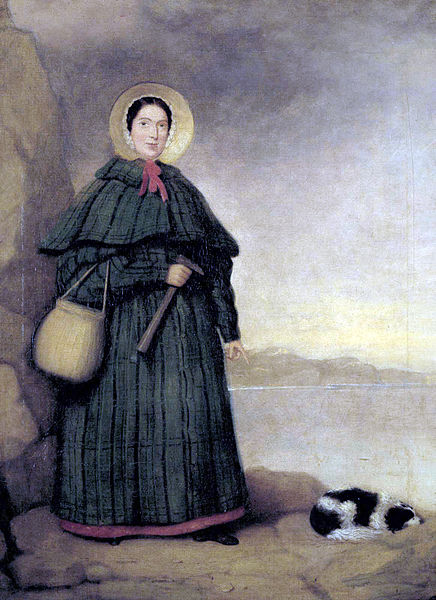
I do admire Tracy Chevalier for creating a story based around such an unusual topic and real-life characters who aren’t very well known. Mary Anning (pictured here with her dog, Tray) and Elizabeth Philpot are both real historical figures who contributed to the science of palaeontology, and as I knew nothing about either of them it was good to have the opportunity to learn about their lives. It was only after finishing the book and looking up the real-life Mary and Elizabeth that I realised how many details Chevalier had included that were based on fact.

I could sympathise with two women trying to gain recognition in a male-dominated field and the difficulties they faced in getting people to take notice of their work and give them the credit they deserved. They were unable to join the Geological Society of London, for example, because it was open only to men.

“That is all she will get, I thought: a scrap of thanks crowded out by far more talk of glory for beast and man. Her name will never be recorded in scientific journals or books, but will be forgotten. So be it. A woman’s life is always a compromise.”

Although I can’t say I loved Remarkable Creatures, it was enjoyable enough and a gentle, easy read. I do think it’s great though that this book has helped to bring two very important but little-known women back into the public eye.

The Sunne in Splendour by Sharon Penman

“And what of those who didn’t know him? What happens, too, when all who knew him are dead, when people know only what they’ve been told?”

When I read The White Queen by Philippa Gregory earlier in the year, I became intrigued by Richard III, the Wars of the Roses and the mystery of the Princes in the Tower. The Sunne in Splendour was recommended to me as the best fictional account of Richard III, so I immediately bought a copy – and it has taken me until now to pick it up and read it. I think one of the things that was putting me off was the sheer size of the book; it’s one of those books that is physically difficult to hold because it’s so thick and heavy. But as soon as I started reading I knew I was going to love this book. Not only did it turn out to be the best historical fiction book I’ve read for a long time, it was also one of the best books of any type that I’ve read this year.

The Sunne in Splendour tells the complete life story of Richard III from childhood to death. Penman portrays Richard as a sympathetic figure who has been unfairly treated by history. Sadly, he is often thought of today as the villain of Shakespeare’s Richard III: the evil hunchback who murdered his nephews. It’s worth remembering though, that Shakespeare lived in Tudor England – and it was Henry Tudor who defeated Richard, the last of the Plantagenet kings.

The Wars of the Roses is the term used to describe a series of battles and rebellions that took place between two branches of the English royal family, the House of York and the House of Lancaster, during the late fifteenth century. I already had some basic knowledge of the period before I started reading this book, but even if you don’t I think Penman makes it easy enough to understand. Sometimes a story can suffer from the author’s attempts to include every little bit of interesting information they’ve uncovered in their research, but that’s not actually a problem here. Yes, there’s an enormous amount of detail, but everything feels necessary and helps to build up a vivid picture of Richard’s world.

The author really brought the characters to life and made them feel like real people who I could understand and care about rather than just names on the pages of a school history book. The number of characters with similar names could have caused confusion but I thought Penman handled the problem very well making them easy to identify by using nicknames (Ned, Dickon, Bess etc) or titles (Warwick, Clarence, Montagu) and Edward of Lancaster is given the French version of his name, Edouard, to distinguish him from Edward of York.

The story is told from multiple viewpoints, with surprisingly little of the story being from Richard’s perspective. Much of what we learn about Richard we learn through the eyes of his family, friends and enemies. A lot of time is devoted to the romance between Richard and Anne Neville, but what really fascinated me was the complex relationship between the York brothers, Richard, Edward and George.

As you might expect, there are a number of battle scenes – something that I don’t usually enjoy, but these were so well written that I was able to follow exactly what was happening and could even form mental pictures of the battlefields and the positions of the two opposing armies. The Battle of Barnet kept me up late on a work night and the Battle of Tewkesbury was even more compelling. I loved the way we got to see the human side of the battles, the emotions of the people on the battlefield, rather than just descriptions of the military tactics. While Richard and Edward are clearly supposed to be our ‘heroes’, it’s a testament to Penman’s writing that I could also cry at the deaths of their ‘enemies’.

Being almost 900 pages long, it took me a long time to read this book, but that was mainly because it was so emotionally intense in places that I couldn’t read too much at once. And also, I was dreading reaching the end. The problem with a book like this is that you know what’s ultimately going to happen (at least you do if you have some background knowledge of the period or have read about it before) so I knew what the eventual fate of the characters was going to be.

This is one of the best books I’ve read this year and I can’t believe I’ve never read anything by Sharon Penman before now. At least I know I’ll have hours of reading pleasure ahead of me as I work through the rest of her novels!

The Wilding by Maria McCann

The Wilding is set in England in 1672, just after the end of the Civil War. Our narrator is Jonathan Dymond, a young man who works as a cider-maker. Jonathan lives with his loving parents and leads a quiet, happy life, travelling around the neighbouring villages with his mobile cider-press. But when Jonathan’s father receives a mysterious letter from his dying brother, Jonathan grows suspicious and decides to visit his uncle’s widow to investigate. At his Aunt Harriet’s house he meets Tamar, one of his aunt’s servants, and begins to unravel the circumstances surrounding his uncle’s death.

Due to the fast pace and the plot twists, I would recommend reading this book in as few sittings as possible. I had started off reading it in small portions alongside another book and found it difficult to get into the story; when I decided to put my other book to one side for a while and concentrate solely on this one, I found that I flew through the rest of the novel. The story was entertaining, very compelling and kept me turning the pages.

McCann evokes the period very well. I liked the way she portrayed a small rural community in 17th century England. I also learned more than I could ever wish to know about cider-making and apples…

What does Solomon say? ‘Comfort me with apples.’ Everything about them is kind and comforting: the mild eating apple, the sharp or bitter fruit that crushes to a miraculous sweetness, the homely apples, like tried and trusted friends, that serve all purposes.

But to me, the difference between a good book and a great book is having strong characters that I can connect with – and unfortunately I felt that most of the characters in The Wilding had very little depth. As the narrator, Jonathan was boring and not very engaging. Tamar and her mother were both interesting, well-drawn characters, but as we only saw them through Jonathan’s eyes, I didn’t get to know them as well as I would have liked to. It would have been nice to have had part of the story told from Tamar’s perspective, because Jonathan was just too weak and I felt no emotional involvement with him at all.

So, I thought The Wilding was a good book but not a great one. I would recommend it to people who like well-written, fast moving historical fiction with plenty of twists and revelations.