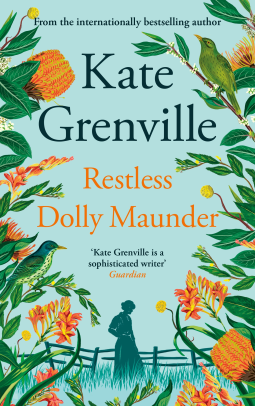
Restless Dolly Maunder by Kate Grenville

Kate Grenville is an author I’ve wanted to read for years but never have, so I’m pleased to have finally had an opportunity to try one of her books. Restless Dolly Maunder is a short novel, inspired by the life of Grenville’s own maternal grandmother, Sarah Catherine Maunder (known to everyone as Dolly).

Dolly is born on a sheep farm in Currabubula, New South Wales in 1881, the sixth of seven children. Her older brothers and sisters can barely read and write, attending school only when their parents can spare them, but by the time Dolly reaches school-age, attendance has become compulsory. Dolly is a bright, intelligent girl and decides that she wants to continue her education and become a teacher after leaving school. Unfortunately, it’s not her decision to make – her father’s permission is required and he refuses to give it, saying that “over my dead body” will a daughter of his go out to work.

As the years go by, Dolly’s siblings begin to marry and move away, while Dolly herself stays on the farm with her parents, eventually marrying Bert Russell, an old friend from school who comes to work for her father. When Dolly discovers that her mother has been keeping a terrible secret from her, she decides that it’s time she and Bert started a new life somewhere else. Aware that farming leaves them at the mercy of the weather, they agree to try something completely different – running a little grocery shop in Wahroonga. It proves to be a success, but Dolly is still not satisfied…in fact, it seems that she’s never going to be satisfied, with anything.

The rest of the novel follows Dolly, Bert and their three children as they move around from place to place, from one business venture to another. Although I did initially have a lot of sympathy for Dolly and understood her desire to make something meaningful of her life, having had her dreams of becoming a teacher destroyed by her father, as the book went on I began to dislike her more and more. It seemed that she was only ever thinking of herself, giving no consideration at all to the effect on her children of constantly being uprooted and disrupted. She was a cold, unloving mother and although she was aware of her faults, she made no attempt to change.

Despite the unlikeable protagonist – and Grenville acknowledges herself in her author’s note that her grandmother was a difficult woman to love – I did enjoy this book. It was interesting to get some insights into life in Australia in the late 19th and early 20th centuries. The family live through both World Wars and although the first leaves them largely untouched, by the time the second comes around Bert and Dolly have sons of fighting age, so are affected in a much more personal way. With this being my first experience of a Kate Grenville book, I didn’t know what to expect from her writing, but I found it very readable. She doesn’t use speech marks, which usually annoys me, but it didn’t bother me too much here, maybe because it’s not a particularly dialogue-heavy book. I’ll look forward to reading more of her work.

Thanks to Canongate for providing a copy of this book for review via NetGalley.
This is book 50/50 for the 2023 Historical Fiction Reading Challenge.

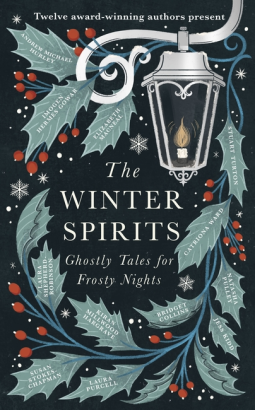
The Winter Spirits: Ghostly Tales for Frosty Nights

The Winter Spirits: Ghostly Tales for Frosty Nights is a collection of twelve new ghost stories written by popular authors of historical and Gothic fiction, all with a Christmas or Advent theme. It’s a follow-up to The Haunting Season, which I haven’t read but which includes eight of the same authors. This is the perfect time of year for ghost stories, so maybe I’ll look for the previous book next winter.

Back to The Winter Spirits and most of the stories are set in the 19th or early 20th centuries, giving them a traditional feel. More variety would have been nice – not just in the time periods, but also in the geographical settings, as the majority take place in Britain, with one or two in America or elsewhere in Europe – but otherwise I really enjoyed this collection. I’ve previously read full-length novels by most of the featured authors, but three of them were new to me: Andrew Michael Hurley, Catriona Ward and Susan Stokes-Chapman. I felt that Hurley’s The Old Play and Stokes-Chapman’s Widow’s Walk were two of the weaker stories, but looking at other reviews, some readers have singled them out as favourites, so I think it’s just a case of different stories appealing to different people! Ward’s contribution, Jenkin, was completely bizarre but added some diversity as it felt quite unlike any of the others.

The biggest surprise, for me, was Natasha Pulley’s The Salt Miracles; I really didn’t get on with her writing style in her novel The Bedlam Stacks, so I wasn’t expecting too much from this tale of disappearing pilgrims on a remote Scottish island (based on St Kilda). However, I ended up loving it – it’s such an unusual and chilling story! Inferno by Laura Shepherd-Robinson, one of my current favourite historical fiction authors, is another I particularly enjoyed – a wonderfully eerie story set in 18th century Italy, where a man is forced to confront his sins. Even better than both of these is Stuart Turton’s creepy and imaginative The Master of the House, in which a young boy who is being neglected by his father makes a deal with the devil. This one feels almost like a very dark fairytale and is one of the highlights of the book.

Of the twelve authors, Laura Purcell is probably the most well established as a writer of horror fiction and she doesn’t disappoint here with Carol of the Bells and Chains, in which a governess trying to deal with two unruly children tells them the story of the Krampus, with unintended consequences. Imogen Hermes Gowar’s A Double Thread, where a woman gets her comeuppance after badly treating her hardworking seamstress, is another I really enjoyed – it made me long for another novel by Gowar, as it’s been a few years since The Mermaid and Mrs Hancock!

The remaining stories are by Elizabeth Macneal, Bridget Collins, Jess Kidd and Kiran Millwood Hargrave. With a range of different styles and subjects, unless you just don’t like ghost stories I think this collection should contain something to please almost every reader.

Thanks to Sphere for providing a copy of this book for review via NetGalley.
The Black Crescent by Jane Johnson

Jane Johnson is a British author who has set several of her novels in Morocco, her husband’s country, with each book exploring a different period in Morocco’s history. The Black Crescent is set in the 1950s, during the time of the French protectorate, when support for Moroccan independence was building momentum.

Our narrator, Hamou Badi, grows up in the remote mountain village of Tiziane, a place where the people still cling to ancient traditions and superstitions. Due to the lines on his hands, Hamou himself is said to be a ‘zouhry’, a legendary figure blessed by a djinn and capable of locating treasure and detecting sources of water. However, it is not treasure that eleven-year-old Hamou finds one day in 1939, but the body of a woman, hidden amongst the palm trees by a dried up riverbed. The lack of interest shown by the French authorities in trying to solve this murder leads to Hamou’s decision to become a police officer and ensure that future victims of crime are given the justice they deserve.

Several years later, in 1955, we rejoin Hamou in Casablanca, where he is now working for the Sûreté, the police force of the French colonialists who are still ruling the country. Hamou takes his job seriously, trying to maintain law and order on the streets of Casablanca, but he quickly discovers that many of his fellow Moroccans see him as a traitor and someone not to be trusted. As the independence movement continues to gather force, Hamou finds himself caught between the two sides and must decide which is most important to him – loyalty to his country or to the employer who pays his wages.

The Black Crescent is a fascinating novel, particularly as I previously had such limited knowledge of French-ruled Morocco. I knew nothing about the work of the Istiqlal (independence) Party or the tensions and unrest following France’s exile of Sultan Mohammed V in 1953. Hamou is the perfect choice of narrator, with one foot in both worlds, showing us that there are good and bad people on both sides. Johnson has clearly researched this period thoroughly (she provides a list of her sources in her author’s note) and writes with an understanding and sympathy for the aims of the Moroccans in attempting to overthrow their French occupiers, but without condoning the violence used by some groups such as the ‘Black Crescent’ of the title.

Hamou is portrayed as an honourable, kind-hearted man trying to navigate his way through a difficult situation and I found him easy to like. He also has a love interest – a young woman he meets in Casablanca – but it only plays a small part in the book and I was just as captivated by the relationship he forms with Madani, the little black cat he rescues and adopts. The book did feel very slow-paced and took much longer to read than I’d expected based on the length, but it held my interest throughout and I learned a lot from it. I wish I’d known there was a glossary at the end of the book, but I was able to understand most of the Moroccan terms from the context anyway, so that wasn’t too much of a problem!

I think The Sultan’s Wife, set in 17th century Morocco, is still my favourite Jane Johnson book so far, but there are three of her earlier novels I haven’t read yet, so that could change!

Thanks to Head of Zeus for providing a copy of this book for review via NetGalley.
This is book 49/50 for the 2023 Historical Fiction Reading Challenge.

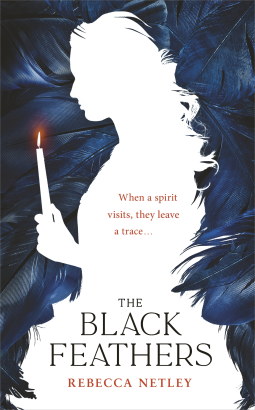
The Black Feathers by Rebecca Netley

The Black Feathers is an eerie Gothic novel, a perfect book to curl up with indoors on a cold, dark night.

It’s 1852 and Edward Stonehouse is returning to Guardbridge, his family estate on the Yorkshire Moors, bringing with him his second wife, Annie, and their baby boy, John. The couple have been married for a year, but this is Annie’s first visit to the house and she is full of apprehension, having been warned by a friend that Guardbridge has a reputation as ‘a place where bad things happen’.

As Annie begins to explore the narrow hallways and dimly-lit staircases of her new home, she finds traces everywhere of Edward’s first wife, Evie, and their young son, Jacob. She longs to know what happened to them, but Edward has made it clear that the subject is not to be discussed, so she turns instead to the other inhabitants of the house – Edward’s sister, Iris, and her old nurse, Mrs North. But here Annie only finds yet more mysteries. Can Iris really communicate with the dead, as she claims, and why does she refuse to venture outside the walls of Guardbridge? And what are the black feathers appearing around the house? Is it true that they mark the spot where a ghostly presence has visited?

The Black Feathers has some obvious similarities with Daphne du Maurier’s Rebecca, as well as a setting reminiscent of Wuthering Heights, but there are enough original elements to make it an enjoyable read in its own right and not too derivative of older classics. I found Annie a likeable character, but Iris intrigued me more, with her passion for spiritualism, interest in taxidermy and the agoraphobia that has kept her indoors for so many years. I wanted to know what had happened to make into the person she became, and although we do eventually find out, Netley keeps us wondering before beginning to reveal the truth. Edward is equally mysterious – seen through Annie’s eyes, he is distant and aloof, a man she has married through necessity and hasn’t yet learned to trust. When we see things from his sister’s perspective, there are hints that he could be quite a different man to the one Annie thinks she has married, but again, we have to wait to find out what sort of person Edward really is and what happened to his first wife and child.

The novel is atmospheric and creepy in places, particularly when Annie begins to see some ghostly apparitions, but I didn’t find it too frightening, which is good as I don’t want to be terrified when I’m reading at bedtime! I felt that the final few chapters let the book down slightly – the unravelling of the house’s secrets involves too much exposition and long stretches of dialogue – but the final twist is clever and unexpected. Rebecca Netley has written another ghost story, The Whistling, which I haven’t read but would like to, having enjoyed this one.

Thanks to Michael Joseph for providing a copy of this book for review via NetGalley.
This is book 47/50 for the 2023 Historical Fiction Reading Challenge.

The Water Child by Mathew West

I enjoyed Mathew West’s first novel, The House of Footsteps, an eerie ghost story set in the 1920s, so I was looking forward to reading his new book, The Water Child. It’s quite different, in both setting and tone, but overall I liked this one as well.

The Water Child is set in Portugal in 1754. Cecilia Lamb is anxiously awaiting the return of her husband John, a Scottish sea captain, who has been away on his latest voyage for much longer than expected. It seems likely that the ship has been wrecked and John is dead, but Cecilia hasn’t given up hope. She spends her days wandering the docks, staring out to sea, certain that her husband is still out there somewhere.

As a young woman alone in an unfamiliar country, this is a difficult time for Cecilia and she struggles to come to terms with John’s absence, beginning to have visions, to hear voices and to suffer from a mysterious sickness. Until she knows for certain that her husband won’t come back, she is unable to mourn or to make arrangements to return to her own family in England – and even if he does come back, will he still be the same person he was when he went away?

Mathew West writes beautifully and creates an almost hypnotic atmosphere as Cecilia moves from one day to the next as if in a dream, watching and waiting, trapped in time until she receives some definite news and can start to move forward. Despite the long absence of her husband (and I’m not going to tell you whether he ever reappears or not), Cecilia does form other relationships – with her maid, Rosalie, and with some other women who understand what it’s like to be the wife of a sailor, while at the same time not fully understanding what is going on inside Cecilia’s mind. West’s previous book had much stronger supernatural elements, but in this one they’re a lot more subtle and it’s open to interpretation whether you think the things Cecilia sees and hears have paranormal explanations or more practical ones.

There are some lovely and vivid descriptions of 1750s Portugal, so I was intrigued by Mathew West’s comments at the end of the book that the Portugal he describes probably never existed and owes as much to fantasy as reality, although he also says that he carried out a lot of research into certain details. I don’t have much knowledge of Portugal in that period (the only other book I’ve read with the same setting is Linda Holeman’s novel, The Devil on Her Tongue), so I would have been interested to hear more about what was real and what was fictional.

There’s one more thing I want to mention; I don’t usually give trigger warnings for books, but there is a brief scene of animal cruelty towards the end of the book which doesn’t really feel necessary and I’m sure the author could have found another way to illustrate the cruelty of the person involved. Otherwise, The Water Child is a dark, unsettling and fascinating novel, slow to begin but picking up pace towards the end. I’ll be interested to see what setting Mathew West chooses next, having written two such different books so far.

Thanks to HarperNorth for providing a copy of this book for review via NetGalley.
This is book 46/50 for the 2023 Historical Fiction Reading Challenge.

The Wayward Sisters by Kate Hodges

It’s 1769 and Nancy Lockaby is on her way to Inverness where she has been invited to stay with the renowned Shakespearean scholar, Caleb Malles, to help him with his research. Nancy is a keen astronomer who has been developing a theory of her late mother’s involving an astronomical phenomenon known as ‘the Fold’ – a theory that has provoked the scorn and derision of her male colleagues at the Greenwich Observatory. Nancy isn’t sure what her role will be in Caleb’s work as she has little interest in literature, but she welcomes the opportunity to get away from the hostile atmosphere of the Observatory for a while and start a new life in Scotland.

Arriving at the large, crumbling Blackthistle House with her maid, Cora, on a cold, snowy night, Nancy is immediately unsettled by the atmosphere. Why are there lights flashing in the window of a turret? Who are the three strange women she sees in the darkness as her carriage approaches the house? Once she settles in, however, she becomes fascinated by Caleb Malles and his passion for Shakespeare’s Macbeth. She also gets to know the three women she glimpsed in the dark and finds them less threatening as she learns more of their backgrounds. But is it true that they have lived for many centuries and possess special powers? And what is Caleb’s real reason for bringing Nancy to Blackthistle House?

The Wayward Sisters is Kate Hodges’ first novel, having previously written several non-fiction books. You never really know what to expect when trying a new author and I had mixed feelings about this book, but generally more positive than negative. The first half is slow, but has a wonderfully eerie, Gothic atmosphere as Hodges sets the scene and introduces the characters. There’s a particularly memorable scene where Nancy encounters some sinister crows during a snowstorm! I had expected elements of Macbeth to be more deeply woven into the plot, but they really aren’t, apart from the presence of the three women, who clearly represent Shakespeare’s three witches, the Weird (or Wayward) Sisters. The witches have more nuance here than in the play, with each being given a detailed backstory of her own.

Kate Hodges writes very well and there are some nice descriptions to bring the Scottish setting to life, although I was surprised that the recent Jacobite Rebellions were barely mentioned as they must surely have still been having an impact on the lives of the Highlanders in the 1760s. Nancy is an interesting heroine; astronomy is an area of science where women could and did make an impact in the 18th century (the most famous female astronomer of that period was probably Caroline Herschel, the first woman to discover a comet) although it was obviously still a male-dominated field and difficult for women to be taken seriously. However, Nancy’s theories regarding the Fold begin to take the story into the realms of science fiction, particularly when the witches get involved and we discover Caleb’s motives for enlisting the services of an astronomer.

I think I would have enjoyed this book more if it had continued as the atmospheric historical fiction novel it seemed to be at first, rather than the more fantastical story it became. There’s a lot to like about The Wayward Sisters, but it wasn’t really the right book for me.

Thanks to Hodder & Stoughton for providing a copy of this book for review via NetGalley.

This is book 45/50 for the 2023 Historical Fiction Reading Challenge.

Scarlet Town by Leonora Nattrass

Scarlet Town is the third book in Leonora Nattrass’s Laurence Jago series set in the final decade of the 18th century. I enjoyed the first two books – Black Drop and Blue Water – and this one is another strong entry in the series.

It’s 1796 and Laurence Jago, accompanied by his friend, the journalist William Philpott, has just returned from his voyage to America (described in Blue Water). Jago, once a clerk in the Foreign Office, is now apprenticed to Philpott and is grateful to his friend for the opportunity, while at the same time angry with him for causing his beloved dog, Mr Gibbs, to be left behind in Philadelphia! Back in England again, they head for Jago’s home town of Helston in Cornwall, intending to visit his cousin Pythagoras (affectionately known as Piggy). On arrival in Helston, however, they are shocked by what they find. Not only does wig-wearing appear to have fallen out of fashion during their absence, but the entire town seems to be caught up in the fever of the upcoming election.

Helston is known as a ‘rotten borough’, where only two men in the town are allowed to vote – and one of these two electors has died under suspicious circumstances. It seems that someone is also attempting to kill the remaining elector, so the town’s patron, the Duke of Leeds, asks Laurence to investigate – but to Laurence’s dismay, his own beloved cousin Piggy begins to emerge as the number one suspect. Will he be able to prove Piggy’s innocence and find the real culprit? And who will win the election if both of the Duke’s electors are unable to vote?

According to the author’s note, the situation described in the book (without the deaths/murder attempts) is based on an election that actually did take place in Helston in the 1790s. Several of the characters are people who really existed, including Sir James Burges, the Duke’s candidate for Parliament, and Stephen Lushington (chairman of the East India Company), the alternative candidate put forward by the town’s mayor – and the novel’s title refers to the red ribbons and silks worn by supporters of the mayor’s candidate as opposed to the blue worn by supporters of the Duke’s. I remember learning about the rotten boroughs at school and the events portrayed in this book perfectly illustrate why electoral reform was so desperately needed. Many people complain about today’s electoral system, but the people of Helston were dealing with a system so corrupt that only a tiny minority were making decisions that affected everyone else, where there was no secret ballot and votes could be bought and sold, leaving the electors open to bribery and blackmail.

As well as the fascinating historical setting, I also found the murder mystery quite compelling; it was maybe not as enjoyable as the mystery in Blue Water, and there were times when I felt it became a bit too complicated, but it was intriguing and kept me guessing until the end. Nattrass also lightens the mood with some humour in the form of Toby the Sapient Hog (based on a real performing pig). I love the 18th century world she has created in this series – everything feels so authentic and thoroughly researched. I’m not sure if there’s going to be a fourth book, but if there is then I can’t wait to read it.

Thanks to Viper for providing a copy of this book for review via NetGalley.
This is book 44/50 for the 2023 Historical Fiction Reading Challenge.