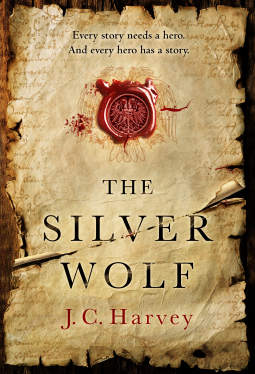
The Silver Wolf by JC Harvey

The Silver Wolf is the first in a new series, Fiskardo’s War, set in Europe during the Thirty Years’ War. This conflict, which took place between 1618 and 1648, is one I’m not very familiar with, so I thought it would be interesting to read a book set in a period that I don’t know much about.

This novel has quite a simple premise: an orphan, Jack Fiskardo (also known as Jacques or Jag to various people at various times) sets out on a quest to find his father’s killers and take revenge. However, the plot is anything but simple! Jack’s adventures take him from the French countryside to the home of an Amsterdam merchant and then to the battlefields of Germany and along the way we meet a huge cast of characters ranging from army scouts and soldiers to tavern keepers, farmers and noblemen. All of these people interact with Jack in one way or another and many of them have intriguing stories of their own, but it’s a lot to keep track of, so be aware that this is certainly not a quick, light read.

The Silver Wolf is divided into three sections: in the first, which begins in 1619, we meet Jack for the first time on the docks of Amsterdam; the second part takes us back several years to fill in some of the details of Jack’s childhood in the village of Belle-Dame near La Rochelle; and finally, in the third section we find Jack in Germany, playing his part in the events of the war while carrying out his private mission of revenge. My favourite was the middle section as it answered some of my questions and gave me a better understanding of what was going on. But although I thought the way the book was structured was quite effective, it did mean that lots of new characters were still being introduced very late in the novel, which I found slightly overwhelming.

The book is written in a lively, often playful style, and the author has opted to use modern speech and slang; I personally prefer dialogue in historical fiction to feel more ‘historical’, but I can see that the choice of language here probably suited the gritty, sometimes brutal, wartime setting. As for the Thirty Years’ War itself, as I’ve said, I previously knew very little about it, so it was good to learn more. The author’s note at the beginning of the book provides a basic outline of the war, why it was fought and the effect it had on the population of Europe, which I found very helpful!

Although I didn’t enjoy The Silver Wolf as much as I’d hoped to, for the reasons I’ve described above, I do think it’s an impressive and ambitious debut novel. I’m not sure whether I will read the second book, but I suspect it will be easier to follow than this one now that the scene has been set, so maybe I’ll be tempted!

Thanks to Allen & Unwin for providing a copy of this book for review via NetGalley.

This is book 3/50 read for the Historical Fiction Reading Challenge 2022.
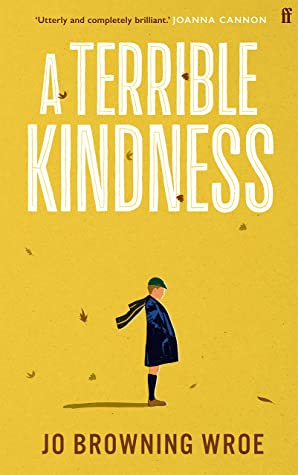
A Terrible Kindness by Jo Browning Wroe

The Welsh village of Aberfan is a place many of us associate with the 1966 mining disaster where a landslide of coal waste collapsed onto the village school, killing 116 children and 28 adults. Among the many volunteers who arrived in Aberfan to help deal with the aftermath of the tragedy were several hundred embalmers. A Terrible Kindness imagines the story of one of these embalmers, the fictional William Lavery.

William is just nineteen years old and newly qualified when the disaster happens, but he works tirelessly alongside older and more experienced embalmers to help identify and tend to the bodies of the victims. Not surprisingly, this will have a profound effect on him and leave him psychologically damaged for years to come. It also brings back memories of other traumatic moments that occurred earlier in William’s life – including one particular incident that led to the breakdown of his relationship with his mother. This incident is only hinted at throughout the book and it’s not until the final chapters that we find out what happened.

The Aberfan disaster is something that is still within living memory for a lot of people, so it’s important that authors handle things like this with care and sensitivity – and I think Jo Browning Wroe does this very well. These scenes are naturally very sad and moving, but also filled me with admiration for these people who voluntarily carried out such an unpleasant, difficult but essential task. However, Aberfan is only the starting point for William’s story and apart from two or three chapters, the rest of the book is set elsewhere.

A lot of time is spent on William’s years as a young chorister at a choir school in Cambridge, the friendships he made there and the events that made him abandon his promising singing career and go into the family embalming business instead. The complex relationships between William, his mother, his uncle and his uncle’s partner are also explored and this is the real focus of the book rather than what happened at Aberfan. I did have a lot of sympathy for William, who was clearly struggling, but I wished he had been able to get help and find a way to move on rather than making life so unhappy for himself and his loved ones for so many years. His mother, Evelyn, also frustrated me with her inability to consider other people as well as herself and I felt that the revelation of the incident that caused her estrangement from William was a bit of an anticlimax.

I think the inclusion of the Aberfan storyline will draw a lot of readers to this book, but will also put other readers off and I do wonder whether a fictional tragedy would have served the purpose of the plot just as well. As an exploration of grief and forgiveness, though, it’s an excellent read and an impressive first novel by Jo Browning Wroe.

Thanks to Pigeonhole for the opportunity to read this book.

This is book 2/50 read for the Historical Fiction Reading Challenge 2022.
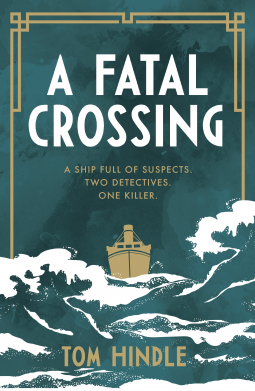
A Fatal Crossing by Tom Hindle

I was drawn to A Fatal Crossing first by the cover, then when I saw that it was a Golden Age-style mystery novel set at sea in the 1920s, I was even more interested. I read the book in October and loved it, but have waited to post my review until publication day, which is today (here in the UK).

The whole story takes place over a four day period in November 1924 as the cruise liner Endeavour approaches New York from Southampton with two thousand passengers and crew on board. When an elderly man is found dead at the bottom of a staircase, the ship’s captain assumes – and hopes – that it’s an accident. However, James Temple, a Scotland Yard inspector, happens to be one of the passengers on the voyage and, after examining the body, he is convinced that the old man has been murdered. The captain gives Temple permission to investigate the crime, but only if he agrees to be accompanied by one of the ship’s officers, Timothy Birch.

Birch has no experience as a detective but follows Temple around the ship as he looks for clues, speaks to suspects and establishes alibis. They quickly discover a link between the dead man and a priceless painting stolen from another passenger, but the mystery deepens when more deaths occur and Temple and Birch find themselves racing against time to uncover the truth before the ship reaches its destination.

This is a complex and engaging mystery novel, with plenty of suspects, lots of red herrings and a strong sense of time and place. Although I felt that there were times when the plot was starting to become quite convoluted and I was struggling to keep track of who was who and who did what, I kept going and was rewarded by some spectacular plot twists near the end which I thought I had worked out in advance, but most definitely hadn’t!

Temple and Birch make an interesting partnership, particularly as it’s a very reluctant one! As an intelligent, competent and experienced detective, Temple is not at all happy about having an inept and bumbling ship’s officer shadowing his every move, saying the wrong things and interfering with the investigation. Birch is our narrator, and as we only see things from his point of view, Temple comes across as bad-tempered, rude and hostile, but there are hints that there’s more to each character than meets the eye. While Temple’s past and his reasons for boarding the Endeavour are shrouded in mystery, we learn that Birch is haunted by the disappearance of his young daughter Amelia and the breakdown of his marriage.

As well as the unusual detecting duo and that unexpected ending, I also loved the setting and the atmosphere. A ship on a long sea voyage is the ideal location for a murder mystery, as all of the suspects are confined in one place with nobody able to arrive or depart until the destination is reached. There’s some wonderful attention to detail as the action moves around the ship from the elegant first class decks to the less luxurious third class areas and the officer’s quarters.

A Fatal Crossing is Tom Hindle’s first novel; having enjoyed it so much, I’m already looking forward to his next one!

Thanks to Century for providing a copy of this book for review via NetGalley.

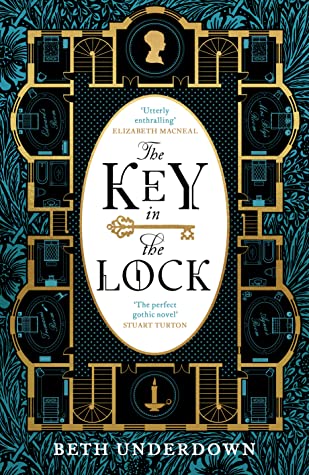
The Key in the Lock by Beth Underdown

The Key in the Lock is Beth Underdown’s second novel. Her first, The Witchfinder’s Sister, was a fascinating historical novel set during the Manningtree witch trials of 1645; this new book sounded very different, but I still wanted to give it a try.

The novel opens in 1918, with Ivy Boscawen trying to come to terms with the death of her son, Tim, shot dead in the trenches of the Western Front. Ivy is desperate to know exactly what happened to Tim, but after speaking to some of his fellow soldiers what she discovers about her son’s death makes her feel even more distressed. Worse still, the loss of Tim triggers memories of another boy, William Tremain, who died thirty years earlier in a fire at the Great House in Polneath, Cornwall. Ivy, whose father was the Polneath doctor at the time, has been haunted by William’s tragic death ever since and has never been able to shake off her feelings of guilt about her actions in the aftermath of the fire.

With Ivy as the narrator, the novel moves back and forth in time between 1918 and 1888, gradually shedding light on the mysteries surrounding both deaths. Family secrets are uncovered, wills are read, inquests are held, clandestine meetings take place and identities are revealed – yet this is not really the exciting, suspenseful Gothic novel I had been hoping for. It moves along at a very slow pace and although I was enjoying it enough to want to read on to the end, I never felt fully engaged with either the plot or the characters.

There is an advantage to the slow pace, however, which is that it gives the reader a chance to try to solve some of the mysteries and guess some of the secrets before Ivy does. It’s a complex story, with lots of pieces that only begin to fall into place towards the end and there were points where I felt confused, particularly as the two timelines often seem to merge together. A chapter heading may indicate that we are in 1918, but after a few paragraphs Ivy starts to remember the events of 1888 again and it’s not always clear which period we are reading about. Also, the ‘key in the lock’ of the title turns out to be several keys to several locks in several doors and I struggled to keep track of the significance of them all.

I did like the atmosphere Beth Underdown creates and the attention to period detail; I never felt that the language or attitudes were too modern. She also writes very convincingly about Ivy’s grief for her lost son, her sense of guilt over what happened at the Great House, and the terrible misunderstandings and assumptions that have persisted for thirty years. It’s a very sad story, where lives are taken too early, acts of kindness go unappreciated until it’s almost too late and wicked deeds go unpunished for too long. An interesting read, but with a tighter focus I think it could have been a much better book.

Thanks to Pigeonhole for the opportunity to read this book.

This is book 1/50 read for the Historical Fiction Reading Challenge 2022.
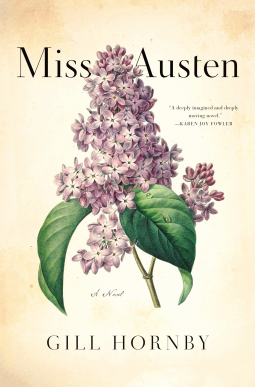
Miss Austen by Gill Hornby

The final book I read in 2021 was one that I very much enjoyed: Gill Hornby’s Miss Austen. The title character is not, as you might expect, the famous novelist Jane Austen, but her elder sister Cassandra. Cassandra, who outlived Jane by nearly thirty years, is known to have burned many of her sister’s letters, although we don’t know exactly why she did this. In this fictional version of Cassandra Austen’s story, Hornby explores a possible reason for the destruction of the letters, while also giving us a glimpse into the lives of Cassandra, Jane and the rest of the Austen family.

The novel opens in 1840 with Cassandra, now an elderly woman, arriving at Kintbury, home of the Fowles, the family of her long-dead fiancé. Following the death of the Reverend Fowle, his daughter Isabella has been left to pack up her parents’ belongings so that a new reverend can move in. Cassandra believes that the letters she and Jane wrote to their friend Eliza Fowle (Isabella’s mother) must still be in the house somewhere and she is determined to find them and remove them before they can be made public.

The story unfolds through the letters Cassandra discovers at Kintbury (not the real letters, of course, as they were destroyed) and through Cassandra’s memories of her younger days. The narrative moves back and forth in time as she remembers the loss of Tom Fowle, the man she should have married, her relationship with Jane and the lives they both led as single women. In the 1840s storyline, we also get to know Isabella, another spinster, and this provides some further insights into what it means to be an unmarried woman in the early 19th century: the lack of security; the pressures created by failing to conform to society’s expectations; and the feeling of being a burden to other family members.

This is a quiet, domestic novel, but I was never bored. There is an authentic period feel and although Hornby doesn’t try to imitate Jane Austen’s writing exactly, the language used generally feels suitable for the time. I enjoyed the occasional references to Jane’s novels, some of which we see her working on and others which the characters read to each other for entertainment. There’s an interesting suggestion that Jane based Mary Bennet in Pride and Prejudice on her sister-in-law, Mary Austen. Most of all, I enjoyed learning a little bit about Cassandra and the world in which she lived.

I had never come across Gill Hornby before, but it seems that not only is she the sister of the writer Nick Hornby, she is also married to one of my favourite authors, Robert Harris! Her earlier novels sound very different and don’t really appeal to me, but I’ve discovered that she has a new book out later this year – Godmersham Park, about a governess in the Austen household. I will be looking out for that one.

Catching up: Three mini-reviews

I always try to finish reviewing the current year’s reads before the new year begins (although I don’t always manage it), so today I’m catching up by posting some brief thoughts on three books read in November and December.

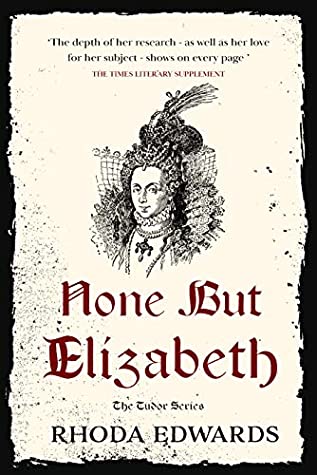
I added None But Elizabeth to my TBR a few years ago after reading Rhoda Edwards’ two novels about Richard III, Some Touch of Pity and Fortune’s Wheel, both of which I enjoyed. This one, first published in 1982, is a fictional retelling of the life of Elizabeth I. The book is written in a straightforward, linear style as we follow Elizabeth from childhood to old age.

There are some things Edwards does very well – the depiction of Elizabeth’s feelings for Robert Dudley, the man she loves but never marries; Elizabeth’s internal conflict over how to deal with the threat of Mary, Queen of Scots; the symbolism used to mark the passing of time; the way in which Elizabethan poetry is woven into the text – but as someone who has read about Elizabeth many times before, there was nothing new or different here. I would recommend reading Margaret Irwin’s Young Bess or Margaret George’s Elizabeth I rather than this one.

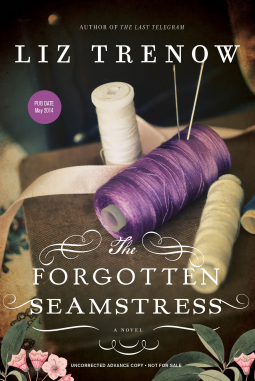
The Forgotten Seamstress by Liz Trenow is a multiple time period novel in which our present day narrator, an aspiring interior designer, finds a beautiful quilt in her mother’s attic with a message embroidered into the lining. She sets out to learn more about the quilt and discovers a connection with a young woman called Maria who spent most of her life in a mental hospital claiming to be a former lover of the Prince of Wales (the future King Edward VIII). As Maria’s story unfolds, in the form of taped interviews recorded by a student in the 1970s, we find out whether she was telling the truth and, if so, what secrets are hidden in the quilt’s design.

I wasn’t expecting too much from this book, but I enjoyed it much more than I thought I would – and for once, I found the modern day storyline as compelling as the historical one. On one level it’s almost a mystery novel, with the narrator hunting for clues to the quilt’s origins, tracking down people who may have known Maria and piecing fragments of information together to try to discover the truth. However, it also provides some insights into social issues such as living conditions in mental institutions, psychiatric treatment in the early 20th century and the later policy of ‘care in the community’. Some parts of the story were too predictable, but it was an interesting read overall and I will probably look for more of Liz Trenow’s books.

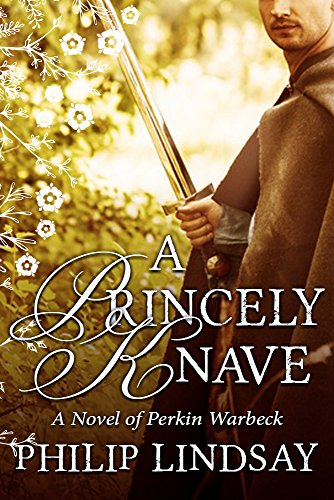
A Princely Knave was the oldest remaining book on my NetGalley shelf (from 2016, I’m ashamed to say). After receiving a copy, I read some negative reviews that put me off it, but in November I finally decided to give it a try. The book was originally published in 1956 as They Have Their Dreams and tells the story of Perkin Warbeck, a pretender to the English throne. Warbeck claimed to be Richard of York, one of the two ‘Princes in the Tower’ – the sons of Edward IV who disappeared from the Tower of London, believed to have been murdered. The novel begins with Warbeck landing in Cornwall in 1497, hoping to lead an army to overthrow Henry VII and take his place on the throne.

Philip Lindsay uses flowery and often antiquated language, a style which was common in older historical novels but feels very dated today. However, I’ve read one or two of his other books so was prepared for this. The biggest problem I had with this particular book was that, apart from Warbeck himself, the characters feel underdeveloped – the group of men who accompany Warbeck in his rebellion are almost indistinguishable and the only significant female character, Warbeck’s wife Katherine Gordon, also lacks depth. Lindsay does explore some fascinating ideas, though; for example, he suggests that even Warbeck himself doesn’t know who he really is – having been told by some that he has royal blood and by others that he is the son of Flemish merchants, he has become unsure of his real identity. I thought it was worth reading, but I probably wouldn’t recommend it unless you’re as interested in this period as I am.

The Girl in the Photograph by Kate Riordan

Kate Riordan’s 2015 novel The Girl in the Photograph is one of many to be compared to the Daphne du Maurier classic Rebecca, but apart from being set in a country house and having a few Gothic undertones, I couldn’t see many similarities. It is, however, an interesting read in its own right, exploring some of the social issues faced by women who lived during less enlightened time periods.

This is a dual-timeline novel, but unlike most, which have one thread set in the present and the other in the past, both narratives in this book are historical. In 1932, we meet Alice Eveleigh, a young woman of twenty-two who lives with her parents and works in an office as a junior typist. With many of her friends becoming engaged, Alice is worried that she will be ‘left on the shelf’, so she is flattered when the new accountant at work, a handsome older man, begins an affair with her. Unfortunately, he is already married and when she inevitably finds herself pregnant, he refuses to leave his wife for her. On discovering what has happened, Alice’s mother quickly packs her off to stay with an old friend at remote Fiercombe Manor where she can give birth away from prying eyes and have the baby adopted.

After arriving at Fiercombe Manor, Alice becomes intrigued by hints of the house’s tragic past, picking up snippets of information about Elizabeth Stanton, whose husband Edward was the Manor’s previous owner. Alice attempts to learn more about Elizabeth from Mrs Jelphs, the housekeeper, but it seems that she is reluctant to talk. Not ready to give up, Alice finds Elizabeth’s diary and gradually her secrets begin to be revealed.

Elizabeth’s story, set in 1898, unfolds alongside Alice’s in alternating chapters, allowing us to see parallels between the lives of the two women. Like Alice, Elizabeth is expecting a baby; unlike Alice, she has a husband, but she still feels very alone. Edward is controlling and distrustful and they don’t have a close or loving relationship, but as Elizabeth’s narrative progresses we begin to wonder whether she is really the most reliable of narrators and whether something could have happened to cause Edward to turn against her.

The Girl in the Photograph is a beautifully written novel, with lovely, vivid descriptions of the old house surrounded by yew trees, the formal gardens and terraces, and the views of rolling meadows and setting suns. Riordan creates an eerie atmosphere, with some very subtle ghostly/supernatural elements. However, I found the book very slow and unnecessarily long – I felt that some of Alice’s chapters could probably have been left out without affecting the overall story too much. Still, the novel offers some fascinating insights into what it was like to be a pregnant woman in the 1930s or the 1890s. Attitudes of society towards unmarried mothers, the challenges of postnatal depression and ‘puerperal insanity’, and the general lack of understanding of women’s mental health issues are some of the subjects Riordan touches upon.

Although I felt that this book didn’t have much, apart from the quality of the writing, to set it apart from others of this type, I thought it was still a worthwhile read. I see Kate Riordan has written several other novels which all sound interesting too.