I, Claudius by Robert Graves

When I decided, a few years ago, to include I, Claudius on my list of books to read for the Classics Club I didn’t really expect to enjoy it. It was a book that I felt I should read, due to its status as a work of classic historical fiction, rather than one that I actually wanted to read. The reason I didn’t particularly want to read it was because Ancient Rome was not a setting I found very appealing. That has slowly begun to change since reading Robert Harris’ excellent Cicero trilogy in 2015 and then Margaret George’s The Confessions of Young Nero earlier this year. It’s probably a good thing, then, that I, Claudius has lingered on my Classics Club list until almost the end – it meant that when I did finally pick it up last month, I was much more receptive to it than I would have been a while ago.

I, Claudius, as you would expect, is narrated by Claudius, the fourth Roman emperor. It takes the form of a fictional autobiography:

I, Tiberius Claudius Drusus Nero Germanicus This-that-and-the-other (for I shall not trouble you yet with all my titles) who was once, and not so long ago either, known to my friends and relatives and associates as “Claudius the Idiot”, or “That Claudius”, or “Claudius the Stammerer”, or “Clau-Clau-Claudius” or at best as “Poor Uncle Claudius”, am now about to write this strange history of my life; starting from my earliest childhood and continuing year by year until I reach the fateful point of change where, some eight years ago, at the age of fifty-one, I suddenly found myself caught in what I may call the “golden predicament” from which I have never since become disentangled.

Claudius doesn’t actually tell us about his time as emperor in this novel – that will come later, in the sequel Claudius the God – but instead he gives us a very detailed account of his family background, his childhood and what it was like to live through the reigns of his three predecessors, Augustus, Tiberius and Caligula, who seemed to become progressively more corrupt, unstable and dangerous. However, it is obvious that the real power in Rome is wielded by Livia, the wife of Augustus (and Claudius’ grandmother) who systematically removes various rivals to the throne to ensure the succession of her own line. The ambitious, manipulative Livia is a great character and a constant presence throughout the novel as she works to control and shape the future of the Empire.

Of course, life for someone part of the imperial family as Claudius is comes with its own set of dangers. With his stammering, his twitching and his limp, he is regarded as an embarrassment, kept in the background and not taken seriously as a possible contender for the throne. There are hints and omens from the beginning – including one memorable scene which takes place early in the novel involving a poetic prophecy spoken by a Sibyl – but otherwise the very qualities that appear to make Claudius unsuitable as an emperor seem to keep him safe as those around him are methodically poisoned, exiled or assassinated. This might not be entirely down to luck, though, as Graves has the historian Asinius Pollio advising Claudius to exaggerate these qualities as they could be his only means of survival.

Although I did enjoy I, Claudius, it was a bit of a challenging read for me at times – but that was mainly due to the fact that I haven’t read a lot of fiction (or non-fiction, for that matter) about the Roman Empire so I only have a basic familiarity with the important events and people of the period. I wouldn’t say that it’s necessary to have any prior knowledge before starting this book, but it would certainly help! A piece of advice for future readers: you may find it useful to draw a family tree as you read, if your edition doesn’t already include one. The relationships between the characters quickly become very complicated, especially as so many of them marry and divorce several times, with children from each marriage (as well as adopted children) – but with a little bit of effort and attention, keeping track of the major players in the story isn’t too difficult.

If I have a criticism of this book it would be that as Claudius spends most of his time telling us about events that happened before his birth, elsewhere in the Empire or in which he had no personal involvement, this occasionally takes away the sense of drama and immediacy that there could have been had our narrator always been at the heart of the action. It’s still quite gripping in places – such as the sequence of events leading up to the death of his cousin Postumus, or the ‘haunting’ of his brother Germanicus (two of the few people to actually show Claudius any kindness) – but it’s probably worth being aware that this is not just a book about Claudius himself but also the history of the Roman Empire in general (the real Claudius was a writer and historian so Graves’ decision to have him tell the story in this way feels authentic).

I can’t comment on the accuracy of this novel, the sources Graves has used or the way he has chosen to interpret the characters, because I simply don’t know enough about the subject, but I do know that I found it much more enjoyable than I’d expected – and that I’m glad I decided to read it, despite my ambivalent feelings about Roman history. I’ll look forward to continuing the story soon with Claudius the God.

Song of the Sea Maid by Rebecca Mascull

Having had such a good experience with my first Rebecca Mascull book, The Wild Air, I knew I would have to read her previous two novels as well – and I was delighted to see Song of the Sea Maid on the shelf on a recent visit to the library. I hoped I would love it as much as The Wild Air…and I did. In fact, I thought this one was even better.

Song of the Sea Maid begins with a little girl living on the streets of London with only one aim in life: to do whatever it takes to survive from one day to the next. When her sole friend and companion, an older boy who may or may not be her brother, is taken by a press gang, she finds herself all alone. Caught attempting to commit a desperate act – stealing from a gentleman – she expects to be punished, but instead she is taken to an orphanage where she is given food, shelter and the name Dawnay Price.

Dawnay is an intelligent child with a natural curiosity for the world around her. As she grows older and teaches herself to read and write, her thirst for knowledge becomes apparent and she is chosen by a generous benefactor to receive a full education. It is not at all common at this time for a girl to be educated beyond the absolute basics, so Dawnay is determined to make the most of the opportunities she has been given. Eager for new experiences and the chance to use her skills, she travels to Portugal and the Berlengas islands where her studies of the flora and fauna lead her to come up with some very controversial theories. It seems the 18th century world is not quite ready for Dawnay and her ideas!

Song of the Sea Maid is a wonderful exploration of what it was like to be a woman trying to forge a career in science in a period when it was not considered normal or socially acceptable to do so. Dawnay has a lot of good luck which enables her to indulge her passion for study and travel, but she also faces many obstacles in both carrying out her work and in making her findings known, and by the end of the novel it becomes clear that she really is, as Rebecca Mascull states in her author’s note, just the wrong person in the wrong place at the wrong time. It made me wonder about all the other people – women in particular, but men as well – throughout history who may have had innovative ideas or developed advanced theories but were dismissed and silenced so that their names and their views have been entirely forgotten today.

I also enjoyed reading about the various places Dawnay visits on her travels; her time spent alone on the Berlengas Islands is particularly interesting – I think I would have felt too isolated and lonely, but Dawnay finds peace and harmony there, coming to think of the rocks and caves as her own. Still, she is unable to completely escape from world events; she is in Lisbon for the Great Earthquake of 1755 (which I have previously read about in Linda Holeman’s The Devil on Her Tongue) and in Minorca a year later when the island is captured by the French. The Seven Years’ War forms an important backdrop to the novel and from time to time Dawnay is brought into contact with the crew of a Royal Navy ship, initially during her voyage to Portugal. I found all the ship-based scenes surprisingly enjoyable – I think my recent forays into Patrick O’Brian’s Aubrey/Maturin series have really helped me in this respect!

I haven’t mentioned yet that Dawnay also falls in love; I found it quite predictable – as soon as one particular character appeared in Dawnay’s life I knew that they were going to be the love interest – but it was still a beautifully written romance which developed slowly throughout the novel. There’s really nothing negative I can say about Song of the Sea Maid; even the use of first person present tense, which I often dislike, didn’t bother me – in fact, I barely noticed it because I found Dawnay’s voice so strong and real.

This is a lovely novel and now I really must read Rebecca Mascull’s first book, The Visitors!

House of Names by Colm Tóibín

After talking recently about my desire to read more fiction set in Ancient Greece, I was pleased to have the opportunity to read Colm Tóibín’s new novel House of Names. It retells the tragic story of the House of Atreus, described in Aeschylus’ famous trilogy, the Oresteia. Not being very familiar with this story, I had no problem following the plot of the novel, but couldn’t help wondering how different my experience would have been if I was already more well-versed in the Greek classics.

House of Names begins in dramatic style with Agamemnon sacrificing his eldest daughter, Iphigenia. In return the gods will bring about a change in the wind which will allow his army to sail to Troy. Iphigenia’s mother, Clytemnestra, is forced to witness the terrible scene – made even worse by the fact that she had believed she was coming to watch her daughter’s wedding, not her murder. The first section of the novel is narrated by Clytemnestra and I thought it was wonderful, vividly describing the moment of the sacrifice and perfectly capturing the agony and heartbreak of a mother at the loss of her child and the bitter fury of a wife at the treachery of her husband. Angry and grieving, Clytemnestra returns to Mycenae to await her husband’s return from Troy and her chance to take revenge:

Her screams as they murdered her were replaced by silence and by scheming when Agamemnon, her father, returned and I fooled him into thinking that I would not retaliate. I waited and I watched for signs, and smiled and opened my arms to him, and I had a table here prepared with food. Food for the fool! I was wearing the special scent that excited him. Scent for the fool!

But what effect will Clytemnestra’s next actions have on her two remaining children, Orestes and Electra? We don’t have to wait long to find out as sections written from the perspective of each of those characters follow. Orestes’ is told in the third person and describes his kidnapping from the palace of Mycenae and his later escape with the help of two other boys, Leander and Mitros. Together, far from home and away from their families, Orestes and his friends must find a way to survive into adulthood. His sister Electra, meanwhile, pushed aside after Iphigenia’s death, watches Clytemnestra and her lover Aegisthus and begins to plot a revenge of her own…

This has been a difficult review for me to write as I still can’t quite decide what I thought of House of Names! I loved the powerful opening section of this novel but, two weeks after finishing the book, that’s the only part that has really stayed with me. The Orestes and Electra sections, although I found them interesting at the time, felt strangely detached and emotionless. The writing style helped to create an eerie, otherworldly feel at times, but it came at the expense of the passion and intensity I would have preferred from a story like this.

I do think that my lack of knowledge of the Oresteia and the fate of the House of Atreus could have been an advantage rather than a disadvantage as far as this book is concerned. I’ve read several other reviews that mention being confused by Tóibín’s decision to change so many details of the story, such as the use of the character of Leander to fill the role of Pylades, but not being familiar with the original I didn’t even notice things like this. Maybe I should have an attempt at reading the Oresteia itself one day. Does anyone know of a good translation to read?

As for Colm Tóibín, I’m looking forward to reading more of his work. Brooklyn is the only other one of his novels that I’ve read and the two couldn’t be more different. Which of his books do you think I should try next?

Thanks to Penguin for providing a copy of this book via NetGalley for review.

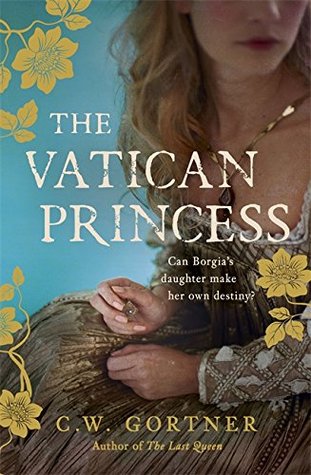
The Vatican Princess by CW Gortner

Since putting together my recent post on historical fiction covers, I seem to be feeling more critical than usual of the covers of the books I read.  I really don’t like this one as not only is it (almost) one of the faceless women covers I highlighted, but there’s nothing about it to suggest the darkness and intrigue usually associated with the Borgias.  Fortunately, though, I did enjoy the book – with a few reservations.  

Set in Renaissance Italy, The Vatican Princess is narrated by Lucrezia Borgia – seductive, manipulative and a well-known poisoner.  Or was she?  Actually, in this version of the Borgia story, she is none of those things.  CW Gortner is very sympathetic to Lucrezia’s situation, portraying her as a vulnerable young woman used by various members of her family to their own advantage and to further their own ambitions.  The novel opens in 1492, with Lucrezia’s father, Rodrigo Borgia, bribing his way to the papal throne as Pope Alexander VI (the second book I’ve read this month featuring a papal conclave).  Lucrezia is only twelve years old but that’s old enough to be useful to her father in securing political alliances and, with this in mind, Rodrigo marries her off to Giovanni Sforza, Lord of Pesaro.   

Lucrezia’s marriage to Giovanni is not a happy one and although it will eventually be annulled and she will marry again – twice – this period of her life forms the largest portion of The Vatican Princess.  It’s a very eventful period and one with plenty of mysteries and controversies, providing endless possibilities for an author to explore.  Why did Lucrezia enter confinement in the Convent of San Sisto while the annulment of her marriage was negotiated?  Did she have a secret son?  Who murdered her brother, Juan?  And was Lucrezia really involved in an incestuous relationship with her other brother, Cesare?  Gortner offers answers, or at least theories, to all of these questions, while showing Lucrezia in a generally very positive light and suggesting that she had much less control over her own fate than is often thought.    

As our narrator, Lucrezia is engaging and easy to like, but I couldn’t help feeling that she was a little bit too innocent and too good to be true – and this made her less interesting to read about than she should have been.  I thought the ambitious Rodrigo was portrayed well, but Cesare needed more complexity and Juan was purely evil with no nuances to his character at all.  However, I was intrigued by the other main female characters in the book: Lucrezia’s mother, Vannozza; the Pope’s mistress, Giulia Farnese; and Lucrezia’s sister-in-law, Sancia of Aragon.  I would be interested in reading more about all of these women, as they have not featured very heavily in the few other fictional accounts of the Borgias that I’ve read so far.       

This is the second novel I’ve read by CW Gortner and although I did enjoy it (and always love a Renaissance Italy setting), I preferred the other one, The Last Queen, which was about Juana of Castile.  I would like to read more of his books, but I don’t really feel drawn to his Tudor mystery series – published as Christopher Gortner – or his recent novels on Marlene Dietrich and Coco Chanel, so that would leave either The Queen’s Vow (about Isabella of Castile) or The Confessions of Catherine de’ Medici.  Have you read either of those?  Which should I read first?     

As for the Borgias, maybe I’ll have another attempt at reading Blood and Beauty by Sarah Dunant soon.  I struggled to get into it the first time but am happy to try again!

The Empress of Hearts by E. Barrington

The Empress of Hearts was originally published in 1928 and was one of several historical novels written by E. Barrington (a pseudonym of Elizabeth Louisa Moresby, who also wrote under the name Lily Adams Beck).  It is described on the cover as “a romance of Marie Antoinette”, but I think that description is slightly misleading.  Marie Antoinette does appear in the novel as a major character, but the focus is really on the scandal known as The Affair of the Diamond Necklace which was thought to be a factor leading to the French Revolution.    
  
The story centres around a diamond necklace created by the Parisian jewellers Boehmer and Bassenge, commissioned by Louis XV of France in 1772 as a gift for his mistress, Madame du Barry.  However, by the time the necklace is ready to be sold to the King, Louis has died and du Barry has been sent away from court.  Boehmer and Bassenge hope the new Queen, Marie Antoinette, will wear it instead, but when her husband, Louis XVI, offers to buy it for her, she refuses, unwilling to appear extravagant and frivolous when the money could be better spent on other things.  Enter Jeanne de la Motte, an ambitious young woman who sees an opportunity to make herself rich and acquire the necklace for herself in the Queen’s name.  The ensuing scandal will damage Marie Antoinette’s reputation and discredit the French monarchy in the eyes of the public:        

Marie Antoinette rose from her chair and moved toward the inner room, holding herself together with an effort so tense that for the moment grace was dead and she moved with stiff, short steps like an old woman. At the door she turned: “Did I not tell you that there would be no need for poison? They will kill me with calumny.”

As you would expect with a book from the 1920s, the writing style is rather different from most modern historical fiction novels; it is more formal and more detailed but, unfortunately, it is also quite dry.  Although I had heard of the Diamond Necklace Affair before, I hadn’t read about it in any depth, so I found The Empress of Hearts an interesting read from that perspective, but as a work of fiction it is less effective – like the other novel I’ve read by Barrington, Glorious Apollo, it would probably have worked better as non-fiction.  We are given large amounts of factual information and as a result the plot moves very slowly and lacks the drama, excitement and tension that should have been present given the subject of the story. 

The characters are not the most vibrant and life-like either, although they had the potential to be fascinating, particularly Jeanne, as the villain of the novel, and Cardinal de Rohan, another prominent figure implicated in the plot.  I was intrigued by the role the Italian occultist Alessandro Cagliostro plays in the story – in reality, it seems that although he was arrested and questioned, it’s uncertain how much involvement he actually had in the Affair – but again, I think there were missed opportunities here.

I’m aware that Alexandre Dumas also wrote a novel about the Affair of the Diamond Necklace – The Queen’s Necklace.  As a fan of Dumas, I’m looking forward to reading it and seeing how he approaches the same subject.

The Tea Planter’s Wife by Dinah Jefferies

I’ve been falling behind with Dinah Jefferies’ novels; after reading her first, The Separation, back in 2014, she has since had another three books published, none of which I had read until picking up The Tea Planter’s Wife a few weeks ago.  I regret not reading it sooner, because I loved it and am now desperate to read her other two, The Silk Merchant’s Daughter and Before the Rains.    

The Tea Planter’s Wife is set in Ceylon (the former name for Sri Lanka) in the 1920s and 30s, and begins with the arrival of newly married Gwendolyn Hooper who has come from England to join her husband, Laurence, on his tea plantation. Gwen is only nineteen years old and barely really knows her husband, a widower much older than herself.  Settling into married life proves to be more difficult than she’d expected, particularly as she also has to get used to a whole new culture and climate.  It doesn’t help that Laurence’s sister Verity comes to live with them and makes it obvious that she resents Gwen marrying her brother.  To make matters worse, Gwen is convinced that Laurence is trying to hide the truth surrounding the death of his first wife, Caroline.   

Feeling lonely and neglected, Gwen is grateful for the friendship of Savi Ravasinghe, a Sinhalese portrait painter, and is mystified as to why Laurence seems to disapprove of him so much.  Then something happens which makes Gwen think that Laurence was right to distrust Savi – and which throws her already troubled life into even more turmoil. 

With its evocative setting and aura of mystery and secrecy, this is a wonderfully atmospheric novel with an almost gothic feel at times.  Throughout the first half of the novel, in particular, I was constantly reminded of one of my favourite books, Daphne du Maurier’s Rebecca: the naive, inexperienced young woman; the mysterious older husband who becomes increasingly distant as soon as the wedding is over; the first wife who, even in death, still casts a shadow over the household.  The similarities lessened as the story continued, though, and more themes and elements were introduced.

Ceylon, as it was known then, is a country I know very little about, so I found it interesting to read of the racial and political tensions between the various groups of people who live on the island – the Sinhalese, the Tamils and the British planters.  With Gwen being a newcomer and unfamiliar with the way of life, we see things through her eyes and share her experiences as she tries to adapt to her new home.  Gwen finds the living standards of the plantation workers particularly difficult to accept and her well-meaning attempts to improve things for them often get her into trouble.  And yet this doesn’t feel to me like an author simply projecting her own modern views onto a character from a bygone time, as often happens in historical fiction, but more a way of showing that Gwen was a decent person who wanted to help in any small way she could, with a natural sympathy for children, the sick and the vulnerable, whatever their colour or status in society.

The setting plays an important part in the story, but so do the people, the decisions they make and the ways in which they communicate – or fail to communicate – with each other.  This is the sort of book where you find yourself becoming frustrated with the characters because they just won’t tell each other the truth…but at the same time you understand why they feel they can’t! 

Having enjoyed The Tea Planter’s Wife so much I’m pleased that I still have two more books by Dinah Jefferies to read.  I just need to decide which one to read next!

The Valentine House by Emma Henderson

The Valentine House surprised me. Having read Emma Henderson’s first novel, Grace Williams Says It Loud, in 2011, I had expected this new one, her second, to be something similar. Instead, what I found was something completely different. Grace Williams was a moving, thought-provoking story of a young girl in a 1950s mental institution; The Valentine House is probably best described as a family saga set in the French Alps.

The house referred to in the title is Arete, a large chalet in the mountains overlooking the village of Hext. It was built by a British mountaineer, Sir Anthony Valentine, in the 19th century and is used as a summer home by successive generations of his family. Our story begins in 1914 when Mathilde, a teenage girl from a farm in the valley, goes to work for the Valentines. Mathilde is an ‘Ugly’, the term given to the unattractive young women who make up Arete’s workforce, specially chosen by Sir Anthony’s wife, Lady C, as being less likely to catch her husband’s eye. Spending her summers at the house, Mathilde gets to know the Valentine family, particularly Daisy, a girl the same age as herself who becomes gradually wilder and more unstable as the years go by.

Decades later, in the summer of 1976, Sir Anthony’s great-great-grandson George is visiting Arete with several of his cousins. Even though Sir Anthony is long gone, his legacy lives on in the Alpine Club which he created to entertain the younger members of the family, and George and his cousins continue to carry out Club activities such as the outdoor physical challenges known as ‘Paideia’. Mathilde is still there too, an elderly woman now, but as much a part of Arete life as she has ever been.

The Valentine House is a dual time period novel: a chapter set in 1976 and written from George’s perspective is followed by one narrated by Mathilde and set earlier in the century. Eventually the two begin to converge and secrets which have been kept hidden from the reader (and from some of the characters) start to be revealed. What is the truth behind the disappearance of Margaret, Sir Anthony’s daughter, whose visits to Arete came to an abrupt stop many years ago? Mathilde is sure that if she could only find out what happened to Margaret everything else that has puzzled her about the Valentines would begin to make sense. Although some of the plot twists and revelations could probably be predicted, I didn’t even try to guess – I just relaxed and let the story take me in whichever direction it wanted to go, which meant I was kept in suspense until the various Valentine mysteries started to unfold.

I did struggle at times to keep track of all the characters and how they were related to each other. This is probably not surprising, as there are five generations of the family featured in the novel; drawing a simple family tree helped to solve the problem, although I wish I’d had the sense to do it at the beginning of the book instead of when I was already halfway through!

I think what I loved most about The Valentine House was the setting; I haven’t been to the area of France described in the book – the Haute-Savoie – but I would like to as Emma Henderson makes it sound beautiful. And this is a good place for me to mention that Sir Anthony himself has a unique way of describing the Alpine mountains and valleys, which you’ll discover in the opening paragraph of the novel. If you find that the language he uses makes you blush, don’t worry – this does not reflect the style of writing throughout the rest of the book!

Although I found both threads of the story very enjoyable, it usually seems to be inevitable with dual timeline novels that readers will have a preference for one storyline over the other and in my case it was the one narrated by Mathilde. And it was Mathilde whose story lingered on in my mind for days after finishing the book.

Now I’m wondering what Emma Henderson’s third book will be about. I hope there’s going to be one!