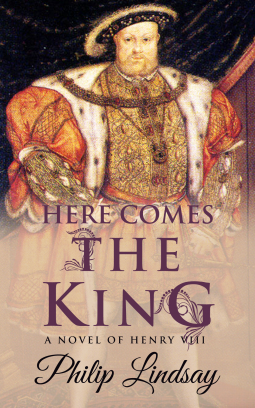
Here Comes the King by Philip Lindsay

Here Comes the King Philip Lindsay (1906-1958) was an Australian author of historical fiction. His books have been out of print in recent years but are now being made available to a modern audience in ebook form by one of my favourite independent publishers, Endeavour Press. Here Comes the King, a 1933 novel about Katherine Howard and Thomas Culpeper, is the first of his books that I’ve read.

Katherine (or Catherine, but I’m sticking to the spelling used in the novel) is a young woman of seventeen or eighteen when she marries Henry VIII at Oatlands Palace and becomes his fifth wife. Her predecessor, Anne of Cleves, has recently been set aside by the king, who believes he was misled as to her appearance. The new queen’s beauty and youthful spirit are much more pleasing to Henry, who calls her his ‘rose without a thorn’. Katherine, though, is less enamoured with her fat, gluttonous, fifty-year-old husband who is suffering from painful leg ulcers and whose moods are becoming increasingly volatile. Although Henry is not generally unkind to her, she is tempted into an affair with the handsome young courtier, Thomas Culpeper – an affair which will lead to both their downfalls.

Here Comes the King is written in the third person from the perspective of several different characters including Culpeper, Henry and Katherine herself, as well as Will Sommers, the king’s fool, Francis Dereham, another man once romantically involved with Katherine, and Jane Boleyn, Lady Rochford, who helps to arrange Katherine’s secret meetings with Culpeper. Jane and Sommers were both in a difficult position, knowing or suspecting what was going on and unsure of what to do with that knowledge, and this made them interesting characters to read about.

However, I felt that I didn’t get to know Katherine very well. She is portrayed as a pretty, flirtatious, immature young girl, and while this does seem to be a widely held view of what the real Katherine was like, I would still have preferred her character to be given a little more depth. Even when she was the viewpoint character, I never felt that I really knew what she was thinking. Culpeper’s character is better written; he is shown in a negative light, being irresponsible, impulsive and a heavy drinker (and allegedly guilty of both rape and murder, although these things are only briefly mentioned as they happen outside the scope of the novel), but his thoughts and feelings come through strongly.

I am far from being an expert on Katherine’s life and her time as Henry’s queen, so I can’t really comment on Lindsay’s accuracy, but the story did seem to follow quite faithfully the general outlines of Katherine’s and Culpeper’s lives. He incorporates things which are known to be historical fact, such as the text of Katherine’s incriminating letter to Culpeper (complete with grammatical mistakes; she is thought to be the least well educated of Henry’s wives) as well as things which may or may not be true but which have become part of the legends surrounding Katherine: practising laying her head on the block the night before her execution, for example, and declaring that “I die a Queen, but I would rather have died the wife of Culpeper”.

I had no problems with Lindsay’s writing (it’s slightly flowery and over-descriptive in places but otherwise feels surprisingly contemporary for a 1930s book) and I would read more of his work, but I didn’t find this particular novel very compelling, maybe because it’s so romance-centred. Admittedly, it would be difficult to write a book about Katherine Howard and not focus on her love affairs; as she spent such a short period as queen and died so young, she left less of a legacy than some of Henry’s other wives, and I think this is why her story has never appealed to me very much. Maybe one of Lindsay’s other novels would interest me more than this one did.

I received a copy of this book for review via NetGalley.

The Viper of Milan by Marjorie Bowen

Marjorie Bowen was a new discovery for me towards the end of last year. Born Margaret Gabrielle Vere Campbell, she wrote more than one hundred and fifty books under several pseudonyms, covering a variety of genres from historical fiction and romance to supernatural horror, crime fiction and biography. Having enjoyed Dickon, her fictional account of the life of Richard III, I decided not to wait too long to try another of her books.

The Viper of Milan The Viper of Milan, originally published in 1906, was Bowen’s first novel and a favourite book of the author Graham Greene. This reissue by Endeavour Press includes an introduction by Greene (I recommend reading it at the end to avoid spoilers) in which he explains how Bowen influenced his own early attempts at writing. The Viper of Milan, he says, taught him that human nature is “not black and white but black and grey”.

The novel is set in Lombardy in the middle of the 14th century and follows a battle for power between Gian Galeazzo Maria Visconti, Duke of Milan, and Mastino della Scala, Duke of Verona. As the story opens, in 1360, Visconti is busy expanding his territories and forging alliances; he has forced della Scala out of Verona and taken his wife, Isotta d’Este of Ferrara, as a hostage. It seems that nobody can stop Visconti in his relentless conquest of northern Italy – nobody apart from della Scala, who vows to regain his lost lands and release Isotta from captivity.

Meanwhile, Visconti’s sister Valentine has problems of her own: her brother has arranged a marriage for her with the Duke of Orleans, while the man she really loves has been imprisoned in a deserted villa outside the city and is slowly starving to death. Another young lady, Graziosa, who lives with her artist father by the western gate of Milan, is also in love – but is her lover really as he seems?

As you can probably tell from my summary of the plot, The Viper of Milan is a dark tale of treachery, trickery and betrayal. I was amazed to learn that Marjorie Bowen was only sixteen years old when she wrote it. Apparently it was rejected by several publishers who considered it an inappropriate novel for such a young woman to have written. What interests me more than the darkness of the story, though, is – as Graham Greene said – Bowen’s view of the ambiguities of human nature. The Duke of Milan, a clever, patient and shrewd man, is also a cruel and brutal one, ruling through fear and violence. In contrast, the Duke of Verona is honest, honourable and trusting, inspiring respect and admiration in those who follow him. It’s only when he discovers that doing the right thing doesn’t always pay that he begins to wonder whether it’s worth continuing to stick to his morals.

After reading Dickon, I thought I had an idea of what to expect from Bowen’s writing, but I found The Viper of Milan to be very different in style and tone. The archaic language which felt slightly unnatural in Dickon suited this book perfectly, with its more melodramatic and gothic feel. This is an ideal read for people who, like myself, enjoy reading authors like Alexandre Dumas and Rafael Sabatini (in fact, Sabatini’s Bellarion is a very similar novel, set in the same part of Italy at about the same time).

If you do choose to read this book, I should warn you that the historical background to the story is not particularly accurate. Some of the characters have the names of real historical figures, but the plot is fictional and many of the things that happen have no basis in history. Having said that, the novel does capture perfectly the atmosphere of early Renaissance Italy with its warring city states and is a wonderfully entertaining story in its own right. There are some beautifully written descriptions of the Lombardy region too. If this sounds like your sort of book, then I would highly recommend The Viper of Milan. If not, Marjorie Bowen does seem to have been a very versatile author, so maybe one of her other books would be of more interest. I will be reading more of them, so I’ll let you know what I discover!

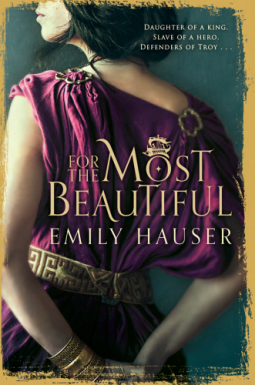
For the Most Beautiful by Emily Hauser

For the Most Beautiful “For the most beautiful”. These are the words inscribed on a golden apple presented by Paris, Prince of Troy, to the goddess Aphrodite whom he has chosen over her rivals, Hera and Athena. In return, the goddess rewards Paris with Helen of Sparta, the most beautiful woman in the world – but unfortunately, Helen is already married. Not surprisingly, her husband, Menelaus, is enraged by the theft of his wife and sends the mighty armies of Greece, led by his brother King Agamemnon, to the shores of Troy to bring her back.

The story of the Trojan War is one that has been told many times before and with which a lot of readers will already be familiar before picking up Emily Hauser’s debut novel, For the Most Beautiful. However, this book retells the story from a feminine perspective and focuses on two female characters – Krisayis and Briseis – who both have important roles to play yet have not been given much attention in other versions such as Homer’s Iliad.

Krisayis (whose name is usually spelled Chryseis) is the daughter of a Trojan priest and companion to Cassandra, a princess of Troy. As the novel begins, we learn that Krisayis is in love with Cassandra’s brother, Troilus, and that, much against her wishes, she is about to become a priestess devoted to the god Apulunas. Our other main character, Briseis, is a princess of Lyrnessus who has unexpectedly found love with her husband Mynes, despite growing up under the shadow of a prophecy which seemed to rule out the possibility of happiness. With the onset of war, the lives of both young women are thrown into turmoil; their paths cross while held captive in the Greek camp, but will they be able to change fate and save Troy?

I found For the Most Beautiful a very enjoyable read. I think it was probably aimed at a younger audience but there was enough depth to keep an adult reader happy too. Having only read two or three other novels about Troy (including Madeline Miller’s The Song of Achilles and Judith Starkston’s Hand of Fire) I found that while I knew the basic outline of the story, a lot of it was new to me and the approach the author took made it feel fresh and original. It was interesting to see how Emily Hauser interpreted the characters of not just Krisayis and Briseis but also Achilles, Patroclus, Paris, Hector, Cassandra and others.

The stories of our two heroines unfold in alternating chapters and I thought these sections of the book were well written and emotionally engaging (both Briseis and Krisayis suffer the death of a loved one and then face further ordeals and difficult decisions after their capture by the Greeks). However, these chapters are interspersed with short scenes in which we witness the gods on their mountain observing and manipulating the lives of the mortals below – and this is the one aspect of the book which really didn’t work for me. The writing style in these sections is quite different – the language feels much more modern and the tense changes from past to present – and the gods come across as bored, shallow and petulant. I think I can see what the author was trying to do here and I’m sure other readers will enjoy the light-hearted, comedy feel of these scenes, but it just made me impatient to get back to Briseis and Krisayis!

After finishing this book, I was pleased to discover that it’s the start of a new Golden Apple trilogy. Greek mythology is not a subject that particularly interests me, but I was still captivated by For the Most Beautiful and am looking forward to reading another two books by Emily Hauser.

I received a copy of this book from NetGalley for review.

The Queen’s Choice by Anne O’Brien

Some queens of England are much better known and have been written about much more often than others; I think it’s fair to say that Joanna of Navarre is not one of them.  As Henry IV’s second wife, Joanna (or Joan as she is sometimes known), doesn’t seem to get a lot of attention as far as historical fiction is concerned.  Anne O’Brien’s new novel, The Queen’s Choice, is the first book I’ve read with Joanna as the main character.

As the novel opens in 1396, Joanna is the wife of John, Duke of Brittany.  While she doesn’t love her husband, who is much older than herself, they have had several children together and their marriage is not an unhappy one.  To the court of Brittany comes Henry Bolingbroke, having been banished from England by his cousin Richard II, and Joanna is given a brief taste of the love and passion which has so far been missing from her life.

Three years later, things have changed.  Henry has returned to England, taken the crown from Richard and imprisoned him in Pontefract Castle, while Joanna herself is now a widow and acting as regent of Brittany on behalf of her young son.  When Henry sends one of his men, Thomas de Camoys, to approach Joanna about the possibility of a marriage alliance, she must make the difficult decision to leave her sons and her regency behind and come to England as Henry’s queen.

I won’t say much more about the plot, because I’m sure future readers will prefer to watch the rest of Joanna’s story unfold for themselves.  What I will say is that the marriage between Joanna and Henry takes place fairly early in the novel; after this, the focus is on their attempts to make their relationship work – which is not always an easy task!  Although their marriage is portrayed as a love match (it seems that there could be some historical evidence to support this), they are both proud people and a lack of communication sometimes causes misunderstandings.  After Henry’s death in 1413, Joanna’s life takes a more dramatic turn during the reign of her stepson, Henry V.

I knew almost nothing about Joanna of Navarre before reading this book, but what little I did know was negative.  It seems that she was greatly disliked by the English people because of her strong connections with France and Brittany at a time when hostilities between England and France were ever present.  Her unpopularity and how she felt about it is covered in the novel – and sometimes her pride and unwillingness to take advice are frustrating – but Joanna is also given lots of good qualities and I liked her overall.  There were times when I felt she reacted to certain situations in the way I would expect a modern day woman to react rather than a medieval one, but otherwise I thought she was a believable and strongly drawn character.

I may have had very little prior knowledge of Joanna, but I didn’t know much about Henry IV either and it was good to have the opportunity to learn more about him from this book.  Henry only ruled England for fourteen years but his reign was an unsettled one: as well as the threat from overseas, he faced rebellions in Wales and in Northumberland, and rumours surrounding the death of his cousin Richard II, said to have been starved to death in captivity.  Although The Queen’s Choice is set several decades before the conflict we know as the Wars of the Roses, we can see how it has its beginnings here, with tensions between rival branches of the family of the late King Edward III (Henry’s claim to the throne coming through the Lancaster line).

This is the third book I’ve read by O’Brien – the other two are The Forbidden Queen (the story of Katherine of Valois) and The King’s Sister (Elizabeth of Lancaster) – and I have enjoyed them all.  I’ll look forward to finding out who will be the subject of her next novel.

I received a copy of this book from the publisher via NetGalley for review.

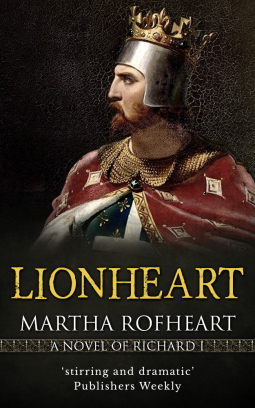
Lionheart by Martha Rofheart

Lionheart Martha Rofheart (1917-1990) was an American author of historical fiction who wrote several novels on subjects as diverse as Cleopatra (The Alexandrian), Henry V (Fortune Made His Sword) and the Greek poet, Sappho (Burning Sappho). Lionheart, her 1981 novel on England’s King Richard I, is the first of her books that I’ve read and although I had one or two problems with it, I did enjoy it and am looking forward to trying her others.

The story of Richard I, known as the Lionheart, is told from the perspectives of not only Richard himself, but five other people who each played a significant role in his life: his mistress, Blondelza; his mercenary captain, Mercadier; his mother, Eleanor of Aquitaine; his wife, Berengaria of Navarre; and his foster-brother and scribe, Alexander. All of these people really existed, apart from Blondelza, who is fictitious, and each of them is given their own section of the book in which to relate their own version of events and to share with us their personal opinion of Richard as a man and as a king.

With six different characters each telling their side of the story, I would have liked their narrative voices to have sounded more distinctive, but they did all seem to blend together, the exceptions being Richard (a child during most of the first section of the novel), and his mother, Eleanor. I have read about Eleanor and Richard recently, in Elizabeth Chadwick’s The Winter Crown, and it was good to read another author’s interpretation of the same characters. The portrayal of Richard here is balanced and well-developed, with each narrator throwing more light on a different aspect of his personality. He is shown to be a complex man, capable of being selfish and inconsiderate, but also courageous, kind-hearted and down to earth.

I’m not sure how I feel about the character of Blondelza, Richard’s mistress. As most of the other characters are real historical figures and the plot of the novel closely follows historical fact, it doesn’t seem quite right for an entirely fictional character to be given such a prominent role in the story. On the other hand, Richard did have an illegitimate son (Philip of Cognac) by an unidentified woman, so there’s plenty of scope there for an author to fill in the gaps, which is just what Martha Rofheart has done. And Blondelza, being a glee-maiden (a female poet or minstrel), is an interesting character to read about, fictional or not!

All of the major events of Richard’s life and reign are covered in the novel, from his childhood and his rebellion (with his brothers) against his father, Henry II, to his meeting with and marriage to Berengaria and, of course, his time on crusade. Obviously the crusades were of huge importance to Richard and it’s understandable that Rofheart goes into a lot of detail in describing them, but I did find that this section of the book (narrated by the monk Alexander) really started to drag, and it didn’t help that it was twice the length of any of the other sections.

Still, this was an enjoyable novel overall and I feel that I learned a lot about not only the life of Richard the Lionheart, but also medieval life in general. I was particularly intrigued by the descriptions of the Courts of Love in Poitiers and the tasks which must be carried out by a knight who wished to prove his love for his lady. Now that I’ve had my first introduction to Martha Rofheart’s writing I’m definitely planning to read her other books, all of which sound interesting.

Thanks to Endeavour Press for providing a review copy via NetGalley.

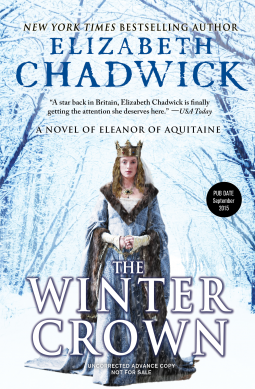
The Winter Crown by Elizabeth Chadwick

The Winter Crown This will be my last post this week, so I’m going to take this opportunity to wish everyone a Merry Christmas! I’ll be back before New Year to tell you about a Christmas-themed read and to share my list of favourite books of 2015, but first here are my thoughts on another recent read – no connection with Christmas, but at least it does have ‘winter’ in the title.

The Winter Crown is the second of Elizabeth Chadwick’s trilogy of novels following the story of Eleanor of Aquitaine. Chadwick uses the alternate spelling Alienor, as she says this is how the name would have been spelled at the time, so I have done the same throughout the rest of this post. The first book in the trilogy, The Summer Queen, covered Alienor’s early years and her marriage to King Louis VII of France. Now, in The Winter Crown, we move on to the next stage in Alienor’s life.

The novel opens in December 1154 when, having had her first marriage annulled, Alienor is crowned Queen of England alongside her second husband, Henry II. As Duchess of Aquitaine in her own right, Alienor has brought Henry wealth, lands and influence – but he has made it clear that he has no plans to allow her to govern her own lands. What Henry wants is a wife who will concentrate on providing and raising children, who will turn a blind eye to his many mistresses and who will keep her opinions to herself. Alienor, though, has other ideas and a marriage that began with so much promise and a certain amount of chemistry, if not love, descends into a series of disappointments and disagreements.

The deterioration of Alienor’s relationship with the king forms a large part of the novel, but so do her relationships with her sons – Henry the ‘Young King’, Geoffrey, Duke of Britanny, and John, the youngest – and her daughters, Matilda, Alie (Alienor) and Joanna. The other son who I haven’t mentioned, of course, is Richard (the future Richard the Lionheart). Alienor makes no secret of the fact that Richard, the heir to her own lands of Aquitaine, is her favourite child, and he is the one whose character is developed most fully in this novel.

For the first half of the novel, Alienor seems to be involved in a constant cycle of pregnancies and births, but that doesn’t mean the story was boring at all. As well as the tensions that are building in Alienor and Henry’s marriage (which get worse when she learns of his new mistress, Rosamund de Clifford), a lot of time is also devoted to Henry’s feud with his chancellor, Thomas Becket. When Henry – against Alienor’s advice – makes Becket Archbishop of Canterbury, he finds that Becket now possesses power which could be used against him instead of for him. The second half of the novel is equally full of conflict, as Henry discovers that his sons are prepared to rise against him in rebellion – and Alienor is forced to take sides.

I have read a few different fictional portrayals of Alienor/Eleanor and I really like the way Elizabeth Chadwick has chosen to portray the character. The Alienor of The Winter Crown is a strong, intelligent woman, keen to play a role in the governance of Aquitaine and England, but restricted due to her gender and the reluctance of her husband to involve her in his decision-making. I was interested to read Chadwick’s author’s note at the end in which she explains why she disagrees with the popular description of Alienor as a powerful medieval woman.

There are plenty of other characters worth mentioning too. Chadwick’s novels often feature a strong female friendship and in this book we meet Isabel de Warenne, wife of William of Blois (son of the late King Stephen of England), who becomes a trusted friend of Alienor’s after being taken into her household. Isabel, and Henry II’s half-brother Hamelin, were two of my favourite characters in the novel: two people who are close to the King and Queen but who don’t always agree with their actions. And readers of Chadwick’s The Greatest Knight will be pleased to know that William Marshal also appears in this novel, as a young man who is brought into Alienor’s service to train her sons in fighting and swordplay. I’m sure we’ll be seeing more of William in the next book.

I am thoroughly enjoying this trilogy so far and am looking forward to reading the final Alienor novel, The Autumn Throne, which should be available next year.

Thanks to Sourcebooks for providing a review copy via NetGalley.

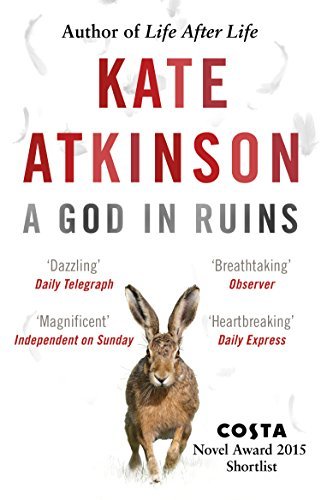
A God in Ruins by Kate Atkinson

A God in Ruins It’s been nearly three years since I read my first Kate Atkinson novel, Life After Life, in which Ursula Todd lives her life over and over again, each new life giving her a chance to alter decisions and mistakes made in the one before. Since then I’ve been catching up with Atkinson’s Jackson Brodie mystery series (I only have one of those left to read) but last week I decided it was time to pick up her latest novel, A God in Ruins, and reacquaint myself with the Todd family.

A God in Ruins is not exactly a sequel to Life After Life – it can be better described as a ‘companion novel’ – and both do stand alone. There are some similarities between the two novels, but there’s also a big difference. While Life After Life follows several different versions of the same person’s life, A God in Ruins concentrates on someone who lives just one life: his name is Teddy Todd and he is Ursula’s younger brother.

Teddy’s story is told in non-chronological order, so that a chapter about his childhood is followed by one set towards the end of his life and then another describing his time as a World War II bomber pilot (there are several wartime chapters interspersed throughout the novel). We also get to know Teddy’s wife, Nancy (who was literally the ‘girl next door’), their daughter, Viola, and grandchildren, Sunny and Bertie. The stories of each of these people unfold gradually, chapter by chapter, and the non-linear timeline means that we are sometimes given hints of something that has happened in the past or will happen in the future but have to wait until later in the book for a revelation. Flashbacks and ‘flashforwards’ often happen in the middle of a paragraph or even a sentence, which I found intriguing rather than confusing.

I enjoyed A God in Ruins but didn’t love it as much as I loved Life After Life, maybe because it felt less innovative without the device of one person living many different lives. Still, many of the same themes are here: life and death, fate and the ways in which our actions in the present can have big consequences in the future, and, of course, the effects of war. I mentioned that there are several chapters on Teddy’s experiences piloting a Halifax bomber during the war. I didn’t initially find these sections very engaging (in the words of Nancy, Teddy’s wife, “Let’s talk about something more interesting than the mechanics of bombing”), but eventually I was drawn in and started to enjoy those chapters as much as the others.

My favourite thing about Kate Atkinson’s writing is the way she creates characters who feel so real and believable – even if some of them are not easy to like, they are still interesting and fully developed. Viola, for example, is a cold and bitter person, unable to offer her children any love and affection, and as her father grows older, resenting every minute of the time she has to spend caring for him. At first it seems that there is no reason for Viola’s selfish behaviour, but later in the novel we learn of something that happened in her childhood that could provide an explanation.

I also liked all the little literary references Atkinson slipped into the story. I was particularly pleased to see that Teddy was an Anthony Trollope reader! As for the ending of the book, I think it’s probably best if I say nothing at all – other than that it’s one of those endings people will either love or hate. Personally, I thought it was perfect; it changed the way I felt about the entire book and left me with a lot to think about, which is what all good novels should do.