Isabella by Colin Falconer

Isabella Isabella is only twelve years old when she comes to England as the wife of King Edward II. As the daughter of Philip IV of France, Isabella is no stranger to life at court and with her father’s parting words still fresh in her mind (“You will love this man. Do you understand? You will love him, serve him, and obey him in all things. This is your duty to me and to France…”) she knows what is expected of her. Nothing could have prepared her, however, for marriage to a man who cares more for his beloved friend, Piers Gaveston, than he does for his young wife, his reputation and his country.

As Isabella grows older she begins to fall in love with Edward, but when Gaveston is executed in 1312 and another favourite, Hugh Despenser, takes his place in the king’s life, she is forced to accept that her love will never be returned. Despenser repeatedly comes between Isabella and her husband, and eventually she finds herself with a choice to make: should she remain loyal to Edward or should she join forces with one of his noblemen, Roger Mortimer, in an attempt to remove him from his throne?

This fictional account of Isabella’s life is the first book I’ve read by Colin Falconer. I was vaguely aware of his name but knew nothing about any of his books or what I could expect from them, so I was pleased to find Isabella available on NetGalley. I have read about Isabella before (in the Edward II section of The Plantagenets by Dan Jones and in fictional form in Maurice Druon’s Accursed Kings series) and she seemed a fascinating woman, so I was looking forward to reading more.

I have to admit, I wasn’t very impressed with this book at the beginning. The combination of third person present tense, simple sentence structure and very short chapters wasn’t very appealing at all. I kept reading, though, and after a while either the writing improved or I got used to the style – I’m not sure which – and the story did start to become more gripping.

With the novel being written from Isabella’s perspective, she is the character we naturally sympathise with. While we can see that Edward truly loves Piers Gaveston, we can also share Isabella’s humiliation at the lack of respect he shows his wife and her frustration at his inability to rule the country effectively while Piers is around. Things become worse for Isabella when Hugh Despenser takes Gaveston’s place and she eventually begins an affair with Roger Mortimer. I was not convinced by Falconer’s portrayal of Isabella and Mortimer’s relationship, however; there was no chemistry between the two characters and Mortimer himself never came to life on the page.

Isabella is a very quick read and a light one, although not quite as light as I thought it would be at first. It would probably be a good introduction to Isabella’s life if you’ve never read anything about her before, as it does seem to follow the historical facts very closely; it was only the style of the writing that I had a problem with. I was sorry, though, that the novel doesn’t span the whole of Isabella’s life – only her marriage to Edward and the Mortimer rebellion are covered, with nothing of her later years or the reign of her son, Edward III. I was left wanting to know more about some of the people and events mentioned in the novel and am now reading She-Wolves by Helen Castor, a non-fiction book which explores the lives of several medieval queens, including Isabella.

I received a copy of Isabella for review via NetGalley.

The Vicomte de Bragelonne by Alexandre Dumas

The Vicomte de Bragelonne This is the third Dumas novel to feature d’Artagnan and his three friends, Athos, Porthos and Aramis. Originally published in serial form as part of a much longer book, it is now usually split into three volumes of which The Vicomte de Bragelonne is the first and Louise de la Vallière and The Man in the Iron Mask are the others. As Dumas is one of my favourite authors I was fully expecting to love this book – and I did, although it was not quite as satisfying as the first two d’Artagnan novels – The Three Musketeers and Twenty Years After.

The first thing to say about The Vicomte de Bragelonne is that it is not really about the Vicomte de Bragelonne! He does appear near the beginning and again near the end, but his role in the story is not really any more significant than any number of other characters. The next thing I should say is that any reader hoping to find the four friends working together again in the spirit of “all for one and one for all” will be disappointed; we do see quite a lot of Athos, but Porthos and Aramis only come into the story very briefly towards the end.

So, what is this book about, then? Well, possibly because this is only one section of a longer work, it’s difficult to give a summary of the plot. The first half of the novel concentrates mainly on d’Artagnan and Athos who are working on two separate schemes both designed to restore Charles II to the throne of England. History tells us that the restoration would be accomplished – though not quite in the way described in this book, which is much more fun than what actually happened!

Later in the book we learn that Aramis and Porthos seem to be helping the Superintendent of Finances, Monsieur Fouquet, to build fortifications on the island of Belle-Île. We don’t find out exactly what they are up to, however, and this part of the story is left shrouded in mystery, presumably to be developed in the next two novels. Finally, there’s the storyline involving the title character, Raoul (the Vicomte), and his love for Louise de la Vallière.

The gaps between these three subplots are filled with lots of chapters detailing the political situation in France in the 1660s (particularly the death of Cardinal Mazarin and the rivalry between Fouquet and Louis XIV’s new Minister of Finance, Colbert) and the romantic intrigues of the French court (revolving around the King’s marriage and also his brother’s marriage to Charles II’s sister, Henrietta). All of this makes The Vicomte de Bragelonne a heavier, slower read than the previous two novels, but I didn’t find it boring at all – I love the way Dumas writes and I love French history, so I didn’t really mind the fact that there was less swashbuckling action and that we don’t see as much of d’Artagnan’s friends.

Of course, where history (or even geography) is concerned it can’t always be assumed that everything in a Dumas novel is completely accurate. I was amazed to find that in Dumas’ world the city of Newcastle had suddenly been transported from the River Tyne to the banks of the River Tweed sixty miles to the north! Dumas also tends to change dates or rearrange the sequence of events whenever the story calls for it as well, though I’m sure I wouldn’t have even noticed most of these alterations if I hadn’t been referring to the notes at the back of the book. I’m pleased to say, by the way, that the notes in the Oxford World’s Classics edition didn’t spoil any of the story – although I avoided the introduction just in case.

As The Vicomte de Bragelonne doesn’t stand alone as a complete novel and wasn’t originally intended to, there are a lot of things left unresolved at the end of the book, as you would expect. I’m looking forward to continuing the story soon with Louise de la Vallière!

Imperium by Robert Harris

“To be ignorant of what occurred before you were born is to remain always a child. For what is the worth of human life, unless it is woven into the life of our ancestors by the records of history?”

These are the words of the Roman statesman, orator, philosopher and lawyer Marcus Tullius Cicero, a man who lived many centuries before I was born and of whom, thanks to Robert Harris, I am no longer ignorant. I had heard of Cicero, of course, but knew very little about his work and nothing at all about his personal life. Now that I’ve read Imperium, the first in a trilogy of novels narrated by Cicero’s slave and secretary, Tiro, I know much more about both.

Imperium Tiro, like Cicero, really existed and is thought to have written a biography of his master which was unfortunately lost during the fall of the Roman Empire. Imperium is a fictional recreation of the first part of Tiro’s biography and follows Cicero from his humble beginnings as he progresses up the ladder of Roman politics and pursues his ambition of becoming one of Rome’s two Consuls.

As a ‘new man’ – in other words, the first in his family to be elected to the Roman Senate – Cicero’s incredible rise to power is a result of hard work, intelligence and natural ability. He is able to put these skills to good use in his position as lawyer, as we see in the first half of the book when he agrees to prosecute Gaius Verres, the governor of Sicily, who has the support of Rome’s aristocracy despite being accused of corruption. The court case is a victory for Cicero but the drawback of this is that he has made enemies of the aristocrats, who will do whatever they can to prevent him rising any further…

As I’ve mentioned before, Ancient Rome has never been one of my favourite periods to read about, so a few months ago I compiled a list of books that I hoped would change the way I feel about Roman history. Imperium is the first novel I’ve selected from that list and it was a fantastic choice. I’d had high hopes for it anyway, because another book by Robert Harris, An Officer and a Spy, was one of my favourite reads of last year, but I enjoyed this one even more than I’d hoped! A book about Roman politics may sound boring, but I can assure you it’s not. Harris is an author of thrillers as well as historical fiction and this is an exciting, entertaining read, not just an educational one. The trial of Verres is as gripping as anything I’ve read and there are more tense moments later in the book, such as when Cicero sends Tiro to spy on a secret meeting of rival senators.

The characterisation of Cicero is wonderful. Seen through the eyes of Tiro, I felt that there was a slight distance between Cicero and the reader at first, but as the story went on I started to like and admire him more and more, especially during his investigations of Verres, when he conducted himself with so much honesty and integrity. It’s not long before some flaws start to appear – as he sets his sights on the positions of aedile, praetor and finally consul, we see him beginning to sacrifice some of his principles for the sake of ambition – but this just makes him more human. Tiro himself is the perfect choice of narrator – someone who is happy to get on with telling the story without intruding into it too much. As the inventor of one of the earliest forms of shorthand he becomes indispensable to Cicero so it’s quite believable that he accompanies Cicero almost everywhere, taking notes and recording conversations.

Cicero was known as a great orator and Harris really captures the power of some of his speeches in the senate and the court. Many of his letters, writings and transcripts of speeches are still available which means Harris would have been able to draw on those to put words into the fictional Cicero’s mouth. While I don’t have enough knowledge to be able to comment on the historical accuracy of the novel, there’s nothing that feels noticeably inaccurate – as he says in his author’s note, the things in this story either really happened, could have happened, or didn’t definitely not happen.

There’s still so much I would like to say about Imperium, but this post is already becoming very long so I will just quickly mention a few other things I liked: the portrayal of other famous Roman figures of the time, particularly Julius Caesar and Pompey the Great; the details of Cicero’s family life and his relationship with his wife, Terentia; the descriptions of how the Roman legal and political systems worked, especially the complex voting methods that led to high levels of corruption during elections; and the exploration of class differences in Ancient Rome.

Having loved this book so much I’m now looking forward to reading the other two in the trilogy. My copy of Lustrum awaits!

The Lady of Misrule by Suzannah Dunn

The Lady of Misrule Lady Jane Grey, Queen of England for just nine days in 1553, has been replaced on the throne by Mary Tudor, the eldest daughter of Henry VIII. As Mary establishes herself as Queen and returns the country to Catholic rule, Jane is taken to the Tower of London to await the trial which will determine her fate. Joining her in her imprisonment is Elizabeth Tilney, a ‘good Catholic girl’ who has volunteered to be Jane’s companion, and it is through Elizabeth’s eyes that the story is told.

Elizabeth and Jane are the same age, but that’s all they have in common. Jane is a quiet, serious girl, devoted to her books and her Protestant faith, while Elizabeth has a livelier, more rebellious personality and has had experiences of life that are very different from Jane’s. Being such incompatible people, living together in the confines of the Tower is not always easy, but gradually a bond starts to form between the two girls. History tells us what will eventually happen to Jane but The Lady of Misrule is a fictional account of the time she and Elizabeth spend in captivity wondering what the future holds.

I came away from The Lady of Misrule with a mixture of feelings, some negative and some positive. The negative feelings are mainly due to my own personal taste in historical fiction. Suzannah Dunn writes in a very contemporary style, using modern slang and exploring emotions, motives and relationships in a way that she thinks modern readers will identify with. I thought this style worked quite well in The May Bride, a domestic family story about the early life of Jane Seymour, but it irritated me this time. I do understand that the author writes in this way intentionally (she explains why in the Q&A on her website) and it’s not a result of carelessness or poor research, but I do prefer historical novels to feel more ‘historical’. As I’ve said, this is definitely just something that will depend on each individual reader’s own taste.

There were plenty of positive things I can say about this book, though. I have read other novels about Lady Jane Grey, but I liked the fact that Dunn’s approach is quite different, writing about just a short period of her life and from the perspective of someone who is meeting her for the first time. Although the girls spend most of the novel in captivity, they do still have some contact with the outside world and Elizabeth is able to relate to us some of the events that are unfolding beyond the walls of the Tower, but the focus is always on Elizabeth’s and Jane’s personal lives. Jane keeps herself at a distance which means that Elizabeth, who can be quite naive when it comes to politics and religion, often finds her difficult to understand and maybe because of this Jane is not an easy character to like. But this is as much Elizabeth’s story as it is Jane’s and as the novel progresses we learn more about Elizabeth’s past, her relationship with a much older man and the secrets she is trying to hide.

I also liked the portrayal of Jane’s husband, the seventeen-year-old Guildford Dudley, who is also imprisoned elsewhere in the Tower awaiting his own fate. It seems that the one bright spot in Guildford’s life is having the chance to speak to his wife when they take their daily walks in the Tower gardens, but Jane has little time for her husband and instead he and Elizabeth become friends. Guildford has been shown in a very negative light in other books I’ve read and it’s easy to forget that he was just a young man who, like Jane, had been used and manipulated by people more powerful than himself. It was good to see such a different side of him in this novel!

While I can’t say that I loved The Lady of Misrule, it was still an interesting read at times and I would recommend it to fans of Tudor fiction who are happy with a more contemporary approach.

I received a copy of this book for review via NetGalley.

Dacre’s War by Rosemary Goring

Dacres War It’s 1523 and ten years have passed since the armies of Scotland and England met at the Battle of Flodden, resulting in victory for the English and the death of King James IV of Scotland. With a child king (the young James V) and a regent who spends much of his time in France, Scotland lacks strong leadership and Henry VIII of England is taking advantage by ordering the destruction of Scottish border towns. The man responsible for doing this, as well as for keeping some sort of order in the lawless English and Scottish border lands is Thomas Dacre, Warden General of the English Marches.

Dacre is the most powerful man in the north, but he is also making a lot of enemies…including Adam Crozier, head of one of the leading families on the Scottish side of the border, who discovers that Dacre is to blame for the murder of his father. Crozier vows to take revenge and begins the process of forming alliances with other borderers and collecting evidence that will help to bring about the Warden’s downfall.

Dacre’s War is the sequel to After Flodden, Rosemary Goring’s first novel which describes the 1513 battle and its aftermath. I read After Flodden last year and thought it was a good book but nothing special, so I wasn’t sure whether or not to read this one. I am so glad I did decide to read it, because I loved it! The few criticisms I had of the first book (the confusing timeline and the predictability of the plot) were not problems for me this time; I thought this second book was more exciting, faster paced and just a stronger novel in general. If you have not read After Flodden yet, picking this one up first shouldn’t affect your enjoyment or understanding too much – while some of the characters are the same, it’s set ten years later and is a complete story with a beginning and an end.

About half of the story is told from the perspective of the Croziers and half from the Dacres’, although there are also a few chapters set within the Scottish and English courts. It would be easy just to accept Crozier as our hero and Dacre as our villain, but both characters are more complex than that. By allowing us to get inside Dacre’s head and see his point of view, he becomes a more fully developed character and we come to understand that, like most human beings, he is a mixture of good and bad. As well as Crozier and Dacre, there’s also an interesting cast of supporting characters, some new and some old – it was nice to see Louise and Hob again and I enjoyed watching Benoit Brenier going off and having adventures of his own.

My favourite thing about both Dacre’s War and After Flodden, though, is the setting. I love the way Rosemary Goring portrays life in the borders in the 16th century – the raids and feuds that made it such a dangerous place to live, as well as the natural beauty of the countryside. I will be happy if she revisits the world of the Croziers in a third novel, but if not then I’ll be interested to see what she chooses to write about next.

The Luminaries by Eleanor Catton

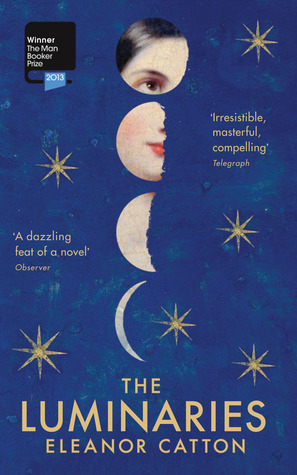
The Luminaries This is the novel that won the Booker Prize in 2013 but despite the hype surrounding it at the time and the fact that it did sound like a book I would enjoy, I have been putting off reading it, mainly because of its length. As well as the Booker Prize, though, it was also nominated for the Walter Scott Prize in 2014 and as I’m slowly working through the shortlists for that particular prize, I decided it was time I read it.

The Luminaries is set in the New Zealand town of Hokitika during the Gold Rush of the 1860s. The story revolves around several strange occurrences which all take place on the same night in January 1866: Emery Staines, one of the town’s richest men disappears without trace; prostitute Anna Wetherell collapses in the street in what is thought to be a suicide attempt; and the reclusive Crosbie Wells is found dead in his own home, surrounded by a large quantity of hidden gold. These things may not seem to be connected at first, but of course they are – as is everything else that happens throughout the 800 pages of this very clever and complex novel.

The first and by far the longest section of the book begins with the arrival of Scottish lawyer, Walter Moody, who is hoping to make his fortune on the goldfields. On his first evening in Hokitika he walks into the Crown Hotel to find that he has interrupted a meeting between twelve men who have gathered to try to make sense of what has been happening. These twelve men are all linked in some way with Emery, Anna, Crosbie or all three – and as Walter listens to their stories he too is drawn into the mystery.

In the sections of the novel that follow – each one half the length of the one before – we move forwards and then backwards in time learning more about each of the main characters and the events leading up to the night of 14th January 1866.

The decreasing length of the chapters corresponds with a waning moon (hinted at by the images on the front cover), one of many astrological elements Eleanor Catton has incorporated into the novel. The character list at the front of the book lists the twelve men who meet in the hotel under the heading ‘Stellar’ and each one is associated with a sign of the Zodiac, while the other characters are listed as ‘Planetary’. Each of the twelve sections of the book begins with an astrological chart and within each section the individual chapters have astrological titles. This was intriguing at first but as I don’t have a lot of interest in astrology it didn’t mean much to me and I quickly gave up trying to interpret it and concentrated on following the story instead.

I have seen lots of comparisons between The Luminaries and the Victorian sensation novels of Wilkie Collins, one of my favourite authors, but I’m not sure if I really agree with that comparison. The book does include lots of elements of the sensation novel (hidden treasure, opium addiction, double identities, séances, forgeries and family secrets) but Eleanor Catton’s writing, in my opinion, lacks the flair and humour of Wilkie Collins’ and the gift for creating strong, unforgettable characters. Apart from one or two, the twelve men of the Crown felt interchangeable and I had to keep looking back at the character list to remind myself which was which. The other eight were slightly stronger (they were the Planetary characters and the ones who tended to drive the story forward) but of these, Anna Wetherell was the only one I really came to care about.

I did enjoy reading The Luminaries, though, and can definitely see why it has been so successful. I was very impressed by the intricate plotting with facts and secrets being slowly unveiled and connections between the characters gradually revealed. I also loved the setting; I have read very few novels set in New Zealand and I certainly haven’t read any set in a New Zealand gold mining town in the 1860s! Because Hokitika is a real place, I could find lots of pictures online which really helped to bring the setting to life. The length of the book wasn’t a problem for me either; the pages seemed to go by much more quickly than I’d expected them to – especially in the second half, where the chapters become shorter and the pace becomes faster.

I know there were a lot of things happening in The Luminaries that I didn’t completely understand (especially all of the allusions to astrology) and lots of little details that I missed. I would probably have to read the book again to be able to fully appreciate it, but for now I’m happy just to have read it once and to have enjoyed it!

The Devil on her Tongue by Linda Holeman

The Devil on her Tongue One day in 1745, a Dutch sailor called Arie ten Brink leaves his home on the Portuguese island of Porto Santo and sets sail for Brazil where he hopes to make his fortune. His thirteen-year-old daughter, Diamantina, is heartbroken; left behind on Porto Santo with her mother, a former African slave, life is not easy and she vows to join her father in Brazil one day.

While she waits for a letter saying that he has reached his destination, Diamantina faces struggles with poverty, her mother’s reputation as a witch, and men who are ready to take advantage of a lonely, vulnerable young woman. Eventually an offer of marriage gives Diamantina a chance to escape, but the marriage is not what she would have hoped for and it seems that her ordeals are not yet over.

I love Linda Holeman’s books (I’ve read all of her adult novels apart from her first one, The Linnet Bird) so it was disappointing to find that The Devil on her Tongue was initially published only in Canada. Luckily for me, Traverse Press have now made it available as an ebook, as they did with the previous one, The Lost Souls of Angelkov, so readers in the UK and US are now able to read it as well.

There are a few things I’ve come to expect from Linda Holeman’s novels; one of them is an interesting and unusual historical setting. I know there must be other books set in 18th century Portugal, but this is the first I’ve read; it’s not a common choice for historical fiction and it made a refreshing change. There are some beautiful descriptions of Porto Santo, and later, of Madeira and Lisbon, and we are given insights into what life was like in each of these places. While the focus is on Diamantina’s personal story, it is played out against a historical background that feels well researched and believable. I particularly loved the vivid depiction of the earthquake that destroyed most of Lisbon in 1755.

Another thing I expect is a long, engrossing and emotional story – and that’s what I got from The Devil on her Tongue. But although Diamantina’s story is certainly very compelling, it’s also very sad; I couldn’t believe one person could experience so much misery and have so little luck in life. I felt so sorry for her but I also admired her resilience as she tried to build a new life for herself in the face of so much betrayal, disappointment and unhappiness. One aspect of Holeman’s novels I really like is the way they explore attitudes towards women in different time periods and cultures – in previous books we have seen how women were treated in 19th century India, Afghanistan and Russia, in 1930s Morocco, and now in a small community in Portugal during the 1700s.

I don’t think this is my favourite of Linda Holeman’s novels (that would probably be the book set in Morocco, The Saffron Gate) but it’s beautifully written and I did enjoy reading it, despite finding the story so sad.

Thank you to Traverse Press for providing a copy of this book for review.