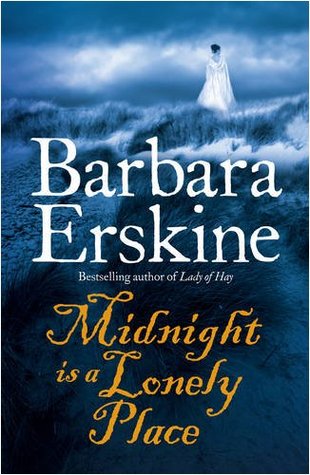
Midnight is a Lonely Place by Barbara Erskine

Midnight is a Lonely Place My first introduction to Barbara Erskine’s work last year, River of Destiny, left me unimpressed but I was assured by Erskine fans that her earlier books were better, so when I found this one at the library I decided to give her another chance. I also thought it sounded like an ideal book to read for the RIP challenge, even though it wasn’t on my original list.

When author Kate Kennedy’s relationship with her boyfriend, Jon, comes to an end and she is forced to move out of their London home, she decides to rent a cottage on the Essex coast where she can spend the winter working on her new biography of Byron. The owners of the cottage, Diana and Roger Lindsey, live in a farmhouse nearby and do their best to make Kate feel welcome, but unfortunately not all the members of the Lindsey family are happy to see her. The eldest son, Greg, an aspiring artist, had been using the cottage for his painting and resents Kate for pushing him out. His fifteen-year-old sister, Alison, is an amateur archaeologist and is furious when she discovers that Kate has been interfering with her dig at what she believes is an ancient Roman grave.

When strange things start to happen at Redall Cottage, Kate suspects Greg and Alison of trying to frighten her away, but after several encounters with ghostly figures she begins to accept that she is being haunted by the ghosts of the Roman soldier Marcus Severus Secundus, his wife Claudia, and the Druid prince, Nion. It seems that Kate has stumbled upon a two thousand-year-old love triangle that ended in a murder and a curse – and secrets that have been buried under the earth for centuries are about to be revealed at last.

Midnight is a Lonely Place was much better than River of Destiny, but still not a book that I can say I loved. I was right about it being a perfect RIP choice, though. It has all the elements of a classic ghost story: a lonely, isolated cottage, an ancient burial site, ghostly apparitions, strange smells and unexplained noises, relentless snow, sleet and blizzards. It’s quite scary in places and you might not want to read it late at night if you’re on your own (while I was finishing the book on Friday evening the real-life weather outside obliged with heavy rain and strong winds which made it even more atmospheric).

While Marcus Severus Secundus, Claudia and Nion do have a strong presence in this novel, the story is set entirely in the early 1990s (which actually feels surprisingly dated from a 2013 perspective) and we only learn about the Roman characters’ lives in brief flashbacks at the start of the chapters. I would have liked their storyline to have been more fully developed as I felt I didn’t get to know them well enough to really care about them or their secrets and this meant that, for me, the novel wasn’t as effective as it would have been with a stronger historical element.

The second half of the book is suspenseful and action packed, as the level of paranormal activity increases and more and more of Kate’s friends and neighbours become involved (at one point it felt as if the whole population of Essex were wandering about getting lost in the snow) but I found the ending disappointingly abrupt. I’m not sure I correctly interpreted the final page and after reading what was quite a long book (more than 400 pages) I had expected a more satisfying conclusion. I certainly enjoyed this book a lot more than River of Destiny but I’m not sure I’ll be looking for any more of Barbara Erskine’s books – though I might still be interested in reading Lady of Hay, her first and best known book.

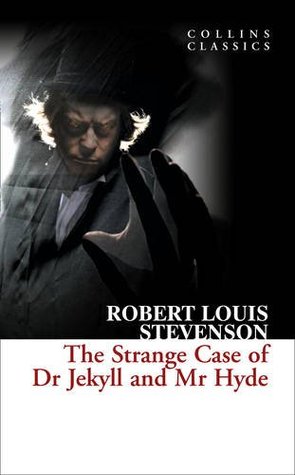
The Strange Case of Dr Jekyll and Mr Hyde by Robert Louis Stevenson

The problem with reading The Strange Case of Dr Jekyll and Mr Hyde in the 21st century is that most of us probably already know what the story involves. Even without having read it or seen any of the film versions, everyone knows what is meant by a ‘Jekyll and Hyde personality’. And this completely takes away the suspense and air of mystery that the story relies on so heavily. I’m sure the original Victorian readership would have found the connection between Dr Jekyll and Mr Hyde much more shocking! So is there still any point in reading it? Yes, I thought there was, because although I knew what the ultimate revelation would be, I didn’t know all the details of the plot or how the conclusion would be reached.

We first see Dr Henry Jekyll and Edward Hyde through the eyes of Jekyll’s friend and lawyer, Mr Utterson, who becomes concerned when he discovers that Jekyll has made a new will leaving everything to Mr Hyde. All Mr Utterson knows about Hyde is that he’s a sinister and brutal man responsible for some cruel and unprovoked acts of violence. The first half of the book follows the lawyer’s attempts to learn more about Hyde and his relationship with Jekyll. It’s only as we approach the end of the story that we hear from Dr Jekyll himself, in the form of a letter addressed to Mr Utterson, and the truth is finally revealed.

The story is cleverly structured so that if you had no idea what was coming, you would be kept wondering, knowing only as much as Mr Utterson knows, and it’s disappointing that for most modern readers the surprise has been spoiled. The part of the story I found the most interesting was the final chapter, after the secret has been uncovered and Jekyll gives his own explanation of what happened and his views on the good and the evil aspects of human nature. We can really feel his desperation as his own dark side grows stronger and things begin to spiral out of his control.

The edition I read contained just the novella The Strange Case of Dr Jekyll and Mr Hyde; other editions include a selection of other Stevenson short stories. Jekyll and Hyde on its own was only 88 pages long and if I’d realised how short it was I would have made time to read it earlier. This was one of my choices for RIP VII, and I would recommend it to other RIP participants who would like to read an important piece of classic Victorian fiction without committing to a full-length novel. I can’t say that I loved it and it’s not something I would want to read again, but I’m glad I’ve read it once and can see why it has become a part of popular culture.

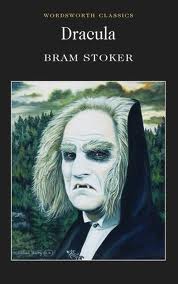
Review: Dracula by Bram Stoker

“My friend. – Welcome to the Carpathians. I am anxiously expecting you.”

When Jonathan Harker travels to Count Dracula’s castle in Transylvania to advise the Count on the subject of buying property in England, he quickly becomes aware that there’s something not quite normal about his host – and after making some terrifying discoveries, he finds himself imprisoned in the castle. Back in England, Harker’s fiancée Mina Murray is anxiously waiting in Whitby for news of Jonathan. But as if she didn’t already have enough to worry about, her friend Lucy Westenra becomes mysteriously ill, with inexplicable puncture wounds on her throat. Could Lucy’s illness have anything to do with the ship that was recently swept into the harbour during a storm?

Interspersed with the main storyline are Dr Seward’s medical notes on one of his patients, a man called Renfield who likes to eat flies and spiders – but what is the connection between Renfield, Lucy and Dracula? Dr Seward brings in his friend Van Helsing, an expert in unusual diseases, and with the help of Mina, Jonathan, Lucy’s fiance Arthur Holmwood and a friend, Quincey Morris, they attempt to solve the mystery and defeat Dracula.

Dracula was an obvious choice for me for the RIP challenge, particularly as it’s one of those books I feel as if I should have read years ago, yet never have (apart from a children’s version which doesn’t really count as it was so heavily abridged). Yet even though I had never read it, a lot of the story was familiar as it has become so firmly entrenched in popular culture. Dracula is not the first vampire story (a few weeks ago I wrote about John Polidori’s The Vampyre and Byron’s Fragment of a Novel) but it’s definitely the most famous.

The book is written in an epistolary style with the entire story being told through letters, journal entries, telegrams and newspaper reports. This structure kept the story moving forward and it was interesting to see so many different perspectives, but I did feel that some of the entries were too short and the story kept switching too abruptly from one person’s journal to another. I would have liked to have spent longer with one character before switching to the next. Some of the ‘voices’ were very similar, but I really liked the character of Mina, who was a strong, sensible, intelligent woman and although she was subjected to the usual Victorian attitudes of the time, she played an important role in the story. In comparison, Lucy is more of a typical Victorian heroine.

The opening section in Transylvania was my favourite part of the book. I loved the atmosphere Stoker created, with the snow falling and the wolves howling.

Though we were in shelter, we could hear the rising wind, for it moaned and whistled through the rocks, and the branches of the trees crashed together as we swept along. It grew colder and colder still, and fine, powdery snow began to fall, so that soon we and all around us were covered with a white blanket. The keen wind still carried the howling of the dogs, though this grew fainter as we went on our way. The baying of the wolves sounded nearer and nearer, as though they were closing round on us from every side. I grew dreadfully afraid, and the horses shared my fear.

When the story moved from Transylvania to Whitby, the pace slowed down and I started to get bored. I did enjoy all the descriptions of Whitby though, with its harbour and ruined abbey. Whitby is only a couple of hours’ drive from where I live, so we go there a lot, and it’s always nice to read about a place you know well.

I actually didn’t find the book very frightening, though maybe that’s just because I was already so familiar with the story. There were some very creepy scenes though, such as when Harker sees Dracula emerging through a window and crawling headfirst down the castle walls:

I was at first interested and somewhat amused, for it is wonderful how small a matter will interest and amuse a man when he is a prisoner. But my very feelings changed to repulsion and terror when I saw the whole man slowly emerge from the window and begin to crawl down the castle wall over the dreadful abyss, face down with his cloak spreading out around him like great wings…I saw the fingers and toes grasp the corners of the stones, worn clear of the mortar by the stress of years, and by thus using every projection and inequality move downwards with considerable speed, just as a lizard moves along a wall.

I’m glad I finally read Dracula, but it’s not going to become a favourite classic of mine. Although I didn’t love it, I thought it was surprisingly easy to read and the first few chapters were great, so if you have any interest at all in vampire stories or gothic horror novels, I think it’s worth reading at least once.

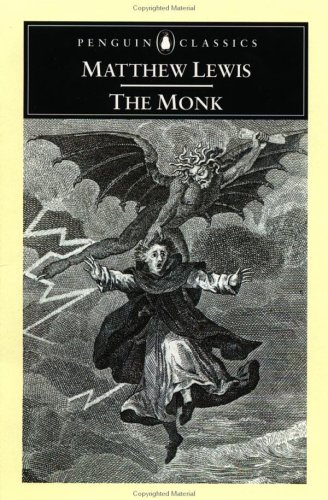
Review: The Monk by Matthew Lewis

The Monk, published in 1796, is an early gothic novel by Matthew Gregory Lewis, which completely dispels the notion that classics are dull and boring! While I wouldn’t say this was an easy read (due to the 18th century writing style and language you do need to concentrate) it was a real pageturner. I actually started to write this review when I was only halfway through the book and I was going to say that although I was enjoying it, I didn’t think it was a great book. Then, as I continued to read, I changed my mind. It is a great book and the best gothic novel I’ve read so far!

The book cover shown above is the Penguin Classics edition of the book. However, my copy of this novel is actually part of a four books-in-one anthology called Four Gothic Novels, which also includes The Castle of Otranto by Horace Walpole, Vathek by William Beckford and Frankenstein by Mary Shelley. I’ve been reading the novels in the order that they appear in the book, but The Monk was the one that I had really been looking forward to reading.

The novel is set in a monastery in Spain, during the time of the Spanish Inquisition. The plot is very complex, but basically there are three main storylines.

The first storyline revolves around Ambrosio, the Monk of the title, who is highly respected within the monastery and attracts large crowds to his sermons. Ambrosio is regarded almost as a saint yet when a beautiful young woman called Matilda tries to seduce him, he is tempted into breaking his vows. After succumbing to this first temptation, Ambrosio goes on to commit one crime after another, each worse than the one before.

We are also given a long account of the adventures of the young Marquis de las Cisternas. When the Marquis rescues a baroness from a gang of bandits, he is invited to accompany her to the Castle Lindenberg in Germany where he meets and falls in love with her niece, Agnes – and learns the legend of the Bleeding Nun. Finally we follow a friend of the Marquis, Lorenzo de Medina, who also happens to be the brother of Agnes. When a young girl from Murcia named Antonia arrives in Madrid, she and Lorenzo fall in love – but things don’t go smoothly for the pair and Antonia soon finds herself in serious danger.

At first it seemed that Agnes and Antonia’s storylines were unrelated to the Ambrosio and Matilda plot, but I soon began to see how cleverly Lewis was weaving the threads of the story together. Ambrosio is a complex character and his downfall was fascinating to read about. Some of my favourite passages were those which gave us an insight into the different facets of his personality.

He pronounced the most severe sentences upon Offenders, which, the moment after, Compassion induced him to mitigate: He undertook the most daring enterprizes, which the fear of their consequences soon obliged him to abandon: His inborn genius darted a brilliant light upon subjects the most obscure; and almost instantaneously his Superstition replunged them in darkness more profound than that from which they had just been rescued…The fact was, that the different sentiments with which Education and Nature had inspired him were combating in his bosom: It remained for his passions, which as yet no opportunity had called into play, to decide the victory.

Some parts of the book are quite gruesome and disturbing, and the passages which describe the sufferings of Agnes and Antonia are horrifying. I thought the final chapter of the book was stunning. There were several different ways the story could have ended, but the ending Lewis chose was absolutely perfect.

This book has almost every element of the gothic novel that you can think of: ghostly apparitions, haunted castles, ancient monasteries, bad weather, fortune telling gypsies, an evil prioress, dark dungeons and shadowy crypts, witchcraft, magic and pacts with the devil. It’s also very daring for the 18th century; with themes of murder, rape, incest, violence and torture, I can see exactly why it was so controversial in its day.

So don’t let the fact that the book was written in the 1700s prevent you from picking it up!

Recommended

If you enjoy this book you might also like The Italian by Ann Radcliffe which I read a few years ago. It’s very similar to this one in both the setting and the atmosphere (and anyone who was put off Radcliffe by the long scenic descriptions in The Mysteries of Udolpho will be pleased to know there are a lot less of those in The Italian).

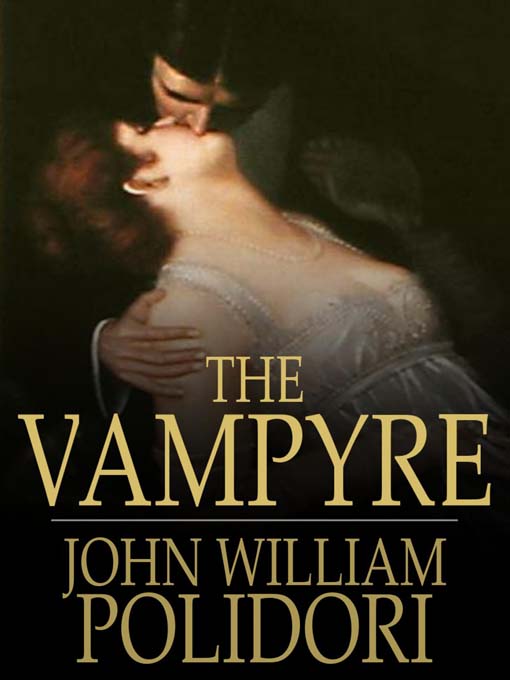
Short Story: The Vampyre by John Polidori

As I’m hoping to read Dracula soon, I thought it might be a good idea to also read one of Bram Stoker’s influences – John Polidori’s The Vampyre. This short story is considered to be one of the first vampire stories in literature and the first to portray a vampire in the way we would recognise today. I have actually been interested in reading this story since I read The Count of Monte Cristo by Alexandre Dumas and was intrigued by the references to the vampire Lord Ruthven. (If you’ve read The Count of Monte Cristo you might remember the scene where the Countess G- is remarking on the Count’s pale skin and nicknames him ‘Lord Ruthven’.)

The origins of The Vampyre are fascinating. John William Polidori was Byron’s personal physician and in 1816, went with him to Switzerland. At the Villa Diodati, on Lake Geneva, Byron and Polidori were joined by the poet Percy Bysshe Shelley, his future wife Mary Wollstonecraft Godwin and her stepsister Claire Clairmont, and decided to amuse themselves by writing horror stories. Mary began work on what would become Frankenstein, and Byron wrote the beginning of a vampire story (which survives today as Fragment of a Novel) based on the various vampire myths and legends. Although Byron abandoned his vampire story, Polidori took inspiration from it and The Vampyre was the result. Unfortunately for Polidori, The Vampyre was wrongly attributed to Byron, despite Byron’s attempts to set the record straight.

As a story, it really isn’t very satisfying. Our narrator is a young Englishman called Aubrey, who travels to Rome with his acquaintance, the nobleman Lord Ruthven. The more time he spends with Ruthven, the more Aubrey begins to distrust him and to realise that Ruthven is not what he seems… The plot is so thin that there’s not much more I can tell you without spoiling it – although really, there’s nothing to spoil as the story is very predictable (for the modern reader anyway – I’m sure it would have been more compelling at the time when it was first published).

The Vampyre is interesting historically because of its portrayal of Lord Ruthven as a mysterious, pale-faced aristocratic figure who preys on innocent young ladies, which is the way many future vampires would be described (the vampires of folklore had generally been described as hideous-looking monsters). If you’re interested in how vampire stories began and how they evolved over the years, this is worth reading. If you’re just looking for a good short story to read, you might be disappointed with this one.

Read The Vampyre online here

Byron’s Fragment of a Novel is also available online and is so short it only takes a few minutes to read. It’s a shame he decided not to continue with this, as I think it had the potential to be much better than The Vampyre. I’ve read a few of Byron’s poems but this is my first experience of his prose and even based on such a short sample of his work I find his writing superior to Polidori’s.

Read Fragment of a Novel online here


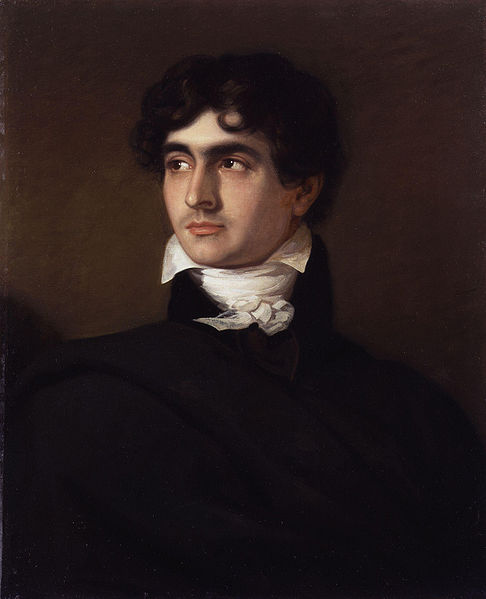
John William Polidori (1795-1821)

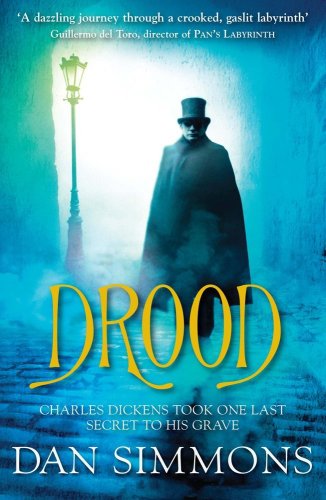
Review: Drood by Dan Simmons

I think I liked the idea of this book more than the book itself. A gothic mystery/horror story set in Victorian London, featuring Charles Dickens and narrated by Wilkie Collins sounded like exactly the kind of book I would enjoy. Unfortunately it didn’t quite live up to its fascinating premise and I was left with mixed feelings about it.

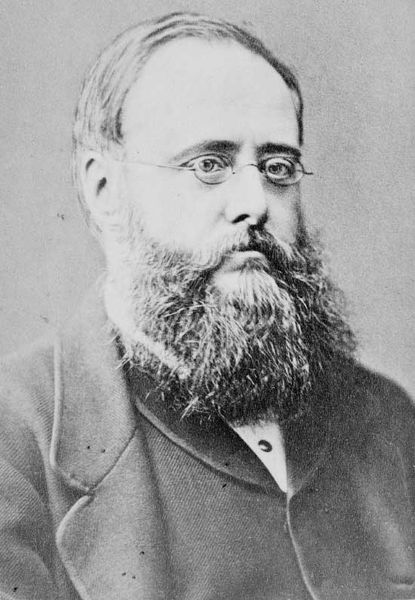
Drood is told in the form of a memoir written by Wilkie Collins (a close friend and collaborator of Charles Dickens, as well as being the author of The Woman in White, The Moonstone and many other novels and plays) and addressed to an unknown reader in the future – that is, to us.

The story begins with the Staplehurst Rail Disaster of 1865, when the train on which Charles Dickens is travelling crashes, sending most of the carriages plummeting over a viaduct into the riverbed below. Luckily Dickens is in one of the few carriages that doesn’t fall. As he helps to rescue people from the wreckage, he encounters a mysterious figure dressed in a black cape who introduces himself only as ‘Drood’. In the days following the train crash, Dickens becomes obsessed with finding Drood and discovering his true identity. With the reluctant help of Wilkie Collins, Dickens begins a search for Drood which leads them through the dark alleys and underground catacombs of London.

Interspersed with the Drood storyline are long passages in which we learn about the family life and living arrangements of both Dickens and Collins, how much they earned for their various novels, their walking tour of Cumberland in 1857, the details of Wilkie’s laudanum addiction, the story of the Swiss chalet given to Dickens by his friend Charles Fechter, Dickens’ interest in mesmerism and every other piece of biographical information you could possibly want to know. Simmons also incorporates some genuine historical letters and quotes which adds some authenticity to the book. I can see why some readers might find this boring, but I enjoyed these sections – I thought the descriptions of Dickens’ reading tours were particularly fascinating.

Simmons has attempted to imitate Wilkie Collins’ narrative style (including the Victorian habit of talking directly to the reader) but I felt that he didn’t get it quite right. He also uses a lot of words and phrases that just sound either too modern or too American to me (the real Collins or Dickens would have walked on the pavement rather than the sidewalk, for example). This is only a small complaint though, as overall, Dear Reader, I thought his style was quite convincing.

I do like the way the book takes us through the process of researching and writing The Moonstone. However, some important plot points are given away so if you haven’t already read The Moonstone and think you might want to, then I would suggest you read it before you begin Drood. It might also be a good idea to read The Mystery of Edwin Drood first (I didn’t and kept wishing I had). Another thing I liked about the book was the way Simmons deliberately tries to confuse and mislead the reader – at several points in the novel we are made to wonder whether something we’ve just read is real or an illusion.

This journey through the cemeteries, opium dens and underground sewers of London is a good atmospheric read for a cold dark night, but I was slightly disappointed by it and despite reading all 775 pages I still can’t decide whether I enjoyed it or not! However, it will almost certainly leave you wanting to learn more about Dickens and Collins and their works, which can only be a good thing. If you like this type of book I would also recommend The Quincunx by Charles Palliser – another book set in Victorian England and written in a 19th century style.

Before I come to the end of this review I would just like to say a few words in defence of poor Wilkie Collins, who happens to be one of my favourite authors. Simmons clearly doesn’t rate Wilkie as a writer (I saw an interview where he described him as ‘mediocre’) and in Drood, the character is portrayed as a not very talented, second-rate author who is consumed with jealousy of the more successful Dickens and becomes increasingly bitter and unlikeable as the book goes on. I admit I’m biased because I’ve absolutely loved every Wilkie Collins book I’ve read; he was a much better writer than Drood suggests and definitely not mediocre, at least in my opinion!

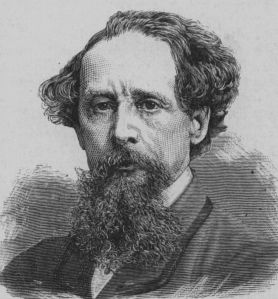
*Pictures of Charles Dickens (top) and Wilkie Collins (bottom) both in the public domain

Genre: Historical Fiction/Horror/Pages: 775/Publisher: Quercus Fiction/Year: 2009/Source: My own copy bought new