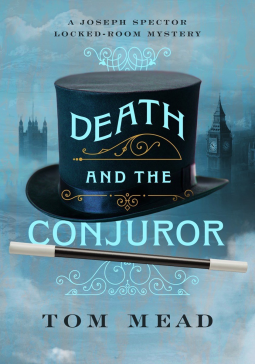
Death and the Conjuror by Tom Mead

Death and the Conjuror is a homage to the great locked room mysteries of the Golden Age and a clever and entertaining novel in its own right. I’m hoping it’s the first in a series as I would love to see more books like this from Tom Mead.

The novel is set in London in the 1930s where the renowned psychiatrist Anselm Rees has been found dead in his study. The door is locked, there’s no sign of a murder weapon and there’s no way for the killer to have escaped without being seen. Inspector Flint of Scotland Yard is baffled by this seemingly impossible murder and calls on retired magician Joseph Spector in the hope that he can use his knowledge of illusions and deceptions to help solve the mystery.

As the detective and the magician begin their investigations, they uncover another intriguing crime – an equally impossible theft – which seems to have links to Dr Rees’ death. Could one of the psychiatrist’s patients be responsible for one or both of these crimes? And can Flint and Spector catch the culprit before another murder takes place?

As with any good mystery novel, there are plenty of suspects, an assortment of clues and lots of red herrings! Suspicion falls not only on the doctor’s own household – including his daughter and her fiancé – but also on three of his patients, celebrities who are referred to as Patients A, B and C, to protect their identities. Each patient has been seeing Dr Rees for help with a specific problem, which we learn more about as the story unfolds. The psychiatric element of the plot is fascinating and reminded me very much of Helen McCloy’s Dr Basil Willing mysteries. It came as no surprise to me, then, to learn that McCloy is one of many classic crime novelists Tom Mead has named as an influence on his writing – along with John Dickson Carr, Ellery Queen, Nicholas Blake and others.

I loved the idea of a magician working alongside the police; Spector has lots of specialist knowledge when it comes to the sort of tricks a murderer or a thief might use to create confusion and cover their tracks. As a locked room mystery it was very satisfying and although I didn’t manage to solve it myself, I enjoyed following the progress of the investigations and was happy for Spector to explain it all for me at the end. As a tribute to the Golden Age mystery I thought it was equally successful. I could almost have believed I really was reading a book from the 1930s, as the author seemed to have made an effort to avoid inappropriately modern language and modern sensibilities. The characters in the book even discuss and reference some of the detective novels of the time, but in such a way that the plots of those books aren’t spoiled for those of us who haven’t read them yet.

This was a great read and I will be hoping for another mystery for Joseph Spector to solve soon.

Thanks to Penzler Publishers, Mysterious Press for providing a copy of this book for review via NetGalley.

This is book 34/50 read for the Historical Fiction Reading Challenge 2022.
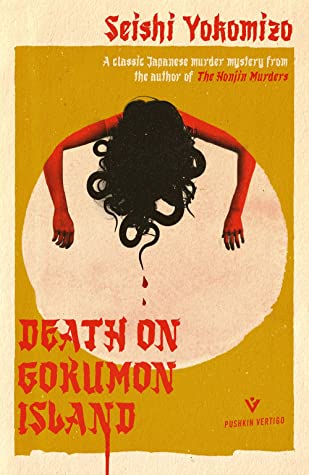
Death on Gokumon Island by Seishi Yokomizo (Trans. Louise Heal Kawai)

The second book I’ve read from my 20 Books of Summer list is this 1948 Japanese mystery novel, now available in an English translation. This is the fourth book in Yokomizo’s Kosuke Kindaichi series to be published in English by Pushkin Press, but actually the second in original publication order. It works as a standalone, with a few references to Kindaichi’s first case, The Honjin Murders, so you could easily start with this one if you wanted to.

Death on Gokumon Island is set in 1946, just after the end of the Second World War, and nearly ten years after the events of The Honjin Murders. Kosuke Kindaichi is on his way to the strangely named Gokumon – or ‘Hell’s Gate’ – Island to deliver the sad news of his army friend Chimata Kito’s death. Kindaichi knows this will be a difficult task, but what really worries him is a prediction made by the dying man that his three half-sisters, who all live on the island in the family home, are going to be murdered.

Arriving on Gokumon Island, Kindaichi gets to know the members of the Kito household, including Chimata’s father who is said to be mad and kept locked up behind bars, as well as another rival branch of the family who live nearby and would benefit from deaths in the main Kito family. The scene is set for a classic murder mystery – and it’s not long before the first murder does take place. Kindaichi begins to investigate, but the islanders are suspicious of newcomers and are reluctant to answer questions.

I struggled to get into this book at first; I felt that we were being introduced to a lot of characters all at once and it was difficult to distinguish between them. I’ve found that with all of the Japanese mysteries I’ve read the authors seem to be more concerned with puzzle-solving than with character development, although Yokomizo is better in that respect than some of the others. After a few chapters I had settled into the story and began to enjoy it. It was good to see more of Kosuke Kindaichi than we did in The Village of Eight Graves; he’s quite endearing with his nervous stammer and head-scratching and the way he makes mistakes and isn’t afraid to admit to them.

Louise Heal Kawai’s translation is clear and easy to read (she also did the translation for The Honjin Murders, although not Eight Graves, which was translated by Bryan Karetnyk). I’m sure Japanese must be a difficult language to translate into English and I do wonder if any nuance is lost along the way, but I was impressed by the way she managed to capture the meaning of the wordplay, poetry and haikus that form part of the plot. I felt I was learning quite a lot about Japanese culture, as well as post-war life in a country that had been on the losing side.

This book has been compared with Agatha Christie’s And Then There Were None, but I don’t think they have much in common other than that they are both mysteries set on islands. This is a very different sort of island, for a start – unlike Christie’s, it’s inhabited, with a fishing community, a mayor, doctors, priests and barbers (to name just some of the characters we meet) – and although there may be a few similarities in the way the murders are carried out, the solution is completely different. It’s a solution I didn’t manage to guess at all; I was convinced I had picked up on an important clue halfway through but it turned out to be a red herring!

Now I need to find time to read The Inugami Curse, the other Yokomizo book currently available in English.

Thanks to Pushkin Vertigo for providing a copy of this book for review via NetGalley.

This is book 2/20 from my 20 Books of Summer list.

The Murder on the Links by Agatha Christie

The May theme for Read Christie 2022 is “a story set in Europe” and The Murder on the Links is the perfect choice as the story takes place almost entirely in France.

First published in 1923, this is a very early Poirot novel (just the second in the series, in fact) and one of several to be narrated by Captain Arthur Hastings. Hastings, a close friend of Poirot’s, is on his way home to England from France when he meets a girl on the train who introduces herself only as ‘Cinderella’. For Hastings, it’s love at first sight, but when they part ways he doesn’t expect to ever see her again.

The next day, Hastings learns that Poirot has just received a letter from a Mr Paul Renauld requesting him to come to his home in France as soon as possible because he believes his life is in danger. The two set off at once, only to discover that Renauld had been murdered the night before, his body found on the new golf course which is under construction near his house. There are several suspects, but when Cinderella reappears and seems to have some involvement in the murder, Hastings will have to choose between his love for her and his loyalty to Poirot.

I enjoyed this, although I don’t think it’s one of the better Poirot novels I’ve read. None of the characters are particularly memorable or appealing; her characterisation would be stronger in later books in the series – maybe at this early stage she was still concentrating on developing the character of Poirot himself. In this book he has a rival – the French detective Monsieur Giraud – and we can see the contrast between their detecting methods. Poirot refers to Giraud as ‘a human foxhound’, someone who ‘sniffs out’ clues like footprints and cigarette ends while failing to see the bigger picture or to consider motive and psychology as well as physical evidence. Meanwhile, Giraud is equally scornful of Poirot’s approach to crime-solving. I’m sure I don’t need to tell you which of the two detectives will eventually solve the mystery!

I usually like the books narrated by Hastings, who is a sort of Watson to Poirot’s Sherlock Holmes. He provides a viewpoint close to Poirot, while also being as mystified as we are by Poirot’s methods and deductions. I did find him slightly irritating in this book, with his tendency to instantly fall in love with every young woman he meets, but the romantic subplot does have a purpose as it leads to Hastings departing for Argentina, only to make occasional reappearances for the rest of the series.

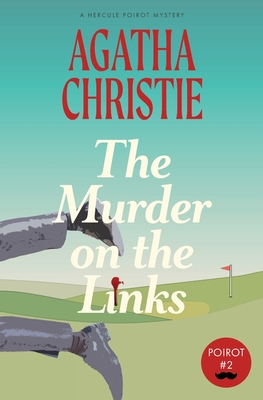
Overall, this is a typically clever and entertaining Christie novel, but probably not one that I’ll be tempted to re-read. As a final note, don’t be put off by the many covers of this book that show people playing golf – apart from the golf course being the location of the dead body, golf has absolutely nothing to do with the plot!

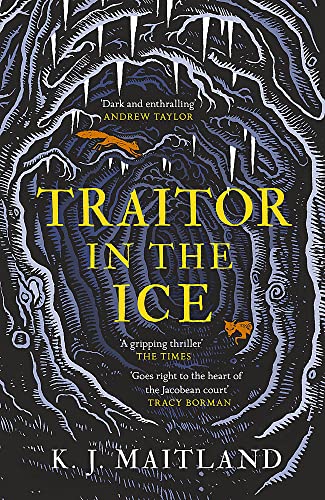
Traitor in the Ice by KJ Maitland

Traitor in the Ice is the second book in KJ Maitland’s new historical crime series set in the early 1600s during the reign of James I of England and VI of Scotland. The first, The Drowned City, introduces us to Daniel Pursglove as he searches for a mysterious Catholic conspirator known as Spero Pettingar in the aftermath of the failed Gunpowder Plot. That book is set in Bristol just after the devastating Bristol Channel Floods of 1607; Traitor in the Ice takes place the following winter – a particularly cold winter referred to as the Great Frost.

In these freezing, icy conditions a man has been found dead in the grounds of Battle Abbey in Sussex. The man was one of the King’s agents, sent to infiltrate the Montague household at Battle to try to root out those with Catholic sympathies. Lady Magdalen, Viscountess Montague is believed to be sheltering Catholic priests within the abbey walls, but the agent has been killed before having the chance to send his report to London. A replacement is needed, so Daniel Pursglove finds himself summoned by the King’s man, Charles FitzAlan, once more and sent to Battle to find evidence of treachery. He quickly discovers that almost everyone in the abbey has something to hide, but when more murders take place Daniel begins to wonder whether he is on the trail of the elusive Spero Pettingar at last.

One of the things I liked about the previous book in this series was the setting; I knew nothing about the Bristol floods and found the descriptions of the city in the aftermath quite eerie and otherworldly. The frozen landscapes of Sussex described in this second novel are equally atmospheric: the ‘withered brown bracken, each frond encased in its own ice-coffin’; the pink light of dawn ‘sending sparks of light shivering across the frost’. It’s the perfect setting for a murder mystery and Maitland weaves her usual mix of superstition and legend into the plot, adding to the sense of time and place. I was particularly intrigued by the practice of ‘night-creeping’, which Maitland explains in more detail in her very comprehensive author’s note at the end of the book.

I had hoped to learn more about Daniel Pursglove in this novel, but that doesn’t really happen and he is still very much a man of mystery by the final page. Although it’s not essential to have read the previous book first, I was pleased that I had as it meant I was familiar with at least some of Daniel’s background and wasn’t quite as confused as I might otherwise have been. I do like Daniel, though, and enjoyed following him through his investigations.

However, I had the same problem with this book that I had with the first one: there was just too much happening! The chapters set at Battle Abbey alternate with others set at court where through the eyes of two cousins, Richard and Oliver, we watch the rise to power of the King’s new favourite, Robert Carr. We also see Robert Cecil, Earl of Salisbury, working to maintain his own influence over King James, while in the streets and taverns of London violence is brewing between gangs of local youths and the Scottish courtiers who are newly arrived in the city. All of this is very interesting, but too much for one book on top of the murders and the Catholic conspiracies! With a tighter focus on just one or two threads of the plot, I think this would be a much stronger series. Anyway, I did enjoy this second novel overall and will be looking out for a third one.

Thanks to Headline for providing a copy of this book for review via NetGalley.

This is book 15/50 read for the Historical Fiction Reading Challenge 2022.
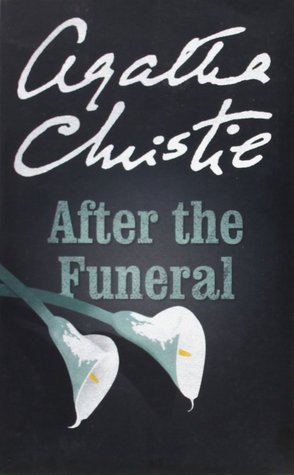
After the Funeral by Agatha Christie

This month’s theme for the Read Christie 2022 challenge is ‘a story Agatha wrote abroad’. After the Funeral, a Hercule Poirot mystery first published in 1953, doesn’t include any travel and is set entirely in England, but it was written while Christie was away on an archaeological dig with her husband Max.

After the Funeral begins, as the title suggests, just after the funeral of the wealthy Richard Abernethie with the family assembling to hear the reading of the will by his lawyer, Mr Entwhistle. As he has no surviving children of his own, it seems that Richard’s fortune is to be divided between his brother and sister, two of his sisters-in-law, and several of his nieces and nephews and their spouses. After hearing the terms of the will, Cora Lansquenet, Richard’s sister, remarks that her brother was murdered. This is not something that has occurred to anyone else, as they have all accepted that Richard died of natural causes, so Cora’s comments are not taken seriously. The next day, however, Cora herself is found dead, having been brutally murdered in her bed.

Mr Entwhistle, the lawyer, is convinced there must be a connection between the two deaths and begins to interview the family members, hoping that they will all be able to prove themselves innocent and avoid bringing shame on the family. As the mystery deepens, he decides that he needs to call in an expert – and so he contacts his friend, Hercule Poirot, who listens to the facts and agrees that an investigation is required…

This is maybe not one of the better known Poirot novels, but it’s one that I particularly enjoyed. After a confusing start – Christie throws a huge number of characters into the opening chapters and it takes a while to straighten out their relationships and remember who they all are – I became completely absorbed in this fascinating mystery, having a few guesses at the identity of the culprit and getting it wrong every time! It’s one of those mysteries where literally any of the characters (apart from Poirot, of course) could have been the murderer and the solution relies on a wonderful twist, which I don’t think many readers will have seen coming. Well done if you did, but I certainly didn’t.

Poirot himself doesn’t have a large part to play in the novel until the second half; before that, it’s actually Mr Entwhistle who is trying to investigate the deaths, by questioning suspects, speaking to doctors and establishing alibis. During that first half of the novel, I couldn’t help thinking that it wasn’t really essential for Poirot to appear in the story at all as Mr Entwhistle seemed to be doing such a good job! However, it’s Poirot’s ‘little grey cells’ that are necessary to spot that final crucial clue and solve the mystery.

Next month’s theme for the Read Christie challenge is ‘a story featuring adventure’. There are plenty of those to choose from!

Who’s Calling? by Helen McCloy

This is the fourth novel in American mystery writer Helen McCloy’s Dr Basil Willing series. I have read and enjoyed all of the previous three – Dance of Death, The Man in the Moonlight and The Deadly Truth – but it’s not necessary to read them in order as each mystery stands alone.

Who’s Calling? was first published in 1942 and begins with a young doctor, Archie Cranford, becoming engaged to Frieda Frey, a glamorous nightclub singer. Although he knows his mother won’t be happy to hear the news, Archie arranges to bring Frieda home to Willow Spring, near Washington, to meet his family and friends. Just before Frieda sets off from New York, she receives an anonymous phone call warning her not to go to Willow Spring. Deciding to ignore this threat, she goes ahead with the visit only to find herself the victim of more sinister calls, as well as other strange phenomena. Could this be the work of a poltergeist or is there a more rational reason for what is going on?

At a dinner party held by the Cranfords’ friends, Senator Mark Lindsay and his wife Julia, a murder takes place which may or may not be connected with Frieda’s ghostly experiences. It’s time to call in psychiatric consultant Dr Basil Willing in the hope that he can solve the crime and identify the murderer.

This is another entertaining Basil Willing mystery – although Willing himself doesn’t make an appearance until halfway through the book. The first half is devoted to setting the scene and introducing the characters, the most memorable being the Cranfords’ cousin, Chalkeley Winchester, an annoying, self-absorbed man described by the others as a ‘spoiled child grown up’ and a ‘male old maid’. I also found the relationship between the Lindsays interesting, as we soon discover that Senator Lindsay is bored and disillusioned with his work and that it’s actually his wife Julia who is the driving force behind his political career.

McCloy begins each of her books with a list of ‘Persons of Interest’, briefly describing the characters who will appear in the novel, and then a second list of ‘Objects of Interest’ – in other words, some of the clues or significant happenings you need to look out for. In this book the objects of interest are particularly intriguing and include ‘a loud KNOCK on the front door – and nothing more’, ‘a BEAD CURTAIN which rustles for a while after a murderer passes’ and ‘a KNITTING BAG that moves without being touched.’ Being given this information in advance doesn’t help at all with solving the mystery, though, and doesn’t really have much purpose other than to add a bit of fun to the book!

I quickly narrowed the suspects down to two, and then correctly guessed which one was the culprit, but I couldn’t work out exactly why they had done it. The solution relies on Basil Willing’s psychiatric knowledge and I don’t think it’s something that would occur to most readers, so I was left feeling that McCloy hadn’t been very fair to us this time. Still, I did enjoy this book and will look forward to reading more from the series.

Thanks to Agora Books for providing a copy of this book for review via NetGalley.

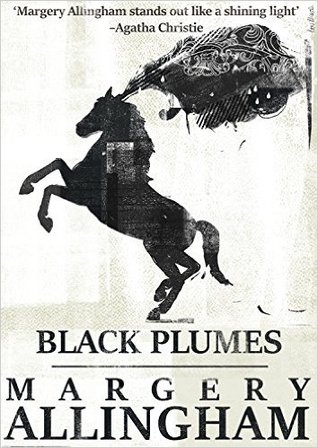
Black Plumes by Margery Allingham

Margery Allingham, one of the four Golden Age ‘Queens of Crime’, was best known for her Albert Campion detective series, but she also wrote several standalone crime novels. I have previously read and enjoyed The White Cottage Mystery, so had high hopes for this one, Black Plumes.

First published in 1940, Black Plumes is set almost entirely in the London home of the Ivory family and the art gallery they own in the building next door. The family matriarch is the elderly Mrs Gabrielle Ivory and the story is written from the perspective of her granddaughter, Frances. As the novel opens, Frances’ father, Meyrick, is on business abroad and has left his son-in-law Robert Madrigal (who is married to Frances’ half-sister Phillida) to run the gallery while he is away. In his absence, however, strange things have been happening: a broken vase, a slashed painting – and finally, an argument between Robert Madrigal and the artist David Field, after which Robert disappears.

A few weeks later, Robert’s dead body is discovered and suspicion quickly falls upon David – leaving Frances in a difficult situation, as David is the man she has just agreed to marry. She tells herself that he must be innocent, but how can she be sure?

As I’ve said, there is no Albert Campion to solve the mystery in this book, which could be a good or a bad thing depending on whether you’re a Campion fan. Instead, there’s Detective Inspector Bridie, an elderly Scotsman from Orkney who is brought in to investigate. However, we don’t really get to see any of his investigations and he doesn’t have a large part to play in the story. I didn’t solve the mystery myself – although I had narrowed it down to two suspects and one of them was correct – but since we see everything through Frances’ eyes rather than the detective’s, I think that made it more complicated.

There’s a touch of romance in the story too, particularly at the beginning where Frances and David agree to announce a fake engagement in order to prevent Frances having to marry someone else, but this storyline turned out not to be as much fun as it promised to be at first (Georgette Heyer does that sort of thing much better). It didn’t help that I found David so annoying; in fact, I didn’t like any of the characters much at all, although I enjoyed most of Gabrielle Ivory’s scenes and the contrast between her Victorian values and her granddaughter’s more modern ones.

After finishing this book, I looked at some other reviews and was confused when I saw everyone complaining about the use of a certain racist term to describe one of the suspects. It seems that this word has been edited out of the new edition I read and replaced with a less offensive term, which I think was a good idea in this case. The racist sentiment is still there, but it’s clear that it’s supposed to be the view of one of the characters rather than Allingham herself.

I think Black Plumes is worth reading if you like Allingham’s writing, but if it had been the first book I’d read by her, I’m not sure that I would have wanted to read more.