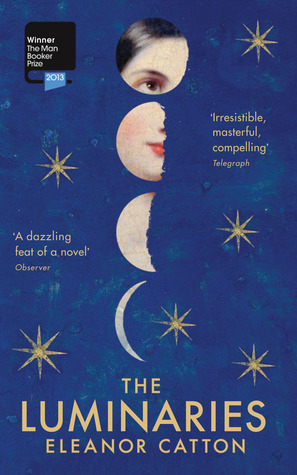
The Luminaries by Eleanor Catton

The Luminaries This is the novel that won the Booker Prize in 2013 but despite the hype surrounding it at the time and the fact that it did sound like a book I would enjoy, I have been putting off reading it, mainly because of its length. As well as the Booker Prize, though, it was also nominated for the Walter Scott Prize in 2014 and as I’m slowly working through the shortlists for that particular prize, I decided it was time I read it.

The Luminaries is set in the New Zealand town of Hokitika during the Gold Rush of the 1860s. The story revolves around several strange occurrences which all take place on the same night in January 1866: Emery Staines, one of the town’s richest men disappears without trace; prostitute Anna Wetherell collapses in the street in what is thought to be a suicide attempt; and the reclusive Crosbie Wells is found dead in his own home, surrounded by a large quantity of hidden gold. These things may not seem to be connected at first, but of course they are – as is everything else that happens throughout the 800 pages of this very clever and complex novel.

The first and by far the longest section of the book begins with the arrival of Scottish lawyer, Walter Moody, who is hoping to make his fortune on the goldfields. On his first evening in Hokitika he walks into the Crown Hotel to find that he has interrupted a meeting between twelve men who have gathered to try to make sense of what has been happening. These twelve men are all linked in some way with Emery, Anna, Crosbie or all three – and as Walter listens to their stories he too is drawn into the mystery.

In the sections of the novel that follow – each one half the length of the one before – we move forwards and then backwards in time learning more about each of the main characters and the events leading up to the night of 14th January 1866.

The decreasing length of the chapters corresponds with a waning moon (hinted at by the images on the front cover), one of many astrological elements Eleanor Catton has incorporated into the novel. The character list at the front of the book lists the twelve men who meet in the hotel under the heading ‘Stellar’ and each one is associated with a sign of the Zodiac, while the other characters are listed as ‘Planetary’. Each of the twelve sections of the book begins with an astrological chart and within each section the individual chapters have astrological titles. This was intriguing at first but as I don’t have a lot of interest in astrology it didn’t mean much to me and I quickly gave up trying to interpret it and concentrated on following the story instead.

I have seen lots of comparisons between The Luminaries and the Victorian sensation novels of Wilkie Collins, one of my favourite authors, but I’m not sure if I really agree with that comparison. The book does include lots of elements of the sensation novel (hidden treasure, opium addiction, double identities, séances, forgeries and family secrets) but Eleanor Catton’s writing, in my opinion, lacks the flair and humour of Wilkie Collins’ and the gift for creating strong, unforgettable characters. Apart from one or two, the twelve men of the Crown felt interchangeable and I had to keep looking back at the character list to remind myself which was which. The other eight were slightly stronger (they were the Planetary characters and the ones who tended to drive the story forward) but of these, Anna Wetherell was the only one I really came to care about.

I did enjoy reading The Luminaries, though, and can definitely see why it has been so successful. I was very impressed by the intricate plotting with facts and secrets being slowly unveiled and connections between the characters gradually revealed. I also loved the setting; I have read very few novels set in New Zealand and I certainly haven’t read any set in a New Zealand gold mining town in the 1860s! Because Hokitika is a real place, I could find lots of pictures online which really helped to bring the setting to life. The length of the book wasn’t a problem for me either; the pages seemed to go by much more quickly than I’d expected them to – especially in the second half, where the chapters become shorter and the pace becomes faster.

I know there were a lot of things happening in The Luminaries that I didn’t completely understand (especially all of the allusions to astrology) and lots of little details that I missed. I would probably have to read the book again to be able to fully appreciate it, but for now I’m happy just to have read it once and to have enjoyed it!

The Widow’s Confession by Sophia Tobin

The Widows Confession It’s the summer of 1851 and visitors are beginning to arrive in the seaside town of Broadstairs, Kent. Among the new arrivals are a young American widow, Delphine Beck, and her cousin, Julia Mardell; two women surrounded by an air of mystery. What is the scandal in Delphine’s past that has led her to flee New York and become estranged from her family? Why has Julia decided to accompany her and why does she keep her face covered by a veil?

Another newcomer is Edmund Steele who has come to Broadstairs to escape from a failed love affair. He is staying at the parsonage with his clergyman friend, Theo Hallam, who is himself trying to move on after a personal loss of his own. Then there’s the artist Mr Benedict, who is planning to spend the summer painting the Broadstairs scenery while his family are staying in nearby Ramsgate, and finally there’s Miss Waring, a nervous woman in her fifties who is visiting with her beautiful young niece, Alba.

All of these people are brought together by Theo’s aunt, Mrs Quillian, who arranges a series of picnics, walks and sightseeing excursions for them. But despite her enthusiasm, there is a lot of tension within the little group and it seems that almost everyone has his or her own secrets to hide. When the body of a young girl is washed up on the beach – and more suspicious deaths follow – it appears that one of the summer visitors could be to blame. Can they put their differences aside and work together to identify the murderer?

The Widow’s Confession is Sophia Tobin’s second novel. Her first was The Silversmith’s Wife, a book I haven’t read and probably won’t now be reading as I found this one quite disappointing. I’m sorry I didn’t like it more as it did sound like the sort of book I would usually enjoy. There were some aspects I enjoyed – the setting, the portrayal of Victorian society and the way the relationships between the characters were developed so carefully – but otherwise the book was just not what I’d expected it to be. Maybe I was misled by the front cover, which gave me the impression the story would be more suspenseful and gothic than it actually was.

I felt that the mystery surrounding the dead girls was ignored for very long stretches of the novel, to the point where I no longer really cared who had killed them or why. I was more interested in the characters themselves, in their tragic pasts and in what had brought each of them to Broadstairs. As a slow-paced, atmospheric study of character and of 19th century life, I thought the novel worked quite well.

What I did love about this book was the setting. Broadstairs was a popular English seaside resort in Victorian times and a favourite holiday spot of Charles Dickens who wrote David Copperfield there (while staying at a house on the cliff which became known as Bleak House). The characters also visit some of the surrounding tourist attractions, all of which are vividly described; I particularly loved reading about their visit to the Shell Grotto in Margate.

For the right reader, I think The Widow’s Confession would be an interesting and worthwhile read, but I have to admit I was pleased when I reached the end and could move on to something else.

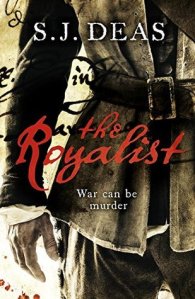
The Royalist by S.J. Deas

The Royalist As someone who loves both historical fiction and mysteries, it’s not surprising that I also enjoy historical mysteries! If the book has an interesting and unusual setting, as this one has, even better.

The Royalist is the first in a planned series featuring the character of William Falkland. Falkland, as the title suggests, is a Royalist and has been fighting for King Charles in the English Civil War. As the novel begins in 1645, he has been captured by Parliamentarians and is in Newgate Prison awaiting his fate. When after several months of imprisonment a guard comes to take him from his cell, he is convinced that the day of his execution has arrived at last. To his surprise, though, he is taken instead to a meeting with Oliver Cromwell, the man with whom Parliament’s hopes of victory lie.

It seems that Cromwell has learned of a previous occasion on which Falkland stood up to his King to see that a criminal was brought to justice – and he is now hoping that Falkland will be able to solve a second crime, this time within Cromwell’s own New Model Army. Large, well-trained and highly disciplined, the New Model Army has been created with the aim of bringing a rapid end to the war. However, with men being pressed into the army regardless of their religious or political beliefs, discontent, disloyalty, fear and resentment are widespread. At the army’s winter camp in the town of Crediton in Devon, three young soldiers appear to have committed suicide – but why? This is what Falkland must agree to find out, in return for his own life.

I enjoyed The Royalist; it’s a very atmospheric book, taking us from a dark, cramped prison cell right into the heart of an army camp in the middle of a cold, harsh winter. This is the unusual setting I mentioned earlier; I’ve read other novels set during the Civil War, but none that focus specifically on the New Model Army. I knew almost nothing about the army before starting this book, and I found it fascinating, particularly the fact that even former Royalists were recruited, often against their will. It was also interesting to read about the ways in which the people of Crediton were affected by the army moving into their town and forcing them out of their homes.

This is not a book about an army on the move so there are (fortunately, in my opinion) no long battle scenes or discussions of military tactics; this is a book about an army that is stationary, based in one place, biding its time. That doesn’t mean there’s no action, of course! As Falkland continues to investigate and begins to uncover the truth about the young men who have died, he finds that he himself is in danger. There’s a lot of suspense as he explores the camp and its buildings in the dead of night, examines the tree where the three soldiers allegedly took their own lives, and tries to decide who can and cannot be trusted.

As the novel’s narrator, Falkland is the character we get to know best, but I still felt that there was plenty of information about his past that he was withholding from us and could reveal in a future novel. There are other interesting characters too: Thomas Fairfax, for example, the commander of the New Model Army and known as ‘Black Tom’ – one of the few real historical figures to appear in the book. There’s also Kate Cain, a woman who has refused to leave Crediton, and with whom Falkland lodges during his time in the town. And I was particularly intrigued by the character of Henry Warbeck, the man given the job of escorting Falkland to the army camp, as I discovered that there was more to him than met the eye at first.

I’m now looking forward to reading the second William Falkland novel, The Protector, which will be out later this year.

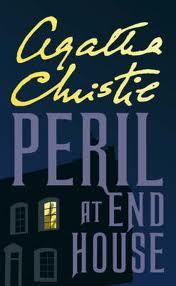
Peril at End House by Agatha Christie

Peril at End House I love Agatha Christie’s books but although there are still a lot that I haven’t read, I find that it works better for me to space them out and read other things in between. It’s been almost a year since the last Christie novel I read, so last week I decided it was time to read another one. This one, Peril at End House, is an early Poirot mystery, published in 1932.

At the beginning of the novel, Hercule Poirot and his friend, Captain Hastings, are taking a holiday in the seaside resort of St Loo. If they were hoping for a peaceful, relaxing break, though, they are about to be disappointed. Taking a walk outside their hotel, they meet a young woman called Nick who lives nearby at End House. As they stand chatting to Nick, she swats away what she thinks is a wasp – and then finds a hole in the brim of her hat and a bullet lying on the ground. Poirot is concerned, especially when she tells him of three other occasions when she has narrowly escaped death in the last few days, but Nick herself appears less worried – she can’t imagine why anybody would want her dead and insists that the incidents must just be accidents.

Poirot resolves to do everything he can to keep Nick safe from harm while he investigates, but it seems that his efforts are in vain as the murder attempts continue. Meanwhile, he uncovers a number of suspects among Nick’s friends and family ranging from her closest living relative, Charles Vyse, and her best friend, Frederica Rice, to her housekeeper Ellen and her Australian lodgers, Mr and Mrs Croft. And as more information comes to light, Poirot discovers that there may in fact be a very good reason for the attempts on Nick’s life.

As I approached the halfway point in this book, I was thinking that this was a very average Poirot novel – not a particularly notable entry in the series at all. I shouldn’t have been so quick to judge because there were some great twists and turns towards the end and the mystery ended up being a much more complex and clever one than I had thought at first.

When I wrote about the last Poirot novel I read – Cat Among the Pigeons – I remarked that that particular book was unusual because Poirot didn’t appear until near the end. This one is the opposite, as Poirot is there in the middle of the action right from the first page and we are plunged straight into the mystery, with little time spent on setting the scene or providing background. Like several of the other early Poirot novels, Captain Hastings narrates the story, which I like because although we don’t actually get inside Poirot’s head, he does at least explain some of his thought processes to Hastings as he goes along.

As so often happens when I read Agatha Christie, I did actually guess the correct solution (or part of it, anyway) very early in the book – and then dismissed the idea as the plot developed and red herrings were dropped into the story, leading me off the scent. The reader is given all the information needed to be able to identify the murderer and their motives, but it’s easy to overlook one or two of the most important clues. Even Poirot himself missed those clues too, which made me feel better about it!

This is not a favourite Poirot novel, but I did enjoy it. Have you read this one? Did you manage to solve the mystery or did you allow Christie to lead you in the wrong direction?

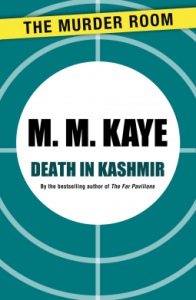
Death in Kashmir by M. M. Kaye

Death in Kashmir I have always thought of M. M. Kaye as an author of historical novels (such as the wonderful Far Pavilions) and although I was vaguely aware that she had also written a series of mystery novels, I had never really thought about reading them. Now that I’ve read the first one, Death in Kashmir, I will certainly be reading the others. What a great book this is!

Death in Kashmir was first published in 1953, but set a few years earlier in 1947, just as India is about to gain independence from Britain. Our heroine, Sarah Parrish, is attending what will probably be the final meeting of the Ski Club of India at Gulmarg, a resort in the mountains of Kashmir. Sarah is hoping for an enjoyable, relaxing holiday but the first sign of trouble ahead comes when another skier has a fatal accident on the slopes. Another death soon follows the first, but this time, the victim – a young woman called Janet Rushton – was able to share an important secret with Sarah before she died.

Sarah is now certain that neither death was accidental but all she wants is to leave Gulmarg and its secrets behind her and have nothing more to do with the whole business. When the skiing party breaks up she visits her aunt in Peshawar and tries to forget what she has learned. Soon, though, her promise to Janet pulls her back to Kashmir where she finds herself caught up in the mission her friend was working on before her death – and this time, Sarah’s own life could be in danger.

I loved this book from the very beginning. It’s so important that a first chapter pulls you straight into the story and this one did, right from the opening line – “Afterwards Sarah could never be quite sure whether it was the moonlight or that soft, furtive sound that had awakened her”. The rest of the story was equally engrossing: a perfect mixture of mystery, suspense, romance and espionage.

The descriptions of Kashmir are stunning. The first part of the book is set in winter on the snow-covered mountain trails of Gulmarg and later the action moves to the Dal Lake in the summer resort of Srinagar where Sarah takes over the lease on a houseboat that once belonged to Janet. Both of these locations are described beautifully, but Kaye also chooses just the right words and images to create a genuinely eerie and unsettling atmosphere. I found myself literally holding my breath as Sarah wondered who was standing outside the ski lodge in the dark, as she watched an unknown figure disappearing up a staircase and as she listened to footsteps on the boards of her houseboat in the night.

What makes Sarah’s situation even more dangerous is that she’s sure the enemy must be one of the group of skiers who were gathered at Gulmarg – the same group who are all now spending the summer in Srinagar. Who should she trust? The hostile Helen Warrender who makes no secret of her dislike for Sarah? The jovial, good-natured Hugo and his long-suffering wife, Fudge? Timid Meril Forbes and her domineering aunt? Or the handsome, polo-playing Captain Charles Mallory? When the villain was eventually revealed it didn’t come as a complete surprise – but I have to admit I had suspected almost everybody at some point, so one of my guesses was bound to be right!

The book is also interesting from the historical viewpoint, being set just before the end of the British Raj and the transfer of powers back to India. Through the stories of Sarah and the rest of the British community in Kashmir, I thought Kaye had perfectly captured the mood of a group of people who knew that their way of life was about to change forever.

I’m now looking forward to reading the other five Death In… mysteries. I just need to decide which one to read next!

The Devil in the Marshalsea by Antonia Hodgson

The Devil in the Marshalsea This is a murder mystery with a difference, being set almost entirely within the confines of an eighteenth century debtors’ prison. Our narrator, Tom Hawkins, is a young man who has rebelled against his clergyman father’s plans for his future and is enjoying himself in London, spending all his money on drinking and gambling. After a big win at the card tables one night, Tom is attacked on his way home and his winnings are stolen, leaving him unable to pay his debts. Taken to the notorious Marshalsea Prison, he is horrified to discover that the last occupant of his cell, Captain Roberts, was murdered. The killer has never been caught, but Tom’s new roommate, the charismatic and mysterious Samuel Fleet, is the man most people believe to be the murderer.

The Marshalea is privately run for profit, so it’s not surprising that the prison governors want the killer identified as quickly as possible to avoid any further scandal. Told that his only chance of being released depends on whether or not he can solve the mystery of Roberts’ death, Tom agrees to investigate. Unsure who can be trusted and beginning to wonder whether such things as truth and justice even exist in a place as corrupt as the Marshalsea, Tom eventually uncovers a web of betrayal and deception on a scale he could never have imagined.

Other authors have written about the Marshalsea, most famously Charles Dickens in Little Dorrit, but Dickens’ Marshalsea was a newer building on a site further down the road; set in 1727, Antonia Hodgson’s novel refers to the original prison. Not knowing anything at all about the Marshalsea, this was quite an eye-opening book for me. I was aware that prisoners were often able to offer bribes in return for better living conditions and privileges, but I hadn’t realised there was such a great disparity between the fate of those who could afford to pay and those who couldn’t.

The prison was divided into two sections. The prisoners who had some money to spend or who had influential friends, lived on the Master’s Side, which was almost like a complete town in itself, with coffee houses, bars, restaurants and even a barber. They had the freedom to move around and in some cases were even given permission to go out into London during the day. For the poor people on the Common Side, things were much worse. Crammed into tiny cells and suffering from starvation, disease and overcrowding, they died at a rate of up to twelve a day. Tom Hawkins, whose best friend happens to work for Sir Philip Meadows, Knight Marshal of the Marshalsea, is lucky enough to find himself on the Master’s Side but with the knowledge that if his luck should run out, he could find himself thrown into the Common Side to meet his death with the others.

This is not a book for the faint-hearted as there are some horrible descriptions of sickness, torture and brutality, not to mention the dirty, squalid conditions the unfortunate inmates of the Common Side were forced to endure. Knowing that this was an experience many people really did have to go through makes it even more horrific. Despite this, I found The Devil in the Marshalsea very entertaining and fun to read. The book is filled with larger than life characters and I was surprised to find, when I read the notes at the end of the book, that many of these people really existed and were mentioned in the diary of John Grano, a debtor who spent a year in the prison from 1728-1729.

As a mystery novel, The Devil in the Marshalsea kept me guessing right until the end. I did not work out who the murderer was and even after the truth was revealed there were still more plot twists and revelations to come. As a work of historical fiction it’s equally impressive; I loved the portrayal of eighteenth century London both inside and outside the Marshalsea. I was so pleased to find that there’s going to be a sequel to this book and I’m already looking forward to meeting Tom Hawkins again!

I received a copy of this book from the publisher for review

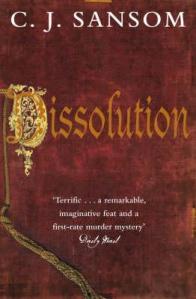
Dissolution by C J Sansom

Dissolution Reading C J Sansom’s alternate history novel Dominion a few months ago reminded me that I still hadn’t read any of his Shardlake books, despite meaning to for years. I noticed last week that my library had the whole series available as ebooks, so it seemed as good a time as any to get started with the first one, Dissolution.

Dissolution is set in the winter of 1537, just after the death of Henry VIII’s third wife, Jane Seymour. Having broken away from the Catholic church and declared himself Supreme Head of the Church of England, the King, with the help of Thomas Cromwell, has begun the process of dissolution of the country’s monasteries. After the closure of some of the smaller religious houses in the north led to rebellion, Cromwell is now taking a different approach and is sending commissioners to the larger monasteries to offer pensions to the monks in the hope that they will voluntarily surrender – or if not, to search for signs of fraud, corruption or other legal reasons to close them down.

At the monastery of Scarnsea, on the coast of Sussex, disaster strikes when one of Cromwell’s commissioners, Robin Singleton, is found brutally murdered in the monastery kitchen. Cromwell sends another of his men, the lawyer Matthew Shardlake, to investigate the mystery of Singleton’s death and discover what has been happening at the monastery. Accompanied by his assistant Mark Poer, Shardlake sets out for Scarnsea but what he learns when he arrives there convinces him that the commissioner had been about to make an important discovery before he was killed.

As a murder mystery, there’s everything here that you would expect: the detective and his sidekick, the isolated house (monastery in this case) cut off from the rest of the world, the small group of suspects each with their own secrets and motives, and the usual string of clues and red herrings. But what made this book stand out for me among other historical mysteries was the fascinating setting and detailed portrayal of monastic life. There are some obvious similarities with Umberto Eco’s The Name of the Rose, although this is an easier read – and set in a completely different time period, of course.

I have read other novels that focus on the dissolution of the monasteries (books such as The Crown by Nancy Bilyeau, for example) but usually from the point of view of the monks and nuns whose way of life has been destroyed. This book is narrated by Shardlake himself and it’s interesting to see dissolution from his perspective, as a dedicated reformer. Shardlake gradually becomes disillusioned with Henry and Cromwell, but for a long time he tries to justify what they are doing and it is only towards the end of the book that he allows himself to have doubts. Something I haven’t mentioned yet is that Shardlake is a hunchback and has spent his life trying to overcome prejudice and rejection. The fact that he has had to deal with a disability in a time much more unenlightened than our own adds another dimension to his personality.

Having taken so long to get round to reading this book, I’m pleased that I did enjoy it! I correctly named the murderer quite early in the story, but while I would like to pretend that I had cleverly managed to solve the mystery I have to admit it was really just a guess. This didn’t spoil the rest of the story at all, though – I had to wait until almost the end of the book to find out if I was right and even after Singleton’s killer was eventually revealed, there were still one or two other developments that took me by surprise! I will definitely be continuing the series with the second book, Dark Fire – but probably not immediately.