The Queen’s Man by Sharon Penman

The Queens Man Having read and loved three of Sharon Penman’s historical fiction novels – The Sunne in Splendour, Here Be Dragons and Falls the Shadow – I’ve been interested in trying her series of historical mysteries set in medieval England. I downloaded the first in the series, The Queen’s Man, when it was offered as the Kindle Daily Deal on Amazon a while ago and have been waiting for the right time to read it.

The Queen’s Man introduces us to Justin de Quincy who, as the novel begins in December 1192, has just discovered that he is the illegitimate son of the Bishop of Chester. Furious that his father will not acknowledge their relationship, Justin sets out on a journey to London where he hopes to start a new life. Before he reaches London, however, he witnesses a murder on a snowy road just outside Winchester. As the killers flee the scene, the dying man – a goldsmith called Gervase Fitz Randolph – gives Justin a letter and makes him promise to deliver it to Queen Eleanor in London.

Eleanor of Aquitaine, widow of Henry II, is anxiously awaiting news of her son, King Richard I, who has disappeared while on crusade. As the weeks go by with no word of the missing king, it’s starting to look likely that he is dead and Eleanor’s youngest son, John, Count of Mortain, is getting ready to claim the throne for himself. Justin de Quincy’s arrival at court in possession of a bloodstained letter gives the Queen a clue as to Richard’s fate – but she still wants to know more.

As Justin was the only witness to the murder and the only person able to identify the killers, the Queen commissions him to investigate. Who was responsible for Gervase’s death? Was it a member of the goldsmith’s own family who wanted him dead or could it have been John who paid the murderers to steal the letter before it could reach Eleanor?

I enjoyed The Queen’s Man; it doesn’t compare with Penman’s straight historical novels – it lacks the depth and the emotional impact – but I didn’t mind that as I knew from the beginning that this would be a different type of book. While the plot and characters (with some obvious exceptions) are fictional, the historical background is as accurate and detailed as you would expect from Penman, with lots of interesting snippets of information that bring the 12th century to life: a visit to both a lazar house (hospital for lepers) and a medieval horse fair are incorporated, for example, and there’s a fascinating description of ‘trial by ordeal’ using hot cauldrons.

As a murder mystery, the plot is quite complex with plenty of suspects and some red herrings – although it’s slightly disappointing that some important information is withheld from the reader until near the end, so it would have been difficult to have guessed the solution before it was revealed.

The Queen’s Man has an interesting variety of supporting characters, ranging from innkeeper’s widow, Nell, and the under-sheriff of Winchester, Luke de Marston, to one of Queen Eleanor’s ladies, the beautiful Claudine. My only concern is that I found Justin de Quincy himself very bland. Based on this first novel, I wouldn’t have thought he was a strong enough character to build a whole series around. I could be wrong about him, though, and I’m still interested enough to want to read the next book, Cruel as the Grave, at some point to see how his story continues.

What Angels Fear by CS Harris

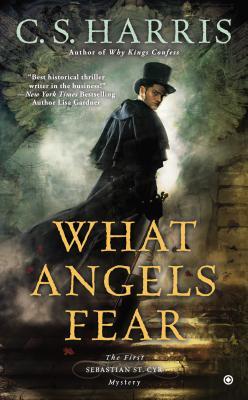
What Angels Fear When I made my list for this year’s RIP challenge, I decided to give priority to books I’ve been wanting to read for a while rather than search out new titles. What Angels Fear, the first in CS Harris’ Sebastian St. Cyr mystery series, is one of those books. I can’t remember where I first heard about this series but I know it has been recommended to me several times over the last few years and did sound like something I would enjoy. There are now ten books in the series, which is slightly overwhelming, especially as I’m already in the middle of so many other series, but I thought it was time I at least gave the first one a try.

What Angels Fear is set in London in 1811. With King George III suffering from mental illness, the Prince of Wales is preparing to start his period as Regent and members of the two main political parties, the Whigs and the Tories – who are strongly divided over issues such as Britain’s role in the Napoleonic Wars – are hoping to gain positions of power and influence in the newly-established Regency.

At the beginning of the novel, Sebastian St. Cyr, Viscount Devlin, returns from fighting a duel to discover that he has become a suspect in a murder investigation. A beautiful young actress, Rachel York, has been found dead on the steps of a church altar and evidence found at the scene has implicated Sebastian. Determined to clear his name, Sebastian decides to investigate the murder himself. As he delves deeper into the circumstances surrounding Rachel’s death, more and more people are drawn into the mystery, including a French spy, an Italian artist and a London street urchin, as well as some of the country’s top politicians and even members of Sebastian’s own family.

I’m pleased to say that I enjoyed What Angels Fear enough to want to read the next book in the series. I didn’t love it, but I found it very entertaining with a good mixture of mystery, political intrigue and romance (Sebastian’s love interest in this book is an actress whose stage name is Kat Boleyn). Harris captures the atmosphere of the Regency period very well, although I occasionally came across a choice of word that didn’t feel quite right. It was probably a mistake to read this book immediately after finishing April Lady as there are few authors who bring the Regency to life as convincingly as Georgette Heyer!

I haven’t really warmed to Sebastian yet, but I’m hoping that will eventually happen if I continue with the series. He is certainly an intriguing character: Harris gives him an interesting past, with five years spent in the army, some family secrets which are only hinted at in this book, and some unusual abilities (he has quick reflexes and very acute eyesight and hearing, which according to the author’s note are signs of Bithil Syndrome, although I couldn’t seem to find out whether this is a real condition or not). Because so many things are left unresolved at the end of this first novel, I’m sure there’s still a lot more to learn about Sebastian and I’m curious to see how his character develops.

What Angels Fear was a good start not only to my reading for the RIP challenge, but also to a new series. Now I’m looking forward to the second Sebastian St. Cyr novel, When Gods Die.

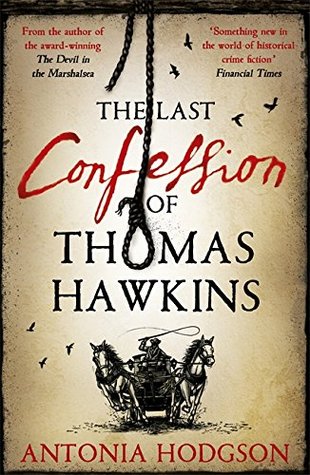
The Last Confession of Thomas Hawkins by Antonia Hodgson

The Last Confession of Thomas Hawkins It’s 1728 and Thomas Hawkins is being escorted through the streets of London towards the gallows at Tyburn. Although he has been found guilty of murder and sentenced to hang, Tom has been promised a pardon and is sure he will be freed. But as he gets closer and closer to the gallows and the pardon doesn’t come, he begins to lose hope. Could this be the end for Thomas Hawkins?

Antonia Hodgson’s debut novel The Devil in the Marshalsea was one of my favourite books of last year. I loved the setting (an eighteenth century debtors’ prison), I loved the entertaining plot, and I loved learning about life in Georgian London, so I was pleased to find that there was going to be a sequel. If you haven’t read the first book, though, that shouldn’t be a problem because The Last Confession of Thomas Hawkins can be read as a ‘standalone historical mystery’, as stated on the book cover. I would still recommend reading the two books in order as there are some minor spoilers in the second one, but it isn’t really necessary.

If you have read The Devil in the Marshalsea you will already have met Thomas Hawkins and will know what he experienced during his time in the notorious Marshalsea Prison. Sadly, as the sequel begins, it seems that Tom has forgotten the lessons he learned in the Marshalsea. He has started to build a new life for himself with Kitty Sparks, bookseller and print shop owner, but this is not enough for Tom and he has returned to his old habits of drinking, gambling and looking for adventure.

It’s not long before things start to spiral out of control again and this time Tom finds himself embroiled in the affairs of Queen Caroline and the king’s mistress, Henrietta Howard, as well as becoming a suspect in a murder investigation. Alternating between Tom’s journey to the gallows and the events leading up to his death sentence, Tom’s story – his ‘last confession’ – gradually unfolds.

This is another great book from Antonia Hodgson and I enjoyed it almost as much as the first. I say ‘almost’ because the fact that The Devil in the Marshalsea was set almost entirely within a debtors’ prison gave the first book a feeling of novelty and originality that this second one doesn’t have. That doesn’t mean I didn’t like the setting of this book too, of course. Hodgson’s portrayal of 1720s London is wonderful: a cockfight in a crowded tavern; a gang leader’s lair in a crumbling slum building; the beautifully furnished rooms of St James’s Palace – all of these are described in vivid detail.

Tom Hawkins, as our narrator, is the perfect character to guide us through Georgian London. His lifestyle means he is familiar with the darker side of society, but his family background makes him a gentleman and it is this combination that brings him to the attention of those who hope to use him for their own ends…including the clever, scheming Queen Caroline (a historical figure I’ve never read about until now). Tom is frustrating, flawed and a bit of a rogue, but he’s also a person you can’t help but like. I’m obviously not going to tell you whether or not he does escape the hangman’s noose, but what I will say is that Antonia Hodgson keeps us in suspense until the end. The final chapter gave me hope that there could be a third book in this series – but if you want to know whether Thomas Hawkins will survive that long, you’ll have to read The Last Confession to find out!

The Luminaries by Eleanor Catton

The Luminaries This is the novel that won the Booker Prize in 2013 but despite the hype surrounding it at the time and the fact that it did sound like a book I would enjoy, I have been putting off reading it, mainly because of its length. As well as the Booker Prize, though, it was also nominated for the Walter Scott Prize in 2014 and as I’m slowly working through the shortlists for that particular prize, I decided it was time I read it.

The Luminaries is set in the New Zealand town of Hokitika during the Gold Rush of the 1860s. The story revolves around several strange occurrences which all take place on the same night in January 1866: Emery Staines, one of the town’s richest men disappears without trace; prostitute Anna Wetherell collapses in the street in what is thought to be a suicide attempt; and the reclusive Crosbie Wells is found dead in his own home, surrounded by a large quantity of hidden gold. These things may not seem to be connected at first, but of course they are – as is everything else that happens throughout the 800 pages of this very clever and complex novel.

The first and by far the longest section of the book begins with the arrival of Scottish lawyer, Walter Moody, who is hoping to make his fortune on the goldfields. On his first evening in Hokitika he walks into the Crown Hotel to find that he has interrupted a meeting between twelve men who have gathered to try to make sense of what has been happening. These twelve men are all linked in some way with Emery, Anna, Crosbie or all three – and as Walter listens to their stories he too is drawn into the mystery.

In the sections of the novel that follow – each one half the length of the one before – we move forwards and then backwards in time learning more about each of the main characters and the events leading up to the night of 14th January 1866.

The decreasing length of the chapters corresponds with a waning moon (hinted at by the images on the front cover), one of many astrological elements Eleanor Catton has incorporated into the novel. The character list at the front of the book lists the twelve men who meet in the hotel under the heading ‘Stellar’ and each one is associated with a sign of the Zodiac, while the other characters are listed as ‘Planetary’. Each of the twelve sections of the book begins with an astrological chart and within each section the individual chapters have astrological titles. This was intriguing at first but as I don’t have a lot of interest in astrology it didn’t mean much to me and I quickly gave up trying to interpret it and concentrated on following the story instead.

I have seen lots of comparisons between The Luminaries and the Victorian sensation novels of Wilkie Collins, one of my favourite authors, but I’m not sure if I really agree with that comparison. The book does include lots of elements of the sensation novel (hidden treasure, opium addiction, double identities, séances, forgeries and family secrets) but Eleanor Catton’s writing, in my opinion, lacks the flair and humour of Wilkie Collins’ and the gift for creating strong, unforgettable characters. Apart from one or two, the twelve men of the Crown felt interchangeable and I had to keep looking back at the character list to remind myself which was which. The other eight were slightly stronger (they were the Planetary characters and the ones who tended to drive the story forward) but of these, Anna Wetherell was the only one I really came to care about.

I did enjoy reading The Luminaries, though, and can definitely see why it has been so successful. I was very impressed by the intricate plotting with facts and secrets being slowly unveiled and connections between the characters gradually revealed. I also loved the setting; I have read very few novels set in New Zealand and I certainly haven’t read any set in a New Zealand gold mining town in the 1860s! Because Hokitika is a real place, I could find lots of pictures online which really helped to bring the setting to life. The length of the book wasn’t a problem for me either; the pages seemed to go by much more quickly than I’d expected them to – especially in the second half, where the chapters become shorter and the pace becomes faster.

I know there were a lot of things happening in The Luminaries that I didn’t completely understand (especially all of the allusions to astrology) and lots of little details that I missed. I would probably have to read the book again to be able to fully appreciate it, but for now I’m happy just to have read it once and to have enjoyed it!

The Widow’s Confession by Sophia Tobin

The Widows Confession It’s the summer of 1851 and visitors are beginning to arrive in the seaside town of Broadstairs, Kent. Among the new arrivals are a young American widow, Delphine Beck, and her cousin, Julia Mardell; two women surrounded by an air of mystery. What is the scandal in Delphine’s past that has led her to flee New York and become estranged from her family? Why has Julia decided to accompany her and why does she keep her face covered by a veil?

Another newcomer is Edmund Steele who has come to Broadstairs to escape from a failed love affair. He is staying at the parsonage with his clergyman friend, Theo Hallam, who is himself trying to move on after a personal loss of his own. Then there’s the artist Mr Benedict, who is planning to spend the summer painting the Broadstairs scenery while his family are staying in nearby Ramsgate, and finally there’s Miss Waring, a nervous woman in her fifties who is visiting with her beautiful young niece, Alba.

All of these people are brought together by Theo’s aunt, Mrs Quillian, who arranges a series of picnics, walks and sightseeing excursions for them. But despite her enthusiasm, there is a lot of tension within the little group and it seems that almost everyone has his or her own secrets to hide. When the body of a young girl is washed up on the beach – and more suspicious deaths follow – it appears that one of the summer visitors could be to blame. Can they put their differences aside and work together to identify the murderer?

The Widow’s Confession is Sophia Tobin’s second novel. Her first was The Silversmith’s Wife, a book I haven’t read and probably won’t now be reading as I found this one quite disappointing. I’m sorry I didn’t like it more as it did sound like the sort of book I would usually enjoy. There were some aspects I enjoyed – the setting, the portrayal of Victorian society and the way the relationships between the characters were developed so carefully – but otherwise the book was just not what I’d expected it to be. Maybe I was misled by the front cover, which gave me the impression the story would be more suspenseful and gothic than it actually was.

I felt that the mystery surrounding the dead girls was ignored for very long stretches of the novel, to the point where I no longer really cared who had killed them or why. I was more interested in the characters themselves, in their tragic pasts and in what had brought each of them to Broadstairs. As a slow-paced, atmospheric study of character and of 19th century life, I thought the novel worked quite well.

What I did love about this book was the setting. Broadstairs was a popular English seaside resort in Victorian times and a favourite holiday spot of Charles Dickens who wrote David Copperfield there (while staying at a house on the cliff which became known as Bleak House). The characters also visit some of the surrounding tourist attractions, all of which are vividly described; I particularly loved reading about their visit to the Shell Grotto in Margate.

For the right reader, I think The Widow’s Confession would be an interesting and worthwhile read, but I have to admit I was pleased when I reached the end and could move on to something else.

The Royalist by S.J. Deas

The Royalist As someone who loves both historical fiction and mysteries, it’s not surprising that I also enjoy historical mysteries! If the book has an interesting and unusual setting, as this one has, even better.

The Royalist is the first in a planned series featuring the character of William Falkland. Falkland, as the title suggests, is a Royalist and has been fighting for King Charles in the English Civil War. As the novel begins in 1645, he has been captured by Parliamentarians and is in Newgate Prison awaiting his fate. When after several months of imprisonment a guard comes to take him from his cell, he is convinced that the day of his execution has arrived at last. To his surprise, though, he is taken instead to a meeting with Oliver Cromwell, the man with whom Parliament’s hopes of victory lie.

It seems that Cromwell has learned of a previous occasion on which Falkland stood up to his King to see that a criminal was brought to justice – and he is now hoping that Falkland will be able to solve a second crime, this time within Cromwell’s own New Model Army. Large, well-trained and highly disciplined, the New Model Army has been created with the aim of bringing a rapid end to the war. However, with men being pressed into the army regardless of their religious or political beliefs, discontent, disloyalty, fear and resentment are widespread. At the army’s winter camp in the town of Crediton in Devon, three young soldiers appear to have committed suicide – but why? This is what Falkland must agree to find out, in return for his own life.

I enjoyed The Royalist; it’s a very atmospheric book, taking us from a dark, cramped prison cell right into the heart of an army camp in the middle of a cold, harsh winter. This is the unusual setting I mentioned earlier; I’ve read other novels set during the Civil War, but none that focus specifically on the New Model Army. I knew almost nothing about the army before starting this book, and I found it fascinating, particularly the fact that even former Royalists were recruited, often against their will. It was also interesting to read about the ways in which the people of Crediton were affected by the army moving into their town and forcing them out of their homes.

This is not a book about an army on the move so there are (fortunately, in my opinion) no long battle scenes or discussions of military tactics; this is a book about an army that is stationary, based in one place, biding its time. That doesn’t mean there’s no action, of course! As Falkland continues to investigate and begins to uncover the truth about the young men who have died, he finds that he himself is in danger. There’s a lot of suspense as he explores the camp and its buildings in the dead of night, examines the tree where the three soldiers allegedly took their own lives, and tries to decide who can and cannot be trusted.

As the novel’s narrator, Falkland is the character we get to know best, but I still felt that there was plenty of information about his past that he was withholding from us and could reveal in a future novel. There are other interesting characters too: Thomas Fairfax, for example, the commander of the New Model Army and known as ‘Black Tom’ – one of the few real historical figures to appear in the book. There’s also Kate Cain, a woman who has refused to leave Crediton, and with whom Falkland lodges during his time in the town. And I was particularly intrigued by the character of Henry Warbeck, the man given the job of escorting Falkland to the army camp, as I discovered that there was more to him than met the eye at first.

I’m now looking forward to reading the second William Falkland novel, The Protector, which will be out later this year.

Peril at End House by Agatha Christie

Peril at End House I love Agatha Christie’s books but although there are still a lot that I haven’t read, I find that it works better for me to space them out and read other things in between. It’s been almost a year since the last Christie novel I read, so last week I decided it was time to read another one. This one, Peril at End House, is an early Poirot mystery, published in 1932.

At the beginning of the novel, Hercule Poirot and his friend, Captain Hastings, are taking a holiday in the seaside resort of St Loo. If they were hoping for a peaceful, relaxing break, though, they are about to be disappointed. Taking a walk outside their hotel, they meet a young woman called Nick who lives nearby at End House. As they stand chatting to Nick, she swats away what she thinks is a wasp – and then finds a hole in the brim of her hat and a bullet lying on the ground. Poirot is concerned, especially when she tells him of three other occasions when she has narrowly escaped death in the last few days, but Nick herself appears less worried – she can’t imagine why anybody would want her dead and insists that the incidents must just be accidents.

Poirot resolves to do everything he can to keep Nick safe from harm while he investigates, but it seems that his efforts are in vain as the murder attempts continue. Meanwhile, he uncovers a number of suspects among Nick’s friends and family ranging from her closest living relative, Charles Vyse, and her best friend, Frederica Rice, to her housekeeper Ellen and her Australian lodgers, Mr and Mrs Croft. And as more information comes to light, Poirot discovers that there may in fact be a very good reason for the attempts on Nick’s life.

As I approached the halfway point in this book, I was thinking that this was a very average Poirot novel – not a particularly notable entry in the series at all. I shouldn’t have been so quick to judge because there were some great twists and turns towards the end and the mystery ended up being a much more complex and clever one than I had thought at first.

When I wrote about the last Poirot novel I read – Cat Among the Pigeons – I remarked that that particular book was unusual because Poirot didn’t appear until near the end. This one is the opposite, as Poirot is there in the middle of the action right from the first page and we are plunged straight into the mystery, with little time spent on setting the scene or providing background. Like several of the other early Poirot novels, Captain Hastings narrates the story, which I like because although we don’t actually get inside Poirot’s head, he does at least explain some of his thought processes to Hastings as he goes along.

As so often happens when I read Agatha Christie, I did actually guess the correct solution (or part of it, anyway) very early in the book – and then dismissed the idea as the plot developed and red herrings were dropped into the story, leading me off the scent. The reader is given all the information needed to be able to identify the murderer and their motives, but it’s easy to overlook one or two of the most important clues. Even Poirot himself missed those clues too, which made me feel better about it!

This is not a favourite Poirot novel, but I did enjoy it. Have you read this one? Did you manage to solve the mystery or did you allow Christie to lead you in the wrong direction?