Murder in Tinseltown by Max Nightingale

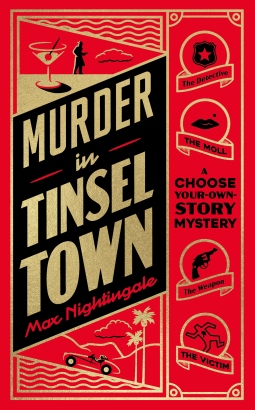
I used to love Choose Your Own Adventure books as a child – who else remembers them? – so when I saw this new adult version of the same concept, I couldn’t wait to read it. Murder in Tinseltown is set in Los Angeles in the 1950s and the reader takes on the role of a detective investigating the murder of an actress. At various points in the story you’ll have the opportunity to choose your own actions and decide what happens next, either by turning to different numbered pages or, in the Kindle edition I read, simply clicking on a link.

You start your adventure at LAPD headquarters on the weekend of the Golden Star Awards when some of Hollywood’s biggest stars have descended on the city. It’s a busy day in the squad room, but when a disturbing call comes through from the Royal Premiere Hotel – “Trouble…hurt…not my fault…help…it’s them…I’m sorry…” – you head straight to the hotel to investigate. You arrive just in time to learn that one of the waiters has discovered Blanche Aikerman, probably the world’s most famous actress, stabbed to death in her room. After witnessing the dead body for yourself, you accompany the hotel manager to the suite of Peter von Hiltz, Blanche’s director, to give him the news. However, he doesn’t answer the door. What will you do next?

This is where the interactive part of the novel begins. Will you ask the manager to let you into von Hiltz’s room? Will you return to the crime scene to look for more clues? Or would you prefer to interview the waiter who found the body? Each option takes you to a different location in the book and the story continues from there until you reach another turning point and are presented with a new set of choices. It could and should have been a lot of fun working through the book and trying to solve the mystery – unfortunately, there were some problems with the structure which made the whole experience less satisfying than I’d hoped.

Maybe there was one route I could have followed through the novel where the story would have flowed perfectly, but surely somebody should have checked that all of the other possible routes also made sense. Early on, I saw a character die right in front of my eyes at an airport – then I returned to the hotel, where that same character was still walking around alive and well as if nothing had happened. Similarly, I found the murder weapon and then someone else found it again later in the book. Looking at other reviews, it seems that most of us noticed those same two things so I’m not sure how they weren’t picked up on by the author or an editor. Also, there are several outcomes where you die, but instead of the book ending as you would expect, you just come straight back to life and are directed to the ‘correct’ option so the story can continue.

From a nostalgia perspective, it was nice to have the opportunity to read a book like this, but I’m disappointed that it didn’t work as well as it could have done.

Thanks to HarperNorth for providing a copy of this book for review via NetGalley.

The Labyrinth House Murders by Yukito Ayatsuji

Translated by Ho-Ling Wong

This is a good example of why it’s often worth giving an author a second chance. I was disappointed with Ayatsuji’s The Decagon House Murders, finding the characters very wooden and the plot a poor imitation of And Then There Were None, so I had decided to stick with Japanese crime authors more to my taste, such as Seishi Yokomizo. Then I read lots of glowing reviews of The Mill House Murders, the second in Ayatsuji’s series to be released in a new English translation, so when I saw the third one, The Labyrinth House Murders, on NetGalley I decided to give him another try.

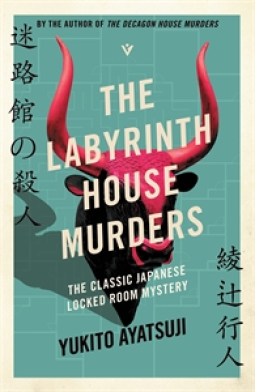
The Labyrinth House, we are told, is the work of the same architect who designed the Decagon House and the Mill House. As its name suggests, the house contains a labyrinth of passageways with the rooms arranged around the edges, so that to get from one room to another it’s necessary to enter the maze. The design is inspired by the Minotaur myth and all of the rooms are named after characters associated with the myth. This very unusual house is the home of the mystery writer Miyagaki Yōtarō.

Miyagaki is in poor health but, as the novel opens, he is preparing for his sixtieth birthday and has invited a group of friends and colleagues to celebrate with him at the Labyrinth House. These include four younger crime authors whom Miyagaki has mentored, a literary critic, his editor Utayama and his wife – and a friend, Shimada Kiyoshi, who is the series detective. As the guests assemble at the house, they are greeted by Miyagaki’s secretary, who gives them the shocking news that their host has committed suicide, leaving them a recorded message to listen to. The recording instructs them not to leave the house or call the police for five days and in the meantime the four authors must each use the time to write a detective story. The four stories will be judged by the other guests and the winner will inherit part of Miyagaki’s fortune.

This book was much more fun than The Decagon House Murders. Although the plot is obviously very contrived, that didn’t bother me and I found it easy enough to just suspend disbelief and accept the premise. Once the story writing competition begins, murders start to take place (in very imaginative ways) and I was completely gripped until the end. My only real criticism is that one of the clues to the solution is something that only a man would think was plausible; Ayatsuji should maybe have discussed it with a woman first before basing a key plot point around it. Sorry to be vague!

I loved the setting of the Labyrinth House and the way so many aspects of the Minotaur myth are worked into the plot. A map of the house is included to help the reader appreciate the layout of the rooms and the labyrinth (and this is where I wished I had a physical copy of the book instead of the ebook). The house has an eerie, unsettling atmosphere and I worried for the characters every time one of them went wandering off on their own! Being originally published in 1988, there are also lots of little details that set the book in that period: the way everyone smokes indoors; the word processors the authors use with floppy disks to save their work; the landline telephones that can so easily (in crime novels, anyway) become cut off from the outside world.

The characters have a bit more depth than the ones in The Decagon House, although I’m finding that characterisation doesn’t seem to be a strong point in any of the older Japanese crime novels I’ve read. Most of the book is written from Utayama’s perspective, although Shimada is the one who does the detective work – and, thankfully, explains some of his deductions to Utayama as he goes along so that the reader can follow what’s happening. And did I manage to solve the mystery? Well, no, I didn’t, but Ayatsuji conceals an important piece of information from us until the end of the book, so I don’t really consider this a fair play mystery anyway. There are also multiple plot twists and a story-within-a-story structure, just to make things even more difficult!

I’m pleased to see that the next book in the series, The Clock House Murders, is being published by Pushkin next year and also pleased that they’re sticking with Ho-Ling Wong as translator, as he’s done such a great job with this one. Meanwhile, I’ll go back and read The Mill House Murders, in the hope that for some reason it was only The Decagon House I didn’t connect with.

Thanks to Pushkin Vertigo for providing a copy of this book for review via NetGalley.

This is my sixth and final book for this year’s RIP XIX challenge.

The Bells of Westminster by Leonora Nattrass

I’ve enjoyed all three books in Leonora Nattrass’ Laurence Jago series (Black Drop, Blue Water and Scarlet Town) and was hoping for a fourth, but it seems she’s moved on to other things, at least temporarily. Like the Jago books, The Bells of Westminster is set in the 18th century but is a completely separate story with a new set of characters to get to know.

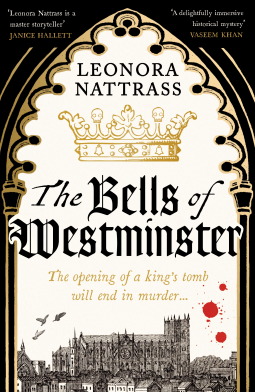
It’s 1774 and King George III has just given his permission for the Society of Antiquaries to open the tomb of Edward I, who rests in Westminster Abbey. The Society wants to discover whether Edward’s body was embalmed, according to his wishes, and whether he was buried with any valuable artifacts. However, the opening of the tomb sets in motion a series of bizarre events: first, a ghostly figure is seen wearing the dead king’s crown, then one of the Antiquaries is found dead and Edward’s body is stolen. Mr Bell, the Dean of Westminster, is given the job of investigating, but his daughter Susan knows he’s not capable of solving the mystery and it will be up to her to solve it for him.

The novel is narrated by Susan Bell who, at twenty-three, is already considered a spinster. Her father would like her to marry her cousin Lindley, an aspiring scientist who is staying with them at the Deanery, but Susan isn’t sure what she thinks of him – and anyway, she’s quite happy with the company of her talking parrot, Cuthbert. Susan’s narration takes the form of diary entries, through which we see the mystery unfold as well as gaining some insights into life within the confines of Westminster Abbey.

I’ll be honest and say that at first I didn’t think I was going to enjoy this book. I had trouble connecting with Susan’s narrative style, peppered with notes and asides, which seemed to be trying very hard to be clever and witty. It also took a long time for the story to really get started, but once the murder happened about a quarter of the way into the book, I became drawn in. Susan’s narration also grew on me after a while and I found I liked her much more than I thought I would at the beginning.

Nattrass explains in her author’s note which parts of the book are based on fact and which are invented. The opening of Edward I’s tomb in 1774 really happened, for example – although the body wasn’t stolen and a ghost didn’t really appear! The characters are also a mixture of real people and fictional ones (Susan Bell is one of the latter). One thing that’s completely real, of course, is the setting: with the whole book being set within Westminster Abbey and its grounds, there are lots of detailed descriptions of the chapels, arches and galleries as well as the various tombs and shrines.

The eighteenth century was also a time of major scientific developments and Nattrass is able to explore some of these through Lindley’s interest in science. In particular, we see how a knowledge of science can work along with – and sometimes in conflict with – superstitions, religion or fear of the supernatural. This is a fascinating novel, then, and although I would still have preferred another Laurence Jago book, I did enjoy this one once I got past the slow, uncertain start!

Thanks to Viper for providing a copy of this book for review via NetGalley.

Book 47/50 for the Historical Fiction Reading Challenge 2024

Ordeal by Innocence by Agatha Christie

The September choice for the Read Christie 2024 challenge is Ordeal by Innocence, a book which, along with Crooked House, Christie herself named as one she felt most satisfied with. It was first published in 1958 and is a standalone novel, with no Poirot, Miss Marple or any of Christie’s other recurring characters.

The novel begins with Dr Arthur Calgary visiting the Argyle family at their home, Sunny Point, to give them what he hopes will be some very welcome news. Two years earlier, Jacko Argyle was found guilty of the murder of his adoptive mother. Although he claimed to have an alibi, he was unable to prove it and was sentenced to life imprisonment. Now, Dr Calgary has come forward to confirm that he was with Jacko at the time of the murder, therefore he couldn’t have committed the crime. Calgary seems to have a valid reason for not speaking out sooner – a head injury affecting his memory, followed by a long trip to the Antarctic – but it’s now too late to help Jacko, who has died of pneumonia in prison. Still, Calgary hopes his belated evidence will bring some comfort to the family. However, it has the complete opposite effect…because if Jacko didn’t kill Mrs Argyle, who did?

This is a novel driven by characters, personalities and motives rather than one with a lot of plot. Most of the book is made up of conversations between various members of the Argyle household as they discuss amongst themselves and with Superintendent Huish the events that took place the night of Mrs Argyle’s murder and who they think could be responsible. There’s the dead woman’s husband, Leo Argyle, who is now planning to marry his secretary, Gwenda; there are the other four adopted Argyle children, Mary, Micky, Tina and Hester, all now adults who have had one reason or another to resent their adoptive mother; and Kirsten Lindstrom, their Swedish nurse who has been with the family for many years. It (unbelievably) doesn’t seem to occur to Dr Calgary, until it is pointed out to him, that by clearing Jacko’s name he has simply cast suspicion on the rest of the family again, but this becomes a major theme of the book – the idea that only the guilty person knows the truth, therefore it’s the innocent who suffer the most:

“The family would come under suspicion,” he said, “and it might remain under suspicion for a long time – perhaps for ever. If one of the family was guilty it is possible that they themselves would not know which one. They would look at each other and – wonder… Yes, that’s what would be the worst of all. They themselves would not know which…”

Another theme Christie tackles in this book is adoption and the question of nature vs nurture. Sadly, her opinion of adoption seems to be quite a negative one, with several characters stating that the relationship between a child and their adoptive mother can never be as strong as with their biological mother. It’s also strongly implied that some of the Argyle children have criminal tendencies because they’ve inherited those traits from their birth parents and are destined to be bad people regardless of how much love and attention they receive from their adoptive parents. These are not views I agree with, but clearly they are subjects Christie was interested in and wanted to explore in this novel.

As a standalone, I think this book suffers from not really having a character who does any ‘detecting’. Dr Calgary does take on this role eventually, wrapping things up for us in the final chapter, but otherwise we don’t see much of Superintendent Huish and the only member of the Argyle household who shows any interest in trying to solve the crime is Mary Argyle’s husband, Philip. There’s not much action until very late in the book, so most of the focus is on the characters discussing their memories of Mrs Argyle and what they were doing at the time of her death. In this respect, the book reminded me of Five Little Pigs, another Christie novel which deals with a mystery from the past.

Next month, and for the rest of the year, the Read Christie challenge will be moving on to books published in the 1960s and 1970s. I have plenty of those still to read!

I’m counting this as my first book towards this year’s RIP challenge.

Cabaret Macabre by Tom Mead

After enjoying the first two books in Tom Mead’s Joseph Spector mystery series, Death and the Conjuror and The Murder Wheel, I was pleased to see that he had written a third one. I think this might even be my favourite of the three! If you haven’t read any of them, you could start here if you wanted to; although there are some references to Spector’s earlier cases, there are no spoilers and all three mysteries work perfectly as separate standalones.

It’s December 1938 and retired magician Joseph Spector has been approached by the wife of Sir Giles Drury, a prominent judge, who wants him to identify the sender of some threatening letters. She believes the culprit may be Victor Silvius, who attacked her husband nine years earlier and has been confined in a private sanatorium ever since. Having noted Spector’s involvement in solving the recent Dean case (described in The Murder Wheel), she hopes he will be able to find out who is behind the letters.

Coincidentally, Spector’s friend Inspector Flint of Scotland Yard has had a visit from Caroline Silvius, sister of Victor Silvius. Caroline believes someone is trying to murder her brother and she’s convinced that person is Sir Giles Drury. With Spector and Flint both investigating the same situation from opposite sides, it’s inevitable that their paths will cross. Arriving at Marchbanks, the Drurys’ country estate, during a period of heavy snow, both men are baffled when a member of the family is found dead under very unusual circumstances. Can they solve the mystery before another murder takes place?

I really enjoyed Cabaret Macabre. It’s very cleverly plotted, with not one but two locked room style murders for Flint and Spector to investigate, but unlike the previous book, which I found too complicated, this one was easier for me to follow. That doesn’t mean it was easy to solve, however, because it certainly wasn’t! I had no idea how the murders were carried out or who was responsible for them, even though the clues were all there in the text. Tom Mead really is a master of this type of mystery and it’s easy to see the influence authors like John Dickson Carr and Agatha Christie have had on his work.

The book has a large number of suspects (and also potential victims) including Sir Giles, his wife and their four sons and stepsons, Victor and Caroline Silvius and an assortment of servants at Marchbanks. There’s also another murder case – or was it suicide? – from nine years earlier (the source of the animosity between Victor and Sir Giles), which could provide the key to what’s happening in the present. It’s impressive that Mead manages to pull all of this together without leaving any obvious holes in the plot. What I particularly love about this series, though, is the idea of a former magician becoming an amateur detective and using his special knowledge of illusions and deceptions to solve crimes and assist the police. Although Spector is still something of a mystery himself and reveals very little of his past or his private life, I think he’s a great character and the perfect partner for the more practical, less imaginative Inspector Flint.

If you haven’t tried a Joseph Spector book yet and are a fan of Golden Age mysteries, I do recommend them; this one and the first one, in particular, have quite an authentic 1930s feel, as well as being fun and entertaining. I’m hoping there’ll be more!

Thanks to Head of Zeus for providing a copy of this book for review via NetGalley.

Book 39/50 for the Historical Fiction Reading Challenge 2024

This is book 20/20 of my 20 Books of Summer 2024.

Yes, I have completed my 20 Books of Summer list with nearly a week to go! I’ll be looking back at my 20 books and my experience with this year’s challenge in a special post at the end of the month.

The Golden Tresses of the Dead by Alan Bradley

I had thought this book, published in 2019, was going to be the last in Alan Bradley’s Flavia de Luce series, so I hadn’t rushed to read it, thinking that once I had I would have no more to look forward to. Then I discovered that there’s actually another book coming in September – which will be the eleventh in the series – and decided to pick this one up now in preparation.

The Golden Tresses of the Dead begins in 1952 with our twelve-year-old heroine Flavia de Luce attending the wedding of her elder sister, Ophelia (known as Feely). I won’t tell you who she’s marrying, in case you haven’t reached this point in the series yet – or haven’t started at all. Everything is going well, apart from the usual naughtiness of Flavia’s annoying little cousin, Undine, but when Feely steps forward to cut into her wedding cake she screams in horror. There’s a human finger inside the cake! As Feely retreats to her room to recover from the shock, Flavia whisks the finger away to her laboratory so she can examine it and try to identify its owner.

The next day, Arthur W. Dogger & Associates, the new detective agency Flavia has formed with her father’s friend and manservant Dogger, receives its first client. A Mrs Prill is trying to track down some stolen letters and wants Flavia and Dogger to help. When they begin investigating, however, they discover that Mrs Prill hasn’t been entirely honest with them. Are the letters really missing – and could there be any connection with the severed finger in the cake?

As I’ve come to expect from the Flavia de Luce books, The Golden Tresses of the Dead (the title comes from Shakespeare’s Sonnet 68) is a quick, entertaining read; I did enjoy it, but it’s not one of the strongest and I think if I didn’t know there was another book on its way, I would have been disappointed with this one as a conclusion to the series. In general, I think the earlier books are more fun and have more charm than the later ones, so if you still haven’t tried one I would recommend going back to the beginning and starting with The Sweetness at the Bottom of the Pie.

Although this book has many of the same elements as most of the others in the series – it’s set, as usual, in and around the small English village of Bishop’s Lacey in the 1950s; Flavia still gets around on her trusty bicycle, Gladys; she still loves chemistry and conducting experiments in her fully equipped laboratory – there are also some differences. Feely leaves for her honeymoon early in the book and Flavia’s other sister, Daffy (Daphne), is tucked away working on her memoirs and only makes one or two brief appearances. The relationship between Flavia and her two sisters is one of the things that has always fascinated me about the series, so I was sorry that it’s not really explored any further here. We do see a lot of Undine, but I’ve never liked her and she doesn’t make up for the absence of Feely and Daffy! Also, as hinted at in the previous book, The Grave’s a Fine and Private Place, crime-solving is no longer a solitary activity for Flavia and she forms a new partnership with Dogger. It works well – Flavia does most of the trespassing, risk-taking and hunting for clues, but Dogger, with the benefit of age and life experience, knows how to interpret those clues. I’ve always loved him and was pleased to see him take such a prominent role in this book.

The mystery itself is complex, involving potential grave-robbing, poisonous plants and two missionaries who may not be quite what they seem, and I’ll admit that I found it confusing and didn’t really understand how everything tied together. I wondered if I just hadn’t been paying enough attention and had missed something, but looking at other reviews it seems that a lot of people had similar problems. This is not a favourite Flavia de Luce book, then, and I’m glad it’s not how the series ends! I’m looking forward to reading book eleven, What Time the Sexton’s Spade Doth Rust, and am hoping it will be better than this one.

Book 38/50 for the Historical Fiction Reading Challenge 2024

A Case of Mice and Murder by Sally Smith

After finishing Sally Smith’s A Case of Mice and Murder I was delighted to find that it’s the start of a new historical mystery series, which is great news as this first book is excellent. I hope we don’t have to wait too long for a second!

The novel is set in 1901 in the Inner Temple, one of the four Inns of Court that make up London’s legal community. Sir Gabriel Ward KC is a barrister who leads a quiet, reclusive life within the Temple grounds, only venturing into the outside world when absolutely necessary. He’s not the sort of person you would expect to become an amateur detective, but that’s what happens when he steps out of his rooms early one morning in May and stumbles across the dead body of the Lord Chief Justice. Sir Gabriel is persuaded by his superiors to investigate before the police are brought in and he reluctantly agrees, despite already being busy with a very different case.

The manuscript of a children’s book, Millie the Temple Church Mouse, had been left at the door of Herbert Moore’s publishing house with no way of identifying or contacting the author. Moore went ahead with publishing the book anyway and it has become a huge success, inspiring Millie toys and a forthcoming stage play. Now a woman has come forward claiming to be the author and Moore is in trouble! Gabriel is Moore’s lawyer and must work on establishing authorship of the book while also trying to solve the mystery of the Lord Chief Justice’s death.

When writing a novel set in the past, creating a sense of time and place is incredibly important and Sally Smith does that extremely well here. She writes in a style that is appropriate to the time period and at no point does it really feel like a ‘modern’ book. The descriptions of the Inner Temple are perfect, both in terms of the physical buildings, chambers and grounds, and the way of life with its rituals and traditions. The Inner Temple, like the neighbouring Middle Temple, is considered a local authority largely outside the jurisdiction of the City of London (hence the police needing to be invited in to investigate the murder) and it makes a fascinating and unusual setting.

Gabriel Ward is a great character and it’s interesting to see him grow as person as the story progresses. At the beginning he is a quiet, solitary man who spends most of his time in his rooms with his books and his legal work, following little routines, such as checking the door three times, that today would be called an OCD. Being forced to leave the confines of the Temple to interview suspects and witnesses from a range of social backgrounds gives Gabriel a different perspective on life and helps him to open up to new ideas. My only complaint is that Smith gives him the character trait of ‘snuffling’, a word she repeats far too often throughout the book. Looking at other reviews, I can see that many of us felt the same way, so I hope Gabriel will snuffle a bit less often in the next book!

The murder mystery is an interesting one, with a solution I hadn’t seen coming, but I found the Millie the Mouse storyline even more enjoyable. I started to have my suspicions about that second mystery by the middle of the book and was pleased to be proved right. I can’t wait to see what Gabriel’s next case will be!

Thanks to Raven Books for providing a copy of this book for review via NetGalley.

This is book 13/20 of my 20 Books of Summer 2024.

Book 30/50 for the Historical Fiction Reading Challenge 2024