N or M? by Agatha Christie

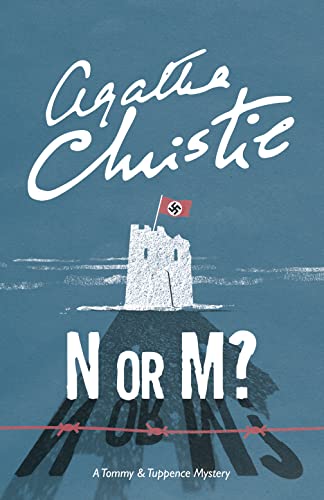
This month – and in August and September – the Read Christie challenge is moving on to books published in the 1940s and 1950s. I have several unread Christies from those decades to choose from, but I decided to start with N or M?, a Tommy and Tuppence novel from 1941. I enjoyed the first two T&T books, The Secret Adversary and Partners in Crime, and this is the third in the series.

I think this is a series best read in order as, unlike Poirot and Miss Marple, Tommy and Tuppence age almost in real time; they were in their early twenties in 1922’s The Secret Adversary and when we join them at the beginning of N or M? they are over forty. Their advancing age has become a source of frustration to them now that the world is at war and it seems that they are too old to make any meaningful contribution. Then, Mr Grant, a secret agent, arrives with an intriguing proposition for Tommy. He must travel undercover on behalf of the Secret Service to a boarding house on the south coast of England in search of two German spies, one male and one female, known only by the initials N and M. The mission must be kept secret from everyone, including Tuppence, who is told that Tommy is being sent to Scotland to take up a boring office job. However, Tuppence is already one step ahead and determined not to miss out on the excitement!

N or M? is more of a thriller/espionage novel rather than a traditional detective novel, which made a nice change from my last two Read Christie selections, which have both been Poirot mysteries. One of the good things about diving into Christie’s books more or less at random as I have been doing over the last few years is that there’s enough variety within her body of work that you never really get bored. However, there’s still a mystery to be solved here – the mystery of the true identities of N and M – and plenty of clues to look out for. I found it very easy to identify one of the spies (and was frustrated that Tommy and Tuppence didn’t work it out as quickly as I did), but I didn’t guess the other one so there were still some surprises in store for me.

With most of the novel being set in and around the Sans Souci boarding house, this means all of the suspects are together in one place, giving Tommy and Tuppence plenty of opportunities to observe them. The most obvious is Carl von Deinim, a German refugee and research chemist, but is he too obvious? The other guests include a larger than life Irishwoman, a retired Major, an invalid and his wife, and a young mother with her two-year-old daughter. Literally anybody could be a spy and Christie does a great job of capturing the sense of danger, mistrust and paranoia. I was quite worried for Tommy and Tuppence at times, even though I knew they must survive as there are more books in the series!

I’ve found that the other Christie novels I’ve read that were published during this same time period barely mention the war, if at all, so it was unusual to find one in which the war is such a central part of the plot and affects the lives of the characters in so many ways. I really enjoyed it and am looking forward to reading the next Tommy and Tuppence book, By the Pricking of My Thumbs – although not just yet, as it’s published in 1968 and we’ll be staying in the 40s and 50s for the next two months.

This is book 11/20 of my 20 Books of Summer 2024.

The Meiji Guillotine Murders by Futaro Yamada

Translated by Bryan Karetnyk

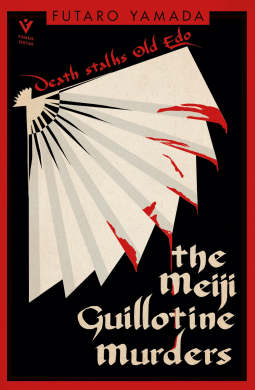
It’s 1869 and Japan has entered the Meiji era. The Tokugawa shogunate has fallen and the Emperor Meiji has been restored to the throne. After centuries of isolation, Japan is finally opening up to foreign trade and undergoing social, industrial and military reform. In Tokyo, a group of corrupt rasotsu (policemen) have found ways to exploit this period of change and upheaval for their own gain. With the arrival of two Chief Inspectors from the Imperial Prosecuting Office, Kawaji and Kazuki, it seems that the rasotsu will be forced to mend their ways – although the two men have other things to occupy their time as well as dealing with corruption.

With a number of bizarre murders taking place around Tokyo, Kazuki and Kawaji (based on a real person who is considered the founder of Japan’s modern police system) engage in a friendly competition to see who can solve the crimes first. A separate chapter is devoted to each case, which at first seem to be unrelated, making the book feel almost like a collection of short stories. There are five cases for the two detectives to solve, with the help of Esmeralda, a young Frenchwoman from a family of executioners whom Kazuki has brought to Japan along with that most deadly of French weapons: the guillotine. Despite the title, the guillotine is not necessarily used to carry out all of the murders in the book, but it represents the changes that Japan is experiencing as the country becomes exposed to modern, western influence. It also provides a reason for Esmeralda’s presence in Tokyo, which is important as she has a significant role to play in the solving of the mysteries.

The Meiji Guillotine Murders was first published in 1979 and is one of several Japanese crime novels that have recently been made available in English by Pushkin Press. However, although I’ve loved some of the others, I didn’t enjoy this one quite as much. Bryan Karetnyk’s translation is clear and readable (I’m already familiar with his work through some of his other translated novels), but I had problems with other aspects of the book. I struggled with the number of characters, particularly as so few of them have clearly defined personalities and with more and more of them being introduced with each new case the detectives investigate. My lack of engagement with the characters made it difficult for me to concentrate on following the plot, which is important as all of the separate cases are quite complex and you do need to be paying attention! I persevered and was rewarded with the final section of the book where, after some surprising twists and turns, everything is tied together perfectly.

I did like the historical setting of the book and felt I was learning a lot about Japan during the Meiji era. At times it seemed more like historical fiction than a murder mystery, which was fine with me, but I think someone picking the book up expecting a more traditional crime novel may be surprised by the amount of historical detail. It’s an interesting, unusual book, and although I’m not sure whether I would read any more by Yamada, I do hope more of them are translated into English for those readers who loved this one. I’m enjoying discovering Japanese crime authors through Pushkin and so far my favourites have been Seishi Yokomizo and Akimitsu Takagi.

Thanks to Pushkin Vertigo for providing a copy of this book for review via NetGalley.

This is book 7/20 of my 20 Books of Summer 2024.

Book 24/50 for the Historical Fiction Reading Challenge 2024

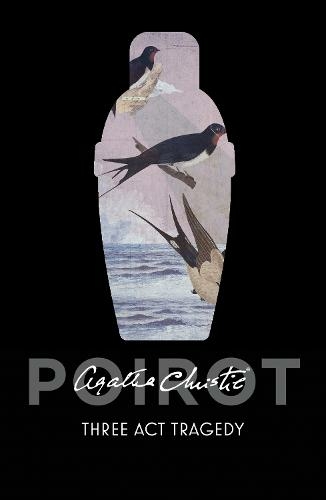
Three Act Tragedy by Agatha Christie

This month for the Read Christie challenge we are reading Christie novels published in the 1930s and I have chosen Three Act Tragedy from 1934. The book was also published in the US as Murder in Three Acts and that’s not the only difference – apparently the motive for one of the murders was also changed for the US edition. I’m not sure if there are any other Christie novels with significant differences between editions or if this is the only one.

Three Act Tragedy is a Poirot mystery but also features one of Christie’s other recurring characters, Mr Satterthwaite, who appears in The Mysterious Mr Quin and Murder in the Mews. At the beginning of the novel, Satterthwaite and Poirot are both attending a dinner party hosted by the stage actor Sir Charles Cartwright at his home in Cornwall. When one of the other guests, the Reverend Babbington, suddenly drops dead after taking a sip of his cocktail, several people suspect murder – yet there are no traces of poison in his glass. Soon afterwards, another death occurs under similar circumstances at a party attended by many of the same guests, but this time the victim is confirmed to have died from nicotine poisoning. Are the two deaths connected and if so, did the same person carry out both murders?

This is another entertaining Christie novel; maybe not one of her strongest plots, but the motive for the first murder is very unusual and I didn’t guess either that one or the motive for the second murder. I did start to suspect who was responsible, but not until much later in the book, so I can’t claim to have solved the mystery. We don’t see very much of Poirot himself as this is one of the books (like Lord Edgware Dies, which I read last month) where he sits at home and waits for other characters to provide him with information, rather than going out to interview suspects and search for clues himself. Instead, the deaths are investigated by Mr Satterthwaite and Sir Charles, with help from Miss Lytton Gore, affectionately known to her friends as Egg.

I would have liked Poirot to have played a bigger part in the story as although I like the elderly Mr Satterthwaite, he’s not very skilled at detecting, and I never really felt fully engaged with either Sir Charles or Egg. There’s an interesting cast of supporting characters, such as Muriel Wills, who writes plays under a male pseudonym, but I felt that some of these weren’t really used to their full potential. This wasn’t a favourite Christie, then, but I did still enjoy it – and it was good to see Poirot sharing a little bit of his personal history in a conversation with Satterthwaite, as he usually reveals very little about himself.

Next month for the Read Christie challenge (and for August and September as well) we are moving on to the 1940s and 1950s. There are plenty of books I still have to read from those decades, but one I definitely have lined up is N or M?, the third in the Tommy and Tuppence series. I’m hoping to make that one a July read.

This is book 5/20 of my 20 Books of Summer 2024.

Lord Edgware Dies by Agatha Christie

This year’s Read Christie challenge has a ‘Through the Decades’ theme and this quarter we’re reading books from the 1930s. My choice for May is Christie’s 1933 Poirot mystery Lord Edgware Dies (published in the US as Thirteen at Dinner).

The novel is narrated by Poirot’s friend, Captain Hastings – a nice surprise as I tend to love the Hastings books and hadn’t realised he was in this one. At the beginning of the book, Poirot and Hastings are visiting the theatre to watch a performance by the American impressionist Carlotta Adams, known for her impersonations of famous people such as the actress Jane Wilkinson. After the show, they are approached by Jane Wilkinson herself, who asks for Poirot’s help in obtaining a divorce from her husband, Lord Edgware. The actress desperately wants to marry the wealthy Duke of Merton and tells Poirot that if Edgware won’t agree to a divorce, she’s just going to have to kill him!

When Lord Edgware is indeed found dead in his own home, having been stabbed in the neck, Jane Wilkinson appears to be the obvious suspect – after all, she was seen entering the house that evening and everyone knew that she wanted her husband dead. However, Edgware had already agreed to a divorce earlier that day, taking away Jane’s motive. And Jane had spent the whole of that evening at a dinner party with twelve other guests, all of whom can provide her with an alibi. Was Jane really in two places at once – or was it Carlotta Adams who entered Lord Edgware’s house in disguise?

This is a very enjoyable Poirot novel with a clever solution, although I don’t think it’s an absolute favourite as I found it a little bit lacking in atmosphere. The whole story takes place in London and we don’t see much of Poirot actually going out in search of clues – instead he sits and waits for the clues to come to him, much to the frustration of Hastings who wishes Poirot would take a more active role in solving the mystery, like their old friend Inspector Japp:

Poirot replied that he preferred to solve it sitting at home.

“But you can’t do that, Poirot.”

“Not entirely, it is true.”

“What I mean is, we are doing nothing! Japp is doing everything.”

“Which suits me admirably.”

“It doesn’t suit me at all. I want you to be doing things.”

“So I am.”

“What are you doing?”

“Waiting.”

Of course, Poirot is the one who correctly identifies the murderer while Japp, as usual, jumps to the wrong conclusions. I also failed to solve the mystery; although I did guess part of the solution very early on, I allowed myself to get distracted by the red herrings, of which there are many!

What I particularly loved about this book was the relationship between Poirot and Hastings and the way they work so well together, with some chance remarks of Hastings’ inadvertently pointing Poirot in the direction of important clues. Having the novel narrated by Hastings means the reader gets to hear Poirot discussing possible theories with him and sharing his thought processes, which I find more enjoyable than the books where we have no idea what Poirot has been thinking until the end. It also means that we only see the various suspects and witnesses from Hastings’ perspective; Jane Wilkinson, for example, presents herself in public as so silly and vacant that we know there must be more to her than meets the eye. Jane is a great character and Jenny Driver, Carlotta Adams’ friend who owns a fashionable London hat shop, was another favourite.

I’m hoping to read another 1930s Christie novel in June, then for July-September we move on to the 40s and 50s!

Close to Death by Anthony Horowitz

At some point in our lives, many of us will have to deal with the problem of difficult neighbours. Loud music and late-night parties, badly-behaved children, disputes over parking and damage caused by cats and dogs are all things that can make life stressful – but most of us wouldn’t resort to murder as a solution. However, that is exactly what seems to have happened at Riverview Close, a street of six large, luxurious houses in an affluent area of London.

The residents of Riverview Close include a doctor, a dentist, a retired lawyer, a chess grandmaster and two former nuns, all of whom have been getting on well together and leading peaceful lives. Everything changes with the arrival of Giles Kenworthy and his family, who are noisy and inconsiderate and succeed in annoying everyone else in the Close. When the residents learn that the Kenworthys are planning to cut down a beautiful tree and build a new swimming pool in its place, they decide to hold a meeting to discuss the situation – but a few weeks later the problem is solved anyway, as Giles is found dead, having been shot with a crossbow.

Five years later, author Anthony Horowitz (who uses himself as a character in his own novels) is looking for a subject for his new book. His previous four have been accounts of mysteries he has investigated alongside the private detective Daniel Hawthorne, but it seems there are no new mysteries to solve – and his publisher is putting pressure on him to start writing. Anthony decides to write about one of Hawthorne’s older cases instead, which happens to be the murder of Giles Kenworthy. Hawthorne agrees to share the details of the investigation with him, but warns him that the ending isn’t very satisfactory.

With large sections of the book set in the past and written in the third person from the perspectives of the residents of Riverview Close, this means Horowitz himself plays a much smaller part in this novel than he did in the earlier books in the series (the first one is The Word is Murder, if you’re wondering). Although I love these books, I know there are a lot of readers who find it irritating and egotistical of Horowitz to use himself as a character, but I think that would be less of a problem with this particular novel.

Because we see less of Anthony, there’s also less time spent on his interactions with Hawthorne, which is a shame as that’s one of my favourite things about this series. I had hoped to learn more about Hawthorne as each book has been slowly adding to our understanding of his character and background, but there aren’t really any major revelations about him in this instalment. There are lots of other interesting characters to get to know, though, including the members of the various households that make up Riverview Close; I particularly enjoyed meeting the two old ladies, May and Phyllis, who used to be nuns but now own a tea shop/book shop that sounds like a great place to visit!

They did not stock any modern, violent crime novels, especially ones that contained bad language. A casual reader looking for Harlan Coben, Shari Lapena, Ian Rankin or even James M. Cain (The Postman Always Rings Twice) would have to continue down the hill to Waterstones at the corner. What they specialised in – exclusively – was cosy crime.

They also stocked a range of gifts that were all crime-related, including the Agatha Christie tea towel May had used to wipe her hands. Other novelties included a Sherlock Holmes magnifying glass, Midsomer Murders mugs and T-shirts, Cluedo jigsaw puzzles and a box of assorted chocolates marked ‘POISONED’, a tribute to the great novel by Anthony Berkeley.

The mystery itself is an interesting one as all of the suspects have the same motive – Giles Kenworthy’s selfish, inconsiderate behaviour – and although I was convinced I had guessed the culprit correctly, it turned out I was wrong. I did wonder why Horowitz (the character) didn’t just look up the solution to the murder on the internet rather than waiting for Hawthorne to tell him the story bit by bit and getting frustrated about not knowing the ending, but that’s just a minor quibble. I’ll look forward to the next book in this series, assuming that there’s going to be one, but I’ll also continue to hope for a new book in the Magpie Murders series!

Thanks to Century for providing a copy of this book for review via NetGalley.

Opening Night by Ngaio Marsh

Opening Night (also published as Night at the Vulcan) is the sixteenth book in Ngaio Marsh’s Inspector Roderick Alleyn series and like many of her novels has a theatrical setting, which makes it perfect for Reading the Theatre, hosted this month by Lory of Entering the Enchanted Castle.

Published in 1951, the novel opens with Martyn Tarne, a young woman from New Zealand, arriving in London to look for acting work. After an exhausting day of unsuccessful auditions and meetings with agents, she eventually finds herself at the door of the Vulcan Theatre where rehearsals are about to begin for a new play, Thus to Revisit. Disappointingly, the play has already been cast, but there’s a vacancy for a dresser to the leading actress, Helena Hamilton, and Martyn finds herself accepting the job.

The next 100+ pages (of a 240 page book) are devoted to describing the backstage preparations for the play, Martyn’s work as first a dresser and then an understudy, and the relationships and interactions between the various members of the cast. There is no hint of any crime until we reach the middle of the book and no sign of Inspector Alleyn either until after the halfway point. I think how much you enjoy this novel will depend on whether you picked it up just because you wanted to read a murder mystery or because you were drawn to the setting.

The crime, when it eventually occurs, involves the death on opening night of one of the actors, Clark Bennington, who is found unconscious backstage after inhaling gas. Suicide is assumed – everyone knows that Bennington has been unhappy and has a drinking problem – but when Alleyn arrives to investigate, he quickly decides that the man was murdered. There are plenty of suspects and motives; for a start, Bennington was married to Helena Hamilton, who has openly been having an affair with one of the other actors, Adam Poole. Also, Bennington is known to have had several heated arguments and altercations before and during the opening night. And to complicate things further, Martyn Tarne’s arrival at the Vulcan has not been welcomed by everyone, least of all Gay Gainsford, a young actress who feels that her role in the company is threatened by Martyn.

Although I would have preferred the murder to have come earlier in the book, once it does happen and Alleyn’s investigation gets under way, the mystery becomes quite an interesting and compelling one. I guessed who the murderer was, but not the motive – and I think it would be very difficult to work that out before it’s revealed right at the end of the book. The mystery is definitely secondary to the setting in this novel, though; Ngaio Marsh herself was a theatre director and her love and knowledge of the theatre comes through very strongly.

Have you read any of Marsh’s Inspector Alleyn novels, theatrical or otherwise? I’ve read very little of her work compared to other Golden Age crime writers so would love to hear your recommendations.

They Found Him Dead by Georgette Heyer – #1937Club

This week, Simon of Stuck in a Book and Karen of Kaggsy’s Bookish Ramblings are hosting another of their very popular clubs, where we all read and write about books published in the same year. This time it’s 1937 Club and for my first book I’ve turned to a favourite author who can be almost guaranteed to have had at least one title published in any chosen club year. In 1937, she had two and although An Infamous Army, a novel set before and during the Battle of Waterloo, is one I read a few years ago and didn’t particularly enjoy, I’m pleased to say that I had a much better experience with this one.

They Found Him Dead is one of twelve contemporary detective novels written by Heyer. It begins with the family, friends and business associates of Silas Kane assembling at his country house to celebrate his sixtieth birthday. As with many large gatherings, there are various tensions between members of the group, but when Silas is found dead at the bottom of a cliff after going out for his usual evening walk, the police decide that it was just a tragic accident. Only fourteen-year-old Timothy Harte, half-brother of Silas Kane’s nephew Jim, suspects murder – and when Kane’s heir, Clement, is shot in the head several weeks later, it seems that he could have been right.

Superintendent Hannasyde and Sergeant Hemingway arrive from Scotland Yard to investigate and quickly discover that there’s a large number of suspects including several nephews and nieces in the line of inheritance, some of Kane’s business partners and even his elderly mother, a woman in her eighties. However, they first need to decide whether they really are dealing with two murders or just one – and if there have been two, were they both committed by the same person?

I thought this was an entertaining novel, although I did panic at first due to the huge number of people introduced in the opening chapter. I wished I had drawn a family tree to keep them all straight in my mind, but after a few more chapters everything had settled down anyway and the characters and their relationships became more clearly defined. As a mystery it’s not a very clever or original one – in fact, it’s quite formulaic in many ways, with the country house, family party, motives revolving around inheritances and business deals and the Scotland Yard detectives all being very familiar to anyone who has read a lot of Golden Age crime. The murderer is also quite easy to guess, once you’ve picked up on one very obvious clue.

What I really enjoyed about this book was not the plot but the characters. I particularly loved Timothy, who has an active imagination leading him to see drama and conspiracy in every situation and is nicknamed Terrible Timothy by Sergeant Hemingway. He does actually help to solve the mystery, but not in the way he had expected! There’s also a bit of romance (although it’s quite understated and not a big part of the book), with Timothy’s half-brother, Jim Kane, falling in love with Patricia Allison, companion to Silas Kane’s mother. I liked these two characters as well; in general, the characters in this book are a more pleasant bunch than in the other Heyer mysteries I’ve read! A few of them also appear in her 1951 novel, Duplicate Death, which I read before this one and I’m now wishing I’d read them in the correct order!

I still have a lot of Heyer’s mysteries left to read and am looking forward to them. They don’t really compare to Agatha Christie’s when it comes to plotting a crime, concealing clues and creating red herrings, but they’re still fun to read. This was a great start to the 1937 Club for me and I’m also enjoying my second book, which I’ve almost finished and will be reviewing later in the week.