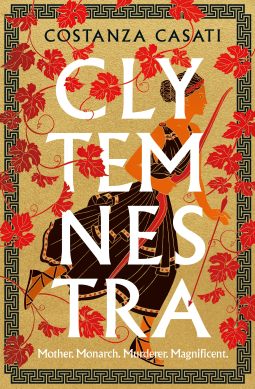
Clytemnestra by Costanza Casati

There are so many Greek mythology retellings around at the moment I thought this one might be too similar to others I’ve read recently (particularly Jennifer Saint’s Elektra) – but I needn’t have worried. With Clytemnestra, Costanza Casati makes a familiar story feel fresh and different, and as a debut novel it’s quite impressive.

Clytemnestra, Helen of Troy’s sister, is most often remembered as the wife of Agamemnon, the King of Mycenae who sacrifices their daughter Iphigenia to summon a wind so he can sail off to join the Trojan War. The heartbroken Clytemnestra takes her revenge on Agamemnon, which in turn provokes their other children, Electra and Orestes, to plot a revenge of their own. Casati’s novel does cover all of this, but a large part of the book is actually devoted to Clytemnestra’s early life as a princess of Sparta, daughter of Tyndareus and Leda, the King and Queen.

Like other Spartan women, Clytemnestra and her sisters are taught to fight, run and wrestle as children and grow up enjoying more independence and freedom than women elsewhere in Ancient Greece. This means that whenever life doesn’t go quite the way they hoped it would, they have the determination and the inner strength to take steps to change things. Early in the novel, a priestess delivers a prophecy that ‘the daughters of Leda will be twice and thrice wed…and they will all be deserters of their lawful husbands’ and over the course of the story we see this prediction begin to come true.

The thing I particularly enjoyed about this novel – and the thing that makes it different from others I’ve read – is that it focuses not just on Clytemnestra and Helen, whose stories are well known, but also on their other siblings. We get to know Castor and Polydeuces (sometimes called Pollux), their twin brothers who go in search of the Golden Fleece with Jason and the Argonauts, their sister Timandra, who marries King Echemus of Arcadia, and the two youngest sisters, Phoebe and Philonoe, who don’t have large parts to play but are not left out of the story either. By spending so much time on Clytemnestra’s childhood and her relationships with her family members, her character is given more depth, so that by the time she is married off to Agamemnon and the familiar, tragic part of her story is set into motion, we have come to know Clytemnestra well and to understand how her environment and upbringing have made her into the person she is.

Something else I found interesting was the portrayal of Clytemnestra’s first marriage to Tantalus, King of Maeonia, shown here to be a marriage made for love, in contrast to her later forced marriage to Agamemnon. Some versions of the Clytemnestra myth don’t make any reference to Tantalus at all, but including him here and showing how Clytemnestra’s life could have followed an entirely different course if he had lived adds another layer to the story.

Clytemnestra is written in present tense, which is never going to be a style I particularly like, but otherwise I found this book very enjoyable. I hope Costanza Casati will write more like this – if so, I think I’ll be adding her to my list of favourite modern Greek mythology authors, along with Natalie Haynes, Madeline Miller and Jennifer Saint.

Thanks to Michael Joseph for providing a copy of this book for review via NetGalley.
The Witch and the Tsar by Olesya Salnikova Gilmore

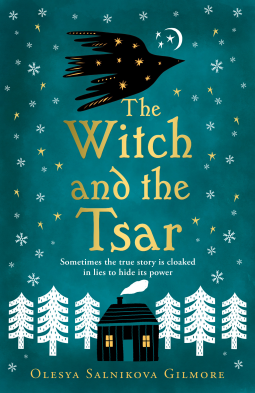
I was drawn to this book by the pretty cover, but also because it sounded similar to Katherine Arden’s Winternight trilogy, which I loved. Set in 16th century Russia, during the reign of Ivan the Terrible, The Witch and the Tsar is a blend of history, fantasy and folklore featuring as its heroine the legendary Baba Yaga. Unlike the traditional idea of Baba Yaga as a ferocious old witch who eats children, however, Moscow-born author Olesya Salnikova Gilmore’s portrayal is something very different.

We first meet Yaga, as she is known, living alone in a forest with her wolf Dyen, owl Noch, and Little Hen, a living hut who stands on chicken legs and has a mind of her own. Half-mortal and half-goddess, Yaga has been badly treated in the past so has chosen a life of solitude, interacting with other people only when they come and seek out her knowledge of healing and potions. She is reluctantly drawn back into society when an old friend, the Tsaritsa Anastasia – wife of Tsar Ivan IV – comes to her to ask for help. Convinced that Anastasia is being poisoned by someone at court, Yaga decides to accompany her friend on the journey back to Moscow to keep her safe.

Returning to the world from which she has hidden away for so long, Yaga is dismayed by the evil she senses all around her. Unsettled by an encounter with a former adversary, Koshey Bessmertny (usually known in Slavic myth as Koschei the Deathless), she is then introduced to Ivan Vasilyevich, the man who will later become Ivan the Terrible, and is struck by his power and volatility. When tragedy strikes the Russian court, Ivan becomes more unstable and launches a campaign of terror with his band of oprichniki burning, raiding and pillaging Russia’s towns and cities. It seems that Yaga is the only one who can stop him, but to do so she will have to learn things about herself and her family that she would prefer not to uncover.

I enjoyed some aspects of The Witch and the Tsar, but others not so much. I wasn’t sure what to think of Yaga herself. On the one hand, it’s good to see a much-maligned character given a more sympathetic interpretation; on the other, Gilmore’s Yaga has so little in common with the mythical Baba Yaga she’s really not the same character at all. Also, we are told that although she has the appearance of a young woman, she has actually lived for hundreds of years – yet she never sounds, thinks or behaves the way I would expect someone with centuries of wisdom and experience to sound, think and behave. She just feels like the young woman she appears to be.

It was interesting to see how Gilmore works characters from other Russian and Slavic myths into the story. As well as Koschei the Deathless, we meet Marya Morevna, Morozko the frost demon, the god Volos, the house spirit Kikimora and others. The fantasy/mythology element becomes very dominant in the second half of the book, more than I would have preferred, but Gilmore does a good job of tying it together with the historical storyline, showing how the actions of the gods and demons are linked to the actions of Ivan and his oprichniki. I was particularly intrigued by the character of Ivanushka, the Tsar’s son and heir; Yaga promises Anastasia she will protect him, but we know from history that his story will take a tragic turn.

I think The Witch and the Tsar is worth reading if you’re interested in Russian history and mythology, but naturally I couldn’t help comparing it to Katherine Arden’s trilogy (beginning with The Bear and the Nightingale) which I found much more enjoyable.

Thanks to HarperVoyager for providing a copy of this book for review via NetGalley.
Recent reads: The Drums of War; Ashes in the Snow; Ithaca

I’m falling behind with my reviews again, so here are my thoughts on three recent reads – all very different books.

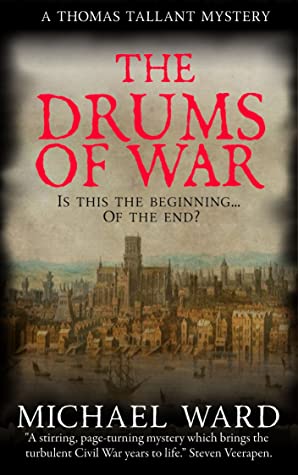
The Drums of War is the third in Michael Ward’s Thomas Tallant mystery series, continuing the story begun in Rags of Time and The Wrecking Storm. It also works as a standalone novel, so don’t worry if you haven’t read the first two in the series.

This third novel opens in London in 1642. With the divisions between King and Parliament becoming greater, England is rapidly heading towards Civil War and spice merchant Thomas Tallant and his friends are being forced to choose sides. Soon Tom finds himself assisting the Puritan leader John Pym in his search for a consignment of stolen gunpowder being smuggled out of London by Royalist forces. Meanwhile, Elizabeth Seymour is carrying out investigations of her own as she sets out on the trail of a mysterious jewel thief. Although Tom and Elizabeth are separated for most of the book and I missed their interactions, I did find both storylines interesting, particularly Elizabeth’s as she suffers a personal trauma and begins to fall back into some of her former bad habits as a result!

As with the first two books in the series, real historical figures appear alongside the fictional ones and as well as John Pym and the commander of the London Trained Bands, Philip Skippon, we also meet the scientist and physician William Harvey and are reacquainted with the intriguing Lucy, Countess of Carlisle. In the second half of the novel, the focus moves away from the mystery-solving for a while to concentrate on the events of the Civil War, particularly the battles of Edgehill and Brentford. This aspect of the story was of less interest to me, but that’s just down to personal taste (I’m not really a fan of battle scenes) and I still found this an enjoyable novel overall.

~

Ashes in the Snow is Oriana Ramunno’s debut crime novel, written in Italian and translated into English by Katherine Gregor. The book is set in Poland during World War II and begins with a young boy, Gioele Errera, finding the body of an SS officer in the snow. The man appears to have choked on an apple, but it soon seems that there is more to his death than that and German criminologist Hugo Fischer is summoned to investigate. Finding the murderer will not be easy, particularly as the dead man’s wife seems reluctant to cooperate, but Gioele agrees to help – if, in return, Hugo will help him to find his family from whom he has become separated.

This is a beautifully written and translated novel but not an easy one to read because, as we quickly discover, Gioele has a twin brother and the two of them have become subjects of the infamous Josef Mengele’s experiments. Of course this sort of thing is not supposed to be pleasant to read about, but I wasn’t really prepared for the level of detail Ramunno goes into in describing this and other parts of Gioele and Hugo’s stories. Hugo is an interesting and likeable character, a man suffering from a degenerative illness who must keep his condition a secret to avoid becoming a target of the Nazi regime himself. He’s an unusual detective and the crime element of the novel works well, but this book wasn’t for me.

~

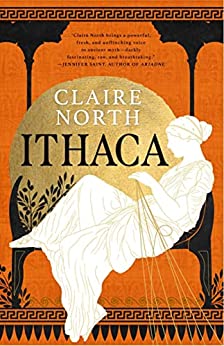
Ithaca by Claire North is the latest of many Greek mythology retellings based on the events surrounding the Trojan War. What makes this one different from the others I’ve read is that it focuses on the story of Penelope as seen through the eyes of the goddess Hera.

It has been seventeen years since Penelope’s husband Odysseus, King of Ithaca, sailed away to war with Troy and although the war is now over, she and her son, Telemachus, are still awaiting his return. Penelope is kept busy running the kingdom with the help of her women, while also trying to defend the island of Ithaca from raiders and fend off the attentions of the crowd of suitors who have descended upon her home in the hope of marrying her if Odysseus never comes back. Meanwhile, Penelope’s cousin Clytemnestra has fled to Ithaca looking for somewhere to hide after murdering her husband, Agamemnon.

Ithaca is quite a long novel and moves at a slow pace; it’s the first in a planned trilogy and Claire North takes her time setting the scene and introducing the characters. I liked the choice of Hera as narrator; she provides a different perspective on a well-known story and I enjoyed her observations of the mortal world and her interactions with other goddesses such as Athena. However, it does mean we are kept at a distance from Penelope herself, which could explain why I found it difficult to form any kind of connection with her – or with any of the other characters. For that reason, I don’t think I’ll be continuing with the second book. Claire North writes beautifully but I needed more than that to sustain my interest and I preferred Margaret Atwood’s The Penelopiad – I didn’t love that one either, but it was a shorter and more memorable read.

Kwaidan: Stories and Studies of Strange Things by Lafcadio Hearn

The next book I’ve read for this year’s R.I.P. XVII event is a fascinating and unusual collection of Japanese short stories, first published in 1904. The writer and translator Lafcadio Hearn was born in Greece and raised in Ireland, before later settling in Japan where he began to collect Japanese legends and folktales which he translated into English. Kwaidan: Stories and Studies of Strange Things contains seventeen of these tales, as well as three essays on insects – one on butterflies, one on mosquitoes and one on ants. These mainly focus on the role of the insects in Japanese and Chinese mythology, art, drama and poetry and are full of intriguing little snippets of information.

The other seventeen pieces are a mixture of ghost stories, fairy tales and strange anecdotes, some of which Hearn translated from old Japanese texts and others which he heard on his travels through Japan and attempted to put into words himself. For example, in his introduction, Hearn states that the story of Yuki-onna, in which a beautiful young woman in white appears to two woodcutters during a snowstorm, was told to him by a farmer in Musashi Province. Although the Yuki-onna character dates back centuries, Hearn’s account is based on this verbal version and not translated from any other source.

The creepier stories in the book are the ones that explore the different kinds of ghosts and monsters that appear in Japanese myth, such as the ‘faceless ghosts’ or noppera-bō, the human-like goblins called rokurokubi with detachable floating heads and the corpse-eating spirits known as the jikininki or ‘hungry ghosts’. These are interspersed with more traditional ghost stories, involving spirits returning after death to look for a loved one or to search for a lost possession. There’s also a great story recounting the legend of Hoichi the Earless, a blind musician who is tricked into playing his biwa (lute) for an audience of ghosts in a cemetery every night. If you want to know what happens to his ears, you’ll have to read the story!

Not all of the stories are particularly spooky, though – some are just, as the title suggests, ‘studies of strange things’. Of a Mirror and a Bell is an account of the legend of the Mugen-Kane bell which was made by melting down old bronze mirrors. Hearn then goes on to explore the Japanese concept of nazoraeru, where one item can be used as a substitute for another, to bring about magical results. There’s also a very short but beautiful story about a pair of oshidori, or Mandarin ducks, and another I enjoyed is The Dream of Akinosuke, about a man who falls asleep and dreams that he is the ruler of his own island province. This story incorporates both butterflies and ants, which makes the insect essays at the end of the book feel more relevant!

Some of the stories are too short or incomplete to be very satisfying, but the collection as a whole is fascinating and I would recommend it to anyone with an interest in Japanese culture and folklore. There’s also a Japanese film version from 1965, also titled Kwaidan, which I haven’t seen, but it seems to be very highly acclaimed and received an Oscar nomination for Best Foreign Language Film.

Have you read this or any other book of Japanese ghost stories?

Book #4 read for R.I.P. XVII

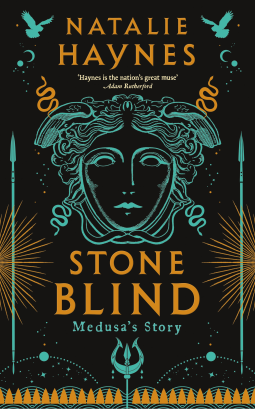
Stone Blind by Natalie Haynes

It’s always good to come across a Greek mythology retelling that has nothing to do with the Trojan War! There have been so many over the last few years (Natalie Haynes’ A Thousand Ships being one of the best I’ve read) that it makes a refreshing change to read about other characters and other myths.

Stone Blind is subtitled Medusa’s Story but is actually written from the perspectives of many different characters, all coming together to tell the tale of the Gorgon Medusa and Perseus’ quest to capture her head. In traditional accounts of this myth, Perseus is seen as the hero, bravely slaying the monstrous snake-haired Medusa whose eyes can turn living creatures to stone. This version looks at things from a different angle, questioning whether it’s really fair to refer to Medusa as a monster and painting Perseus as, if not exactly a villain, a thoughtless, dim-witted boy who ends up completing his quest almost by accident.

While part of the story is told from Medusa’s point of view, we also hear the voices of many other gods, mortals and mythical beings including the other two Gorgons, their sisters the Graia, who share one eye and one tooth between them, the Ethiopian princess Andromeda, who is chained to a rock as a sacrifice, and even the olive trees of Athens. Some have a lot to say, others appear only for a few pages, but each one has an important contribution to make. This is the same style Natalie Haynes used in A Thousand Ships, but I found it more effective here. Whereas in the previous book the various characters’ narratives felt as though they were appearing in a random order, almost like a collection of separate short stories, here they are ordered in a way that makes chronological sense, with each new voice helping to move the story forward.

Medusa, as she is portrayed here, is a very sympathetic character. The only mortal Gorgon of the three and therefore the most vulnerable, she is raised by her two older sisters, Sthenno and Euryale. Medusa’s monstrous features only appear after she is raped by Poseidon in Athena’s temple and the angry goddess punishes her by transforming her hair into a seething mass of snakes and cursing her with the ability to turn everything around her to stone. Condemned to a life of blindness, afraid to uncover her eyes in case her gaze should fall upon one of her beloved sisters, Medusa’s story is very sad – and we know that it is only going to get worse because, far away, Polydectes, King of Seriphos, has challenged Perseus to bring him the severed head of a Gorgon. Fortunately, Haynes doesn’t dwell on the Gorgon-slaying episode, moving straight on with other parts of the myth.

Despite the tragic elements of the plot, the story is told with plenty of humour, particularly in the scenes dealing with the petty squabbling of Zeus, Hera, Athena, Hermes and the other Olympian gods. Haynes does an excellent job of capturing their fickle, petulant natures and the childish rivalries between them. In fact, I can’t really say anything negative about this book, other than that the title is slightly misleading as this is so much more than just Medusa’s story. I’m looking forward to future books by Natalie Haynes and must also go back and read her earlier novel, The Children of Jocasta.

Have you read any other retellings of this myth? If so, I would be interested in any recommendations.

Thanks to Mantle for providing a copy of this book for review via NetGalley.

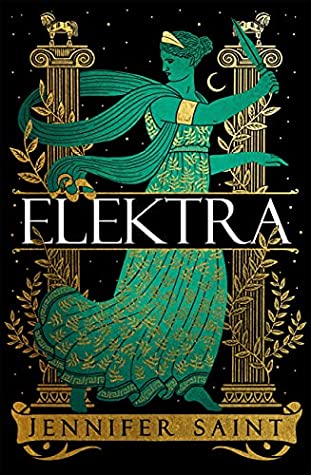
Elektra by Jennifer Saint

I enjoyed Jennifer Saint’s first novel, Ariadne, a retelling of Greek myth from a female perspective, so I was looking forward to reading her new one, Elektra. If you’re familiar with Greek mythology, you’ll know Elektra as the daughter of Agamemnon, King of Mycenae, and his wife Clytemnestra, the sister of Helen of Troy. In this novel, Jennifer Saint tells the stories of both Elektra and Clytemnestra, as well as another woman – Cassandra, the Trojan priestess and prophet.

Elektra begins with the Greeks preparing to go to war against Troy. In order to please the gods so they will produce a wind to allow the fleet to set sail, Agamemnon sacrifices his eldest daughter, Iphigenia. The devastated Clytemnestra vows to take revenge on her husband, but she will have a long time to wait as the Trojan War will last ten years. Meanwhile, Iphigenia’s younger sister Elektra grows up watching in disapproval of her mother’s relationship with her new lover Aegisthus and waiting for her father to return. When Agamemnon does eventually come home – bringing Cassandra with him as a prize of war – further tragedy will strike the family and this time it is Elektra who is left vowing revenge.

This is another beautiful and insightful Greek retelling from Jennifer Saint, but I didn’t like it quite as much as Ariadne, probably because there were large parts of the Ariadne/Phaedra story that were new to me whereas I felt that this book was too similar to others I’ve read recently – Colm Tóibín’s House of Names, Natalie Haynes’ A Thousand Ships and Pat Barker’s The Silence of the Girls, to name a few. If I’d known nothing about Troy or the House of Atreus, I’m sure I would have enjoyed this book much more. Still, there are scenes and moments that never lose their impact no matter how many times you’ve read them: Clytemnestra’s grief and agony when her husband murders their daughter or Cassandra’s desperation as she tries to convince her fellow Trojans that there are Greeks hiding in the giant wooden horse.

I do wonder why Elektra was chosen as the title of the novel, as it’s as much the story of Clytemnestra and Cassandra as it is of Elektra (each of them narrating their own chapters). In fact, for the first half of the book at least, Elektra’s role is the smallest – and she is certainly the most difficult to like of the three narrators. I had a lot of sympathy with the doomed Cassandra, both blessed with the gift of prophecy and cursed to never be believed, and while some of Clytemnestra’s choices may be questionable, how could you not feel for a mother who has lost a child in such a horrifying way? Elektra, though, is harder to understand; I didn’t think it was made very clear why she felt such loyalty to her father and why she could forgive his murderous actions but not her mother’s. Although I did enjoy Cassandra’s chapters, perhaps if they’d been left out there would have been more time to explore the relationship between Clytemnestra and Elektra.

Although this book wasn’t completely successful for me, I’ll look forward to more by Jennifer Saint, particularly if they focus less on Troy and more on other areas of Greek myth.

Thanks to Headline for providing a copy of this book for review via NetGalley.
The Penelopiad by Margaret Atwood

I wanted to join in with this year’s Margaret Atwood Reading Month (hosted by Buried in Print) but knew I wouldn’t have time for one of her longer novels; The Penelopiad, at 199 pages, seemed the perfect choice as it would also count for the Novellas in November event (hosted by 746 Books and Bookish Beck). The Penelopiad was published in 2005 as part of the Canongate Myths series, of which I’ve previously read Baba Yaga Laid an Egg by Dubravka Ugrešić and Ragnarok by AS Byatt. It’s a retelling of the events of the Odyssey from the perspectives of Penelope and the twelve maids who were hanged by her son, Telemachus.

Penelope narrates her story from a modern day underworld where she wanders through the fields of asphodel occasionally encountering the spirits of other characters from Greek mythology. With little to do in the afterlife other than to think and remember, Penelope recalls her childhood in Sparta, her marriage to Odysseus and, particularly, the events that followed her husband’s departure to fight in the Trojan War. Left behind in Ithaca to raise baby Telemachus, Penelope awaits news of Odysseus but as the years go by it looks less and less likely that he is going to return.

Many of you will already know how the story progresses from there – the suitors, the shroud, the fate of the twelve maids, the bed carved from an olive tree – so I won’t go into the plot in any more detail. However, Atwood doesn’t just use Homer’s Odyssey as a source; she also draws upon other works including Robert Graves’ The Greek Myths to help fill in the gaps and provide a different view of Penelope’s character and story. Penelope is usually associated with faithfulness and patience and seen as perhaps a less interesting woman than Helen of Troy or Clytemnestra; in The Penelopiad, Penelope tells us how frustrated she is with the way she has been portrayed and how she really feels about rivals such as Helen.

Penelope’s own narrative is interrupted now and then by her twelve maids, who speak with one voice in a Greek chorus. As well as giving their own version of the events that build up to Odysseus ordering Telemachus to kill them, they also comment on Penelope’s account, leading us to question her motives and to wonder what exactly was and was not true. The sections narrated by the maids are written in a different style every time – a poem, a ballad, a lecture and even a court trial – but although I understood the need for a second perspective other than Penelope’s, these were my least favourite parts of the book. I found the modern language used by Penelope and the maids a bit jarring too and I think overall, I would have just preferred a more straightforward and conventional retelling of Penelope’s story.

I didn’t find this as satisfying as the other Margaret Atwood books I’ve read, but it was a quick, witty and entertaining read and it’s always good to see women from Greek myth given voices of their own.