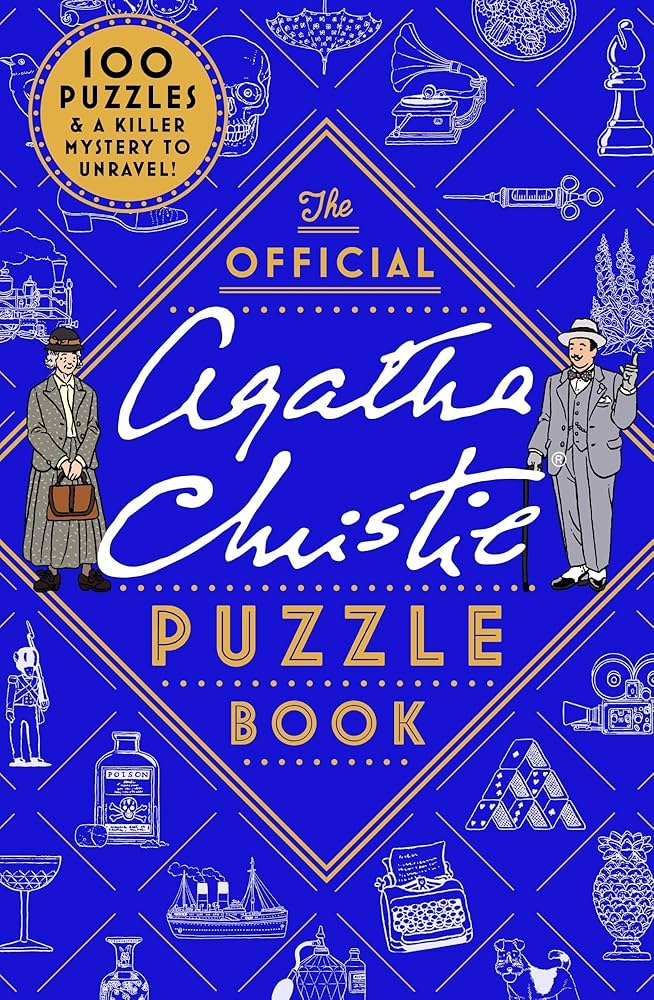
The Official Agatha Christie Puzzle Book

This is a book I received last Christmas (a present from my sister) and now that I’ve completed all of the puzzles in it, and with Christmas almost here again, I thought I would post a short review. It would make a great gift for any friends or family members who are Agatha Christie fans.

The book is divided into sections, with each one themed around a different Christie novel. For example, Chapter 5 is based on The ABC Murders, so many of the puzzles involve the alphabet or the letters A, B and C, while Chapter 9, Murder on the Orient Express, has puzzles about trains and snow. A few of them do require a knowledge of the original novel, but the majority could be solved even if you’d never read Christie before.

The puzzles in the book are nicely varied and range from crosswords and wordsearches to anagrams, logic puzzles and many more. I found some of them very easy to solve, but others were much more challenging. There are solutions included at the back of the book if you get stuck!

Each chapter ends with a letter written by Charles, a new librarian at Greenway, Christie’s old holiday home which is now a museum owned by the National Trust. The letters are addressed to his Aunt Mary and relate to the disappearance of the former librarian, Mrs Ashmore, who has gone missing, leaving behind a bundle of puzzles for Charles to solve. This framing story helps to tie the whole book together, as the mystery of Mrs Ashmore’s disappearance can only be solved once you’ve completed all of the other puzzles in the book.

If you already own this book, or if it doesn’t appeal, maybe you would prefer The Offical Poirot Puzzle Book, which has just been released in time for Christmas. There’s also The Official Agatha Christie After School Detectives Club aimed at children aged 8 and up, so something for all the family!

100 Books to Live By: Literary Remedies for Any Occasion by Joseph Piercy

I’m sure we’ve all turned to books in times of need, whether for advice and support or simply for comfort and distraction from the realities of life. 100 Books to Live By is Joseph Piercy’s guide to the books he believes can help with various problems and difficult situations. It’s part of a planned series from Michael O’Mara Books which will also include 100 Poems to Live By and 100 Speeches to Live By.

After an introduction in which Piercy describes the meaning of bibliotherapy – “the practice of using literature as a tool for emotional and psychological healing” – he then provides his 100 recommendations, prefacing each one with the condition or situation it is intended to remedy. Processing a Divorce, Questioning One’s Faith/Sexuality, Feeling Lost in the World, Learning Lessons from the Past and Valuing Friendship are just a few examples. Following each ‘prescription’, we are given one or two alternative remedies – just in case our TBR wasn’t already long enough!

Many of the books recommended here are classics from the 19th and 20th centuries, but Piercy does also include some contemporary titles and translated works to add variety and diversity. Sometimes the book suggestion seems an obvious match for the condition it’s remedying, such as Wuthering Heights for the Perils of Forbidden Love and the Folly of Vengeance or As I Lay Dying for Facing the Inevitability of Death, but other times I was surprised by the choice of book. Piercy explains his reasons for his decisions and you can see that a lot of thought has gone into choosing appropriate books, but be aware that although he does usually avoid giving away major plot points, if you haven’t already read the book you may come across things you would prefer not to know.

As well as the specific ‘prescriptions’ and ‘remedies’, Piercy also includes books he describes as ‘medicine cabinet essentials’ – in other words, they cover several different problems and issues. Anna Karenina, Madame Bovary and I Know Why The Caged Bird Sings are some examples of these. His discussion of each book is very short, usually just a page or two, and I think if you were hoping for a more in-depth analysis of bibliotherapy you would need to look elsewhere, but this is a quick, fun read and I can almost guarantee you’ll end up with a long list of titles you can’t wait to explore!

Thanks to Michael O’Mara Limited for providing a copy of this book for review via NetGalley.

A History of England in 25 Poems by Catherine Clarke

If you had to choose a selection of poems to represent your country’s past, which ones would you pick? What can poetry teach us about a nation’s history, culture and identity? These are some of the questions Catherine Clarke sets out to answer in this wonderful new book which tells the story of England through twenty-five famous and not-so-famous poems.

Beginning with the 8th century poem Cædmon’s Hymn, written in Old English, the book then moves chronologically through time, ending with Zaffar Kunial’s The Groundsman from 2022. Familiar names including Geoffrey Chaucer, Shakespeare, Tennyson and Lewis Carroll are all represented, but so are some lesser known poets from more diverse backgrounds such as Phillis Wheatley, the first African-American woman to have her poems published, and Grace Nichols, an immigrant to Britain from Guyana. The poems have all been selected for what they can tell us about specific moments in English history: Viking raids, the Battle of Agincourt, the plague, the miners’ strikes, the Great Storm of 1987 and many more.

Before picking up this book, it’s important to know that it shouldn’t really be approached as simply a poetry anthology. Not all of the poems appear in full – many are just extracts – and they haven’t necessarily been chosen for the beauty of the language. The literary merit of each poem is discussed only briefly or not at all, as Clarke is more interested in the life of the writer, why they chose to write that particular poem at that particular time and how the poem fits into the wider context of what was happening in England during that period. Each poem is given its own chapter and with twenty-five of them to get through, the chapters are relatively short, although still long enough to say everything that needs to be said.

I enjoyed every chapter – although I was already familiar with most of the historical figures and topics discussed in the book, it was interesting to see them from different, unusual perspectives and to discover some new poems I’d never read before. Some of my favourites were Mary Leapor’s Crumble Hall, written through the eyes of a servant in an 18th century country house; Adlestrop by Edward Thomas, describing a train briefly stopping at a station in 1914; and Elizabeth Barrett Browning’s The Cry of the Children, a protest against child labour during the Industrial Revolution.

I can highly recommend this book to anyone with an interest in English history. If you also like poetry it would be helpful, but not essential! I thought it was a fascinating approach and it would be good to read about another country’s history seen through the lens of its poetry like this.

Thanks to Penguin Classics/Allen Lane for providing a copy of this book via NetGalley.

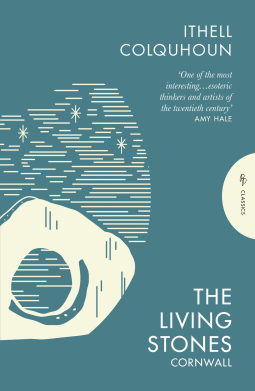
The Living Stones: Cornwall by Ithell Colquhoun

Earlier this year I enjoyed reading Ithell Colquhoun’s The Crying of the Wind, an account of the author’s travels around Ireland, so I decided to read her other travel book, The Living Stones, published two years later in 1957. This one is inspired by her visits to Cornwall in the late 1940s, where she came in search of escape from post-war London. As an artist, she wanted a suitable property to use as an occasional refuge where she could paint in peace and in 1949 she purchased Vow Cave, a small wooden studio with very basic living facilities.

Vow Cave (Colquhoun tells us that Vow is derived from vugha, the Cornish word for cave) is in the village of Lamorna on the Penwith peninsula a few miles from Penzance. Although she writes about the landscape, the surrounding countryside and some local places of interest, this book isn’t really a travelogue in the same sense as The Crying of the Wind, where the author described trips and excursions to different areas of Ireland. Instead, she explores the culture and history of Cornwall in general, with chapters devoted to separate topics, giving it almost the feel of a collection of short essays.

Lots of Cornish customs and rituals are discussed, ranging from the Gorsedh of Cornwall, or gathering of the bards, and the ‘Obby ‘Oss (hobby horse) festival in Padstow to the Furry Day celebrations which mark the arrival of spring (the name likely has nothing to do with fur and comes from the Cornish word for ‘fair’ or ‘feast’). There’s a chapter on traditional Cornish foods such as potato cakes, Cornish cream and the Cornish pasty, and another on folk medicine and witchcraft – Colquhoun has a particular interest in the occult. Some sections are fascinating, although there were others where I found my attention wandering.

Both books I’ve read by this author feel random and meandering, lacking in focus. I found that the best way to read them was in small doses, a few short chapters at a time alternating with other books, rather than straight through from beginning to end. As a pair, they’re definitely worth reading if you have any interest in Ireland or Cornwall, and I did learn a lot from them. Colquhoun has also written a novel, Goose of Hermogenes, which sounds intriguing!

Thanks to Pushkin Press Classics for providing a copy of this book for review via NetGalley.

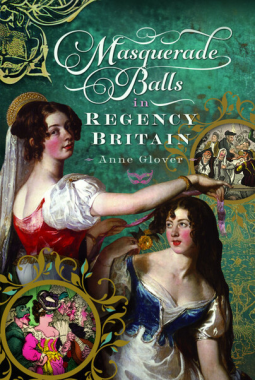
Masquerade Balls in Regency Britain by Anne Glover

Having read a lot of fiction set in the Regency period, the masquerade ball is something I’ve come across often. It tends to be the setting for some of the novels’ pivotal moments, with masked characters free to behave in ways they normally wouldn’t and mistaking each other’s identities, leading to unexpected romances, accidental interactions with the wrong person and other surprises that are only revealed when the masks come off! This new book by Anne Glover looks at the facts behind the fiction, exploring the real history of the masquerade ball.

The book begins with a discussion of the popular venues used for masquerades. Not surprisingly, the focus is overwhelmingly on London, where masquerades were regularly held at the Argyll Rooms and the Pantheon, as well as outdoor events at the Ranelagh Gardens and Vauxhall Gardens. However, Glover does acknowledge the popularity of masquerade balls in seaside resorts like Margate and Brighton, in other large cities around Britain and Ireland and in other countries such as India. She also looks at private masquerades, where a wealthy person would open their own home to family and friends. The balls would all have different characteristics depending on the size and style of the venue, the ticket price and the class of guests they were trying to attract (the Argyll Rooms required a subscription, whereas the Pantheon was open to anyone who could afford a ticket).

Glover then devotes separate chapters to each individual aspect of the masquerade ball. I found the chapter on lighting particularly interesting. She explains that although we may imagine masquerades as dark, dimly-lit affairs, it was actually important for them to be brightly lit – to help guests stay awake as the balls often started at ten or eleven at night and went on until dawn; to make it safer for people wearing masks to move around; and for the host to show that they could afford to light hundreds of lamps. The Pantheon was said to have 10,000 variegated lamps arranged in different designs. The rooms would be decorated with transparencies – pictures painted on paper, silk or linen and illuminated from behind – and artificial flowers, while pictures and designs would be chalked onto the dance floors, again with the practical purpose of stopping dancers from slipping.

The types of dances popular during the Regency are discussed, along with additional entertainments which started to be added as masquerade balls became more ambitious, including fireworks, lotteries and performances by dancers, singers and acrobats. Then of course, there’s the food – the formal ‘supper’, which often took place at one or two o’clock in the morning, versus the idea of a buffet or refreshments available throughout the entire event which became more popular as we moved into the Victorian era. Costumes are the subject of another chapter. People who wore the ‘domino’ (a simple hooded cloak with a mask) were often looked down on by other guests for not making enough effort; character costumes based on figures from history or literature were preferred, and this leads into a discussion of cultural appropriation and symbols of national identity.

Although masquerade balls could be attended by people from various walks of life, they were obviously aimed mainly at the very rich and privileged and as I read, I couldn’t help thinking about all the working class people who were excluded from entertainments like these – and all the money that was spent on something only lasting one night. I suppose at least the balls created plenty of work for costume makers, artists, musicians and performers, cooks and caterers!

I found this book interesting, but I thought the style and structure made it a bit too dry and scholarly for the general reader. I’m sure it would be of great help as a reference book for someone writing a Regency novel, though. Anne Glover has clearly carried out a huge amount of research and gone into an incredible amount of detail in each chapter, but I would have preferred something that was more fun to read. Still, I did learn a lot from it and coincidentally, the very next novel I picked up after finishing it happened to feature a masquerade ball!

Thanks to Pen & Sword History for providing a copy of this book for review via NetGalley.

Come, Tell Me How You Live by Agatha Christie

This was surprisingly good! Not being a big non-fiction reader or having a particular interest in reading about archaeological digs, I wasn’t sure what to expect from this book and only picked it up because it’s this month’s selection for the Read Christie 2025 challenge. However, I needn’t have worried – I found it a funny, light-hearted and vibrant account of Christie’s time in the Middle East, with no long, dry descriptions of digs, and just as enjoyable to read as some of her detective novels.

Come, Tell Me How You Live was first published in 1946 under the name Agatha Christie Mallowan (her married name). The title is a play on words as a ‘Tell’ is an archaeological term for an artificial mound created by debris from generations of human occupation – therefore indicating the site of an abandoned town or city. The book describes Christie’s experiences of visiting Syria, a country rich in ancient Tells, in the 1930s with her archaeologist husband, Max Mallowan.

From the opening pages, where Christie writes about the difficulties of acquiring suitable clothing for a trip to Syria during the British winter – and the indignities of being informed that she’s O.S. (outsized) – her sense of humour shines through and continues to do so for the rest of the book. She’s prepared to poke fun at herself and Max but also brings the other people in the book to life with witty observations and amusing little anecdotes. Michel, their driver, who is obsessed with being ‘economical’, allows their truck to run out of fuel in the desert because he was curious to see how far it would last without filling up and almost buys two hundred rotten oranges at a market just because he’s negotiated a good price for them. Then there’s Mac, the solemn, silent young architect who accompanies them on the trip, who never seems to show any emotion, no matter what the occasion. I also loved the Postmaster, who constantly tries to get the Mallowans to accept any letter addressed to a random European, and the ‘professional cat’ who comes to the rescue during their stay in Amuda in a house infested by rodents and insects.

There may be some passages and attitudes that aren’t entirely acceptable to a modern reader, but Christie was writing for a 1940s audience and I think she was generally respectful of the Syrian people and their culture. With this book, she provides a lot of insight into what it was like to be an Englishwoman so far from home, in a world so different from her own. What she doesn’t provide is any detailed information on archaeology or their finds. Her focus is always on everyday life and her general impressions of the landscape, the people she meets and their customs. Even her writing is barely mentioned, although we know that she was working on novels such as Murder on the Orient Express during her time in Syria.

I thoroughly enjoyed this book and am grateful to the Read Christie challenge for highlighting it this month. I’ll be taking part again in August with the Poirot mystery One, Two, Buckle My Shoe.

Book 10/20 for 20 Books of Summer 2025.

The Crying of the Wind: Ireland by Ithell Colquhoun

Ithell Colquhoun was a completely new name for me when I spotted this book on NetGalley recently, but I know now that she was a prominent British surrealist painter in the 1930-40s, as well as an occultist, poet and author of both fiction and non-fiction. The Crying of the Wind, originally published in 1955, describes her travels around Ireland and her impressions of the people she meets and places she visits. It’s the first of three travel books she wrote, with a book on Cornwall following in 1957 and then one on Egypt which has never been published.

Colquhoun bases herself near the village of Lucan on the River Liffey, to the west of Dublin. In each chapter, she sets out on a walk or an excursion by car to visit different parts of Ireland, including Glendalough, Connemara and Cashel. The structure seems a bit haphazard, with no real order or pattern to the places she visits, and the book definitely has the feel of a personal journal rather than something you could use to plan out your own travels. It’s an interesting book, though, and I did enjoy reading it. The descriptive writing is beautiful at times, as you would expect from a book written by a painter; here she describes the approach to Connemara’s Twelve Bens mountain range:

Across miles of mulberrydark bogland we drove towards them, the tawny of king ferns lining the ditches that bordered the road. Air of a wonderful transparency arched above us, blue washed with white gold. I did not regret our slow pace, enforced by the pot-holes in the road, since I could watch the mountains from gradually shifting angles.

Although Colquhoun includes some anecdotes about her encounters with Irish people, the way they live and the conversations she has with them, the main focus of her writing is on the beauty of the natural environment and on places of historical interest such as old churches, holy wells and remains of ancient forts and towers. She often laments the rate of progress and its effect on the natural world; when walking in the countryside, she is very aware of the noise of traffic on busy roads nearby and the sights of new housing developments and factory chimneys altering the landscape forever.

With her interest in the occult, Colquhoun spends a lot of time discussing the myths, legends and folklore of each place she visits. She believes in ghosts, spirits and supernatural beings and accepts their existence in a very matter-of-fact way.

Their forms vary; a friend described one she had seen on some downs in Dorsetshire as being ‘the size of a haystack, opaque but fluid at the edges, moving very quickly’; another is sometimes seen like a tower racing over wide sands on the north coast of Cornwall. I have myself seen in Cornwall one like a massive pillar of unknown substance, with filaments stretched from the top seemingly to hold it to the ground like the guy-ropes of a tent.

The Crying of the Wind is an unusual travel book, then, and also a fascinating one. I’ll look forward to reading her Cornwall book, The Living Stones, which is also available in a new edition from Pushkin Press.

Thanks to Pushkin Press Classics for providing a copy of this book for review via NetGalley.