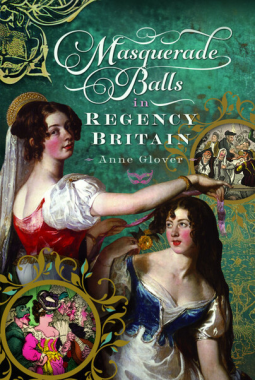
Masquerade Balls in Regency Britain by Anne Glover

Having read a lot of fiction set in the Regency period, the masquerade ball is something I’ve come across often. It tends to be the setting for some of the novels’ pivotal moments, with masked characters free to behave in ways they normally wouldn’t and mistaking each other’s identities, leading to unexpected romances, accidental interactions with the wrong person and other surprises that are only revealed when the masks come off! This new book by Anne Glover looks at the facts behind the fiction, exploring the real history of the masquerade ball.

The book begins with a discussion of the popular venues used for masquerades. Not surprisingly, the focus is overwhelmingly on London, where masquerades were regularly held at the Argyll Rooms and the Pantheon, as well as outdoor events at the Ranelagh Gardens and Vauxhall Gardens. However, Glover does acknowledge the popularity of masquerade balls in seaside resorts like Margate and Brighton, in other large cities around Britain and Ireland and in other countries such as India. She also looks at private masquerades, where a wealthy person would open their own home to family and friends. The balls would all have different characteristics depending on the size and style of the venue, the ticket price and the class of guests they were trying to attract (the Argyll Rooms required a subscription, whereas the Pantheon was open to anyone who could afford a ticket).

Glover then devotes separate chapters to each individual aspect of the masquerade ball. I found the chapter on lighting particularly interesting. She explains that although we may imagine masquerades as dark, dimly-lit affairs, it was actually important for them to be brightly lit – to help guests stay awake as the balls often started at ten or eleven at night and went on until dawn; to make it safer for people wearing masks to move around; and for the host to show that they could afford to light hundreds of lamps. The Pantheon was said to have 10,000 variegated lamps arranged in different designs. The rooms would be decorated with transparencies – pictures painted on paper, silk or linen and illuminated from behind – and artificial flowers, while pictures and designs would be chalked onto the dance floors, again with the practical purpose of stopping dancers from slipping.

The types of dances popular during the Regency are discussed, along with additional entertainments which started to be added as masquerade balls became more ambitious, including fireworks, lotteries and performances by dancers, singers and acrobats. Then of course, there’s the food – the formal ‘supper’, which often took place at one or two o’clock in the morning, versus the idea of a buffet or refreshments available throughout the entire event which became more popular as we moved into the Victorian era. Costumes are the subject of another chapter. People who wore the ‘domino’ (a simple hooded cloak with a mask) were often looked down on by other guests for not making enough effort; character costumes based on figures from history or literature were preferred, and this leads into a discussion of cultural appropriation and symbols of national identity.

Although masquerade balls could be attended by people from various walks of life, they were obviously aimed mainly at the very rich and privileged and as I read, I couldn’t help thinking about all the working class people who were excluded from entertainments like these – and all the money that was spent on something only lasting one night. I suppose at least the balls created plenty of work for costume makers, artists, musicians and performers, cooks and caterers!

I found this book interesting, but I thought the style and structure made it a bit too dry and scholarly for the general reader. I’m sure it would be of great help as a reference book for someone writing a Regency novel, though. Anne Glover has clearly carried out a huge amount of research and gone into an incredible amount of detail in each chapter, but I would have preferred something that was more fun to read. Still, I did learn a lot from it and coincidentally, the very next novel I picked up after finishing it happened to feature a masquerade ball!

Thanks to Pen & Sword History for providing a copy of this book for review via NetGalley.

Come, Tell Me How You Live by Agatha Christie

This was surprisingly good! Not being a big non-fiction reader or having a particular interest in reading about archaeological digs, I wasn’t sure what to expect from this book and only picked it up because it’s this month’s selection for the Read Christie 2025 challenge. However, I needn’t have worried – I found it a funny, light-hearted and vibrant account of Christie’s time in the Middle East, with no long, dry descriptions of digs, and just as enjoyable to read as some of her detective novels.

Come, Tell Me How You Live was first published in 1946 under the name Agatha Christie Mallowan (her married name). The title is a play on words as a ‘Tell’ is an archaeological term for an artificial mound created by debris from generations of human occupation – therefore indicating the site of an abandoned town or city. The book describes Christie’s experiences of visiting Syria, a country rich in ancient Tells, in the 1930s with her archaeologist husband, Max Mallowan.

From the opening pages, where Christie writes about the difficulties of acquiring suitable clothing for a trip to Syria during the British winter – and the indignities of being informed that she’s O.S. (outsized) – her sense of humour shines through and continues to do so for the rest of the book. She’s prepared to poke fun at herself and Max but also brings the other people in the book to life with witty observations and amusing little anecdotes. Michel, their driver, who is obsessed with being ‘economical’, allows their truck to run out of fuel in the desert because he was curious to see how far it would last without filling up and almost buys two hundred rotten oranges at a market just because he’s negotiated a good price for them. Then there’s Mac, the solemn, silent young architect who accompanies them on the trip, who never seems to show any emotion, no matter what the occasion. I also loved the Postmaster, who constantly tries to get the Mallowans to accept any letter addressed to a random European, and the ‘professional cat’ who comes to the rescue during their stay in Amuda in a house infested by rodents and insects.

There may be some passages and attitudes that aren’t entirely acceptable to a modern reader, but Christie was writing for a 1940s audience and I think she was generally respectful of the Syrian people and their culture. With this book, she provides a lot of insight into what it was like to be an Englishwoman so far from home, in a world so different from her own. What she doesn’t provide is any detailed information on archaeology or their finds. Her focus is always on everyday life and her general impressions of the landscape, the people she meets and their customs. Even her writing is barely mentioned, although we know that she was working on novels such as Murder on the Orient Express during her time in Syria.

I thoroughly enjoyed this book and am grateful to the Read Christie challenge for highlighting it this month. I’ll be taking part again in August with the Poirot mystery One, Two, Buckle My Shoe.

Book 10/20 for 20 Books of Summer 2025.

The Crying of the Wind: Ireland by Ithell Colquhoun

Ithell Colquhoun was a completely new name for me when I spotted this book on NetGalley recently, but I know now that she was a prominent British surrealist painter in the 1930-40s, as well as an occultist, poet and author of both fiction and non-fiction. The Crying of the Wind, originally published in 1955, describes her travels around Ireland and her impressions of the people she meets and places she visits. It’s the first of three travel books she wrote, with a book on Cornwall following in 1957 and then one on Egypt which has never been published.

Colquhoun bases herself near the village of Lucan on the River Liffey, to the west of Dublin. In each chapter, she sets out on a walk or an excursion by car to visit different parts of Ireland, including Glendalough, Connemara and Cashel. The structure seems a bit haphazard, with no real order or pattern to the places she visits, and the book definitely has the feel of a personal journal rather than something you could use to plan out your own travels. It’s an interesting book, though, and I did enjoy reading it. The descriptive writing is beautiful at times, as you would expect from a book written by a painter; here she describes the approach to Connemara’s Twelve Bens mountain range:

Across miles of mulberrydark bogland we drove towards them, the tawny of king ferns lining the ditches that bordered the road. Air of a wonderful transparency arched above us, blue washed with white gold. I did not regret our slow pace, enforced by the pot-holes in the road, since I could watch the mountains from gradually shifting angles.

Although Colquhoun includes some anecdotes about her encounters with Irish people, the way they live and the conversations she has with them, the main focus of her writing is on the beauty of the natural environment and on places of historical interest such as old churches, holy wells and remains of ancient forts and towers. She often laments the rate of progress and its effect on the natural world; when walking in the countryside, she is very aware of the noise of traffic on busy roads nearby and the sights of new housing developments and factory chimneys altering the landscape forever.

With her interest in the occult, Colquhoun spends a lot of time discussing the myths, legends and folklore of each place she visits. She believes in ghosts, spirits and supernatural beings and accepts their existence in a very matter-of-fact way.

Their forms vary; a friend described one she had seen on some downs in Dorsetshire as being ‘the size of a haystack, opaque but fluid at the edges, moving very quickly’; another is sometimes seen like a tower racing over wide sands on the north coast of Cornwall. I have myself seen in Cornwall one like a massive pillar of unknown substance, with filaments stretched from the top seemingly to hold it to the ground like the guy-ropes of a tent.

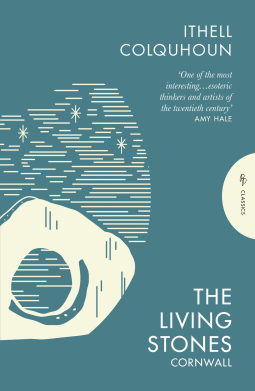
The Crying of the Wind is an unusual travel book, then, and also a fascinating one. I’ll look forward to reading her Cornwall book, The Living Stones, which is also available in a new edition from Pushkin Press.

Thanks to Pushkin Press Classics for providing a copy of this book for review via NetGalley.

That Dark Spring by Susannah Stapleton

One of my resolutions for 2025 was to read more non-fiction books, so I’m ashamed to say this is only my second one this year. Oh, well – I still have more than seven months to add a few more to that total. I would also like to widen the range of topics I normally choose to read about and try something different, but for now, with That Dark Spring, I have stayed within one of my usual areas for non-fiction – true crime.

The crime in question is the murder – or could it be suicide? – of Olive Branson, an Englishwoman in her forties found dead at her farmhouse in a village in Provence. This happens in April 1929, when she is discovered submerged in a water tank outside the house, a bullet wound between her eyes and a revolver nearby. The local policeman and doctor conclude that Olive shot herself, but not everyone is happy with this verdict. Back in England, Olive’s wealthy, influential cousin demands that the case be reopened, so one of France’s top detectives, Alexandre Guibbal, is summoned from Marseille to investigate.

It’s an intriguing mystery! Could Olive really have lifted the heavy cistern lid, lowered herself in and shot herself – with her left hand, despite evidence suggesting that she was right-handed? Guibbal doesn’t think so and quickly turns his attentions to François Pinet, believed to be a lover of Olive’s for whom she had changed her will to leave him the Monte Carlo Hotel, which she had recently purchased. As evidence mounts up against Pinet, he insists that he is innocent and is defended by many of the villagers who are keen to support ‘one of their own’. There’s eventually a trial, but even then a lot of questions are left unanswered. Susannah Stapleton can’t – and doesn’t – give us those answers, leaving us to draw our own conclusions and try to decide what really happened.

I enjoyed That Dark Spring overall, although it took me a while to get into it due to the amount of background information provided in the first half of the book: a history of the village of Les Baux and the Baussenc people; an account of Olive’s early life and her career as an artist; detailed descriptions of the two rival hotels in Les Baux; and a long and (as far as I could tell) irrelevant biography of the poet Frédéric Mistral. Some padding is to be expected in books of this type, of course, but I found that I only became fully engaged with the story when it returned to the central crime. There are some points that wouldn’t be out of place in a detective novel, such as where Guibbal consults an astronomer in an attempt to decide exactly when darkness fell on the night of the crime or where Pinet tries to use the sighting of a car as an alibi and becomes entangled in his own lies.

It’s frustrating that we still don’t know the truth behind Olive’s death and probably never will. If Pinet was innocent and we assume that suicide was unlikely, that must mean someone else got away with murder – but who was it? Stapleton doesn’t really steer us into one way of thinking or another; she just provides the facts and some possible theories for us to consider. She suggests that the police may have been so determined just to pin the blame on somebody that they ignored or failed to collect important evidence, leaving Pinet’s fate up to the lawyers and the jury.

Stapleton has drawn on a number of primary sources and includes excerpts from Olive Branson’s diaries and letters throughout the text, giving it a more personal touch. There are also notes at the end, a bibliography and a list of Olive’s exhibited artworks. I had never heard of Olive until now, so it’s good to have learned a little bit about her. I’ll have to go back and read Susannah Stapleton’s other book – The Adventures of Maud West, Lady Detective.

Thanks to Picador for providing a copy of this book for review via NetGalley.

Britain’s Greatest Private Detective by Nell Darby

As someone who enjoys detective novels, I was naturally drawn to this non-fiction book about a real life private detective who achieved fame and success in the late Victorian era. His name (at least the one by which he was best known) was Henry Slater and he was the owner of Britain’s leading detective agency. This new book by Nell Darby explores Henry Slater’s life and career and looks at the world of the early private detective in general – the backgrounds they came from, the type of cases they dealt with, the methods they used and the problems that could arise from those methods.

The Matrimonial Causes Act 1857 is one of the key factors that gave rise to the private detective in the second half of the 19th century. This made it possible for people to request a divorce through the law courts (rather than through a private Act of Parliament as previously) as long as they could prove their spouse had committed adultery. Women would also need to prove one other offence, such as desertion or cruelty. But how could people obtain evidence to show that their partner had been unfaithful? By employing a private detective, of course, and asking them to shadow their husband or wife and look for proof of infidelities. And what do you think happened if the detective couldn’t find any proof – and their client was paying them to deliver results?

Slater’s Detective Agency, who operated from offices in London’s Basinghall Street, advertised all sorts of detective work, but most of their business relied on divorce cases. It was one case in particular that brought about their downfall. Having been hired on behalf of a Mrs Kate Pollard to help her divorce her husband, the agency resorted to underhand methods to get the evidence they needed and were betrayed by a former employee with a personal grudge against Henry Slater. This led to a trial which damaged Slater’s business and exposed his true identity. The Pollard case and the trial which followed form a large part of the book, although Darby moves back and forth between that story, a personal biography of Henry Slater himself and a general history of private detective agencies.

This is a fascinating book and has clearly been very well researched (there’s a long bibliography and an extensive section of notes), but it wasn’t quite what I expected. I thought there would be details of more of Slater’s cases than just the Pollard one and more discussion of the other types of work the agency carried out as well as divorces, but maybe there just wasn’t enough information available to do that. I can’t agree with other reviews saying the book reads like a detective novel as there’s very little actual ‘detecting’ being done and certainly not much similarity between Henry Slater and Sherlock Holmes, whose adventures were appearing in print during the same period that Slater was operating. The jumping around from one topic to another also disrupts the flow of the book and meant I couldn’t become as immersed in it as I would have liked.

Still, I enjoyed learning about Henry Slater and how he established his agency, how he found work first through advertising and then through the strength of his fame and reputation, and how he faced challenges from rival companies. It seems that although Slater can be admired for what he achieved in building his business up from nothing and reaching the very top in his chosen profession, he was less skilled in handling his personal relationships with friends and employees – and this, together with his determination to keep his perfect record in winning divorce cases, is what led to his demise.

I was intrigued by the occasional mentions of the women detectives Slater employed, particularly the ones described as ‘cyclist detectives’ who followed their suspects by bicycle. I’ve discovered that Nell Darby has written another book, Sister Sleuths: Female Detectives in Britain, which sounds like a good companion to this one and I’m sure it would be an interesting read as well.

Thanks to Pen & Sword for providing a copy of this book for review via NetGalley.

The Peepshow: The Murders at 10 Rillington Place by Kate Summerscale

When I first saw the title of Kate Summerscale’s new true crime book, I wondered if it dealt with the Thompson/Bywaters murder case, the subject of A Pin to See the Peepshow by F. Tennyson Jesse. Then I saw the subtitle and knew this was a book about a different crime – the John Reginald Christie murders at 10 Rillington Place in London. However, I was partly right, because Tennyson Jesse herself was actually involved in this case as well and appears in this book in her role as author and journalist.

In March 1953, John Reginald Christie was arrested following a seven-day manhunt after the bodies of three women were found in his kitchen alcove. The body of his wife, Ethel, was then discovered under the floorboards, as well as the remains of two more women in the garden. Christie admitted to being responsible for all of these deaths and was hanged in July 1953. However, just three years earlier, Timothy Evans, another tenant at the same address, was believed to have killed his wife and baby daughter and was also hanged. Evans had changed his story several times and after withdrawing a confession he had made to the police, he accused Christie of committing both murders. Did the jury get it wrong and hang an innocent man, allowing Christie to go on killing more people?

The Peepshow is a detailed and thorough account of the Rillington Place murders – sometimes a bit too detailed, for example where we are given the personal histories of the most minor of characters or a list of every single reported sighting of Christie in a seven day period. In general, though, it’s all interesting information that adds up to a full picture of not just the crime itself but also the state of British society in the early 1950s. Some of Christie’s victims were prostitutes or from deprived backgrounds and Summerscale spends a lot of time discussing their stories and the sequence of events that brought them into contact with their killer. She also explores the racist attitudes of the period – it seemed that many of the white residents of Rillington Place were so busy complaining about living amongst black people, they failed to notice that they were also sharing the building with at least one murderer. Other topics Summerscale touches upon include illegal abortions (Christie carried these out in his rooms at Rillington Place) and the poor living conditions in multiple-occupancy housing.

To give the book a more personal touch, Summerscale focuses on two people who were investigating the murders from different perspectives. One was Harry Procter, star reporter with the Sunday Pictorial, who arrived at Rillington Place to report on the discovery of the bodies in the kitchen – and remembered that three years earlier he had visited the same house to interview Christie about the Timothy Evans case. Now, with more information available, Procter became convinced that he – and the police – made a terrible mistake and that it was in fact Christie who was responsible for the murders of Beryl and baby Geraldine.

Procter’s theory was shared by the author Fryn Tennyson Jesse, who was researching the case for a new book in the Notable British Trials series. Fryn was dealing with morphine addiction and poor eyesight, but was determined to attend Christie’s trial, where she came to the same conclusion as Procter. However, there was very little appetite from the authorities to look again at the Evans case – the police didn’t want to admit that they failed to identify the correct culprit and it’s believed that the Tory government of the time didn’t want to cast doubt on the justice system as it would strengthen opposition to the death penalty. Although Timothy Evans has now been posthumously pardoned, it seems that we still don’t know for certain what happened to Beryl and Geraldine Evans and if you’re hoping for answers or lots of new evidence, you’re not going to find anything conclusive in The Peepshow. I was left feeling confused about the whole thing, which isn’t really Summerscale’s fault – the confusion was caused by both Evans and Christie confessing to various murders, then changing their stories – but it’s not very satisfying if you prefer everything to be neatly wrapped up at the end of a book.

I did find this an interesting read, although I think it needed more structure; it seemed to jump around a lot, from one topic to another and backwards and forwards in time, which stopped it from flowing as well as it could have done. Still, it was good to learn more about this complex true crime and the social conditions that may have contributed to it.

Thanks to Bloomsbury Circus for providing a copy of this book for review via NetGalley.

Eighteen: A History of Britain in 18 Young Lives by Alice Loxton

What sort of person were you when you were eighteen years old? What had you accomplished by that point in your life and what were your hopes and dreams for the future? Or, if you haven’t reached that age yet, what would you like to achieve before your eighteenth birthday? In her new book, Eighteen: A History of Britain in 18 Young Lives, Alice Loxton explores the stories of eighteen historical figures, some famous and some more obscure, with a focus on the first eighteen years of their lives and how their childhoods shaped the adults they would later become.

The book is arranged in chronological order, so the first historical figure to be covered is the Anglo-Saxon monk and scholar, the Venerable Bede, and the last is the fashion designer Vivienne Westwood. Each section is quite short – it’s not a long book and there are lots of lives to get through – but I think Alice Loxton achieves what she sets out to do, which is to shine a light on the early lives of her subjects and the ways in which they are influenced by not only their own family background and upbringing, but also the world around them. She looks only briefly at the achievements that make them famous after the age of eighteen, but that information is available elsewhere and this book is trying to do something different.

Loxton chooses her subjects from all walks of life and a range of different backgrounds, including royalty, artists, engineers, actors and writers. They are almost equally split between men and women and England, Scotland, Wales and Northern Ireland are all represented. I was less interested in the people I’d read about before, such as Elizabeth I and the Empress Matilda, but there were others I was completely unfamiliar with and I found these chapters fascinating. I’m ashamed to say I knew nothing at all about the life of Jacques Francis, a diver originally from West Africa who attempted to recover the wreck of the Mary Rose during the Tudor period, or Sarah Biffin, an English artist born in the late 18th century without arms or legs.

Alice Loxton’s writing style is very readable and I flew through this book in much less time than it normally takes me to read non-fiction. Although it’s not marketed as being for any particular age group, it’s clearly aimed at readers closer to the age of her subjects, so she doesn’t bombard us with too much information and provides sources and notes at the back of the book rather than interrupting the text. She tries to find analogies that will make sense to young, modern readers, such as comparing a royal progress with a rock band going on tour, and imagines what the lives of some of her other historical figures would look like as a film adaptation or a slideshow. The main biographical chapters are also interspersed with other chapters describing a very special 18th birthday party, but I’ll leave you to find out more about that for yourself if you read the book!

Eighteen would be a fun, accessible way for teenagers to explore British history, but for those of us who are older it’s still an entertaining read and provides a good starting point for further investigation into some of these fascinating historical figures. I’m now interested in reading Alice Loxton’s previous book, Uproar!, about printmakers in Georgian London.

Thanks to Pan Macmillan for providing a copy of this book for review via NetGalley.