The Vatican Princess by CW Gortner

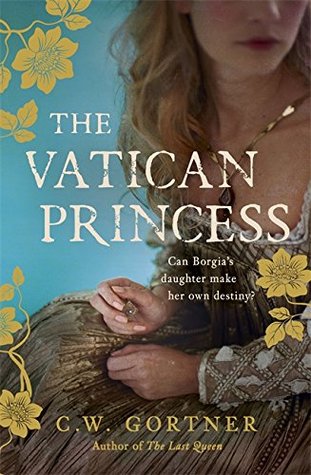
Since putting together my recent post on historical fiction covers, I seem to be feeling more critical than usual of the covers of the books I read.  I really don’t like this one as not only is it (almost) one of the faceless women covers I highlighted, but there’s nothing about it to suggest the darkness and intrigue usually associated with the Borgias.  Fortunately, though, I did enjoy the book – with a few reservations.  

Set in Renaissance Italy, The Vatican Princess is narrated by Lucrezia Borgia – seductive, manipulative and a well-known poisoner.  Or was she?  Actually, in this version of the Borgia story, she is none of those things.  CW Gortner is very sympathetic to Lucrezia’s situation, portraying her as a vulnerable young woman used by various members of her family to their own advantage and to further their own ambitions.  The novel opens in 1492, with Lucrezia’s father, Rodrigo Borgia, bribing his way to the papal throne as Pope Alexander VI (the second book I’ve read this month featuring a papal conclave).  Lucrezia is only twelve years old but that’s old enough to be useful to her father in securing political alliances and, with this in mind, Rodrigo marries her off to Giovanni Sforza, Lord of Pesaro.   

Lucrezia’s marriage to Giovanni is not a happy one and although it will eventually be annulled and she will marry again – twice – this period of her life forms the largest portion of The Vatican Princess.  It’s a very eventful period and one with plenty of mysteries and controversies, providing endless possibilities for an author to explore.  Why did Lucrezia enter confinement in the Convent of San Sisto while the annulment of her marriage was negotiated?  Did she have a secret son?  Who murdered her brother, Juan?  And was Lucrezia really involved in an incestuous relationship with her other brother, Cesare?  Gortner offers answers, or at least theories, to all of these questions, while showing Lucrezia in a generally very positive light and suggesting that she had much less control over her own fate than is often thought.    

As our narrator, Lucrezia is engaging and easy to like, but I couldn’t help feeling that she was a little bit too innocent and too good to be true – and this made her less interesting to read about than she should have been.  I thought the ambitious Rodrigo was portrayed well, but Cesare needed more complexity and Juan was purely evil with no nuances to his character at all.  However, I was intrigued by the other main female characters in the book: Lucrezia’s mother, Vannozza; the Pope’s mistress, Giulia Farnese; and Lucrezia’s sister-in-law, Sancia of Aragon.  I would be interested in reading more about all of these women, as they have not featured very heavily in the few other fictional accounts of the Borgias that I’ve read so far.       

This is the second novel I’ve read by CW Gortner and although I did enjoy it (and always love a Renaissance Italy setting), I preferred the other one, The Last Queen, which was about Juana of Castile.  I would like to read more of his books, but I don’t really feel drawn to his Tudor mystery series – published as Christopher Gortner – or his recent novels on Marlene Dietrich and Coco Chanel, so that would leave either The Queen’s Vow (about Isabella of Castile) or The Confessions of Catherine de’ Medici.  Have you read either of those?  Which should I read first?     

As for the Borgias, maybe I’ll have another attempt at reading Blood and Beauty by Sarah Dunant soon.  I struggled to get into it the first time but am happy to try again!
Conclave by Robert Harris

Robert Harris has become one of my favourite authors over the last few years – his three Cicero novels and An Officer and a Spy are all excellent – so I had every intention of picking up his latest book, Conclave, as soon as it was published in 2016. The time never seemed quite right, though, which is why it wasn’t until last week that I finally settled down to read it.

Unlike the other Harris novels I’ve read, which were set in the past, Conclave is set in the modern day; the actual date is never stated, but there are enough clues to indicate that it’s in the very near future. As the title suggests, it is a fictional account of a papal conclave – the meeting at which cardinals gather to elect a new pope. Although there have been two conclaves in recent years (resulting in the election of Pope Francis in 2013 and Benedict XVI in 2005), I have to confess that I didn’t pay a lot of attention to either – I remember the television cameras waiting for the first glimpse of white smoke emerging from the chimney of the Sistine Chapel, the crowds assembling in St Peter’s Square and the announcements of the papal name each new pope had chosen, but not much else. Rest assured, though, that you need have absolutely no familiarity with the conclave process or with the politics of the Catholic Church in order to enjoy this book!

Following the death of an unnamed pope, the reader is guided through the entire conclave by Jacopo Lomeli, Dean of the College of Cardinals, the man responsible for overseeing the election. With over one hundred cardinals from all over the world arriving at the Vatican to participate, there are plenty of contenders for the papal throne and voting takes place as a series of ballots which continue until a clear winner is found. At first, the sheer number of characters in the novel is overwhelming; we are introduced to cardinal after cardinal and I knew I would never be able to keep them all straight in my mind – but as it turned out, I didn’t really need to. It quickly emerges that there are only a few who have a real chance of becoming pope and Harris does a great job of helping us get to know each of the candidates and to form an opinion of whether they would or would not make a good Holy Father. Ambitious or humble, honest or unscrupulous, each has his own strengths and weaknesses and, as Harris is a writer of thrillers, you can also expect lots of secrets to be revealed, some of which have the potential to influence the outcome of the conclave.

Cardinal Lomeli is a wonderful character. In his position as Dean, he is usually the first to discover the secrets I’ve just mentioned, and must decide how to deal with them. Time after time, he is forced to examine his conscience: is he really just doing his duty or is he in danger of interfering too much? Does he simply believe that the truth must be told or could he be accused of trying to manipulate the result of the election? It’s all very exciting and as the voting pattern changed with each fresh ballot, I became more and more anxious to find out who was going to be the new pope! I knew who I wanted to be chosen and who I suspected would be chosen, but Harris kept me waiting until the very end of the book to find out for sure.

And, unfortunately, it was the ending which struck the only wrong note for me. I had been able to sense that some sort of twist was coming up, and when it did, I felt slightly cheated. It was something that had actually passed through my mind earlier in the novel, only to be dismissed because I had also thought of several other, more convincing ways in which the story could end. I’m sorry I can’t be more specific and explain what I mean, but it would definitely be a spoiler! Still, apart from the ending (which I’m sure some readers will like more than I did), I did thoroughly enjoy this book. It was tense, gripping and – with my complete lack of knowledge of what a conclave involves – absolutely fascinating!

I spotted an earlier Robert Harris novel, Archangel, at the library yesterday so that will be the next of his books that I’ll be reading. It’s not one that had sounded particularly appealing to me, but I’m more than happy to give it a try.

The Empress of Hearts by E. Barrington

The Empress of Hearts was originally published in 1928 and was one of several historical novels written by E. Barrington (a pseudonym of Elizabeth Louisa Moresby, who also wrote under the name Lily Adams Beck).  It is described on the cover as “a romance of Marie Antoinette”, but I think that description is slightly misleading.  Marie Antoinette does appear in the novel as a major character, but the focus is really on the scandal known as The Affair of the Diamond Necklace which was thought to be a factor leading to the French Revolution.    
  
The story centres around a diamond necklace created by the Parisian jewellers Boehmer and Bassenge, commissioned by Louis XV of France in 1772 as a gift for his mistress, Madame du Barry.  However, by the time the necklace is ready to be sold to the King, Louis has died and du Barry has been sent away from court.  Boehmer and Bassenge hope the new Queen, Marie Antoinette, will wear it instead, but when her husband, Louis XVI, offers to buy it for her, she refuses, unwilling to appear extravagant and frivolous when the money could be better spent on other things.  Enter Jeanne de la Motte, an ambitious young woman who sees an opportunity to make herself rich and acquire the necklace for herself in the Queen’s name.  The ensuing scandal will damage Marie Antoinette’s reputation and discredit the French monarchy in the eyes of the public:        

Marie Antoinette rose from her chair and moved toward the inner room, holding herself together with an effort so tense that for the moment grace was dead and she moved with stiff, short steps like an old woman. At the door she turned: “Did I not tell you that there would be no need for poison? They will kill me with calumny.”

As you would expect with a book from the 1920s, the writing style is rather different from most modern historical fiction novels; it is more formal and more detailed but, unfortunately, it is also quite dry.  Although I had heard of the Diamond Necklace Affair before, I hadn’t read about it in any depth, so I found The Empress of Hearts an interesting read from that perspective, but as a work of fiction it is less effective – like the other novel I’ve read by Barrington, Glorious Apollo, it would probably have worked better as non-fiction.  We are given large amounts of factual information and as a result the plot moves very slowly and lacks the drama, excitement and tension that should have been present given the subject of the story. 

The characters are not the most vibrant and life-like either, although they had the potential to be fascinating, particularly Jeanne, as the villain of the novel, and Cardinal de Rohan, another prominent figure implicated in the plot.  I was intrigued by the role the Italian occultist Alessandro Cagliostro plays in the story – in reality, it seems that although he was arrested and questioned, it’s uncertain how much involvement he actually had in the Affair – but again, I think there were missed opportunities here.

I’m aware that Alexandre Dumas also wrote a novel about the Affair of the Diamond Necklace – The Queen’s Necklace.  As a fan of Dumas, I’m looking forward to reading it and seeing how he approaches the same subject.

The Tea Planter’s Wife by Dinah Jefferies

I’ve been falling behind with Dinah Jefferies’ novels; after reading her first, The Separation, back in 2014, she has since had another three books published, none of which I had read until picking up The Tea Planter’s Wife a few weeks ago.  I regret not reading it sooner, because I loved it and am now desperate to read her other two, The Silk Merchant’s Daughter and Before the Rains.    

The Tea Planter’s Wife is set in Ceylon (the former name for Sri Lanka) in the 1920s and 30s, and begins with the arrival of newly married Gwendolyn Hooper who has come from England to join her husband, Laurence, on his tea plantation. Gwen is only nineteen years old and barely really knows her husband, a widower much older than herself.  Settling into married life proves to be more difficult than she’d expected, particularly as she also has to get used to a whole new culture and climate.  It doesn’t help that Laurence’s sister Verity comes to live with them and makes it obvious that she resents Gwen marrying her brother.  To make matters worse, Gwen is convinced that Laurence is trying to hide the truth surrounding the death of his first wife, Caroline.   

Feeling lonely and neglected, Gwen is grateful for the friendship of Savi Ravasinghe, a Sinhalese portrait painter, and is mystified as to why Laurence seems to disapprove of him so much.  Then something happens which makes Gwen think that Laurence was right to distrust Savi – and which throws her already troubled life into even more turmoil. 

With its evocative setting and aura of mystery and secrecy, this is a wonderfully atmospheric novel with an almost gothic feel at times.  Throughout the first half of the novel, in particular, I was constantly reminded of one of my favourite books, Daphne du Maurier’s Rebecca: the naive, inexperienced young woman; the mysterious older husband who becomes increasingly distant as soon as the wedding is over; the first wife who, even in death, still casts a shadow over the household.  The similarities lessened as the story continued, though, and more themes and elements were introduced.

Ceylon, as it was known then, is a country I know very little about, so I found it interesting to read of the racial and political tensions between the various groups of people who live on the island – the Sinhalese, the Tamils and the British planters.  With Gwen being a newcomer and unfamiliar with the way of life, we see things through her eyes and share her experiences as she tries to adapt to her new home.  Gwen finds the living standards of the plantation workers particularly difficult to accept and her well-meaning attempts to improve things for them often get her into trouble.  And yet this doesn’t feel to me like an author simply projecting her own modern views onto a character from a bygone time, as often happens in historical fiction, but more a way of showing that Gwen was a decent person who wanted to help in any small way she could, with a natural sympathy for children, the sick and the vulnerable, whatever their colour or status in society.

The setting plays an important part in the story, but so do the people, the decisions they make and the ways in which they communicate – or fail to communicate – with each other.  This is the sort of book where you find yourself becoming frustrated with the characters because they just won’t tell each other the truth…but at the same time you understand why they feel they can’t! 

Having enjoyed The Tea Planter’s Wife so much I’m pleased that I still have two more books by Dinah Jefferies to read.  I just need to decide which one to read next!

The No. 1 Ladies’ Detective Agency by Alexander McCall Smith

Alexander McCall Smith’s No. 1 Ladies’ Detective Agency books seem to have been around forever, but I have never really felt tempted to try one. It didn’t help that whenever I noticed some on the library shelf, they tended to be the later books in the series and my personal preference is always to start at the beginning if possible…so when I had the chance, earlier this year, to read the first book in the series via NetGalley, I thought it would be a good opportunity to finally see what it was like.

The No. 1 Ladies’ Detective Agency is set in Botswana and features thirty-four-year-old Mma Precious Ramotswe. When her father dies, leaving his herd of cattle to Precious, she sells them and uses the money to buy herself a house and an office which becomes the headquarters of her very own detective agency. She hangs a sign above the door, employs a secretary, then sits back and waits for clients. They do come, eventually, and Mma Ramotswe finds herself with an intriguing selection of cases to investigate.

This is not a straightforward detective novel with one central mystery to be solved; instead, there are lots of separate little mysteries, with only a few pages devoted to some of them, although a few are longer. They are not particularly complex – I often managed to solve them myself, which is unusual for me – and deal mainly with cheating husbands, rebellious teenagers and cases of insurance fraud, for example, rather than more serious crimes. Mma Ramotswe takes a practical approach to her detective work, based around common sense and logic, and following the guidance of The Principles of Private Detection by Clovis Andersen. Sometimes she makes mistakes, but more often than not she is successful and proves that those who tell her women can’t be detectives are most definitely wrong!

As well as the mysteries, there are also chapters relating earlier episodes in Mma Ramotswe’s life, descriptions of Botswana – its scenery, its wildlife and its people – and some insights into African culture. The novel is disjointed and messy and, apart from one slightly more involved case to which we return several times throughout the book, there is no overarching plot. And yet, somehow, it does work! I really enjoyed getting to know Mma Ramotswe and picking up a little bit of knowledge of a country I previously knew nothing about.

I haven’t been left wanting to rush out and buy all the other books in the series, but I would be happy to try another one at some point. Maybe those of you who are familiar with Alexander McCall Smith’s work can tell me if it’s necessary to read this series in order or if you can just dip in and out. Are they all as episodic as this one? And are there any of his other books or series that you would recommend?

The Valentine House by Emma Henderson

The Valentine House surprised me. Having read Emma Henderson’s first novel, Grace Williams Says It Loud, in 2011, I had expected this new one, her second, to be something similar. Instead, what I found was something completely different. Grace Williams was a moving, thought-provoking story of a young girl in a 1950s mental institution; The Valentine House is probably best described as a family saga set in the French Alps.

The house referred to in the title is Arete, a large chalet in the mountains overlooking the village of Hext. It was built by a British mountaineer, Sir Anthony Valentine, in the 19th century and is used as a summer home by successive generations of his family. Our story begins in 1914 when Mathilde, a teenage girl from a farm in the valley, goes to work for the Valentines. Mathilde is an ‘Ugly’, the term given to the unattractive young women who make up Arete’s workforce, specially chosen by Sir Anthony’s wife, Lady C, as being less likely to catch her husband’s eye. Spending her summers at the house, Mathilde gets to know the Valentine family, particularly Daisy, a girl the same age as herself who becomes gradually wilder and more unstable as the years go by.

Decades later, in the summer of 1976, Sir Anthony’s great-great-grandson George is visiting Arete with several of his cousins. Even though Sir Anthony is long gone, his legacy lives on in the Alpine Club which he created to entertain the younger members of the family, and George and his cousins continue to carry out Club activities such as the outdoor physical challenges known as ‘Paideia’. Mathilde is still there too, an elderly woman now, but as much a part of Arete life as she has ever been.

The Valentine House is a dual time period novel: a chapter set in 1976 and written from George’s perspective is followed by one narrated by Mathilde and set earlier in the century. Eventually the two begin to converge and secrets which have been kept hidden from the reader (and from some of the characters) start to be revealed. What is the truth behind the disappearance of Margaret, Sir Anthony’s daughter, whose visits to Arete came to an abrupt stop many years ago? Mathilde is sure that if she could only find out what happened to Margaret everything else that has puzzled her about the Valentines would begin to make sense. Although some of the plot twists and revelations could probably be predicted, I didn’t even try to guess – I just relaxed and let the story take me in whichever direction it wanted to go, which meant I was kept in suspense until the various Valentine mysteries started to unfold.

I did struggle at times to keep track of all the characters and how they were related to each other. This is probably not surprising, as there are five generations of the family featured in the novel; drawing a simple family tree helped to solve the problem, although I wish I’d had the sense to do it at the beginning of the book instead of when I was already halfway through!

I think what I loved most about The Valentine House was the setting; I haven’t been to the area of France described in the book – the Haute-Savoie – but I would like to as Emma Henderson makes it sound beautiful. And this is a good place for me to mention that Sir Anthony himself has a unique way of describing the Alpine mountains and valleys, which you’ll discover in the opening paragraph of the novel. If you find that the language he uses makes you blush, don’t worry – this does not reflect the style of writing throughout the rest of the book!

Although I found both threads of the story very enjoyable, it usually seems to be inevitable with dual timeline novels that readers will have a preference for one storyline over the other and in my case it was the one narrated by Mathilde. And it was Mathilde whose story lingered on in my mind for days after finishing the book.

Now I’m wondering what Emma Henderson’s third book will be about. I hope there’s going to be one!

Vittoria Cottage by D E Stevenson

This is only the third book I’ve read by D E Stevenson, but I’m finding that her novels are perfect when I’m in the mood for something gentle and undemanding, but still with convincing characters, some insights into human nature and just enough plot to keep me interested from beginning to end. Having read what other people have to say about her books it seems that they vary in quality, but I think I’ve been lucky with the three I’ve chosen to read so far (Miss Buncle’s Book, Amberwell and now this one).

Vittoria Cottage is the first in a trilogy. The ‘cottage’ of the title is located in the quiet English village of Ashbridge and is home to the Dering family. Arnold Dering died before the novel opens, leaving behind his widow Caroline and their two daughters (there’s also a son who is with the army in Malaya). The younger daughter, Bobbie, doesn’t give Caroline any problems – at least not during the course of this first novel – but the same can’t be said about pretty, selfish Leda. Her engagement to law student Derek causes concern for both families, who can see that the young couple will have no money and are perhaps not very well suited anyway. However, Caroline and Derek’s father resist the temptation to interfere too much and leave Derek and Leda to learn this the hard way.

Meanwhile, Caroline has a romantic interest of her own, although she tries to deny even to herself that she is falling in love. He is a newcomer to the village – Robert Shepperton, a man with a mysterious past. What did he do during the war? What happened to his family? And why has he come to Ashbridge? When Caroline’s sister Harriet, a London actress, arrives for a long stay at Vittoria Cottage, she also finds herself drawn to Robert. But which sister, if either, is Robert interested in?

The main characters in the novel are well drawn and engaging (apart from one or two, such as Bobbie, who remain a bit shadowy) and I liked Caroline immediately. As an older, more mature heroine, she is sensible and practical and if she can sometimes be frustratingly naive and lacking in self-confidence, it only makes her all the more human. I enjoyed watching her relationship with Robert Shepperton slowly develop – a relationship built around friendship and trust. I also liked Caroline’s maid, Comfort Podbury, a young woman who has gained a lot of weight due to a medical condition and is devoted to Caroline because she is one of the few people in Ashbridge who doesn’t judge her by her size.

Vittoria Cottage was published in 1949 and the effects of the war on Caroline and her friends are clear – rationing is still in place, the Derings wonder where Mr Shepperton gets enough coupons to buy so many new clothes, and Caroline is surprised when she finds herself in trouble for attempting to send eggs to Harriet in London. If I’m going to be critical, I could say that this book doesn’t feel very original and I can think of quite a few other novels I’ve read by similar authors which have similar settings and similar types of characters. I don’t think that matters too much, though, because DE Stevenson is very good at writing novels like this and, as I said at the start of this post, sometimes they are just what I’m in the right mood for.

I didn’t enjoy Vittoria Cottage as much as the last Stevenson book I read, Amberwell, but I did like it. The ending seems very abrupt and, without saying too much about it, it’s satisfying in some ways but in others not very satisfying at all! If I want to know what happens next to the Dering family, I’ll have to read the other two in the trilogy, Music in the Hills and Shoulder the Sky.