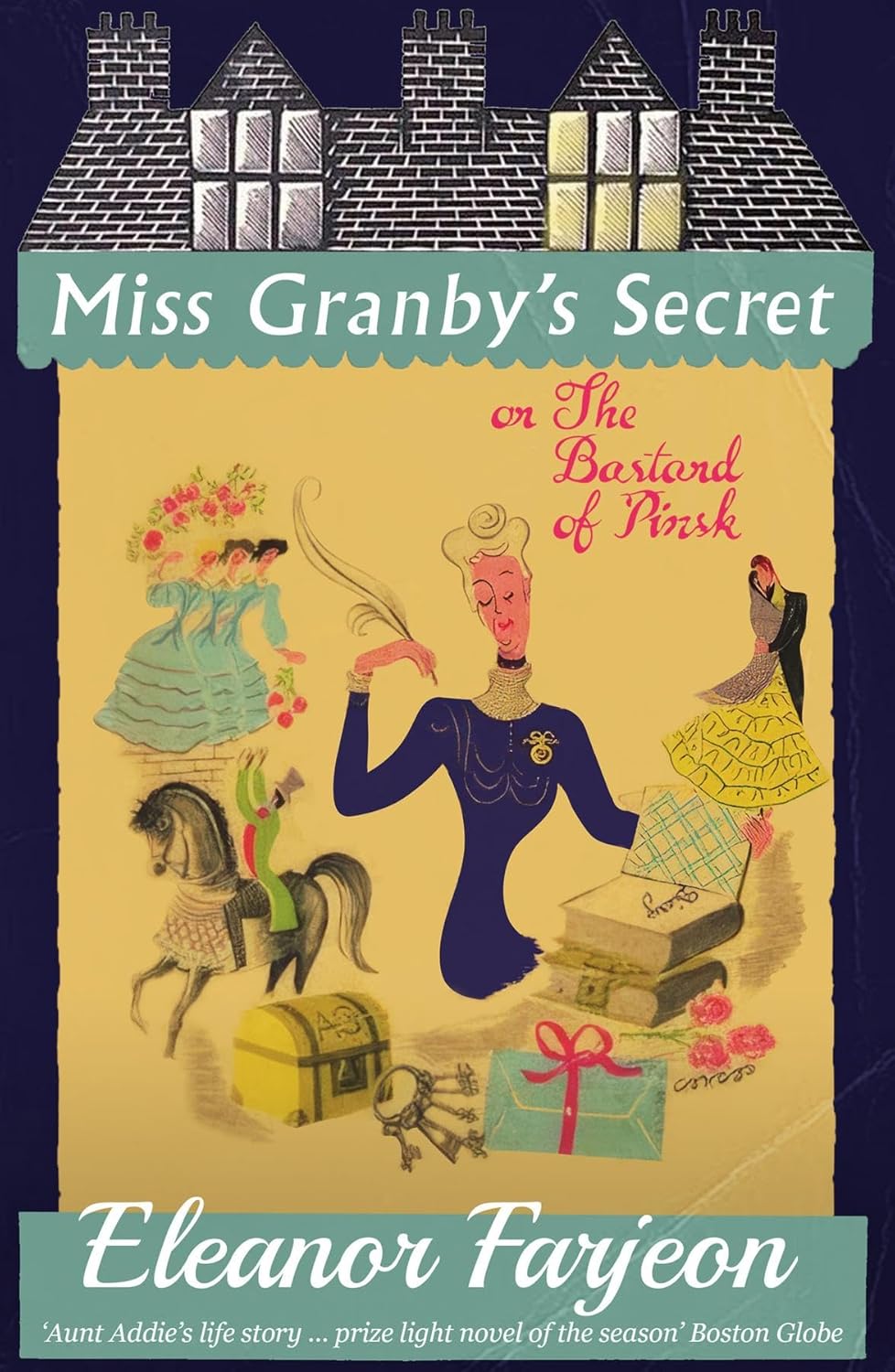
Miss Granby’s Secret: or The Bastard of Pinsk by Eleanor Farjeon

Like many readers who have previously enjoyed books published by Dean Street Press, I was pleased to hear recently that they were continuing with their Furrowed Middlebrow imprint, after a period when the future had looked uncertain. Miss Granby’s Secret: or The Bastard of Pinsk is the first new book since that announcement was made. First published in 1941, it was written by Eleanor Farjeon and this edition also includes an introduction by Elizabeth Crawford.

The novel opens with the death of Miss Adelaide Granby in 1912. Miss Granby had been a prolific and very successful author, publishing forty-nine romance novels and gaining a large readership, but to her great-niece Pamela, she was always just Aunt Addie. Pamela, who considers herself a ‘modern woman’, has long suspected that Addie, who never married, didn’t understand the facts of life – in fact, Addie always insisted that she didn’t want to know, as it would affect the innocence of her writing. When a large, elaborate wreath is delivered to the funeral, then, accompanied by a romantic poem and a card inscribed “from Stanislaw”, Pamela is intrigued by the idea that Addie must once have had a love interest after all.

Pamela has inherited Aunt Addie’s house and her collection of papers, which includes letters, diaries and the unpublished manuscript of her first novel, written when she was just sixteen. This novel is entitled The Bastard of Pinsk (it seems from Addie’s notes that she believes a bastard is “a very noble Hero of Royal Blood”). As Pamela reads the documents she looks for clues to the identity of Stanislaw and wonders if it will be possible to track him down.

The text of The Bastard of Pinsk is included in its entirety, forming a story-within-a-story. Incorporating lots of tropes of the Romantic or Gothic novel, it’s both ridiculous and quite amusing, mainly because Adelaide Granby clearly doesn’t understand the words she’s using or what they imply. Although it was fun for a while, I started to get impatient to go back to the main story, but I’m sure for other readers it will be their favourite part of the book! I can see why the full story was included, though, as some of the things the young Addie writes about have parallels with her own life.

I enjoyed Pamela’s parts of the book and seeing the mystery of Addie’s relationship with Stanislaw unfold and overall I found it a lovely, entertaining read. A good choice for the revival of this imprint!

Thanks to the publisher for providing a copy of this book for review.

The Briar Club by Kate Quinn

Kate Quinn’s new novel, The Briar Club, begins with a murder in a Washington, D.C. boarding house on Thanksgiving, 1954. We don’t know who the victim is – that will be revealed later on – but it does seem that the killer is likely to be one of the seventeen people gathered in the kitchen waiting to be interviewed by the police. To get answers, we have to go back to the day four years earlier when Grace March arrives at Briarwood House and agrees to take the tiny apartment in the attic…

Grace is just one of several women living in the house, all of whom are hiding secrets and in some cases are not quite what they seem. There’s Nora, who works at the National Archives and is in love with a gangster; Bea, a former baseball player forced to give up her dreams; Claire, who is desperately trying to save to buy her own home; Fliss, an Englishwoman with a baby and an absent husband; unhappy, spiteful Arlene whom nobody likes; and Reka, an elderly Hungarian refugee. The novel unfolds through a series of interlinked short stories each focusing on one of these women, interspersed with chapters describing the aftermath of the Thanksgiving murder. The latter are narrated by Briarwood House itself, because the house knows better than anyone else what has been going on within its walls!

I enjoyed The Briar Club, but found some of the women’s stories much more engaging than others. Nora’s story came first and was completely gripping, which maybe raised my expectations too high for the rest of the book. By the time I reached Bea’s section in the middle, I was starting to get bored, although things did pick up again later on. Despite the brief chapters about the murder that are scattered throughout the book, I think anyone who starts to read this expecting a mystery novel or a thriller will be disappointed – but if you like character-driven novels with a slower pace it will probably be more to your taste. Speaking of taste, food and drink play a big part in the story, with each character sharing some of their recipes with us! So if you want to know how to make Bea’s ragù, Arlene’s candle salad or Claire’s potato pancakes, the instructions are all in the book (and even if you’re not a cook, I recommend skipping to the end of each recipe where you’ll find a suggestion for a suitable song to accompany the meal).

Although each woman in the house has her own individual story to tell, they all get together for weekly social gatherings in Grace’s attic room (the ‘Briar Club’ of the title) and over the years most of the women begin to form close bonds. A very different kind of relationship that also develops is between the women of the Briar Club and the two children of their landlady, Mrs Nilsson. Pete Nilsson gets a chapter of his own, but I particularly loved seeing how his younger sister, Lina, grows in confidence (and improves her baking skills) due to the friendship and support of the Briar Club. The novel also provides us with a snapshot of life in America in the early 1950s, with a focus on McCarthy and the fear of communism.

The Briar Club was an enjoyable read overall, but I would have preferred some of the women’s stories to be cut short or left out altogether. So far, The Rose Code is still my favourite of the three Kate Quinn books I’ve read (the other is The Diamond Eye).

Thanks to HarperCollins for providing a copy of this book for review via NetGalley.

This is book 16/20 of my 20 Books of Summer 2024.

Book 34/50 for the Historical Fiction Reading Challenge 2024

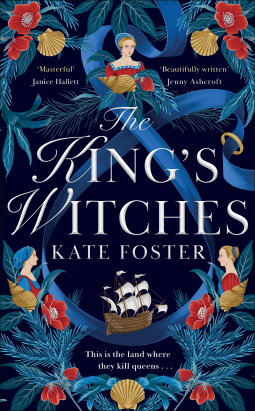
The King’s Witches by Kate Foster

Historical novels based on real-life witch trials seem to be very popular at the moment; I can think of several I’ve read just in the last two or three years. The King’s Witches is another and takes the slightly different approach of telling the story not only of the so-called witches, but also of the woman married to the man behind the witch hunts, King James VI of Scotland.

The novel opens in Denmark in 1589, where Anna, daughter of King Frederick II, is preparing for the arrival of the Scottish ambassador who will escort her across the sea to her new life in Scotland. Anna is betrothed to James VI and before leaving Denmark, they undergo a handfasting ceremony by proxy, with the Earl Marischal standing in for James. Setting sail for Scotland a few days later, Anna’s ship is hit by violent storms and is forced to turn back several times. Witches are blamed for summoning the winds in an attempt to stop the new queen from reaching her destination and by the time Anna eventually arrives in Scotland the fear of witchcraft is becoming widespread.

In the town of North Berwick, another young woman, Jura, is working as a maid in the Kincaid household. Jura has inherited her mother’s skills as a healer and knowledge of herbs and charms, but when the whispers of witchcraft grow louder – and the unwanted attentions of her master become more difficult to avoid – she is forced to flee to Edinburgh. However, escaping both the witch hunts and the Kincaids is not going to be easy…

The King’s Witches is narrated by both Anna and Jura, as well as a third woman, Kirsten, who is Anna’s lady-in-waiting and accompanies her on the journey from Denmark. Kirsten has been to Scotland before, but is very secretive regarding what happened during her previous visit and we will have to wait until later in the book for her full story to emerge. Kirsten and Jura are both fictional characters, but Anna (usually known as Anne of Denmark) was obviously a real person. However, Kate Foster doesn’t stick entirely to historical fact; for example, the real Anna was only fourteen years old when she married James VI, but Foster makes her slightly older at seventeen. She also uses the Celtic tradition of handfasting, which expires after a year, to introduce the idea that Anna was ‘on trial’ and the marriage would only go ahead if she managed to please James. I didn’t feel that this – or the fictional lover Foster creates for Anna – was really necessary or added much to the book and I would have preferred Anna’s story to follow the facts, considering we already had two other entirely fictional viewpoint characters.

The witchcraft aspect of the book is interesting, particularly the connection between the North Berwick witch trials, in which Jura is involved, and previous trials in Germany and Denmark which inspired James VI to take similar action. The storms that delay Anna’s voyage to Scotland in the novel really happened and really were blamed on witches. The King’s paranoia increases until he decides that the town of North Berwick (not to be confused with Berwick-upon-Tweed, by the way) is a nest of witches plotting to kill him, possibly in league with the Earl of Bothwell, and eventually more than 70 people are implicated. Foster explores all of this not just from the perspective of Jura, who is directly affected as a suspected witch, but also Anna from her position close to the King, and Kirsten, who provides a sort of bridge between the two worlds.

Even with the addition of the Anna and James angle, this book felt a bit too similar to other books I’ve read about historical witches, but obviously that won’t be a problem if you haven’t read as many of them as I have! I did still find it enjoyable and will have to look for Kate Foster’s first book, The Maiden, which I haven’t read.

Thanks to Mantle for providing a copy of this book for review via NetGalley.

This is book 15/20 of my 20 Books of Summer 2024.

Book 33/50 for the Historical Fiction Reading Challenge 2024

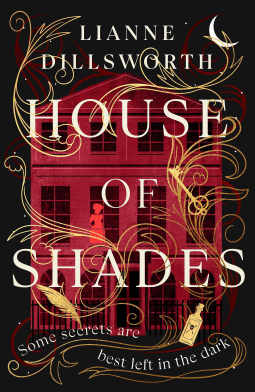
House of Shades by Lianne Dillsworth

I enjoyed Lianne Dillsworth’s first novel, Theatre of Marvels, so I was looking forward to her new book, House of Shades, which sounded like an atmospheric Gothic mystery. It turned out to be not quite what I expected, although that’s not necessarily a bad thing.

The setting is London, 1833. Hester Reeves is a young black woman whose mother has recently died, urging Hester to take care of her younger sister, Willa. Unfortunately, Willa already seems to be getting herself into trouble, having caught the eye of Rowland Cherville, the manager of the factory where she works. Rowland is running the factory on behalf of his invalid father, Gervaise, and with the differences in race and social status, Hester is sure his intentions towards her sister are not good. If only Hester and her husband, Jos, could improve their financial situation, then they could move out of the slums of King’s Cross and get Willa away from Rowland’s influence…

Hester’s chance to make some money comes when the local vicar puts her name forward for a job at Tall Trees, home of the elderly Gervaise Cherville, who has a serious medical condition and wants someone to nurse him through it. Hester is considered suitable for the position as she is a ‘doctoress’ – not really a female doctor, as it will still be several decades before the first woman earns her medical degree and even longer for the first black woman to do the same, but someone with a knowledge of herbs and healing potions. However, Hester soon discovers that Mr Cherville has another task in mind for her.

The Chervilles made their fortune through mahogany and they own slaves on a plantation in Honduras. With the Slavery Abolition Act of 1833 stating that slavery is to be abolished across most of the British Empire, it seems that Gervaise has developed a conscience and wants to give compensation to his slaves – not the ones in Honduras, though, whom he has never met, but two who once lived at Tall Trees before running away. Aphrodite and Nyx have been missing for many years and Gervaise wants Hester to help track them down so he can make amends.

If you can accept the rather unlikely plot (for a start, is it really believable that a wealthy 19th century gentleman like Gervaise Cherville would bring an unknown young woman from a slum community into his home as a nurse?), this is quite an entertaining novel. Like Dillsworth’s first book, it has a likeable heroine, it’s easy to read and the pages go by surprisingly quickly. There are a few twists, although they’re fairly predictable and I was hoping for one or two more! Apart from Hester herself, most of the other characters lack depth and nuance – there’s no real explanation for why Rowland is such a wicked person with seemingly no redeeming qualities at all, and we don’t see much of Willa’s good side either, which makes it difficult to understand why Hester views her as such a beloved sister, putting her needs above those of herself and her husband.

The most interesting aspect of the book is Gervaise Cherville’s desire for atonement and his attempt to make reparations for the harm he has caused. It seems clear that, at least at first, Cherville’s main motive is to assuage his own guilt, but Hester reflects that “maybe when it came down to it, all apologies were like that, even when they were heartfelt.” I would have liked more depth here as well, but maybe that would have been difficult as the whole novel is narrated by Hester and we never get inside Cherville’s head to see what he’s really thinking or whether his feelings are genuine.

House of Shades is a book with lots of good ideas and interesting themes, but I struggled to get past the implausibility of the plot and on the whole I preferred Lianne Dillsworth’s first book.

Thanks to Hutchinson Heinemann for providing a copy of this book for review via NetGalley.

Book 32/50 for the Historical Fiction Reading Challenge 2024

The Elusive Pimpernel by Baroness Orczy

Since reading Baroness Orczy’s The Scarlet Pimpernel several years ago, I have been slowly working my way through the rest of the Pimpernel series. There are various recommended reading orders – some following publication dates and others attempting to follow an internal timeline – and I’m not sure if I’ve chosen the best route through the series, but The Elusive Pimpernel is the fifth book I’ve read. Like the others, this one revolves around the efforts of the English adventurer known as the Scarlet Pimpernel to rescue aristocrats from the guillotine during the French Revolution.

*If you have not read the first book and would prefer not to know the identity of the Scarlet Pimpernel, you may want to avoid the rest of this review as I can’t really discuss this book without naming him!*

First published in 1908, the novel begins in September 1793 with Citizen Chauvelin, the Scarlet Pimpernel’s arch-enemy, receiving orders from Robespierre in Paris. Having failed to capture the Pimpernel in the past, Chauvelin is being given one last chance. He must go to England as a representative of the Committee of Public Safety, responsible for the interests of French citizens who have settled in England. The real reason for his mission, however, is to hunt down the Scarlet Pimpernel and bring him back to France dead or alive.

As the action switches temporarily to England, we meet a French actress, Désirée Candeille, who has been befriended by Marguerite Blakeney, wife of Sir Percy, the Scarlet Pimpernel himself. Unknown to Marguerite, Désirée is in league with Chauvelin and part of the scheme to lure Sir Percy to France. Will their scheme be successful – and could Marguerite unintentionally be the one to lead her husband into the trap?

Although it’s not quite as good as the original book, The Elusive Pimpernel is probably the best of the sequels I’ve read so far. The plot Chauvelin comes up with to capture Sir Percy is so fiendishly clever I couldn’t see how he was going to find a way out of it. Of course, I knew that he probably would find a way out, because he’s the Scarlet Pimpernel, after all, and there are more books in the series, but it seemed to me that he was well and truly trapped this time! One of the things I like about these books is that Chauvelin is by no means portrayed as a bumbling idiot who is easily outwitted; his plan would almost certainly have succeeded against anybody less brilliant than Sir Percy.

We don’t see very much of the other members of the League of the Scarlet Pimpernel, although we are briefly reunited with some characters from the previous book, I Will Repay (so I would recommend reading that book before this one, if you can). Marguerite, though, plays a big part in the story and is one of our main viewpoint characters. It’s frustrating to see how easily she is manipulated, but she does mean well and her love for Percy isn’t in doubt, so I can forgive her!

Continuing chronologically, the next book for me to read will be Lord Tony’s Wife. Have you read that one – or any of the others in the series?

This is book 14/20 of my 20 Books of Summer 2024.

Book 31/50 for the Historical Fiction Reading Challenge 2024

This is also book 44/50 from my second Classics Club list

A Case of Mice and Murder by Sally Smith

After finishing Sally Smith’s A Case of Mice and Murder I was delighted to find that it’s the start of a new historical mystery series, which is great news as this first book is excellent. I hope we don’t have to wait too long for a second!

The novel is set in 1901 in the Inner Temple, one of the four Inns of Court that make up London’s legal community. Sir Gabriel Ward KC is a barrister who leads a quiet, reclusive life within the Temple grounds, only venturing into the outside world when absolutely necessary. He’s not the sort of person you would expect to become an amateur detective, but that’s what happens when he steps out of his rooms early one morning in May and stumbles across the dead body of the Lord Chief Justice. Sir Gabriel is persuaded by his superiors to investigate before the police are brought in and he reluctantly agrees, despite already being busy with a very different case.

The manuscript of a children’s book, Millie the Temple Church Mouse, had been left at the door of Herbert Moore’s publishing house with no way of identifying or contacting the author. Moore went ahead with publishing the book anyway and it has become a huge success, inspiring Millie toys and a forthcoming stage play. Now a woman has come forward claiming to be the author and Moore is in trouble! Gabriel is Moore’s lawyer and must work on establishing authorship of the book while also trying to solve the mystery of the Lord Chief Justice’s death.

When writing a novel set in the past, creating a sense of time and place is incredibly important and Sally Smith does that extremely well here. She writes in a style that is appropriate to the time period and at no point does it really feel like a ‘modern’ book. The descriptions of the Inner Temple are perfect, both in terms of the physical buildings, chambers and grounds, and the way of life with its rituals and traditions. The Inner Temple, like the neighbouring Middle Temple, is considered a local authority largely outside the jurisdiction of the City of London (hence the police needing to be invited in to investigate the murder) and it makes a fascinating and unusual setting.

Gabriel Ward is a great character and it’s interesting to see him grow as person as the story progresses. At the beginning he is a quiet, solitary man who spends most of his time in his rooms with his books and his legal work, following little routines, such as checking the door three times, that today would be called an OCD. Being forced to leave the confines of the Temple to interview suspects and witnesses from a range of social backgrounds gives Gabriel a different perspective on life and helps him to open up to new ideas. My only complaint is that Smith gives him the character trait of ‘snuffling’, a word she repeats far too often throughout the book. Looking at other reviews, I can see that many of us felt the same way, so I hope Gabriel will snuffle a bit less often in the next book!

The murder mystery is an interesting one, with a solution I hadn’t seen coming, but I found the Millie the Mouse storyline even more enjoyable. I started to have my suspicions about that second mystery by the middle of the book and was pleased to be proved right. I can’t wait to see what Gabriel’s next case will be!

Thanks to Raven Books for providing a copy of this book for review via NetGalley.

This is book 13/20 of my 20 Books of Summer 2024.

Book 30/50 for the Historical Fiction Reading Challenge 2024

The Dumas Club by Arturo Pérez-Reverte

Translated by Sonia Soto

For Spanish and Portuguese Lit Month, hosted by Stu of Winstonsdad’s Blog, I decided to read a book that sounded perfect for me. A bibliomystery set in the world of antiquarian booksellers, paying tribute to Alexandre Dumas, whose novels I love. What could go wrong?

The Dumas Club (or The Club Dumas – it has appeared under both titles) was originally published in Spanish in 1993 and translated into English three years later by Sonia Soto. You may have watched the 1999 film adaptation The Ninth Gate, starring Johnny Depp; I don’t think I’ve seen it, but apparently it’s very different from the book and completely removes the Dumas connection, which seems strange but maybe they thought there was too much going on and couldn’t include everything.

Lucas Corso is a ‘book detective’ who hunts down rare or valuable books on behalf of his clients. Corso has found that unscrupulous dealers and collectors are prepared to pay large sums of money for the books and don’t really care whether the methods he has used to get hold of them are particularly legal or ethical. In The Dumas Club, we follow Corso as he travels across Europe on two separate missions. The first concerns an early draft of a chapter from Alexandre Dumas’ The Three Musketeers. The chapter, titled Anjou Wine, appears to be written at least partly in Dumas’ own handwriting and Corso’s job is to prove its authenticity.

His second task is more complex and involves a very different kind of book: The Book of the Nine Doors of the Kingdom of Shadows, published by Aristide Torchia in 1666. This rare and sinister book is thought to contain the key to summoning the Devil and Torchia was burned at the stake shortly after its publication. Only one copy is thought to have survived. Corso’s client, Varo Borja, owns a copy of the book which he believes may be a forgery and he wants Corso to examine two other copies, one in Portugal and one in France, to determine which is genuine and which are fakes.

Setting out on his journey, Corso begins to encounter some mysterious strangers who remind him of characters from books. For example, he is pursued by a man with a scar who resembles Rochefort, the ‘Man from Meung’, from The Three Musketeers and he also crosses paths with a young woman who introduces herself as Irene Adler after the character from the Sherlock Holmes stories. Corso is unsure whether these people are interested in The Anjou Wine, The Nine Doors or both, so he must try to keep the manuscripts out of their hands until he has solved the two mysteries.

The Dumas Club is an unusual novel and there were lots of things I liked about it. As a Dumas fan, I enjoyed all the references to The Three Musketeers and other titles; it’s not really essential to be familiar with Dumas, but you’ll definitely get more out of the book if you are. Pérez-Reverte includes a lot of unnecessary information, though, such as a full bibliography of all Dumas’ works inserted into the middle of a chapter. This info-dumping continues throughout the book, as well as lots of long digressions into printing and binding techniques and discussions of first editions, illustrations and rare collections. Some of it is quite fascinating and I think people who love books as physical objects more than for the words they contain will find it particularly interesting, but it doesn’t make for a very quick or easy read.

Although I enjoyed following the Anjou Wine thread of the story, Corso’s second mission revolving around The Nine Doors and the occult was of less interest to me and reminded me too much of The Da Vinci Code. It didn’t help that I didn’t like Lucas Corso at all and found most of the other characters equally unpleasant. Still, the ending is clever and we are given answers to both of the mysteries, so I think my feelings about this book are probably slightly more positive than negative. Another of Pérez-Reverte’s novels was recommended to me a few years ago – Captain Alatriste – and wonder if I would get on better with that one.